Fort Mason: A Coastal Fort and Military Port in San Francisco
Site at a Glance
- Country
- United States
- Primary era
- Modern
- Eras represented
- Early Modern, Modern
- Civilizations
- Spanish
- Site type
- Military
- Remains
- Fort
On this page12 sections
History
Fort Mason is a former coastal fort and military port in San Francisco, United States, first developed as a Spanish artillery battery, a group of guns in a defensive position, in 1797. It later became a U.S. Army center for organizing Pacific troop and supply movements, especially during World War II.
Spanish Artillery Position
In 1797, the Spanish Presidio of San Francisco, a Spanish military post, established a battery at Punta Medanos, now Black Point, to defend the anchorage at Yerba Buena. The position was occupied briefly and abandoned by 1806.
U.S. Coastal Defenses
The land that became part of Fort Mason included 13.5 acres purchased by John C. Frémont in the mid-1850s for $42,000. The American explorer and Union Army major general spent about $40,000 improving it. In 1863, the U.S. government took the property without payment under an executive order from President Abraham Lincoln. Although the government returned land to 49 nearby owners in 1870, Frémont and several others were excluded. Congress directed the Court of Claims to determine compensation in 1898. Frémont’s heirs sued in 1968, arguing that the order had not been carried out, and the dispute had by then lasted more than a century.
During the American Civil War, the Army built temporary defenses around San Francisco Bay. In 1864, it constructed a battery at Point San Jose, then the name for the Upper Fort Mason site. The fort took the name Fort Mason in 1882, honoring Richard Barnes Mason, a military governor of California before it became a state. In 1885, President Grover Cleveland formed the Endicott Board, a federal body tasked with reviewing and modernizing coastal defenses. The board ranked San Francisco Harbor second in strategic importance only to New York. The resulting program added forts, batteries, and guns around the harbor, including at Fort Mason.
Army Command and Port Development
Fort Mason served as headquarters of the re-established Pacific Division from 1904 until the command was eliminated in 1907. The division, a regional Army command, included the Department of California, which covered the Hawaiian Islands, and the Department of the Columbia. Major General Arthur MacArthur Jr. was its first and only commander, serving from 1903 to 1907.
In 1912, the Army began building a port facility at Fort Mason to store supplies and support Army Transport Service ships carrying personnel and materiel to Alaska, Hawaii, the Philippines, and other Pacific posts. The facility was complete by 1915, as the Army expanded its Pacific presence and sent much of the construction material for those posts through San Francisco.
World War II Port Operations
On May 6, 1932, the Army established the San Francisco Port of Embarkation, a command and facility for organizing overseas movements of troops and supplies. Modeled on the New York port, it made Fort Mason its headquarters and one of its installations. The command took responsibility for the Army Transport Service, the San Francisco General Quartermaster Depot at Fort Mason, and the Overseas Replacement and Discharge Service at Fort McDowell on Angel Island.
As war spread through Europe in 1939, the Army judged Fort Mason’s port facilities too limited for major Pacific operations. It began acquiring facilities in Oakland, Seattle, and elsewhere in the San Francisco area in 1941. By the end of World War II, Fort Mason and 13 other facilities formed the San Francisco Port of Embarkation. On October 1, 1940, Colonel John C. H. Lee was promoted to brigadier general and appointed commanding general of the Pacific Ports of Embarkation. Based at Fort Mason, he spent a year improving Army port facilities between Seattle and San Diego.
During the war, Fort Mason housed the headquarters of the San Francisco Port of Embarkation, which managed military transport facilities throughout the Bay Area. The network included 20 ocean-going piers with 43 berths, 2,867,000 square feet of warehouse space, 1,984,000 square feet of transit sheds, and 7,640,000 square feet of open storage. Its facilities extended to Alameda, Richmond, Emeryville, Hamilton Field, the Presidio, Stockton, and Humboldt Bay. The Oakland Army Base was the network’s largest installation, while Camp Stoneman served as its main troop staging area.
The San Francisco port was the second largest of the eight U.S. ports of embarkation during World War II. It moved 1,647,174 passengers and 23,589,472 measured tons of cargo into the Pacific; a measured ton is based on cargo volume rather than weight. The port handled two-thirds of the troops sent to the Pacific and more than half of Army cargo shipped through West Coast ports. Its highest monthly passenger total was 93,986, in August 1945.
The Army ferry USAT General Frank M. Coxe, with USAT meaning United States Army Transport, made as many as eight scheduled trips a day between Fort Mason and the processing center at Fort McDowell. The vessel USAT Meigs carried cavalry horses from a Fort Mason pier to Fort Mills, an Army coastal-defense post on Corregidor Island in the Philippines.
Postwar Use and Public Administration
Fort Mason remained active during the Korean War. In 1955, the San Francisco Port of Embarkation was renamed the U.S. Army Transportation Terminal Command Pacific, and the port was disestablished on October 1. Fort Mason then became headquarters of the Pacific Transportation Terminal Command. Embarkation operations continued into the early 1960s. In 1965, the command headquarters moved to the Oakland Army Terminal, and most of Fort Mason’s embarkation facilities fell out of use. The Army continued to use and maintain some former officers’ housing.
The National Park Service took over administration of Fort Mason in the 1970s as part of the Golden Gate National Recreation Area. In 1976, the lower port area became Fort Mason Center, a nonprofit organization for cultural programs and organizations. The wider historic district, with 49 historically important buildings across about 1,200 acres, is listed on the National Register of Historic Places, the federal register of historic properties. The lower port area, covering 21 acres, became a National Historic Landmark District in 1985 for its role in World War II.
Remains
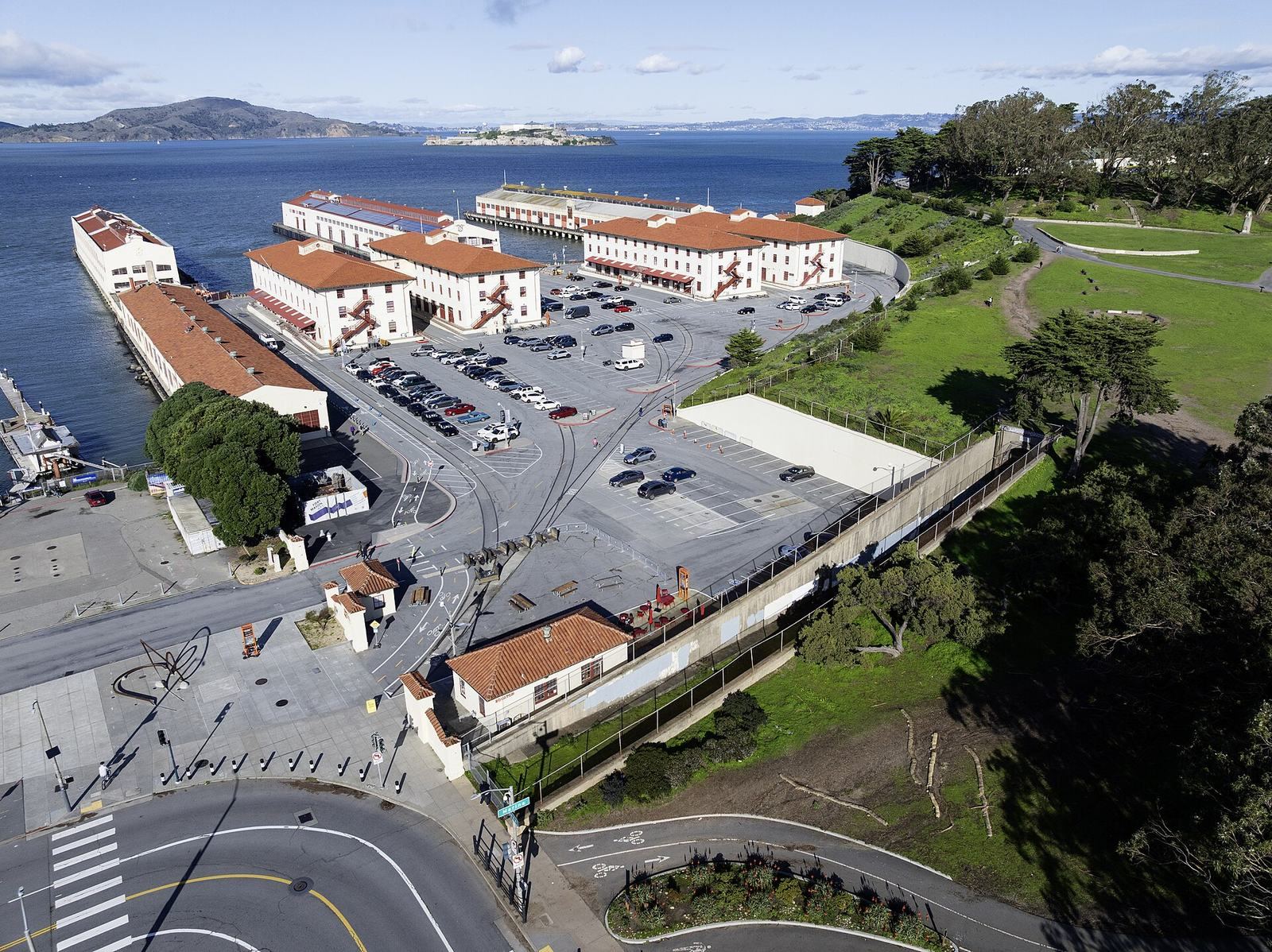
Fort Mason has two main areas: Upper Fort Mason occupies a headland, while the lower port lies near water level to its west. The headland preserves remains of the original coastal defenses, and the lower area retains features of the former military harbor. Late nineteenth- and early twentieth-century buildings, parks, and gardens are also part of the site. Marina Green lies to the west, and Aquatic Park is to the east.
Upper Fort Mason
Black Point
Black Point is a promontory at the far end of the Fort Mason headland. Spanish settlers called it Punta Medanos and Punta de San José. After 1849, the name Black Point came into use, referring to the dark-colored California bay laurels that grew on the bluff.
1864 Battery
The battery built at Point San Jose in 1864 had a breast-high brick wall and mounts for six 10-inch Rodman cannons, large guns designed for coastal defense, and six 42-pounder guns. Excavations in the early 1980s revealed well-preserved remains of its western half.
Harbor Infrastructure
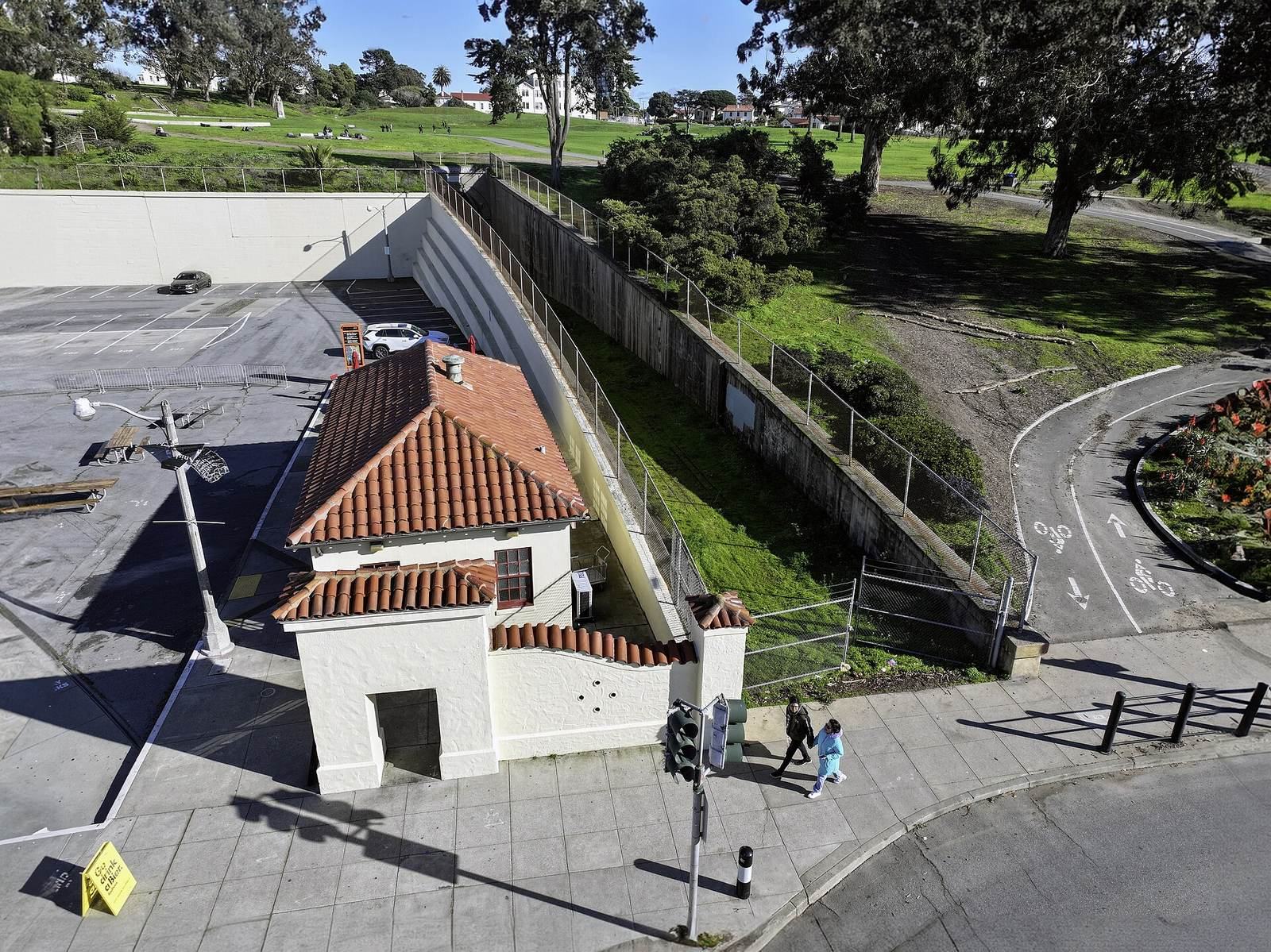
The lower port includes three piers and their associated warehouses or sheds. A railway tunnel passes beneath Upper Fort Mason, linking the port with the State Belt Railroad along the Embarcadero, a freight railway on San Francisco’s waterfront. The tunnel is no longer in use.
Buildings and Landscape
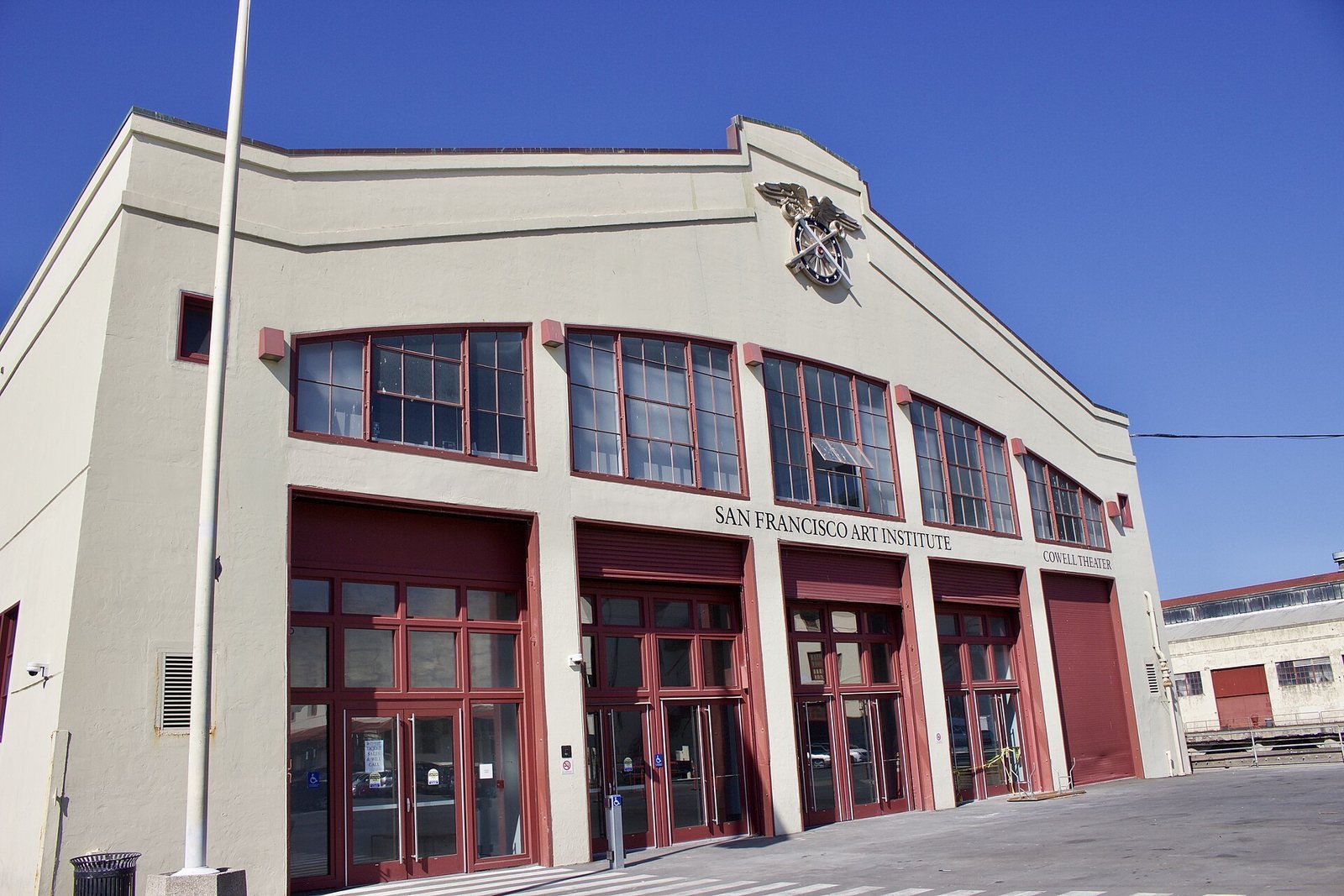
The site’s buildings, parks, and gardens date from the late nineteenth and early twentieth centuries. Some former officers’ housing remains in Army use, some is rented, and one of the larger buildings has been converted into a youth hostel. A path follows the harbor edge and climbs across the headland. The historic Herbst Pavilion housed a San Francisco Art Institute graduate-program campus from 2017 until its closure in 2022. The lower port area is now used as an arts and cultural campus.