Vårfrukyrkan, Enköping: A Romanesque Church in Sweden
Site at a Glance
- Country
- Sweden
- Primary era
- Medieval
- Eras represented
- Medieval, Early Modern, Modern
- Civilizations
- Swedish
- Site type
- Religious
- Remains
- Church
On this page8 sections
History
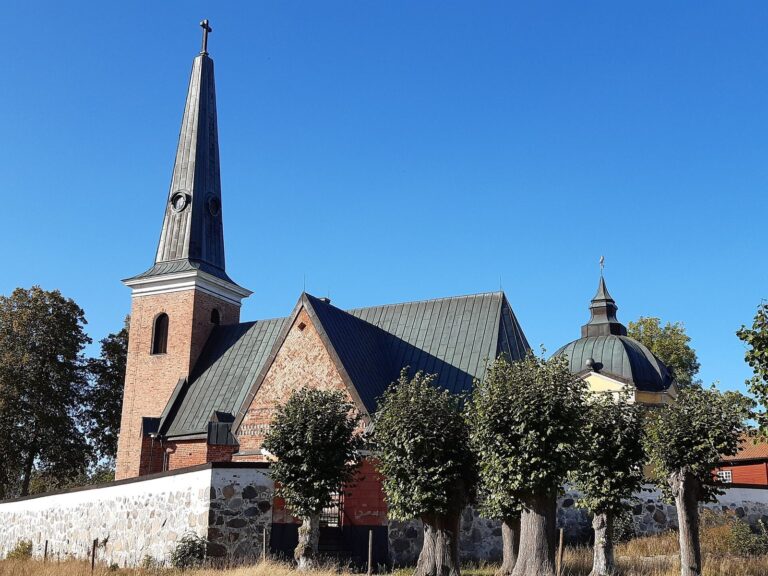
Vårfrukyrkan is a large church in Enköping, Sweden, built and consecrated in the 12th century in the Romanesque style, a medieval form characterized by massive masonry. It served the provost of Fjärdhundraland, a folkland, or historic territorial district, and is considered one of Sweden’s oldest churches.
Foundation and medieval alterations
In the first half of the 15th century, star vaults were added. Late in that century, the central tower was dismantled and a new choir was built at the east end. The choir and crossing were vaulted, and wall paintings were added. The sacristy was probably constructed in the early 16th century.
Parish and town church
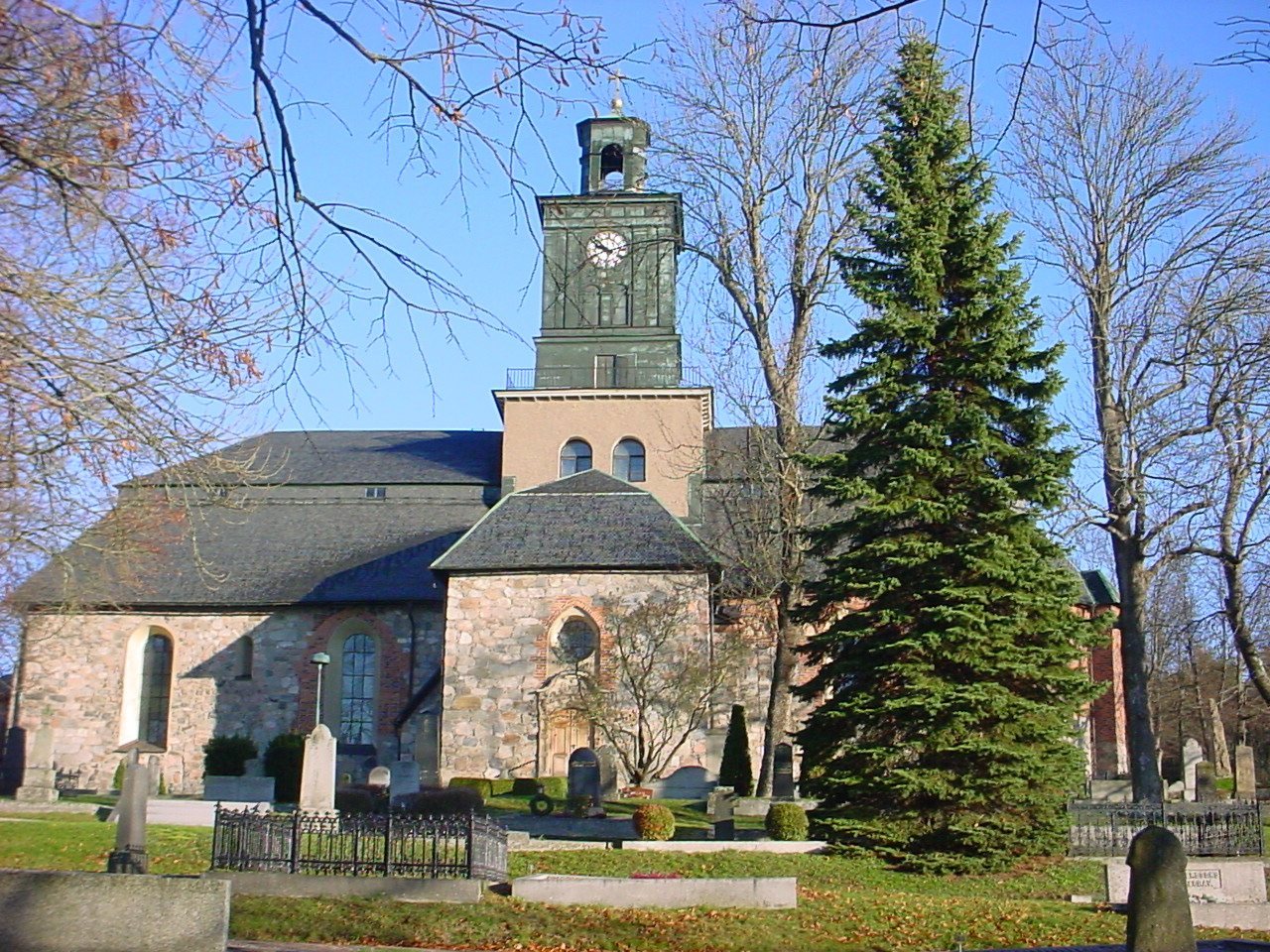
During the later Middle Ages, Vårfrukyrkan became the parish church of Vårfrukyrka, Enköping’s rural parish. In 1548, it also became the town church of Enköping. A wooden tower was raised above the crossing in 1839.
The church belongs to Enköping parish in the Church of Sweden, the country’s Lutheran church, and the Diocese of Uppsala, an ecclesiastical administrative district. In Finnish, it is also called Mary’s Church.
Restoration and organ history
A restoration in 1903 and 1904 added numerous wall paintings, designed by Agi Lindegren and painted by Carl Wilhelm Pettersson.
Jöns Smed repaired the organ in 1642, and a back positive, an organ division in a separate case behind the player, was added during the 1640s. In the 1730s, an older organ from Uppsala Cathedral was incorporated into it. This instrument may have included parts of an organ by Hans Henrich Cahman, damaged in the cathedral fire of 1702. Mattias Swahlberg the Younger built a new organ in 1788, reusing the back positive and earlier stops. Åkerman & Lund Orgelfabriks AB built another organ in 1903. Magnussons Orgelbyggeri built the present main organ and choir organ in 1975.
Remains
Plan and vaulted spaces
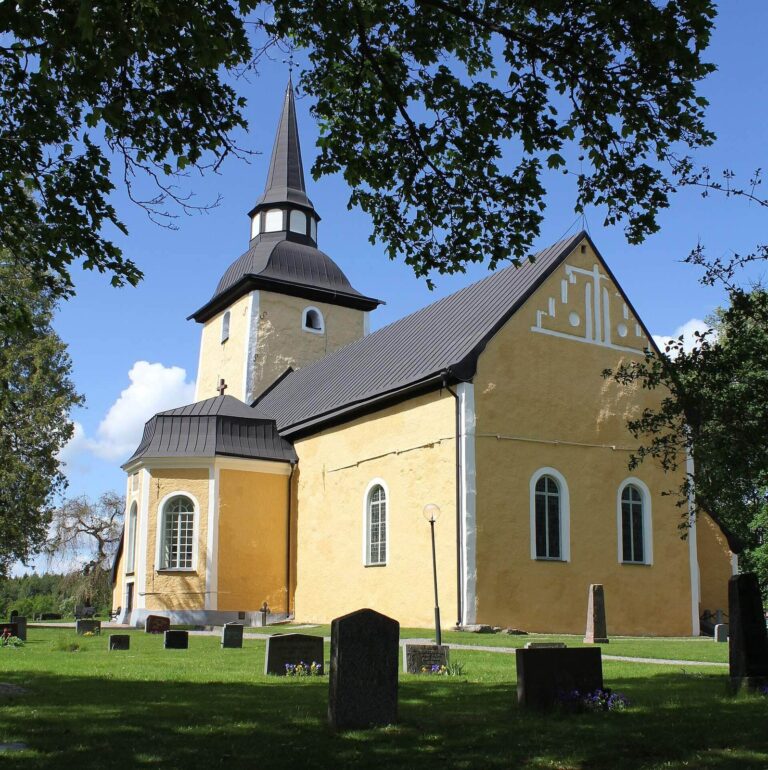
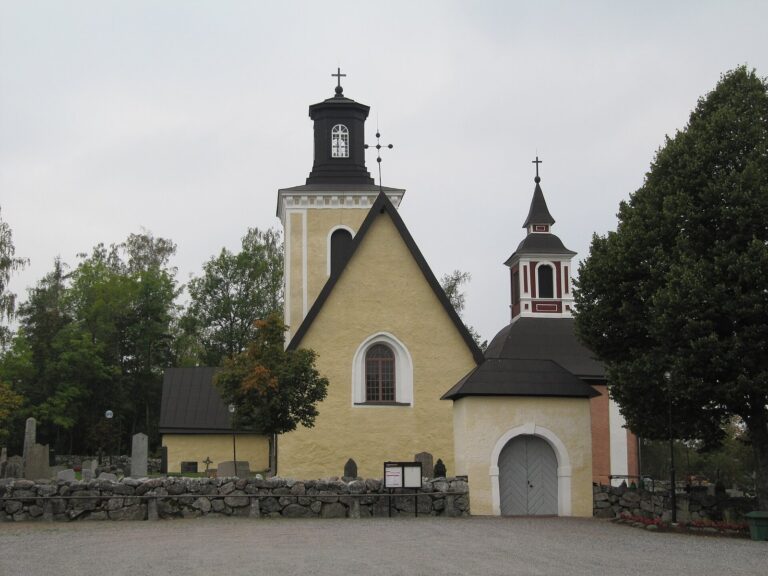
Grey stone and brick form the church. Its original Romanesque plan comprised a nave, a narrower choir ending in an apse, a rounded or polygonal end to a church space, and transepts with apses. A central tower stood over the crossing, where the nave and transepts meet. The present choir has a three-sided end at the east, and a wooden tower rises over the crossing. Star vaults cover the nave and transepts, while the choir and crossing have Sture vaults, a type of late-medieval vault used in Swedish churches.
Wall paintings and sculpture
Medieval wall-painting remains survive alongside later painted decoration. The church also preserves medieval sculptures, including a 14th-century face of Christ. In the north transept, a 13th-century figure of Christ hangs from a former triumphal crucifix, a crucifix traditionally placed at the division between a church’s nave and choir.
Furnishings and organs
The 1792 altarpiece by Per Ljung consists of a cross with a burial shroud. Fragments survive from a baptismal font dating to the late 15th century, and the pulpit dates from the 1790s. The present main organ has mechanical action, in which keys operate pipes through mechanical linkages, and slider chests, which use sliding boards to control airflow to sets of pipes. Its compass is 56/30, meaning 56 notes on the manual keyboard and 30 on the pedal, and it has three free combinations, preset selections that the organist can configure. The fronts of its main division and pedal come from the 1788 organ; the back-positive front dates to the 1640s. The choir organ is also mechanically operated, has a slider chest, and has a 56/27 compass, with 56 manual notes and 27 pedal notes.