Tiefburg Handschuhsheim: A Medieval Water Castle in Heidelberg


Site at a Glance
- Rating
- 4.5
- Popularity
- Low
- Country
- Germany
- Primary era
- Medieval
- External website
- Open
- Eras represented
- Medieval, Early Modern, Modern
- Civilizations
- Electoral Palatinate, Holy Roman Empire
- Site type
- Military
- Remains
- Castle
On this page11 sections
History
Tiefburg Handschuhsheim is a medieval water castle in Germany, located in Handschuhsheim, now a district of Heidelberg. Its origins are uncertain, but the castle existed by the thirteenth century and is also dated to around 1300. As a fortified residence protected partly by managed waterways, it became the ancestral seat and principal home of the Lords of Handschuhsheim, a family of knightly ministerials, or service nobles who served powerful lords in military and administrative roles.
Origins and the Lords of Handschuhsheim
An earlier lordly seat may have stood on a western spur of the Heiligenberg in the Bürgel area, although both its existence and the date when it was abandoned remain uncertain. The castle later known as Tiefburg Handschuhsheim became closely tied to the Lords of Handschuhsheim. When the family died out in the male line in 1600, ownership passed in 1624 to the Lords of Helmstatt, who retained the property for more than three centuries.
War damage and the Helmstatt estate
The castle suffered repeated damage during the seventeenth-century conflicts. It was set on fire several times in 1642 during the Thirty Years’ War, the major European conflict of 1618–1648. By 1674, it had been destroyed and was no longer fit for habitation. Further damage occurred in the period of the War of the Palatine Succession, also called the Nine Years’ War, which lasted from 1688 to 1697 and brought extensive destruction to the Palatinate.
Around 1700, Georg Adam Christoph von Helmstatt built a noble estate beside the ruined castle, on the site of the former lordly manor house. The estate had once formed part of the wider castle complex and continued to receive maintenance, while the ruined core castle received only makeshift upkeep. The Helmstatt family subsequently lived in the neighboring estate.
Renovation and later uses
Between 1911 and 1913, Raban, Count von Helmstatt, renovated the complex and made its residential building usable again. The building was rented to several Handschuhsheim residents before being converted into a youth hostel in 1921. Raban’s son Bleickard von Helmstatt sold the castle to the City of Heidelberg in 1950, which transferred the property to the Handschuhsheim district association. The hostel closed in 1951, and the castle thereafter became a venue for events.
The restored residential building now accommodates rooms for local associations, the office of the Handschuhsheim district association, and a local-history archive. The castle courtyard continues to host events. Tiefburg Handschuhsheim is also the principal setting of Walter Laufenberg’s historical novel Ritter, Tod und Teufel, published in Munich in 1992.
The legend of the walled-in knight
In 1770, Johann Ferdinand Joseph, Baron von Helmstatt, discovered a skeleton in medieval armor sealed inside a concealed cavity behind a wall, also described as one of the castle’s cellar areas. The find gave rise to the legend of the “walled-in knight.” One version claims that the man was punished by being walled up alive because of an affair with a woman associated with Hirschhorn Castle, a historic castle linked to the town of Hirschhorn in the Neckar valley.
The armor was said to have been given to the Electoral Palatine general von Rothenhausen and later passed through the collection of Carl Theodor, an eighteenth-century elector of the Palatinate and later of Bavaria. It eventually entered the royal antiquities collection in Munich but is now lost. Since 1977, a replica donated by the Handschuhsheim district association has marked the discovery site.
Remains
Moat and entrance
The castle stands northwest of the former village center of Handschuhsheim. It was originally enclosed by a water-filled moat about 12 meters wide, supplied by the Mühlbach. At the northeastern corner, a masonry-blocked inlet still marks the former water supply. After the connecting channel was drained, the route was used as an access way to the neighboring estate. The bridge leading into the castle survives across the filled-in moat, while fragments of the enclosing walls remain within surrounding properties.
Medieval core
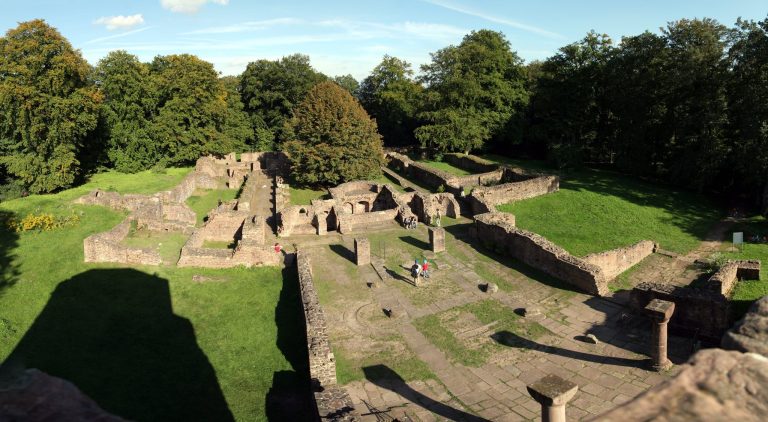
The central castle has a quadrangular defensive-wall enclosure and barrel-vaulted cellars dating from the High Middle Ages, the period from approximately the eleventh through the thirteenth centuries in European history. The surviving core consists chiefly of foundations, the vaults of the residential tower, and sections of the defensive walls. These remains preserve the castle primarily as a ruin while retaining the outline of its medieval fortified enclosure.
Renaissance rebuilding
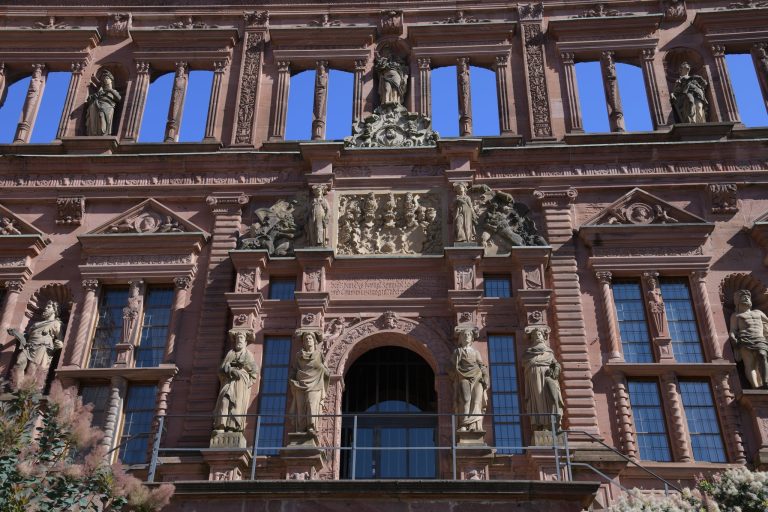
Other surviving parts of the complex display Renaissance characteristics, reflecting a major rebuilding between 1500 and 1600. Stone coats of arms dated 1544 remain on the balustrades of balconies incorporated into the outer walls. They provide a more precise date for this phase of alteration and show how later residential features were integrated into the defensive structure.
Manor buildings and the Ritterhaus
The new manor house built beside the ruined core around 1700 was accompanied by stables and barns. During the renovation of 1911–1913, the residential building known as the “Ritterhaus” was rebuilt and enlarged within the castle courtyard. Together with the surviving ruins, these buildings preserve the physical transition from medieval castle to neighboring noble estate and later residential complex.
The discovery site
The concealed cavity behind a wall, in one of the castle’s cellar areas, is associated with the skeleton found in 1770. A replica of the armor linked to the discovery is displayed at that location, connecting the surviving fabric of the castle with the later legend of the walled-in knight.