Peterskirche: Heidelberg’s University Church


Site at a Glance
- Rating
- 4.5
- Popularity
- Low
- Country
- Germany
- Primary era
- Modern
- External website
- Open
- Eras represented
- Medieval, Early Modern, Modern
- Civilizations
- Electoral Palatinate, German, Holy Roman Empire
- Site type
- Religious
- Remains
- Church
On this page15 sections
History
Peterskirche is the oldest church in Heidelberg’s old town, Germany. Its predecessor was built in the twelfth century on the Klingenteich debris fan before Heidelberg was founded as a city. The church was established by the Prince-Bishopric of Worms, an ecclesiastical territory whose bishop governed both religious affairs and associated lands. Its dedication to Saint Peter points to a connection with Worms Cathedral, which shared the same patron saint.
Medieval foundation and parish church
Peterskirche is first mentioned in 1196, when Konrad, a parish priest of Heidelberg, appears in the records. In 1225, the territory passed as a fief to the Palatinate, a major principality of the Holy Roman Empire whose count palatine ruled Heidelberg and its surrounding lands. Heidelberg was then founded as a city, but the church remained outside the new walls, which enclosed only the eastern part of the present old town.
The church served as Heidelberg’s parish church until the larger Church of the Holy Spirit was built in the fourteenth century. From 1400, Peterskirche became one of three proprietary churches of the University of Heidelberg. A proprietary church stood under the special patronage and jurisdiction of an institution rather than the ordinary authority of the local diocesan hierarchy. The other two university churches were St. Laurentius in Altdorf near Nuremberg and St. James in Lauda.
The three churches were exempt from their diocesan bishops and placed directly under the pope. Their administration was entrusted to Heilmann von Wattenheim, dean of the collegiate church at Neustadt. Through this responsibility, he effectively acquired the standing of a papal archdeacon. University patronage continued until the Reformation, the sixteenth-century religious movement that created Protestant churches and transformed Peterskirche’s religious identity.
Rebuilding and confessional change
The medieval church was substantially enlarged between 1485 and 1496 in the Late Gothic style. Alexander Bellendörfer, chancellor and senior notarial official of the Electoral Palatinate, laid the foundation stone on 16 March 1485. The church’s original appearance is unknown, while archaeological evidence for its earlier Late Romanesque and High Gothic phases remains limited.
After Elector Maximilian I of Bavaria took control of Heidelberg, the Dominican Johann Andreas Coppenstein served as Catholic parish priest from 1624 to 1630. He tried unsuccessfully to reorganize Catholic religious life in the city. The destruction of Heidelberg in 1689 and 1693 left Peterskirche burned out, with only the lower stump of its tower surviving. Its interior was later reconstructed as a Baroque church with a transept, the cross-arm that gives a church a transverse plan.
The union of the Lutheran and Reformed churches in Baden in 1821 altered the church’s position within Protestant religious life. Peterskirche lost some of its former importance, although its links with Heidelberg University continued. From 1864 to 1870, under Ludwig Franck-Marperger, it was extensively rebuilt as a three-aisled hall church in the then-prevalent Neo-Gothic style. In a hall church, the nave and aisles are approximately equal in height, creating a unified interior. The work was supported by the university and was financed in part with money from the sale of church land for the construction of the Odenwald Railway in 1859 and 1860.
University church and modern use
The nineteenth-century rebuilding changed both the church’s appearance and its role. Only the choir, old sacristy, and university chapel retained their medieval appearance after the reconstruction. In 1896, Peterskirche became Heidelberg’s official university church. Under the agreement of that year, it was transferred to Heidelberg University as a place of worship. The building is owned by the Evangelical Foundation Pflege Schönau and is not assigned to a parish.
Many university professors were buried in Peterskirche, including Marsilius of Inghen, the university’s founding rector and a medieval philosopher and theologian. His grave no longer survives, but a memorial plaque was installed in the university chapel in 2011 for the university’s 625th anniversary. Around 150 epitaphs, memorial inscriptions or monuments to the dead, remain on the church’s interior and exterior walls. They commemorate university professors and members of the Electoral Palatinate court.
The church continues to host Protestant university services on Sundays and religious holidays. Members of Heidelberg’s theological faculty and pastors of the Protestant Student Society conduct them under the responsibility of a university preacher working with a congregation-elected church council. Peterskirche is also used for concerts, Peterskirchendialog public discussions, and the Academic Lunchbreak, a program of short, generally accessible academic lectures held during the university term.
Remains
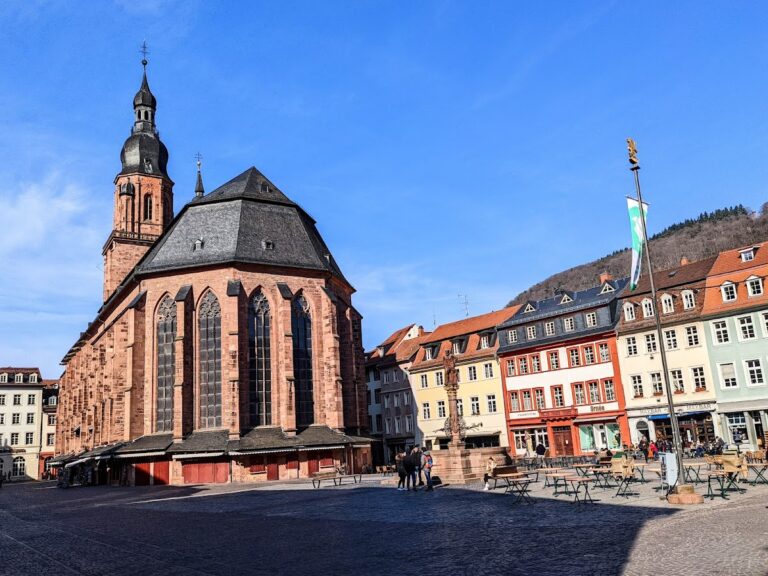
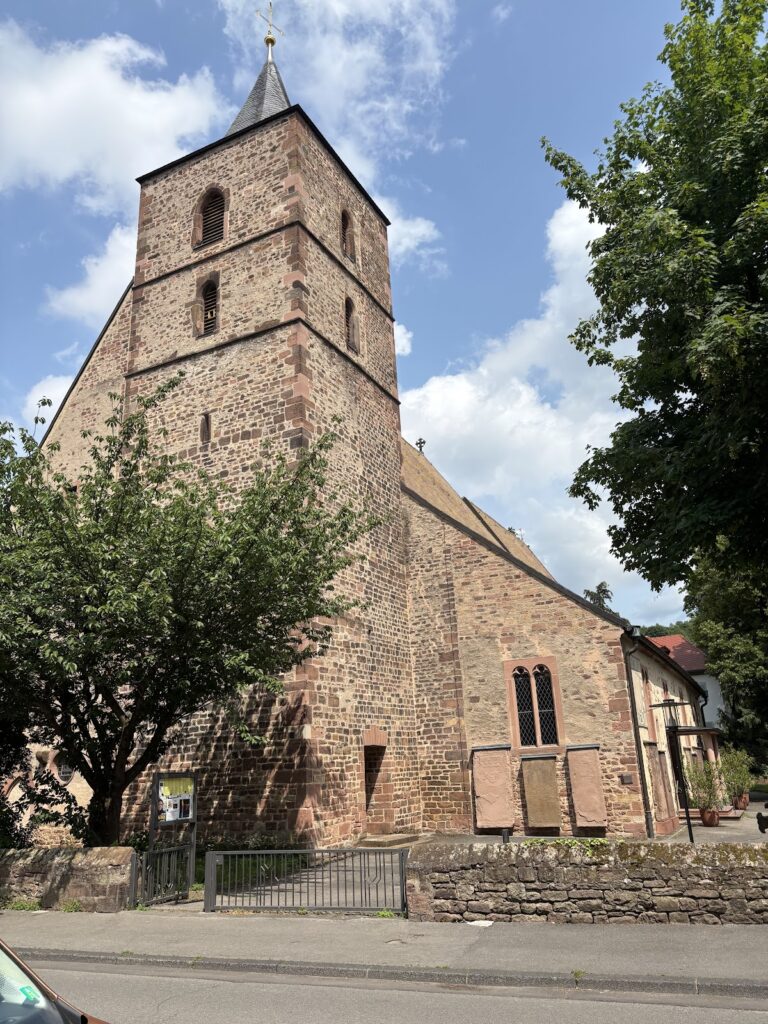
Peterskirche combines surviving Late Gothic fabric with the Neo-Gothic structure created in the nineteenth century. The enclosing walls of the choir and nave belong to the important Late Gothic phase, while the present building has three aisles arranged as a hall church. Two chapels were added to the nave in 1496, one pair on each side, and a sacristy was later built on the south side. The choir, old sacristy, and university chapel preserve the clearest medieval appearance within the rebuilt complex.
Medieval and rebuilt fabric
Choir and nave
The choir and nave retain walls from the Late Gothic rebuilding of 1485 to 1496. These elements form the historic core of the present church, although the rest of the building reflects the extensive Neo-Gothic reconstruction of 1864 to 1870. The two pairs of side chapels added in 1496 extend the nave laterally, while the later south sacristy forms another part of the surviving medieval arrangement.
Tower
The tower was remodelled in 1884 to resemble the tower of Freiburg Minster. Its delicate spire was later covered by a copper roof to protect it from weathering. The tower’s present form therefore belongs to the nineteenth-century phase of alteration that reshaped much of Peterskirche after the earlier destruction.
Memorials and churchyard
Inscriptions and university memorials
Approximately 150 epitaphs are placed on the interior and exterior walls. These memorials commemorate professors of Heidelberg University and members of the Electoral Palatinate court. The side university chapel contains the plaque dedicated to Marsilius of Inghen, while an honorific plaque in the southern side chapel commemorates Olympia Fulvia Morata, a poet and humanist.
Churchyard memorials
Part of the churchyard survives. It once served as the main cemetery for the castle district and the city while Peterskirche stood beyond the city walls. On the southeastern exterior, a university memorial plaque commemorates victims of war and tyranny. Nearby is the surviving gravestone of Hans Jacob Rieter, a Swiss textile entrepreneur who was beaten to death during a robbery in 1811.
Modern liturgical and artistic features
Interior furnishings
The interior renovation of 2004 and 2005 introduced a new altar, pulpit, baptismal font, Easter candlestick, and free-standing choir cross. Matthias Eder created the cross and the other new liturgical furnishings. The cross is made from COR-TEN steel, a weathering steel that develops a protective rust-colored surface.
Stained glass and sculpture
Johannes Schreiter’s stained-glass cycle was installed in stages. Four windows were added in July 2006, with three in the southern university chapel representing Encounter, Resurrection, and Persecution. The northern side chapel, used for prayer and meditation, contains the window Peace. A modern Christ sculpture by the Korean artist Lee Choon-Mann was installed there in March 2008.
Five further Schreiter windows were installed between November 2010 and July 2012, completing the nine-window cycle. The three large nave windows depict Holy Spirit and Baptism on the north side and Heavenly Jerusalem on the south side. Two smaller windows represent Word and Sacrament.
Organ
Johannes Klais of Bonn built the organ in 1984. It has 34 stops distributed across three manuals and a pedal. Its tracker and stop actions are mechanical, while an electronic registration system provides 8,000 memory settings, a sequencer, and a crescendo roller.
A Luther oak planted east of the church in 1883 commemorates Martin Luther’s four-hundredth birthday. Together with the medieval walls, nineteenth-century tower and hall church, university memorials, modern glass, and later furnishings, it forms part of the physical record of Peterskirche’s continuing religious and academic life.