Monastery of St. Michael: A Medieval Benedictine Foundation on the Heiligenberg
Site at a Glance
- Rating
- 4.7
- Popularity
- Low
- Country
- Germany
- Primary era
- Medieval
- Eras represented
- Classical, Medieval
- Civilizations
- Holy Roman Empire, Roman
- Site type
- Religious
- Remains
- Fortified Monastery
On this page9 sections
History
The Monastery of St. Michael in Heidelberg, Germany, is a Christian Benedictine foundation established in the ninth century as a branch of Lorsch Abbey, using Carolingian building traditions associated with the dynasty of Charlemagne and his successors. Built on the Heiligenberg, it occupied a sacred place with much older Celtic and Roman associations and remained an important religious site until its abandonment in the sixteenth century.
Earlier sacred use and the ninth-century foundation
Structures had stood on the Heiligenberg since the Celtic period. A Roman sanctuary occupied the site beneath the later Basilica of St. Michael, and the hill had become Christian by the seventh century, when Merovingian-period burials were made there. Thiotroch, abbot of Lorsch Abbey, secured the transfer of an existing church and enlarged it. The Lorsch Codex mentions a monastery in 870, although no archaeological remains confirm a monastery from that date, and the entry may project the later foundation backward.
Rebuilding and pilgrimage
In 1023, Reginbald, then abbot of Lorsch and later bishop of Speyer, rebuilt the Monastery of St. Michael and its basilica with Carolingian building elements. During this work, a conduit was constructed from a spring on the Weißen Stein because the Bittersbrunnen was becoming less reliable as the principal water source on the Heiligenberg.
Abbot Friedrich von Hirsau was buried at the monastery in 1070. His burial turned St. Michael into a pilgrimage site, although he was never canonized. In 1094, the Stephanskloster was founded on the southern summit of the Heiligenberg from St. Michael. Its construction was financed through inheritances associated with participants who had died during the First Crusade, the series of campaigns fought in the eastern Mediterranean between 1096 and 1099.
Changing monastic administration
Benedictine administration ended in 1226, when the Archbishop of Mainz took over Lorsch Abbey. After a short Cistercian period, Premonstratensians from Allerheiligen Abbey occupied both monasteries. The Premonstratensians, also called Norbertines, were a Western Christian order following the rule established by Norbert of Xanten.
Archaeological evidence indicates that a fire occurred during the conflict between the Electoral Palatinate and the Electorate of Mainz, after which the complex was rebuilt. In 1503, a bell tower of the Basilica of St. Michael collapsed and reportedly killed three monks in their sleeping quarters. The identity of this tower remains uncertain, because the principal tower east of the church was still shown in detail in a sixteenth-century sketch and in an engraving published by Matthäus Merian in 1654.
Abandonment and dismantling
The monastery was abandoned soon after the tower collapse and was already regarded as deserted in 1537. During secularization, the transfer of ecclesiastical property and institutions into secular ownership or administration, the ruins passed to Heidelberg University. In 1589, the university senate ordered the monasteries to be demolished and their stones sold to discourage settlement in the ruins. The order appears to have been carried out only partly. The present ruined condition also reflects the later removal of stone by surrounding farmers, particularly from Handschuhsheim, who used the monastery as a quarry.
Remains
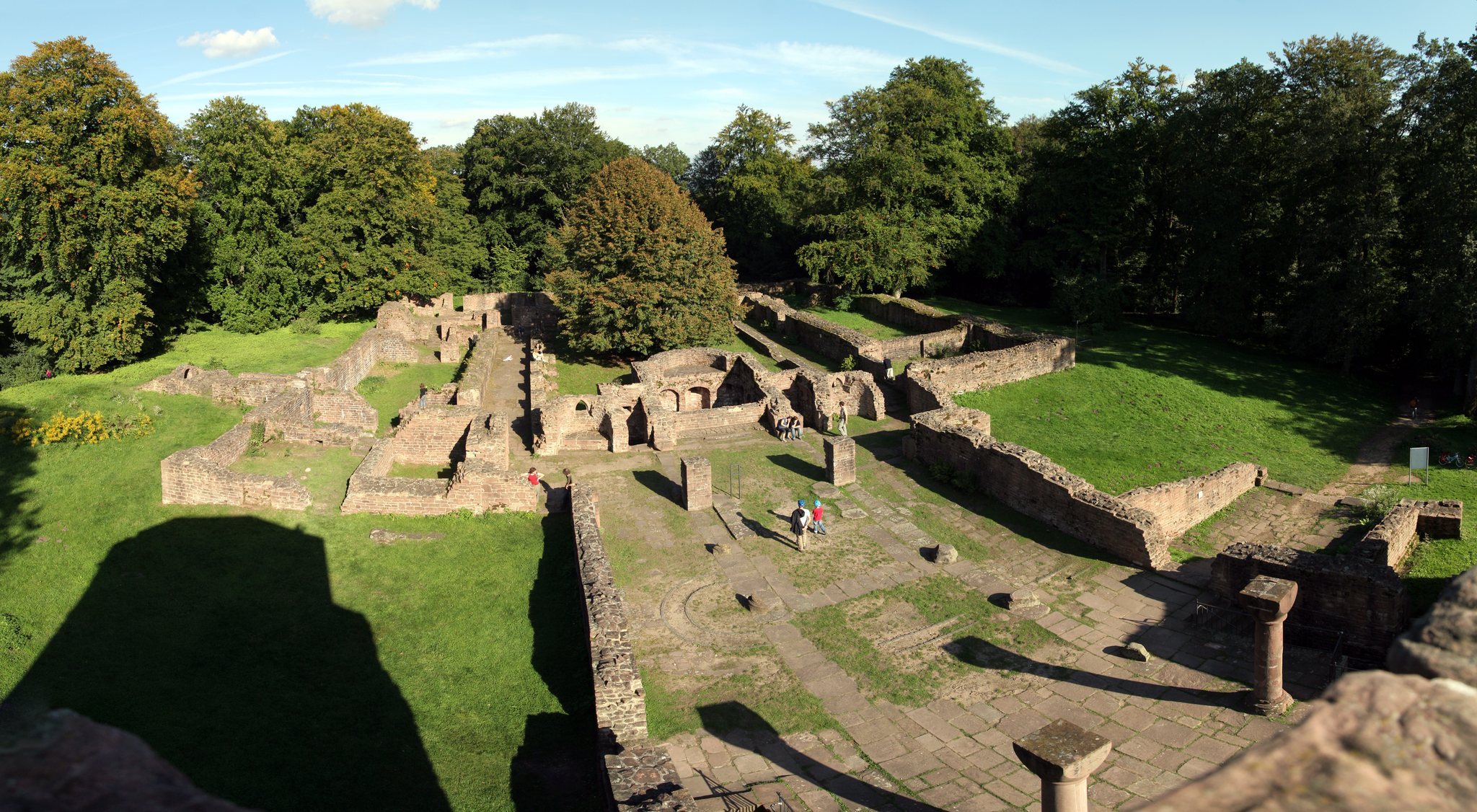
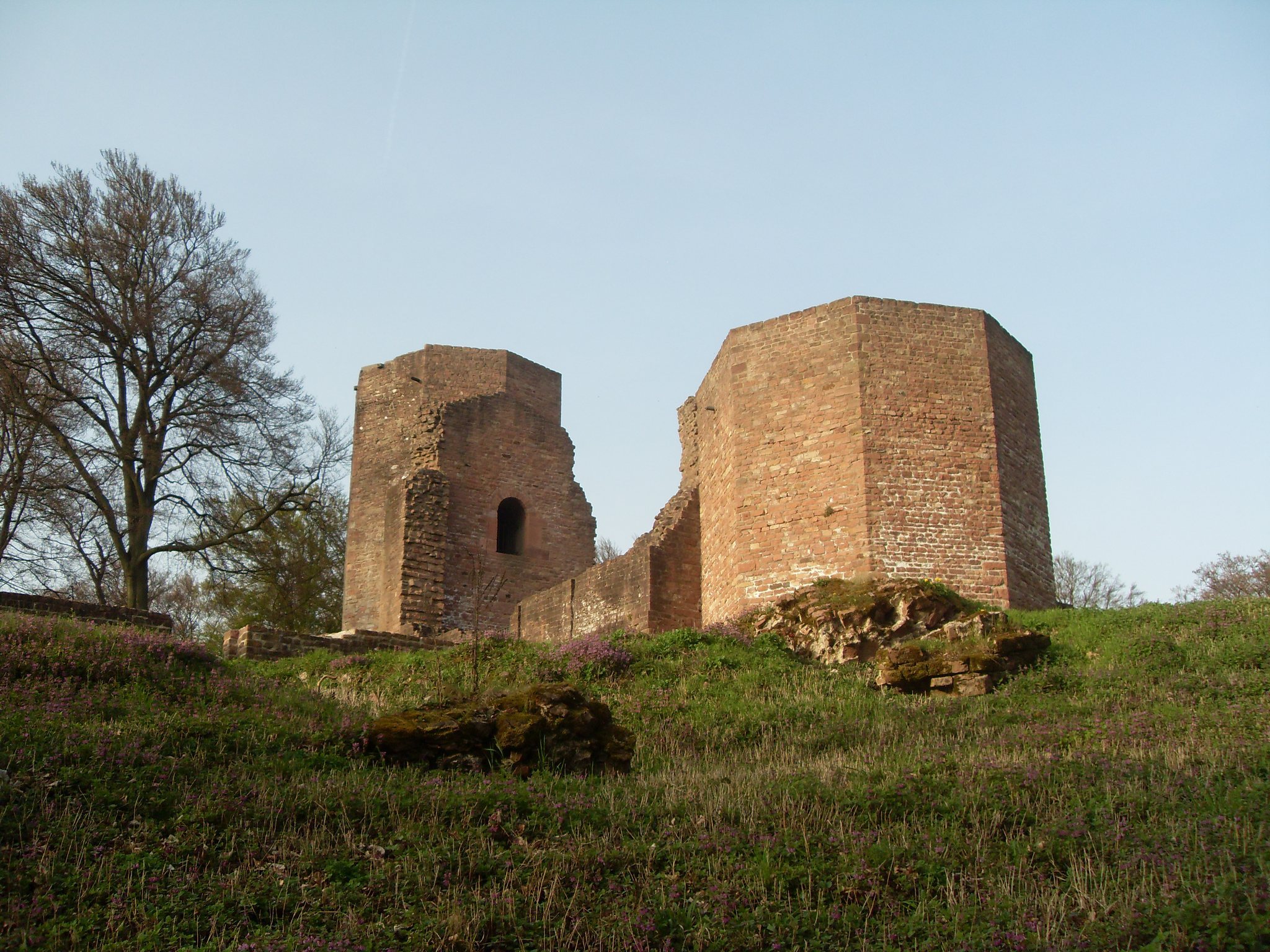
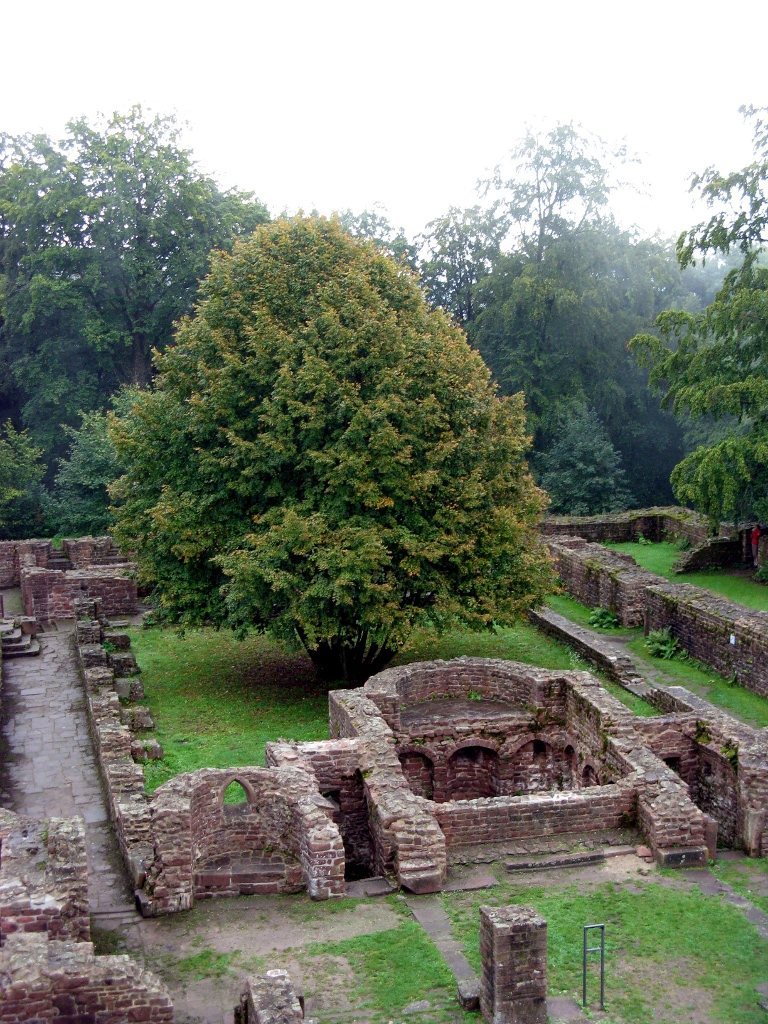
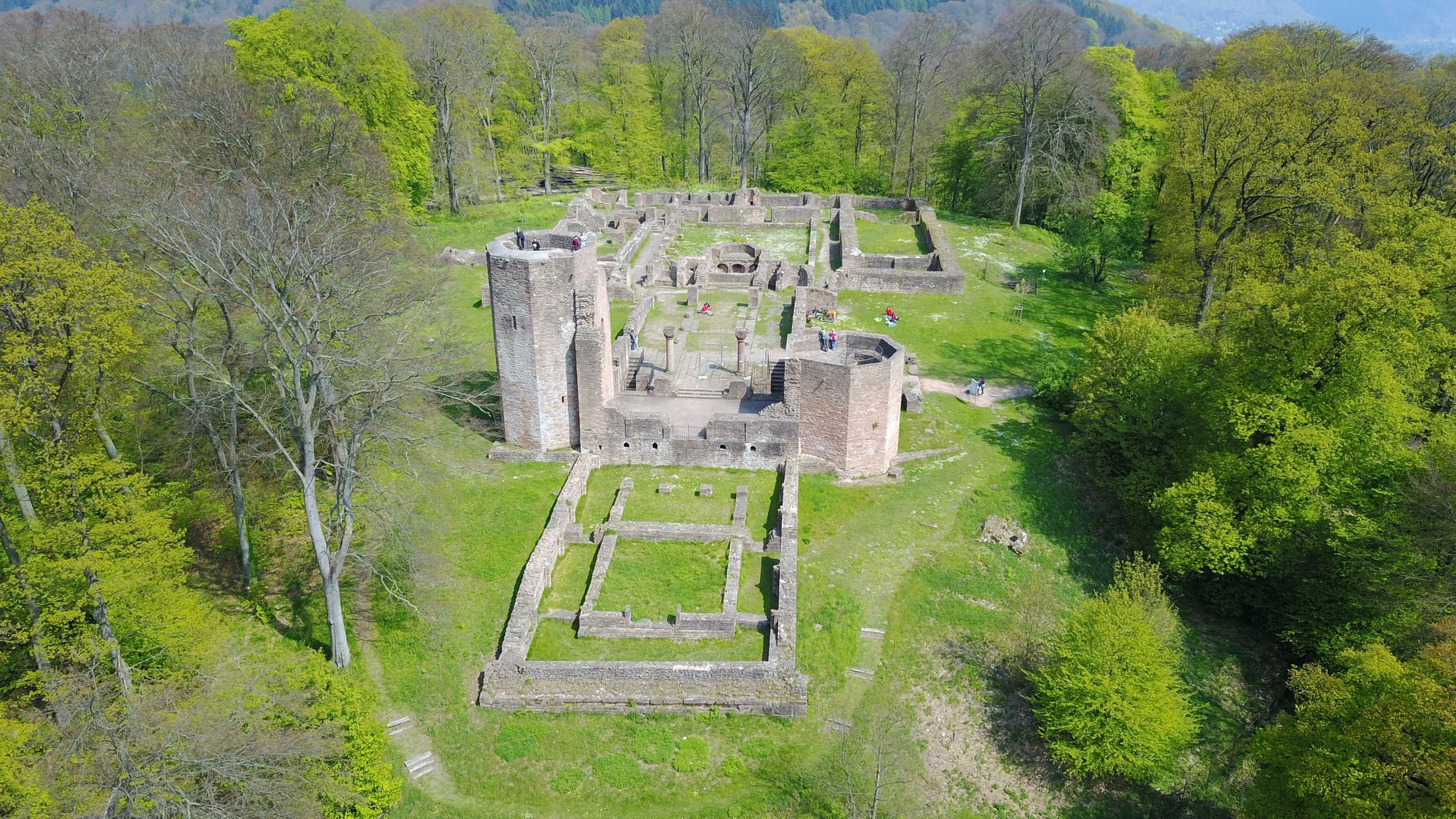
The Monastery of St. Michael occupies the highest point of the Heiligenberg within an enclosure formed by two ring walls. The surviving complex consists mainly of foundation remains, the ruins of the Basilica of St. Michael, a crypt, the north wing of the cloister, other monastery buildings, and two towers of different heights.
Basilica and Roman sanctuary
The basilica ruins stand above the remains of a Roman sanctuary. A votive stone links the sanctuary with Mercurius Cimbrianus, a regional form of the Roman god Mercury worshipped in parts of the northern Roman world. Stone slabs set into the nave floor mark the plan of the temple, including an apse, or rounded end, on its north side. The later Christian complex therefore preserves physical evidence of the earlier Roman religious use beneath the basilica.
Cloister and monastery buildings
The north wing of the cloister survives together with foundations and other remains of the monastery buildings. These fragmentary structures form part of the wider enclosure around the basilica and reflect the complex’s development as a monastic settlement rather than as an isolated church.
Water supply and western towers
A conduit connected the monastery with a spring on the Weißen Stein and supplied water near the complex. In the western part of the enclosure, two towers of different heights remain. Both can be climbed as viewing platforms. The higher northwestern tower rises about 14 metres and overlooks the Rhine Valley. The principal tower east of the church was still represented in detail in Matthäus Merian’s 1654 engraving and in a probably sixteenth-century sketch, while the evidence does not establish whether it was the tower that collapsed in 1503.