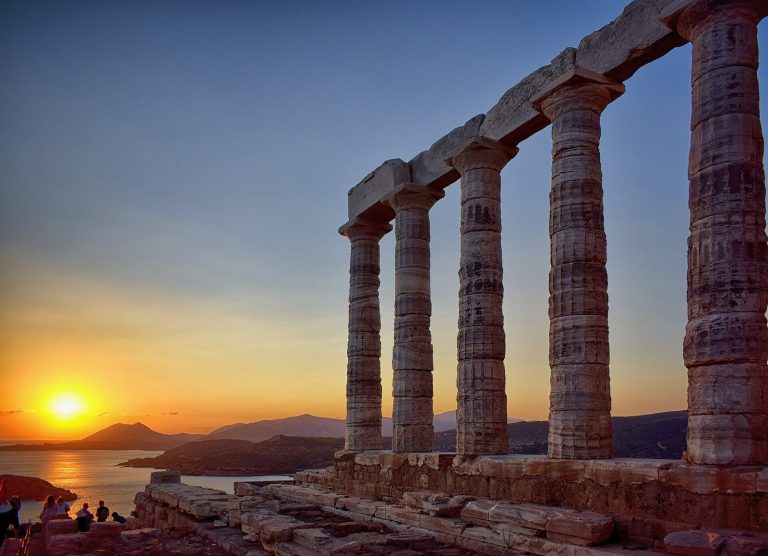
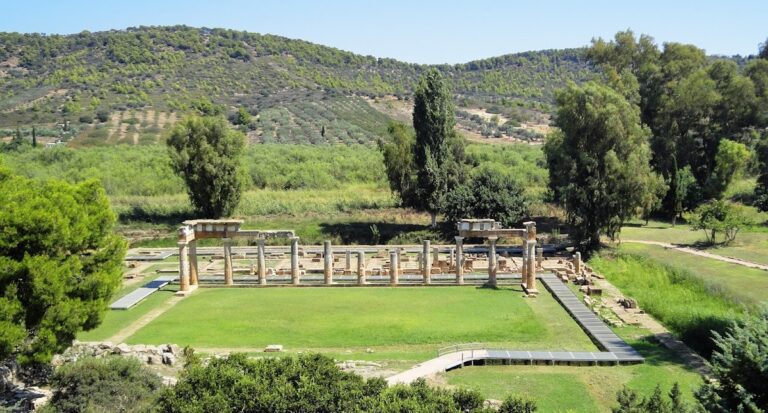
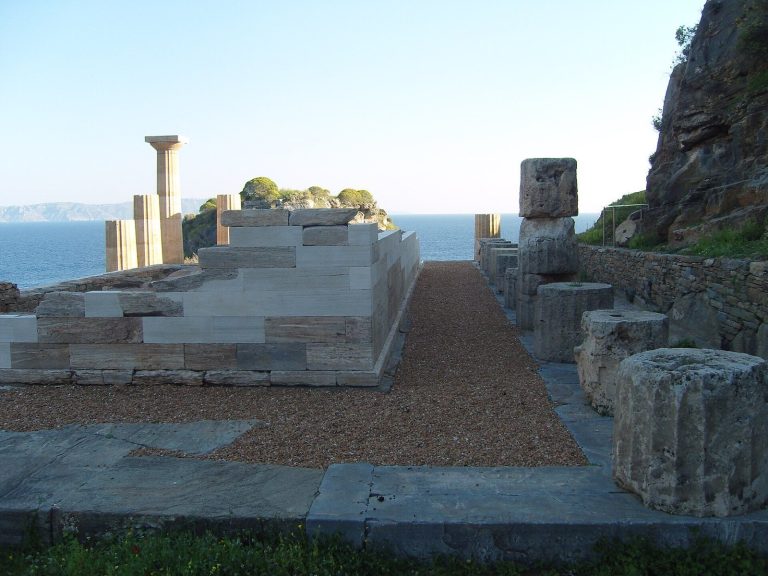
Thoricus: An Ancient Mining Settlement and Athenian Deme
Site at a Glance
- Popularity
- Medium
- Country
- Greece
- Primary era
- Classical
- Eras represented
- Stone Age, Bronze Age, Classical
- Civilizations
- Ancient Greek, Mycenaean
- Site type
- City
On this page12 sections
History
Thoricus was an ancient coastal settlement in southeastern Attica, Greece, later organized as a deme, a local community and administrative district, within the Athenian civic system. Its status as a deme dates to 508 BC, during the reforms of Cleisthenes. The settlement also became an important center for the Laurion mining district, and its history links early metal production with the growth of classical Athens.
Early settlement and mining
People lived in the area from the Neolithic, or later Stone Age, around 4500 BC. Occupation continued through the Early and Middle Helladic periods of Bronze Age Greece, the Mycenaean period, a Late Bronze Age civilization centered on mainland Greece, and the Geometric period, an early Greek era associated with geometric decoration. Activity at Thoricus persisted into later antiquity.
Mining and metalworking shaped the settlement’s development. Lead extraction in the Laurion district began in the third millennium BC, while silver extraction is attested from about 1500 BC. Metalworking at Thoricus was established before the ninth century BC, challenging the earlier proposal that Phoenicians, an ancient eastern Mediterranean people, introduced metallurgy to the Greeks. Thoricus prospered especially in the fifth and fourth centuries BC, when mining and metal production supported its growth. Its harbor carried substantial trade, particularly in timber and metals. Its long industrial history places it among Europe’s earliest industrial zones.
Civic life and classical prosperity
Thoricus belonged to the Acamantis civic tribe and its coastal subdivision. From 508 to 307/306 BC, it sent five or six members to the Athenian council. It sent six during each of the following periods, from 307/306 to 224/223 BC and from 224/223 to 201/200 BC. The ancient deme came to an end in the third century AD.
Tradition counted Thoricus among twelve early Attic settlements founded by Cecrops, a legendary king of Athens. It also held that Theseus, a legendary king and hero, later united those communities with Athens. The settlement’s name has been linked either to an eponymous hero or to an ancient Greek word.
Fortification, Roman resettlement, and abandonment
In 409 BC, Athens fortified Thoricus to protect the Laurion mines and the city’s food supply. The settlement declined as the mines were exhausted. Sulla, a Roman general and statesman, had his forces destroy Thoricus in 86 BC. People later resettled the site under Roman rule, and Pausanias, a second-century Greek traveler and writer, visited it. Thoricus was finally abandoned in the sixth century AD amid Slavic migrations into Attica.
Myth and archaeological exploration
Mythic traditions associated Thoricus with Demeter, the goddess of agriculture and grain. One story placed her landing there during her journey from Crete to Eleusis; another called it the first place she reached in Attica. Cephalus, a figure in Greek myth, was said to have been born or to have lived at Thoricus. One tradition placed his death there, while another told that Eos, goddess of the dawn, carried him away to live among the gods. In the nineteenth century, Christopher Wordsworth argued that Sophocles’ reference to a Thorician stone recalled Cephalus’s passage to the gods, in a way comparable to the fate of Oedipus.
Exploration of the temple area by the Society of Dilettanti began in 1817, while excavations on the western slope brought mining and metalworking traces to light from around 1820. Walter Miller led an excavation of the theater in 1886 for the American classical-studies institution in Athens. Valerios Stais directed work on Mycenaean remains on the hilltop in 1893 and 1894 for the Athens Archaeological Society. Belgian archaeological work began in the 1960s, including a mission active from 1963 to 1976; excavations have continued since.
Remains
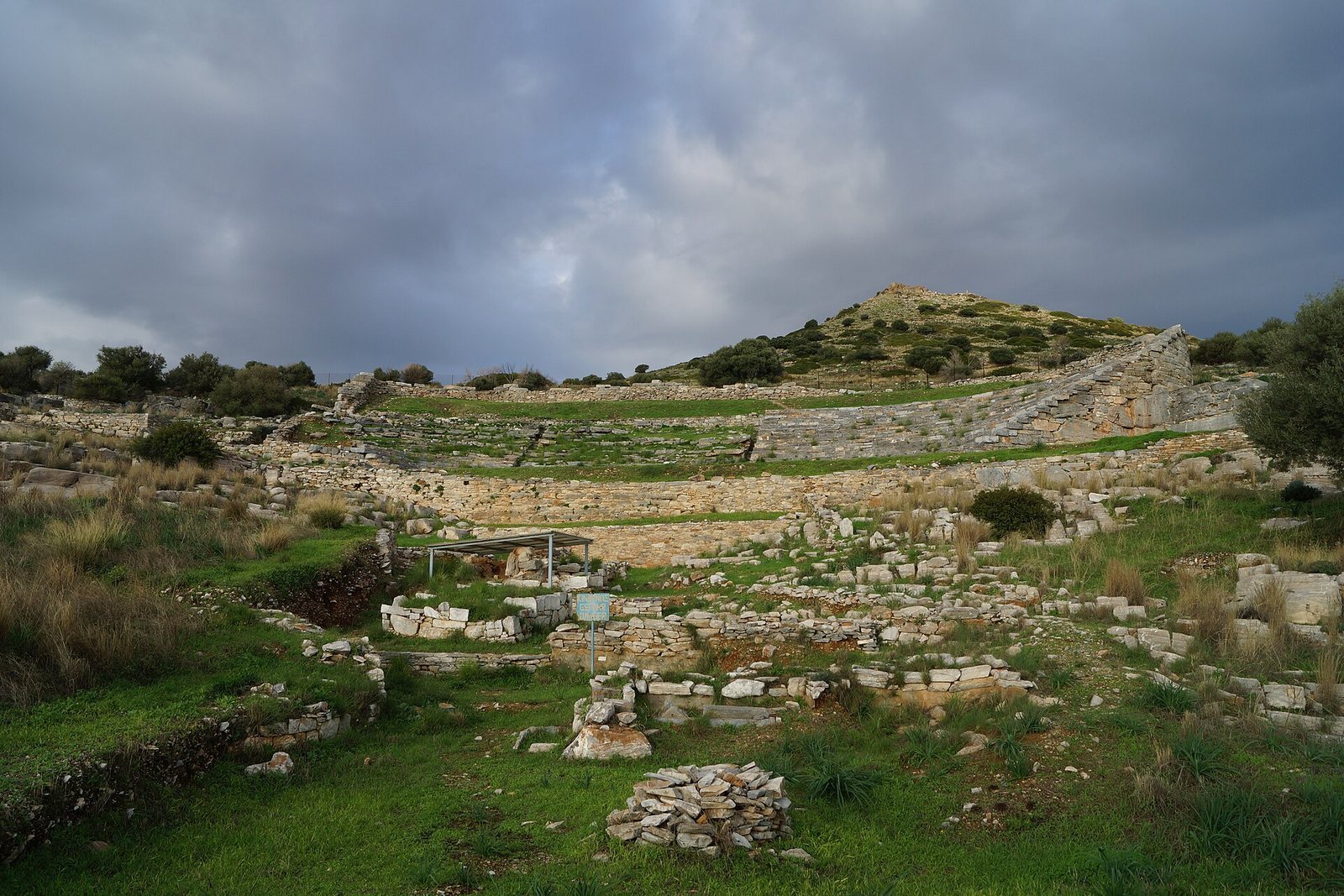
The ancient center was arranged around Velatouri Hill, with its fortified summit, occupied slopes, nearby plains, and harbor. The hill rises about 145 metres, and the settlement also extended across a small peninsula between Thorikos Bay and Fragkolimano. The site lies near modern Thorikó in the municipality of Lavreotikí.
Topography and fortifications
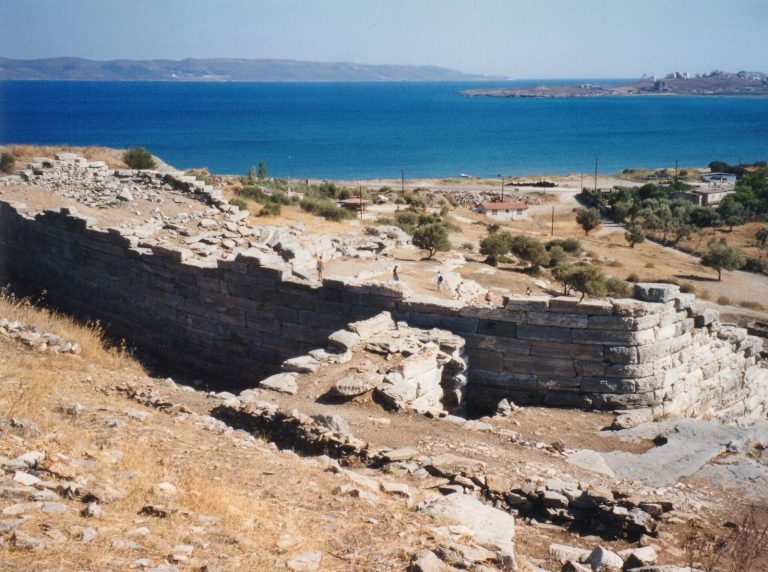
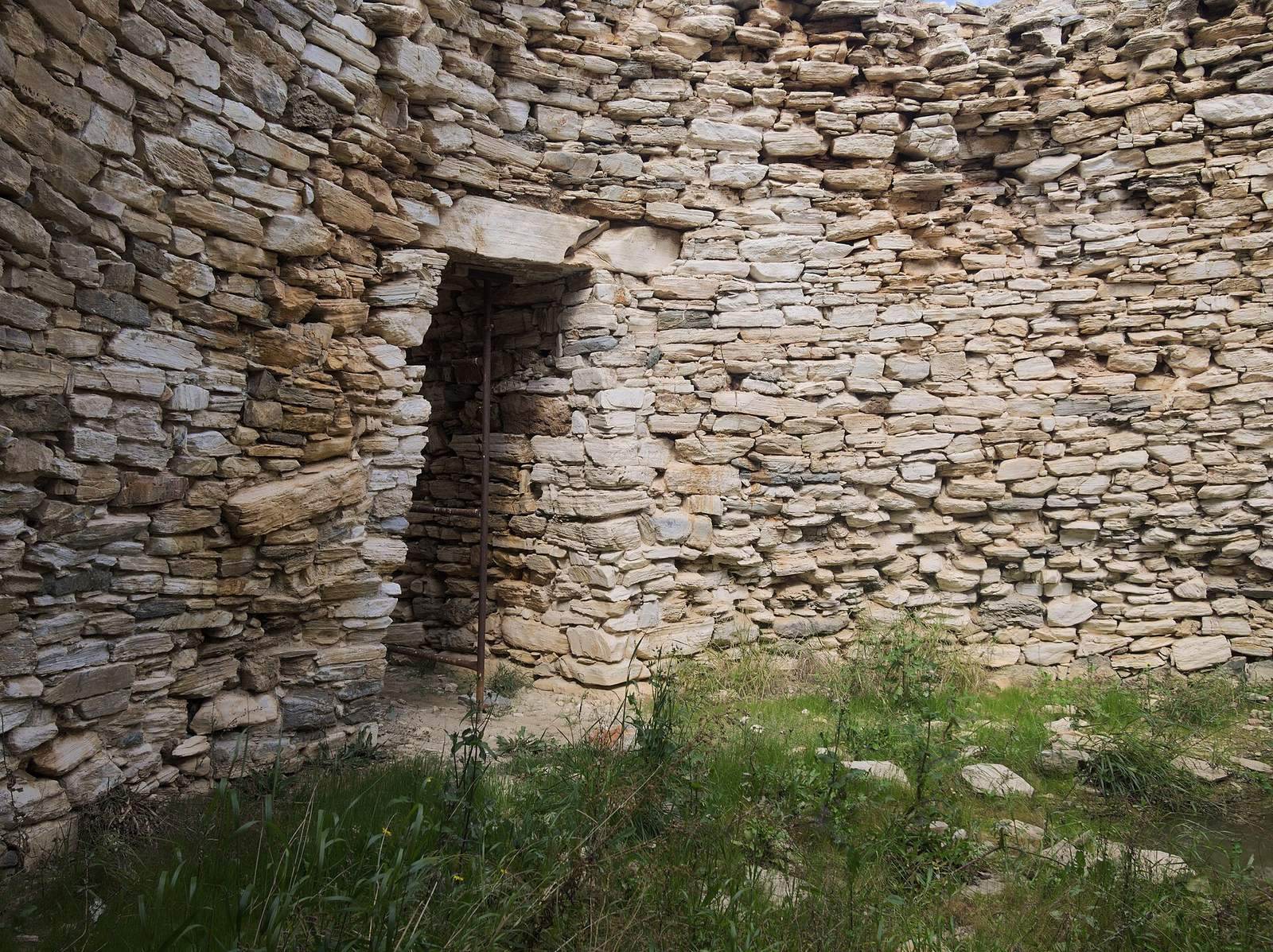
The fortified center occupied Velatouri’s summit, while the ancient harbor lay to its south. The bays on either side of the hill are now called Porto Mandri and Fragkolimano, and Makronisos Island provided natural shelter for the harbor. The defensive walls enclosed a small plain extending toward Porto Mandri and followed the ridges north, south, and west of it. More than 600 metres of wall survive, together with six towers, seven gates, and a small secondary gate. The hilltop center stood on a rise above the Frangó Limióna stream.
Prehistoric and Mycenaean remains
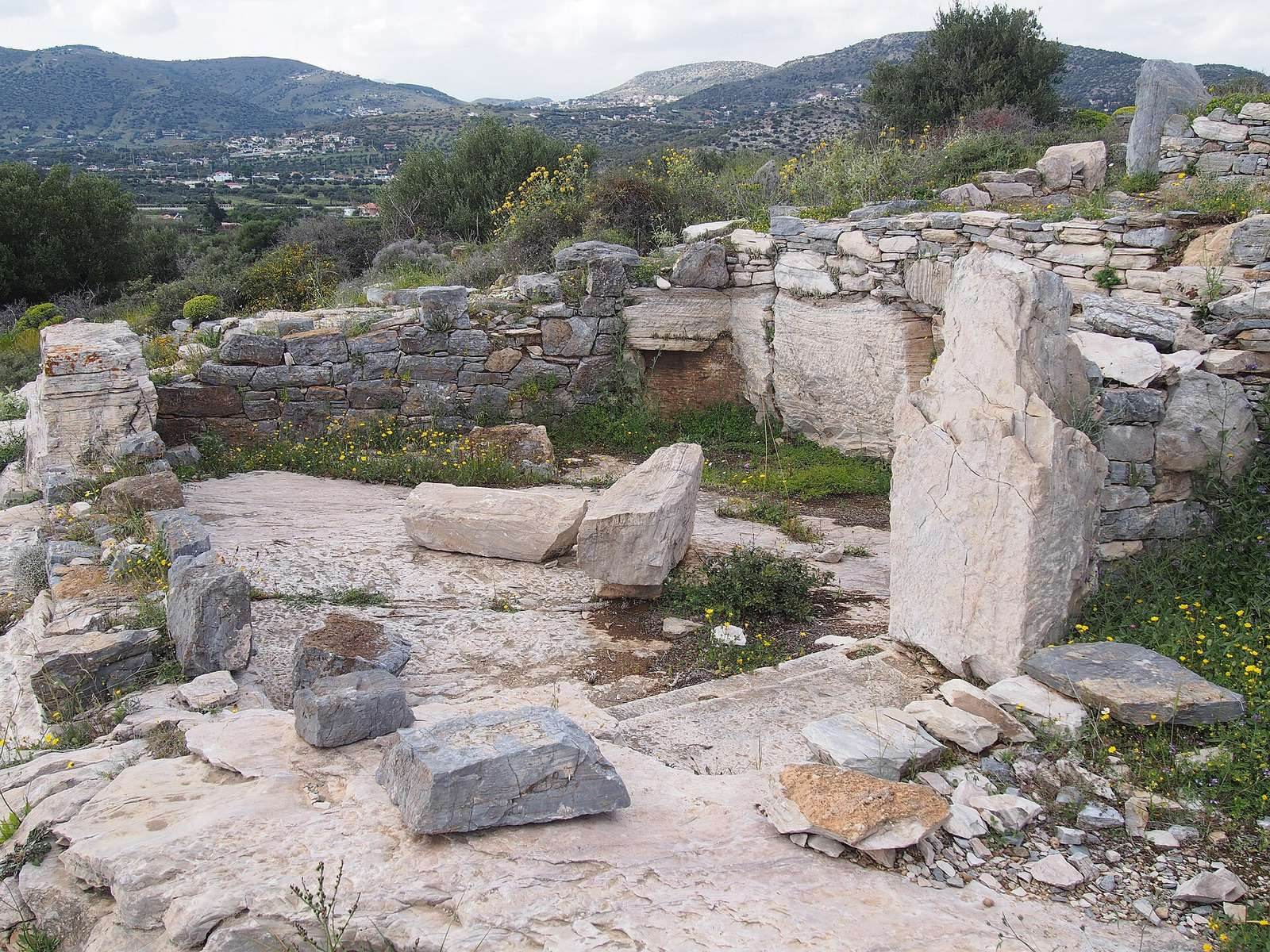
Habitation and burial remains span the Paleolithic, Neolithic, Helladic, Mycenaean, and Geometric periods. On Velatouri, settlement traces from the Neolithic period and houses dating to 2900–1600 BC reflect early occupation. A Mycenaean settlement and fortified center occupied the summit. Circular tombs dating broadly to 1600–1100 BC include the largest on the hill’s eastern side, while the remains of other tombs lie near the summit. A late Mycenaean installation dates to the twelfth century BC. One tomb yielded pottery and figurines dated to the sixth through fourth centuries BC. Finds from the tombs and installation are held at the National Archaeological Museum in Athens.
Mining and metalworking
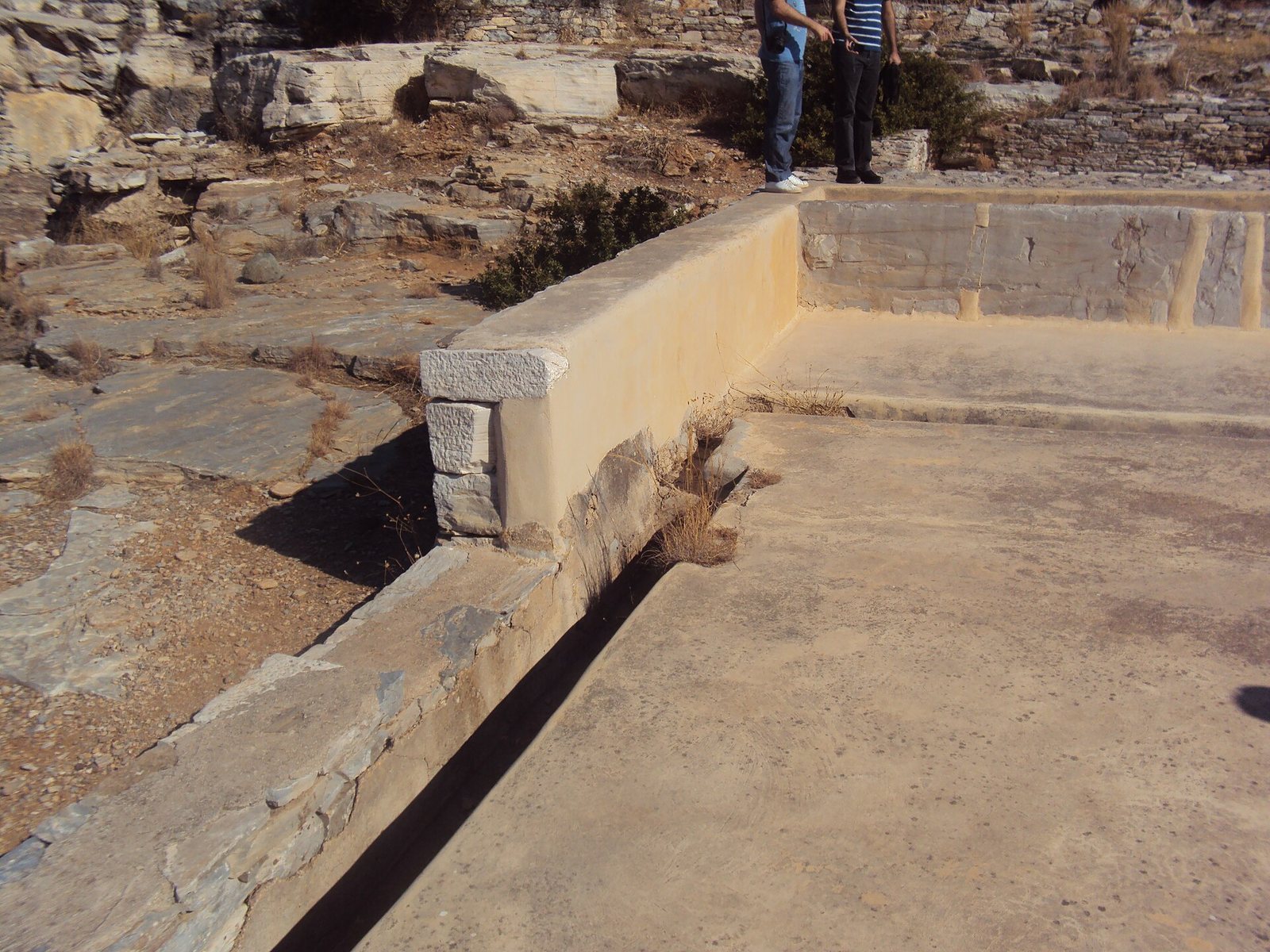
Mining galleries and shafts cut into the hill. On its southwestern slope, remains of an industrial quarter include houses, taverns, workshops, roofed colonnades, and streets. A lead-oxide product of silver-lead processing, known as litharge, came from a house on Velatouri dated to about 1350–1300 BC. Ore-smelting works included basins connected by channels, and an ancient ore-washing installation stands beside the theater.
Theater and public buildings
Theater and associated structures
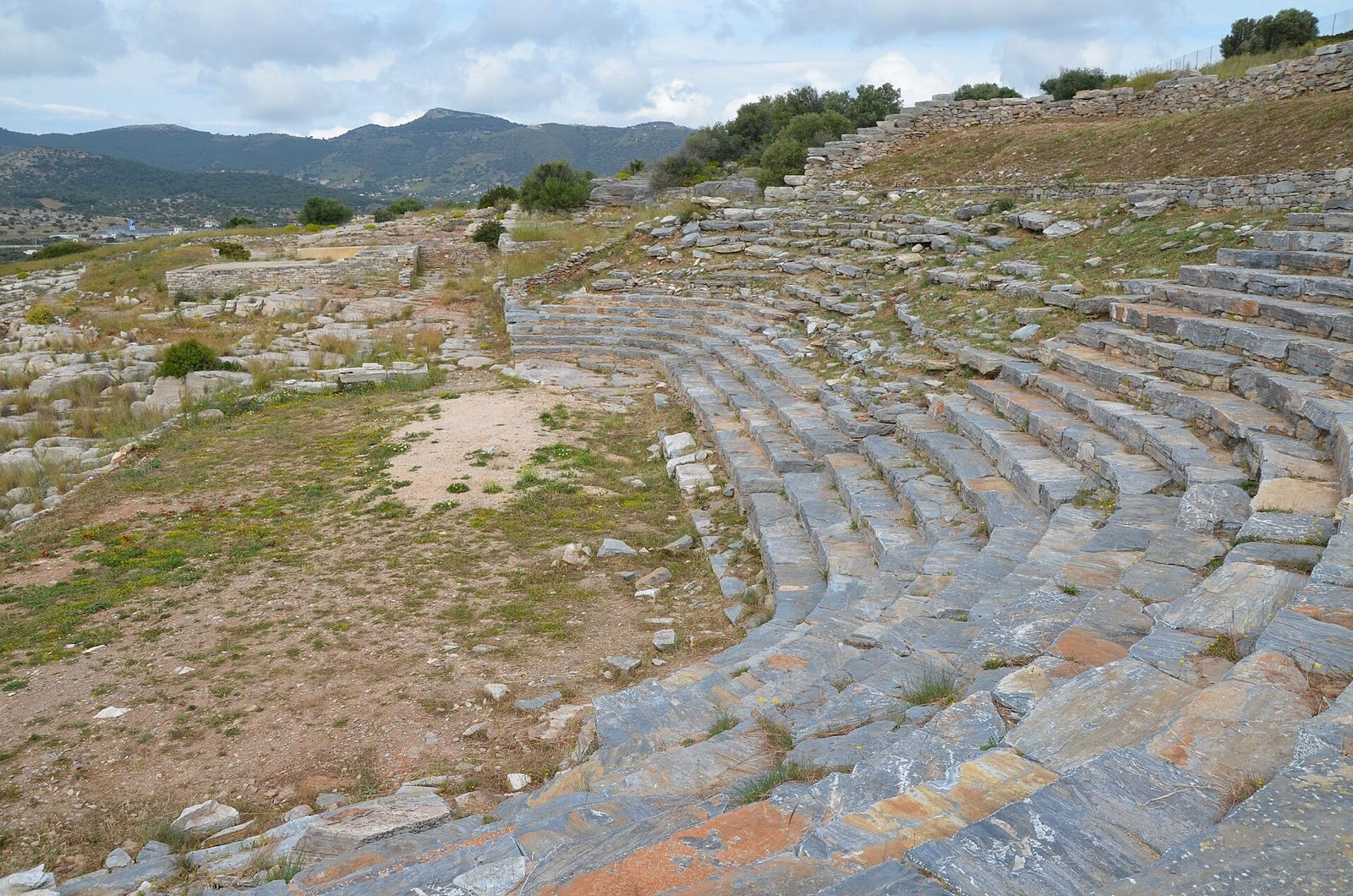
The theater occupies the southern slope of Velatouri. Its earliest part dates to about 525 BC, and it was developed in stages through about 300 BC. The performance area is elliptical, and the broad, elongated seating area has unequal wings. The theater held about 2,700 spectators. Curved seating was added at its eastern and western ends in the mid-fifth century BC, with further curved rows added at the rear around 300 BC. A small temple to Dionysus, god of wine and theater, and a banquet room with five seats stood west of the theater; an altar stood to its east.
Sanctuary and porticoes
A large marble building arranged as a double roofed colonnade dates to the late fifth century BC. An inscription identifies it as a telesterion, a building for religious initiation rites, associated with Demeter and Kore, also called Persephone. A separate small temple near colonnades with benches may have been dedicated to Hygieia, a goddess associated with health. In the western plain, remains of a four-sided portico with columns have also been identified.