Church of Agios Georgios Vravronas: A Late Byzantine Chapel in Greece


Site at a Glance
- Rating
- 4.7
- Popularity
- Medium
- Country
- Greece
- Primary era
- Medieval
- External website
- Open
- Eras represented
- Classical, Medieval, Early Modern
- Civilizations
- Ancient Greek, Byzantine, Ottoman
- Site type
- Religious
- Remains
- Church
On this page9 sections
History
The Church of Agios Georgios Vravronas is a small late Byzantine chapel in Greece, built in the mid-fifteenth century within the ancient Sanctuary of Artemis at Vravrona. The sanctuary, dedicated to Artemis, an ancient Greek goddess, forms the archaeological setting for the later Christian building, which stands a short distance from the Early Christian Basilica of Vravrona, a church type dating from the first centuries of Christianity. The chapel belongs to the parish of Saint Nicholas in Markopoulo.
Late Byzantine Foundation
The church was constructed on the northwestern side of the sacred rock, with part of its structure cut into the rock. Evidence around the building indicates that a larger Christian church had previously occupied the location. A section of a semicircular apse in front of the chapel’s smaller sanctuary apse, together with fluted columns, points to this earlier building. Rock-cuttings also preserve traces of structures connected with the ancient sanctuary.
Saint Timothy and the Ottoman Period
Around 1580, during the early period of Ottoman rule, Saint Timothy came to Vravrona seeking a more solitary religious life. A Christian monk and ascetic, he repaired the church and used it as a hermitage with a nearby cave. He purchased the area called “Paleos Vravonas,” renovated the site, added new wall paintings, and built new cells. The surviving paintings include works made before 1589, connecting the chapel’s later religious use with this period.
Restoration and Continuing Religious Use
Conservation work in 1960 revealed earlier wall paintings, including a rare image of Saint Timothy, a depiction of Saint Cosmas wearing four ceremonial liturgical tunics, and a decorative motif at the base of the south wall. A restoration in 1962 removed unnecessary additions from the west side, a later icon screen considered inferior, and floor tiles, exposing the original floor. The church is recognized as part of an archaeological site and as a protected building. Its annual celebration is held on Saint George’s feast day, 23 April, or on Easter Monday, with Vespers and the Divine Liturgy.
Remains
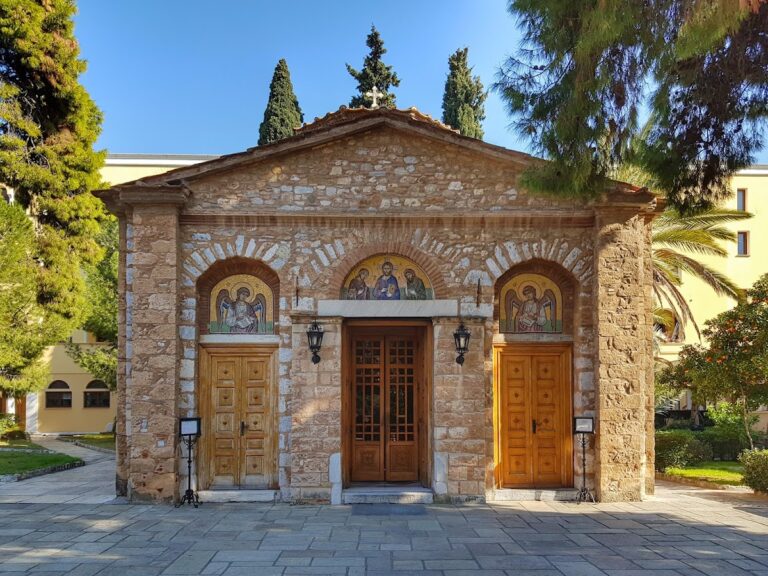
The surviving chapel is a compact, single-room building whose late Byzantine design combines a rock-cut position with a tiled roof, a dominant dome, and a western entrance space. Much of its fabric uses materials dating from the early Christian period. The structure’s small scale and irregular forms reflect its construction on the northwestern side of the sacred rock.
Chapel Structure
Dome and Roof
A dual-pitched tiled roof covers the church, while an octagonal dome forms the largest part of the building. The dome rests on blind arches, which are recessed arches without openings, arranged crosswise. At the west, a vaulted narthex, or entrance vestibule, has a raised tiled roof. Its roof and the dome create two elevated projections above the chapel.
Sanctuary and Openings
On the east side, an irregular blind apse, a recessed sanctuary termination that does not open through the wall, rises to the level of the roof tiles. Loophole-like windows are carved at the cardinal points. In front of this small sanctuary apse are the remains of part of a larger semicircular apse and fluted columns, preserving the physical evidence of an earlier Christian church.
Wall Paintings and Earlier Traces
Only a few wall paintings remain inside the chapel. The rare image of Saint Timothy survives alongside the paintings revealed during the 1960 conservation work, including Saint Cosmas in four liturgical tunics and the decorative design along the lower south wall. Cuttings in the surrounding rock preserve further traces of earlier structures associated with the ancient sanctuary, linking the chapel’s remains to the long occupation of Vravrona’s sacred landscape.