The Govan Stones: An Early Medieval Sculpture Collection in Glasgow
Site at a Glance
- Popularity
- High
- Country
- United Kingdom
- Primary era
- Medieval
- Eras represented
- Medieval
- Civilizations
- Unclassified
- Site type
- Burial
- Remains
- Necropolis
On this page22 sections
History
The Govan Stones are a collection of early medieval carved monuments at Govan Old Parish Church in Glasgow, Scotland, United Kingdom. Established in 2007 and owned by the Govan Heritage Trust, the collection brings together 31 monuments, most thought to date from the ninth to eleventh centuries. Its sculpture is internationally important and reflects Govan’s place in the history of the Clyde valley.
Early Christian Govan
Christian activity at Govan is believed to have begun between the early fifth and early sixth centuries. Two Christian burials found beneath the foundations of a later church were radiocarbon dated to AD 435–601 and AD 474–601.
By the ninth and tenth centuries, Govan had become an important church centre as the kingdom of Strathclyde developed upriver from Dumbarton. The size of the churchyard and the quantity of early medieval sculpture suggest that the church received royal support. The carved monuments are thought to have commemorated the power and wealth of Strathclyde’s rulers.
From Alt Clut to Strathclyde
Dumbarton Rock was the centre of Alt Clut, a Brittonic kingdom named for the “Rock of the Clyde.” Brittonic refers to the Celtic-speaking peoples and languages of Britain. The Annals of Ulster, a medieval chronicle, describes Alt Clut as a kingdom from the sixth century into the later ninth. Symeon of Durham, a medieval English chronicler, records a Northumbrian army returning from “Ovania” after attacking Dumbarton Rock in 756. Northumbria was an Anglo-Saxon kingdom in northern England and southern Scotland.
In 870, after a four-month siege, Vikings destroyed the Britons’ twin stronghold at Dumbarton Rock, where the Clyde and Leven meet. Artgal, king of Alt Clut, was either killed or enslaved. The loss of the citadel increased the strategic importance of Govan and nearby Partick as a new ruling dynasty established the successor kingdom of Strathclyde. The chronicle names the kingdom of Ystrad Clud in 872, a change understood to reflect this shift in political power. A predecessor of Partick’s twelfth-century royal estate and Doomster, or Dempster, Hill may also have contributed. The hill may have served as a meeting place adapted from a Bronze Age burial mound.
Preservation and archaeological recovery
The Govan Sarcophagus was found in the churchyard in 1855 during the digging of a grave. In 1926, it and other stones were moved inside the church to protect them from the weather. The sarcophagus may have been buried earlier for protection, perhaps during the sixteenth-century Scottish Reformation, when religious images were often destroyed or removed. The Govan Cross was given to residents of Jordanhill House at an uncertain date, around the replacement of one of the churches, and returned to Govan Old in 1928.
Fourteen recumbent gravestones beside the churchyard’s east wall were thought to have been lost in 1973, when a neighbouring Harland and Wolff shipyard plating shed was demolished and the stones were mistaken for debris. In 2019, schoolboy Mark McGettigan found one during the Stones ’n’ Bones community archaeology programme; two more were later uncovered. The discoveries raised the possibility that additional stones from the group may survive.
Excavation at the graveyard included work by the television archaeology programme Time Team in 1996. Subsequent excavations and surveys, led by Professor Stephen Driscoll of the University of Glasgow Archaeology and Clyde Archaeology, continued into 2026. Driscoll discovered the Govan Warrior in 2023 while re-excavating an area examined in 1996. Work in 2024 recovered a carved fragment with interwoven bands, and in 2025 archaeologists found a large posthole packed with stones near a gravel roadway.
Remains
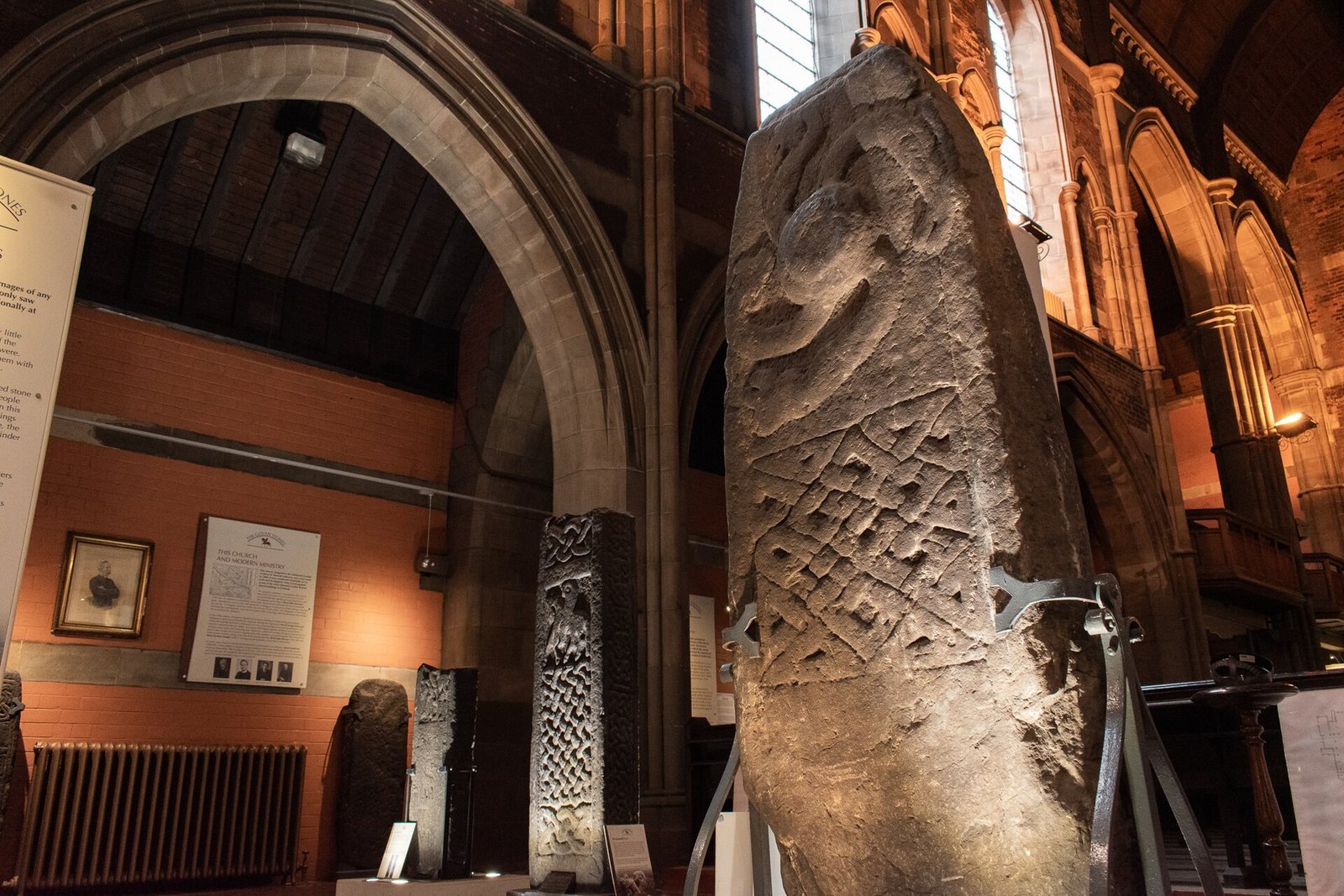
The remains comprise carved stone monuments from the churchyard surrounding Govan Old Parish Church, alongside foundations and other features revealed by excavation. The collection is displayed in the church, with recumbent grave markers arranged around its interior walls. Excavation has also exposed features in the graveyard’s southeast area.
Churchyard and early structures
Early church foundations
Near the southeast corner of the present church, excavators found foundations thought to have supported an early medieval wooden church. Boulders set into a trench form the base, with smaller stones laid to create a level surface. Because the site has remained in use since its establishment, the form of its earliest church is difficult to establish.
Gravel roadway and excavated finds
An early medieval gravel roadway is being uncovered in the southeast part of the graveyard. The Govan Warrior was found in this area. It is a damaged, lightly incised figure that appears to show a warrior in profile, with a small round shield strapped over the shoulder and a staff, spear, or sword resting on the left shoulder. Much of the face is destroyed, though it appears to have a pointed beard and a ponytail. Nearby discoveries include a fragment carved with interwoven bands and a large posthole filled with packing stones.
The Govan Sarcophagus
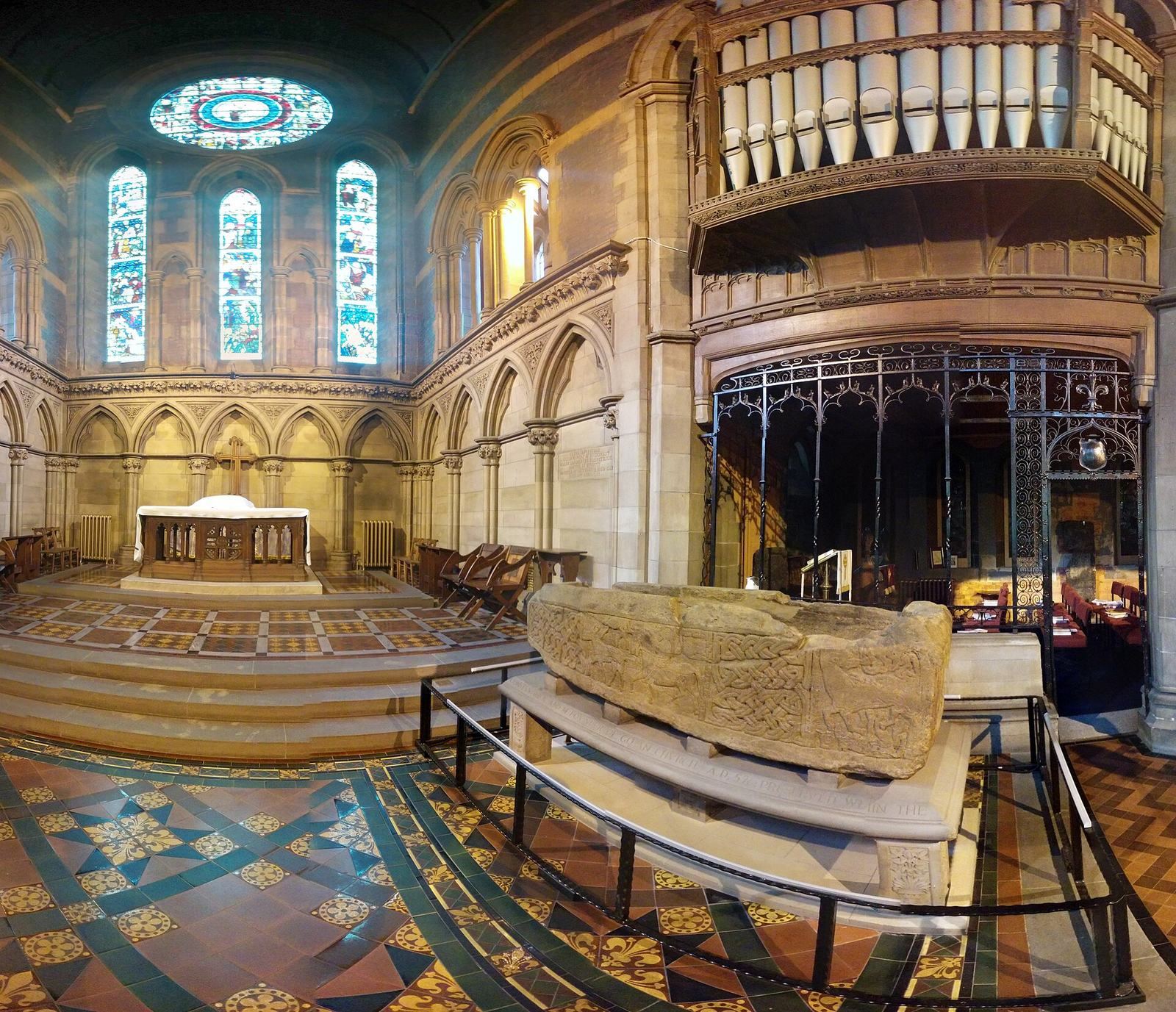
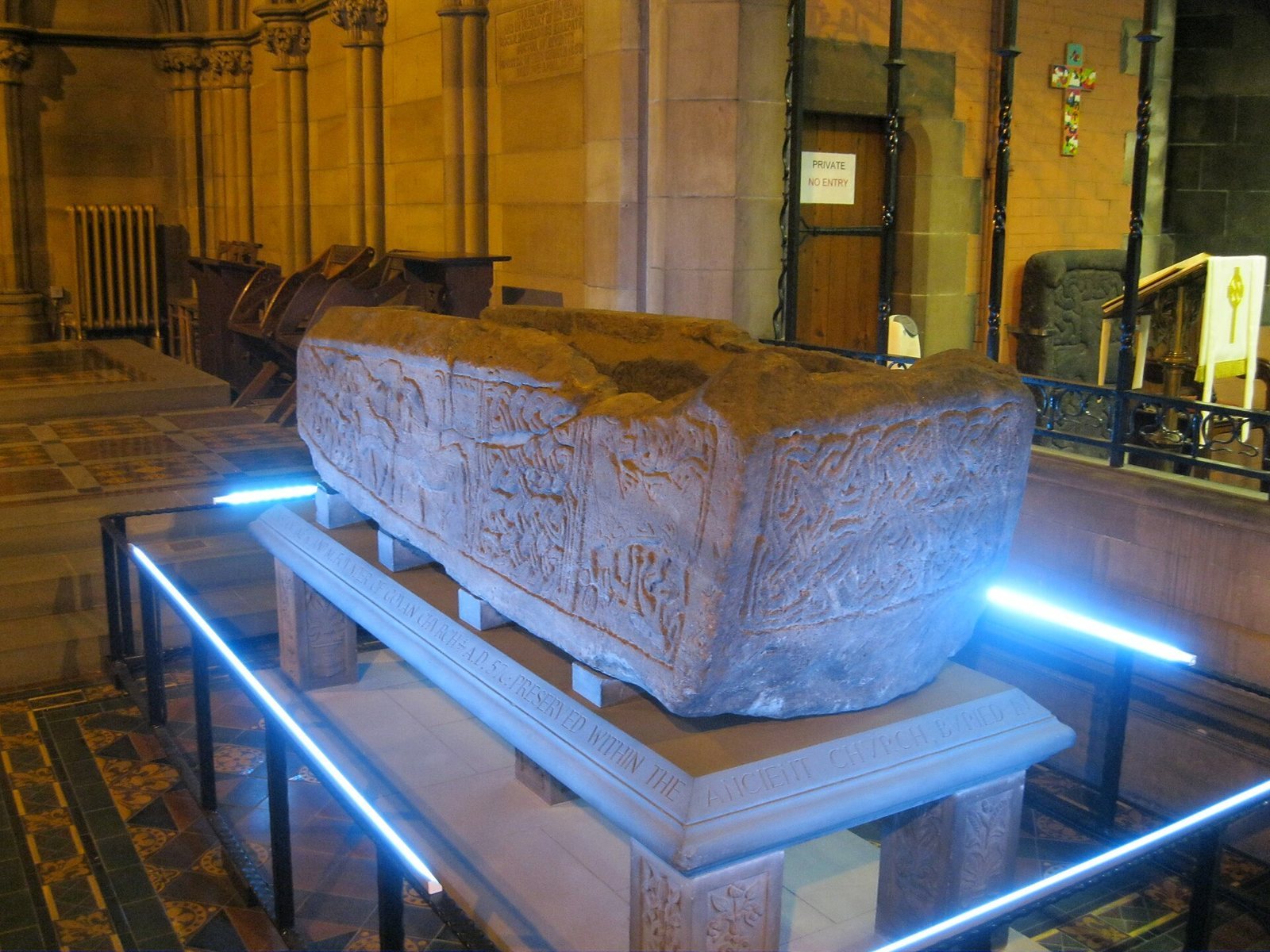
The Govan Sarcophagus is a monumental coffin carved from a single block of sandstone and displayed in the church museum. It is the only known example of its type from pre-Norman northern Britain. Its richly decorated exterior has been interpreted as a display intended to make a saint’s remains a focal point within the church. The coffin may have been dedicated to the church’s patron saint, St Constantine, though the saint’s identity is debated. Suggested candidates include Causantín mac Cináeda, king of the Picts from AD 862 to 877, and Donald f. Constantine, king of Alba from AD 889 to 900.
The carvings draw on Insular art, the artistic traditions of Britain and Ireland. One face shows a mounted hunter pursuing a stag, perhaps accompanied by a dog. Hunting scenes occur in Pictish art and are thought to connect the image with royalty and power. Another carving shows an animal trampling a snake and a possible wolf. Its angular ornament has led to an interpretation of the animal as the Lamb of God, a Christian image of Christ as a sacrificial lamb.
On the other long face, one panel arranges four beasts in a near-mirrored pattern, while varying their individual designs. A second shows two long-necked animals crossing necks and intertwining their tongues or ears with the other animal’s tail. Other panels are filled with interwoven bands cut into the stone, including patterns that form snake shapes.
Hogbacks
Five large sandstone monuments found within the early churchyard are hogbacks, carved stones shaped to evoke roofed buildings. The type originated in Yorkshire and combines Scandinavian and Anglo-Saxon influences. Govan’s examples are exceptionally large compared with hogbacks elsewhere.
Govan 2
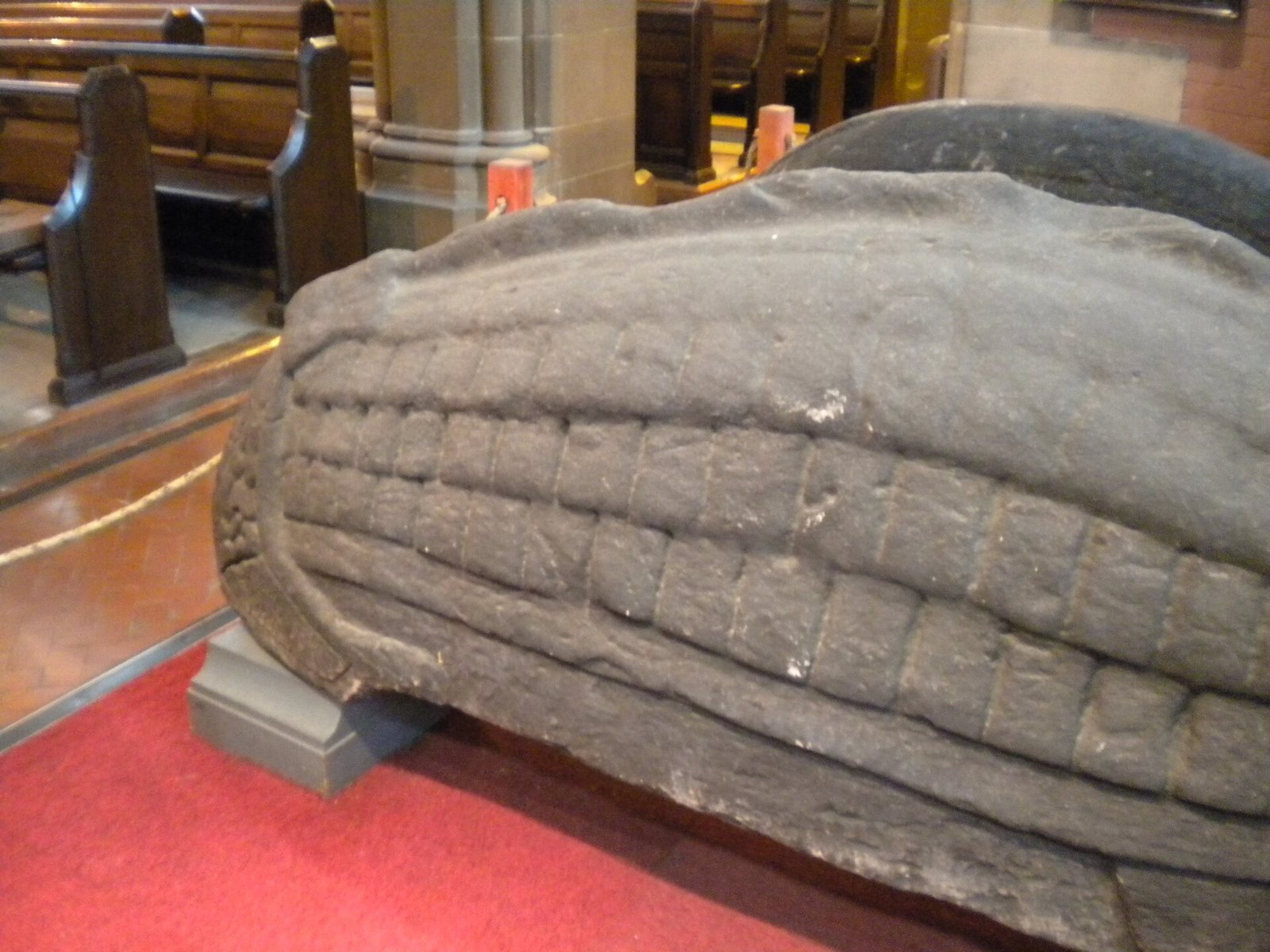
At two metres long, Govan 2 is the smallest of the five and is dated to the early tenth century. It is considered probably the oldest in the group. Two rows of roof-shingle-like carving run across it, above interwoven ornament. The patterns differ from side to side and do not form an uninterrupted band. One face has separated plaited elements with small pellet-shaped fillers, a treatment found on no other Govan hogback. It also carries a running ring-knot pattern with fret-like details. On the opposite side, parts of a four-strand plait have been reduced to crossing diagonal bars, with four small pellets beside them.
Govan 3
Govan 3 is massive and was recarved, probably in the early medieval period, to resemble a single large animal. A full-bodied beast, with legs, is carved in three dimensions and extends from one end of the monument to the other. The stone may earlier have resembled examples from Brompton, with large beasts gripping the ends.
Govan 4
Govan 4 was also roughly recarved to suggest one animal. Its beast faces outward, an unusual arrangement for a hogback, and its four bent legs point towards its head. The raised roof ridges resemble a spine, while the roof-like patterning suggests scales.
Govan 5
Govan 5 has a pair of gripping beasts on panels at its ends, one of which is badly worn. Interwoven ornament in the Govan School style surrounds the panels and may represent the animals’ backs. A roughly circular hollow at the centre of the top appears to have been made after the early medieval period. Its roof-shingle pattern remains well preserved. The beasts are shown from the side with open jaws and legs that intersect along the base, an arrangement unique among known hogbacks.
Govan 6
Govan 6 is 2.4 metres long and heavily eroded, apparently after prolonged exposure to the elements. Its roof-like pattern has distinctive concave sides. One end appears to retain a dragon- or serpent-like beast facing away from the ridge. A matching figure may once have occupied the other end, but it may have been removed accidentally or during recarving to make the whole stone resemble one creature.
Cross-shafts
The museum displays two cross-shafts, the upright stems of freestanding crosses. Both would have been carved on all four sides when complete. Their form has been compared with the more intact Barochan Cross at Paisley Museum.
Govan Cross
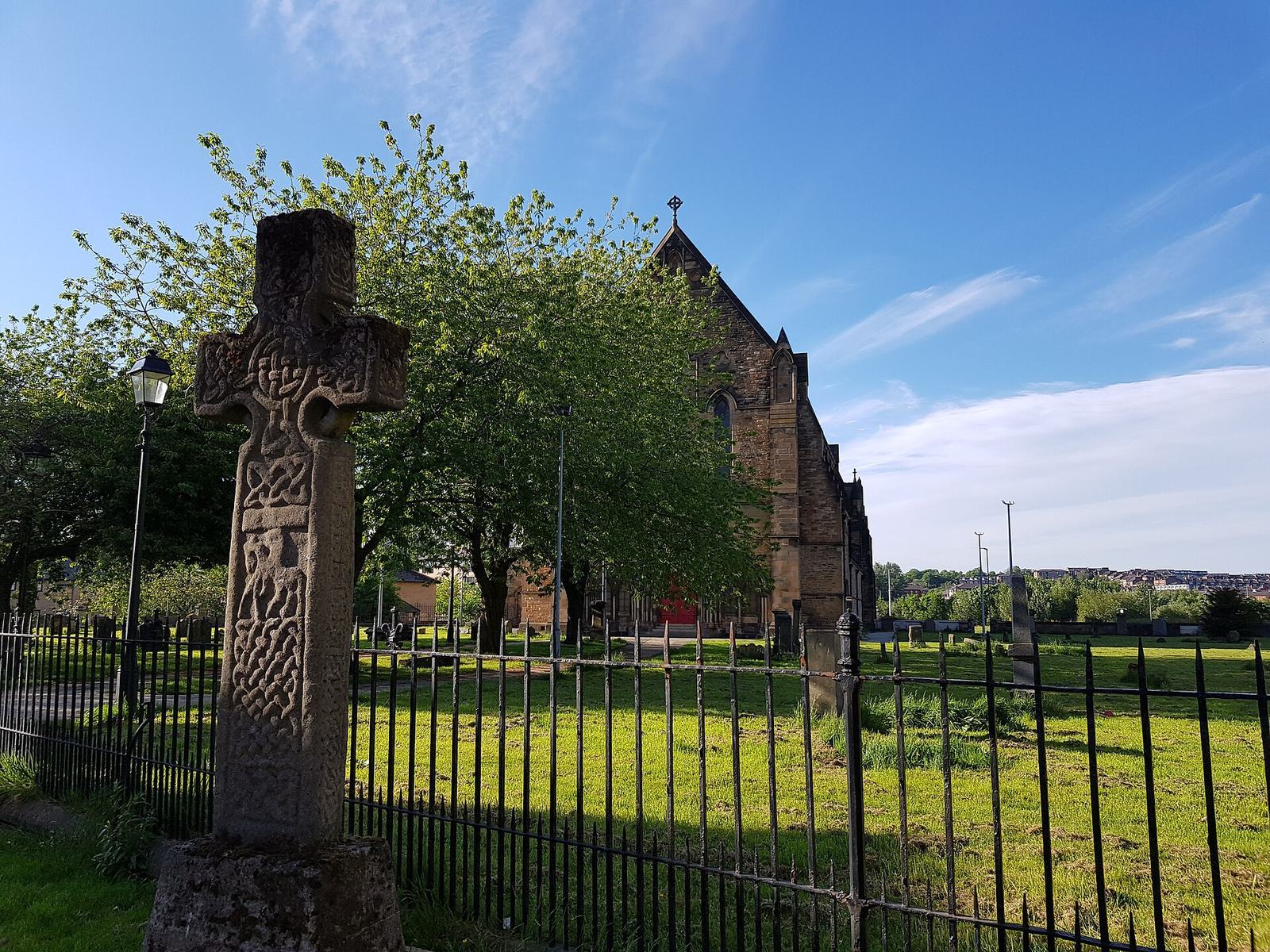
Also known as the Jordanhill Cross, the Govan Cross has several forms of interwoven ornament carved into the stone. Its clearest surviving figure is a man on horseback, but erosion has removed most of the detail. The horse’s and rider’s eyes remain visible.
Inverted Cross
The Inverted, or Upside Down, Cross is displayed upside down in the ecclesiastical north transept. Its broad outward-facing side is badly damaged or worn, while its two side faces preserve more of their interwoven ornament. They retain the cross’s only figure carving that can be read as a biblical scene, possibly David’s anointing by Samuel.
Upright cross-slabs
Sun Stone
The heavily eroded Sun Stone has a large raised boss with four snakes emerging from it in a sun-like arrangement, above a panel of angular interwoven ornament. Its other broad face bears a cross, interwoven carving, and a rider. A projecting joint at the top may be too small to have held a stone cross-head, prompting suggestions that the slab served an architectural purpose.
Cuddy Stane
The Cuddy Stane takes its name from its rider’s mount, which looks more like a donkey than a horse. An illustration from 1856 shows the rider’s upper body, a probable sword and ponytail, and a projecting joint for a presumed cross-head. The stone has since been damaged and severely worn. It was also reused as an early modern grave cover, with carved initials. Though it now appears plain, traces of an interwoven panel remain beneath the horseman.
Recumbent cross-slabs
Twenty-one recumbent cross-slabs, or grave markers laid horizontally, are displayed around the church’s interior walls, out of 37 originally recorded. Their sizes, shapes, and decoration vary. Each has a cross with an incised border dividing the surface into at least two panels, as well as a plain border along the edge; at least five have projecting ornaments at their corners. The stones show varying degrees of wear and have been reused since at least the seventeenth century.