Gallery of Modern Art: A Museum in Glasgow’s Former Royal Exchange
Site at a Glance
- Popularity
- High
- Country
- United Kingdom
- Primary era
- Modern
- Eras represented
- Early Modern, Modern
- Civilizations
- British
- Site type
- Economic
- Remains
- Market
On this page10 sections
History
The Gallery of Modern Art is a museum in Glasgow, United Kingdom, housed in a neoclassical building, a style that revived ancient Greek and Roman forms, constructed in 1778. It began as the townhouse of William Cunninghame of Lanishaw, a wealthy tobacco merchant whose fortune came from the triangular slave trade, an Atlantic system linking Europe, Africa, and the Americas through the forced transportation and sale of enslaved Africans. The building cost £10,000.
Townhouse, bank, and exchange
The Royal Bank of Scotland acquired the building in 1817 and used it as its headquarters. After the bank moved to Buchanan Street, the premises became the Glasgow Royal Exchange, where merchants discussed commodities, shipping, and insurance. The exchange occupied the building for more than a century.
From 1827 to 1832, Scottish architect David Hamilton directed a major remodelling. In 1880, the building gained Glasgow’s first telephone exchange, installed for merchants. Its use declined as telephones became common in homes.
Libraries and the modern art museum
Glasgow’s municipal authorities bought the building in 1949. Stirling’s Library moved there in 1954, together with the Patent Library and Commercial Library. After the library returned to Miller Street, the building was adapted as the Gallery of Modern Art, which opened in 1996. Glasgow City Council owns the museum.
The gallery presents temporary exhibitions of modern and avant-garde art by Scottish, British, and international artists, covering work from the mid-1950s to the present. It has no collection of its own; the works it exhibits belong to Glasgow Museums. Its programme also includes biennial projects on contemporary social issues.
In 1996, Glasgow Museums director Julian Spaulding commissioned French artist Niki de Saint Phalle to create an entrance installation and decorate the pediment panel. Her initial proposal for moving sculptures was dropped in favour of a mosaic. Architectural historian Gavin Stamp objected that it would disrupt the building’s neoclassical appearance. A compromise allowed the work to proceed.
In 2012, Eric and Jean Cass donated works by de Saint Phalle to Glasgow Museums through the Contemporary Art Society. The gift included 13 sculptures, a lithograph, educational books about preventing sexually transmitted infections, and other writings. The material was exhibited at the gallery from 16 November 2012 to 16 February 2014.
Remains
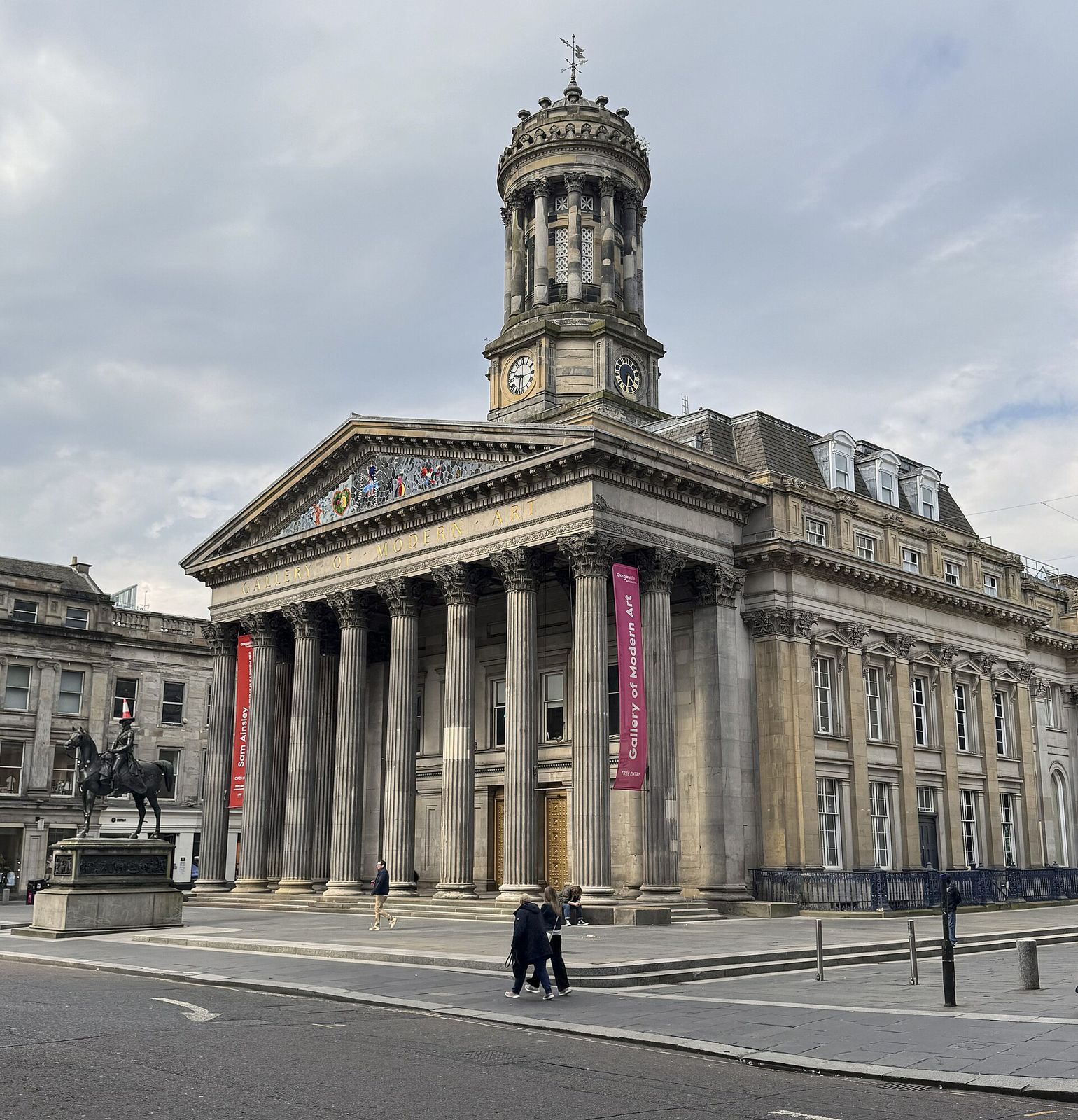
The building stands in Royal Exchange Square. Its neoclassical exterior and interior reflect its original use as a townhouse and the extensive remodelling of the early nineteenth century. Today it contains three floors of exhibition space and a study library in the basement.
Exterior and interior spaces
Entrance façade and hall
Hamilton’s remodelling added Corinthian columns, with elaborate leaf-like capitals, to the entrance façade facing Queen Street. A cupola, or small dome-like roof structure, rises above the building, while a large hall was added at the rear. The hall now includes de Saint Phalle’s entrance installation, with mirror fragments of varied shapes and sizes covering the room in a mosaic.
Elliptical atrium
The elliptical atrium serves as a gallery. It retains some details from the townhouse’s original interior, including plaster ornament, and is lit by a skylight.
Artworks and sculpture
Tympanum mosaic
The two-dimensional mosaic on the tympanum, the panel within the pediment, depicts Saint Mungo with the fish, tree, bell, and bird associated with his miracles. It also includes references to betrayal and adultery, reflecting de Saint Phalle’s feminist ideas. The stone pieces removed to make way for the mosaic were kept in case the work was rejected; the mosaic remains in place. Saint Mungo is traditionally regarded as Glasgow’s patron saint.
Equestrian statue
An equestrian statue of the Duke of Wellington, sculpted by Carlo Marochetti, was erected in front of the museum in 1844. The recurring practice of placing a traffic cone on the statue’s head is believed to have begun as a prank. Authorities have repeatedly removed the cone and warned that it could damage the sculpture.