Dōmyō-ji: A Buddhist Nunnery in Fujiidera, Japan


Site at a Glance
- Rating
- 4.1
- Popularity
- Low
- Country
- Japan
- Primary era
- Early Modern
- External website
- Open
- Eras represented
- Classical, Early Modern
- Civilizations
- Yamato
- Site type
- Religious
- Remains
- Monastery
On this page14 sections
History
Dōmyō-ji is a Buddhist nunnery in Fujiidera, Japan, affiliated with the Omuro branch of Shingon Buddhism, a major Japanese tradition centred on esoteric ritual, mantras, and mandalas. Its traditional foundation dates to the sixth century, and its mountain name is Rendōzan, a customary designation used by Japanese Buddhist temples.
The Haji-dera foundation
The area around Dōmyō-ji was associated with the Haji clan, a regional family traditionally regarded as ancestors of Sugawara no Michizane and descendants of Nomino Sukune. In 594, at the initiative of Prince Shotoku, an early Japanese imperial prince associated with the promotion of Buddhism, Haji no Yashima donated his residence for a nunnery. The resulting institution, Haji-dera, became the Haji clan temple and stood south of Haji Shrine, now known as Dōmyō-ji Tenmangu.
Haji-dera later formed part of a shrine-temple complex, in which a Buddhist temple served a Shinto shrine. The original compound was extensive, with seven main halls and a five-story pagoda. This arrangement shaped the religious landscape around the temple and shrine before later political changes divided their institutions.
Michizane and the renaming of the temple
In 901, Sugawara no Michizane, a Heian-period court scholar and statesman, was exiled to Dazaifu. Tradition holds that he visited his aunt, the nun Kakuju-ni, at the temple while travelling into exile. He is said to have composed a poem lamenting their impending separation. The episode later became part of the “Dōmyō-ji” scene in Sugawara Denju Tenarai Kagami, a work performed in puppet theatre and kabuki.
After Michizane’s death, an Eleven-Headed Kannon was enshrined at the temple in 947. Kannon is the bodhisattva of compassion, while the Eleven-Headed form expresses expanded powers of perception and compassion. Haji-dera was then renamed Dōmyō-ji after Michizane’s literary name, “Dōmyō.” A Tenmangu shrine was also established within Haji Shrine, which subsequently became centred on the Tenmangu institution. Michizane was later revered as Tenjin, a deity associated with scholarship.
Medieval religious and political roles
During the Kamakura period, Dōmyō-ji became a subordinate temple of Saidaiji in Yamato Province. In 1298, through the efforts of the monk Ninshō, it became a prayer temple of the Kamakura shogunate. A prayer temple was supported to conduct religious services on behalf of a ruler or government. Dōmyō-ji later served the same function for the Muromachi shogunate.
Destruction, relocation, and separation
In 1575, fire caused by the conflict known as the Battle of Takaya Castle destroyed most of Dōmyō-ji, including the Tenmangu complex. The temple was subsequently restored. After the Ishikawa River flooded in 1716, Dōmyō-ji was moved into the Tenmangu precinct. A new main hall was built immediately west of the Tenmangu main sanctuary, and the Buddhist temple and shrine gradually became integrated once again.
The modern separation of Buddhism and Shinto in 1872 divided the complex. Two of Dōmyō-ji’s five sub-temples became households of Shinto priests, while the Tenmangu institution was renamed Haji Shrine, now Dōmyō-ji Tenmangu. In September 1873, Dōmyō-ji finally separated from the shrine and moved to its present site west of the Higashi-Koya Highway.
Dōmyō-ji is the third site on the Prince Shotoku Sacred Sites pilgrimage and the fifth on the Kawachi Asuka Ancient Temples pilgrimage. Its Eleven-Headed Kannon is designated a National Treasure. A second wooden Eleven-Headed Kannon, known as the “Trial Kannon,” and a wooden standing statue of Prince Shotoku are designated Important Cultural Properties.
Dōmyō-ji rice and flour
The nuns of Dōmyō-ji traditionally produced dried cooked rice known as Dōmyō-ji hoshi-i. A tradition says that, after Michizane’s exile to Dazaifu, Kakuju-ni offered him rice each day in the direction of Kyushu and distributed the offerings that returned. The rice acquired a reputation for curing illness, encouraging its preparation in dried form for storage. Dōmyō-ji hoshi-i has a history of more than a thousand years and continues to be sold.
The dried rice was also coarsely milled to make Dōmyō-ji flour, which is used in Japanese confectionery. In regions where the Kanto-style form of sakura-mochi is less common, the Kansai-style confection itself may be called “Dōmyō-ji.” The writing on its wrapping paper is traditionally regarded as the handwriting of Toyotomi Hideyoshi.
Remains
Dōmyō-ji’s surviving features combine the present temple’s principal building with material traces of the earlier Haji-dera compound and a group of important wooden religious images. Large foundation stones from the former halls remain within the precinct, while foundation stones from the five-story pagoda survive south of the temple. Together, these remains indicate the scale of the earlier complex and preserve part of its original physical arrangement.
Main hall and former compound
Main hall
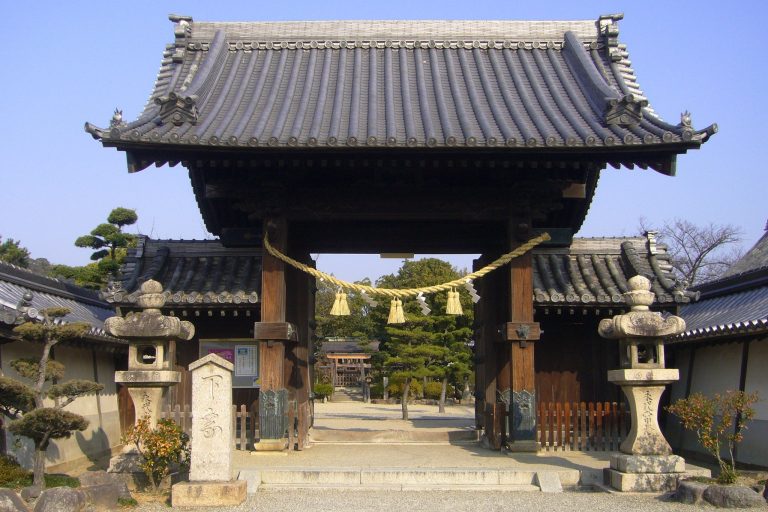
The main hall is the principal building of Dōmyō-ji and houses the temple’s principal image, a standing Eleven-Headed Kannon. The building belongs to the temple’s present religious setting after its separation from Dōmyō-ji Tenmangu in the nineteenth century.
Haji-dera foundations
The former Haji-dera compound was laid out with seven main halls and a five-story pagoda. Large foundation stones from the halls remain in the precinct, and the pagoda’s foundation stones are preserved to the south. These stones are surviving elements of the earlier temple complex that preceded the later relocations and institutional division.
Wooden Buddhist and historical images
Eleven-Headed Kannon
The National Treasure Eleven-Headed Kannon is a standing wooden image from the early Heian period, or ninth century. Tradition attributes its carving to Sugawara no Michizane. The figure is 98 centimetres high and was carved from a single piece of kaya wood. Its construction follows a sandalwood-image style, using kaya as a substitute for sandalwood, and its natural wood remains unpainted.
Trial Kannon
The standing wooden image called the “Trial Kannon” is designated an Important Cultural Property. Tradition also attributes this image to Sugawara no Michizane, linking it with the temple’s long association with his memory.
Prince Shotoku image
The wooden standing statue of Prince Shotoku is another Important Cultural Property. Its interior contains needle-written inscriptions by two individuals, along with Shingon mantras and seed syllables. A seed syllable is a sacred syllable used in esoteric Buddhist ritual to represent a deity or spiritual principle.
The statue’s associated deposits include a one-volume Lotus Sutra written in small gold characters on indigo paper and a Srimala Sutra with a blood-written colophon dated March 15, 1286. They also include a combined volume containing volume 578 of the Great Perfection of Wisdom Sutra and the Heart Sutra, with a colophon dated April 7, 1286.
Other deposits comprise a volume joining the Ten Great Vows, the Ten Vows of Samantabhadra, the Thirty Verses on Consciousness-Only, the Heart Sutra, and an abbreviated Lotus Sutra. Each text has a record of a vow and names connected through a religious bond, dated April 8, 1286. The collection also contains a kana-script prayer dated April 5, 1286, a dialogue between the Zenkōji Buddha and Prince Shotoku, and a brocade pouch holding aromatic wood.