Enichi-ji Temple: A Historic Buddhist Complex in Fukushima, Japan


Site at a Glance
- Rating
- 3.9
- Popularity
- Very Low
- Country
- Japan
- Primary era
- Medieval
- External website
- Open
- Eras represented
- Medieval
- Civilizations
- Japanese
- Site type
- Religious
- Remains
- Monastery
On this page16 sections
History
Enichi-ji Temple is a historic Buddhist temple complex in Japan, founded in 807 during the early Heian period by Tokuitsu, a prominent monk of the Hossō school, a Buddhist tradition concerned with consciousness and perception. Tokuitsu came from Nara to promote Buddhism in the Aizu region. The temple later became a powerful religious and economic institution, although warfare, fire, and Meiji-era religious suppression transformed its scale and status.
Foundation and Early Growth
Tokuitsu had already been active in spreading Buddhism in Aizu and was associated with the founding of other temples in the region. He also took part in major doctrinal debates with Saichō of the Tendai movement and corresponded with Kūkai of the Shingon tradition. After Tokuitsu died in 842, Enichi-ji was succeeded by Kon’yō, also known as Kin’yō.
At the height of its early prosperity, the complex was said to include about 300 resident monks, several thousand armed temple-affiliated forces, and approximately 3,800 subtemples. The temple developed within a landscape associated with mountain worship. Mount Bandai lies to the northeast, Umagatake to the north, and Mount Azuma farther north. Mount Bandai erupted in 806, one year before Enichi-ji was founded, and a possible connection between the eruption and the temple’s establishment has been proposed, although the relationship remains interpretive.
A tradition preserved in the Chronicle of Kokuō Shrine and the Genkō Shakusho tells of a daughter of Taira no Masakado, a tenth-century provincial warlord. According to the tradition, she fled to Enichi-ji during his final battle, entered religious life under the name Nyōzōni, and returned to her home region 33 years after his death.
Medieval Influence and Conflict
During the late Heian period, Enichi-ji formed close ties with the Jō clan, whose influence extended from Echigo to Aizu. In 1172, Jō Sukinaga donated 75 villages in Ogawa Estate, in eastern Echigo Province, to the temple. This grant reflects the material base that supported the institution during its medieval development.
Enichi-ji was drawn into the Genpei War, the late twelfth-century conflict between the Taira, or Heike, and Minamoto forces. The temple supported the Heike side. Its head monk, Jōtanbō, led troops from the four districts of Aizu to reinforce a Jō commander against Kiso Yoshinaka, a Minamoto leader, in Shinano Province. After the defeat at the Battle of Yokota-gawara in 1181 and Jōtanbō’s death, the temple temporarily declined.
Protection from regional lords enabled Enichi-ji to recover during the medieval period. An illustrated plan from the Muromachi period, which broadly covered the fourteenth through sixteenth centuries, shows that several temple buildings and a settlement along the temple front had developed by that time. The temple also became associated with pilgrimage routes leading from this settlement to Mount Azuma Shrine. Its Yakushi-dō connected it with the eastern Yakushi tradition among the Five Yakushi Temples of Aizu.
Warfare, Suppression, and Revival
In 1589, after the Battle of Suriagehara, the warlord Date Masamune entered Aizu. Enichi-ji was caught in the warfare that followed, and every building except the Kondō burned. The Kondō itself was destroyed by fire in 1626. It was later rebuilt, but the temple never recovered its former scale.
The historic temple was abolished in 1869 during the haibutsu-kishaku movement, the suppression and destruction of Buddhism associated with religious reforms during the Meiji Restoration. A restoration movement eventually secured permission to use the temple name again in 1904. Enichi-ji was then revived in its present form as a Shingon temple, a Japanese tradition of esoteric Buddhism.
Archaeological excavations began after the Second World War and continued through several campaigns in the Honji, Kaidan, and Kannonji districts. The ruins were designated a National Historic Site in 1970. In 2016, they were also recognized as a component cultural property of Japan Heritage under the registered name “Enichi-ji Ruins.” The Bandai Enichi-ji Museum opened in 1987 in the southwestern part of the Honji district to preserve and display cultural properties connected with the temple and discoveries from the excavations. The wider ruins have been prepared as a historic-site park.
Remains
The surviving remains are distributed across the Honji, Kaidan, and Kannonji districts. Honji occupies the central temple compound, while Kaidan lies to its west and Kannonji stands 1.7 kilometers northeast in mountainous terrain at an elevation of approximately 570 to 590 meters. Excavated foundations, reconstructed buildings, earthworks, stone embankments, ritual objects, and burial-related features together reveal the scale and changing organization of Enichi-ji.
Honji Central Compound
Central Temple Buildings
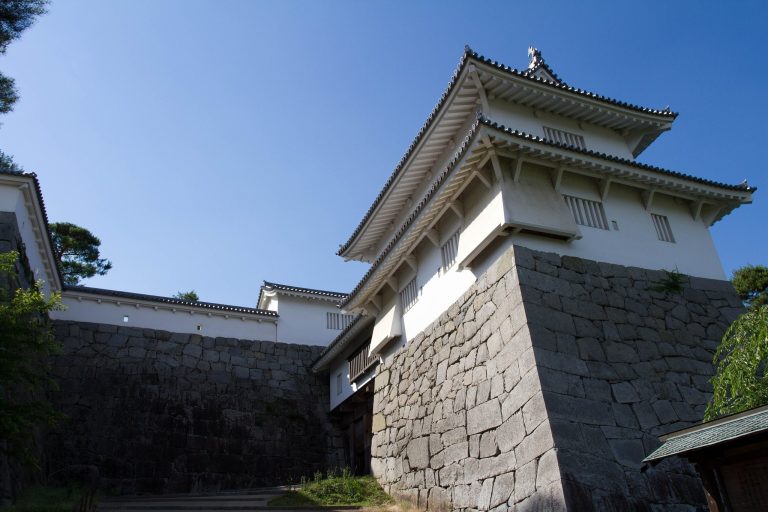
The Honji district occupies the former central compound. Excavation indicates that its principal buildings probably stood in a north to south line, comprising a Middle Gate, Kondō, Lecture Hall, and Dining Hall. The remains are incorporated into the historic-site park. The Kondō was reconstructed in 2008, followed by the Middle Gate in 2009. A reconstructed seated statue of Yakushi Nyorai inside the Kondō was opened to the public in 2018.
Yakushi-dō and Niōmon
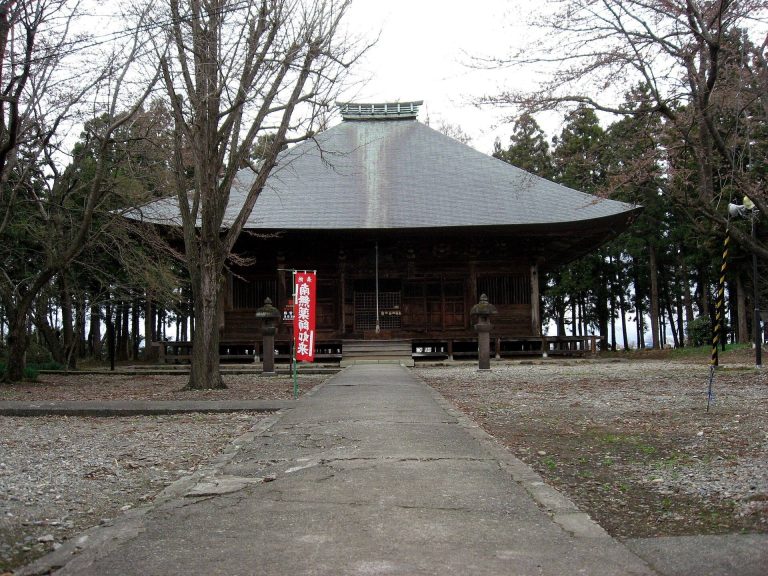
East of the central compound are the Yakushi-dō and Niōmon. The original Yakushi-dō housed a statue of Yakushi Nyorai and was revered as the eastern Yakushi among the Five Yakushi Temples of Aizu. Successive fires are said to have destroyed the hall, and the present building was reconstructed during the Meiji period.
Eastern Buildings and Tokuitsu Mausoleum
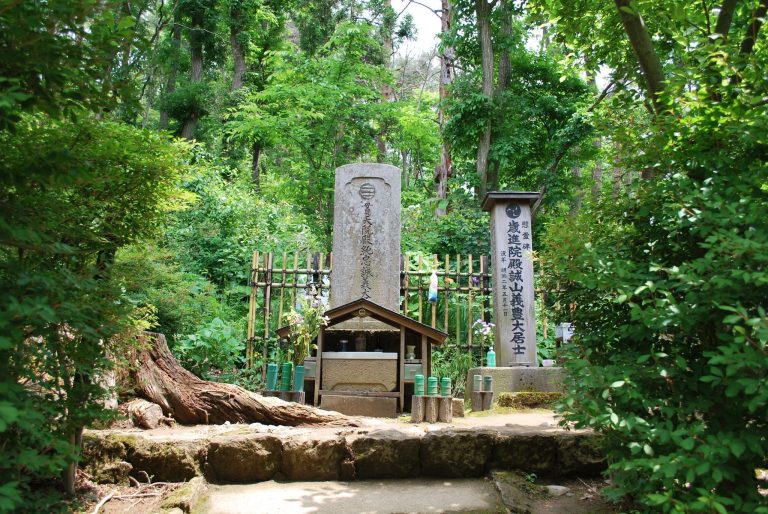
Farther east stand the Ryūhō-ji Fudō Hall and a memorial monument to Jōtanbō. Behind the hall, in woodland, earthworks and stone embankments survive from the former temple complex. North of the central compound, the Tokuitsu Mausoleum contains a five-ring stupa believed to mark Tokuitsu’s grave. This Buddhist funerary monument, formed from shapes representing the five elements, is thought to date from the Heian period.
Kaidan District
Hill-End Archaeological Feature
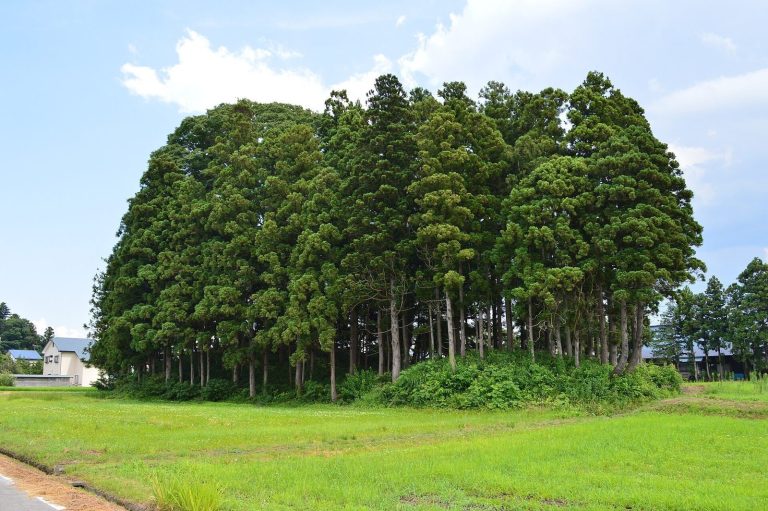
The Kaidan district lies west of Honji and contains a mound-like feature formed at the end of a hill. It was traditionally regarded as the location of an ordination platform. Excavations instead uncovered Heian-period stone pagodas and fragments of cremated bone, leading to the interpretation that the feature may have served as a burial area.
Buildings and Iron-Smelting Remains
South of the mound-like feature, in the surrounding rice fields, excavations revealed foundations of buildings, post-built structures, and remains of iron-smelting furnaces. These features extend the archaeological picture of the district beyond the elevated mound and show that its remains include both architectural and industrial traces.
Kannonji District
Kannonji lies in mountainous terrain northeast of Honji. Five exposed building foundations survive there. The area has not yet been excavated, but the scale and arrangement of the foundations have been interpreted as the remains of a gate, pagoda, main hall, and storehouse.
Objects and Reconstructed Features
Three-Pronged Vajra
A white-bronze ritual three-pronged vajra, an implement associated with indestructibility and spiritual power, is connected with Enichi-ji. Dating from the Nara period, it is designated an Important Cultural Property of Japan. The object is not kept at the temple. It was loaned to the Aizuwakamatsu Castle Tower Local History Museum in 1995, stolen while there, and found in Tokyo in August 2006.
Bato Kannon Hall
The museum grounds include a reconstruction of the Bato Kannon Hall, formerly located at the summit of Umagatake. Its interior contains a small shrine cabinet and votive plaques. Water from Ryūgasawa Spring, one of the springs in the western foothills of Mount Bandai included among Japan’s “One Hundred Famous Waters,” is conveyed to the museum grounds.