Teopanzolco: An Aztec Ceremonial Center in Cuernavaca
Site at a Glance
- Rating
- 4.1
- Popularity
- Very Low
- Country
- Mexico
- Primary era
- Medieval
- Eras represented
- Medieval
- Civilizations
- Aztec
- Site type
- Religious
- Remains
- Sanctuary
On this page26 sections
History
Teopanzolco is an Aztec archaeological site in the Vista Hermosa district of Cuernavaca, Mexico. Most of its visible remains date from the Middle to Late Postclassic period, approximately AD 1300–1521, although earlier phases are also present. The ceremonial center formed part of ancient Cuauhnahuac, the Tlahuica predecessor of modern Cuernavaca, and its preserved structures are described as the surviving remains of that city.
Early settlement and the Tlahuica center
The Morelos Valley was settled from about 2000 BC. During the Classic Period, Teopanzolco came under the influence of Teotihuacan. Later, during the Postclassic period, Tlahuica groups, a Nahua-speaking people of the Morelos region, established the lordship of Cuauhnahuac and founded both the settlement that preceded Cuernavaca and Teopanzolco.
Teopanzolco probably served as Cuauhnahuac’s original ceremonial center during the Early Aztec period, approximately AD 1150–1350. The ceremonial center was later transferred to a more defensible location in the area now occupied by central Cuernavaca. Construction at Teopanzolco then ended, although the site remained part of the wider settlement landscape.
Mexica rule and the end of the prehispanic site
In 1427, Moctezuma Ilhuicamina, an Aztec ruler whose reign expanded Mexica power into neighboring regions, conquered the Tlahuicas. Teopanzolco and the surrounding territory were incorporated into the Aztec Empire. The inhabitants paid tribute, including cotton produced in the region, and took part in Mexica military campaigns. Tlahuicas continued to live in the area and pay tribute until the Spanish conquest ended the prehispanic history of the site in 1521.
The archaeological evidence indicates that local inhabitants and Mexica conquerors coexisted at Teopanzolco. Its dominant architectural style and most abundant ceramics are Mexica, or Aztec, despite the earlier Tlahuica occupation and development of the ceremonial center. A historical tradition also associated the site with large-scale sacrifice. One recorded account called it the “House of the Devil” and connected it with the mass sacrifice of people from Huexotzinco.
Rediscovery and archaeological investigation
Teopanzolco was rediscovered during the Mexican Revolution in the 1910s. Forces commanded by Emiliano Zapata, a leading revolutionary commander in Morelos, installed an artillery emplacement on the Great Platform and fired on federalist positions in central Cuernavaca. The cannon fire loosened the soil and exposed stonework beneath it.
Initial archaeological work began in 1921 under Manuel Gamio and José Reigadas Vertiz. Román Piña Chan and Eduardo Noguera investigated the site in 1956–1957, excavating the structure known as Ehecatl and conducting stratigraphic tests, which examine successive layers of soil to establish the relative sequence of occupation and construction. Roberto Gallegos and Juan Dubernard continued the work in 1963. Jorge Angulo Villaseñor investigated the Tezcatlipoca structure in 1968–1969, followed by Wanda Tomassi in 1980.
Since 1985, Mexico’s Instituto Nacional de Antropología e Historia, the federal institution responsible for archaeological and historical heritage, has carried out annual maintenance and minor investigations. This work included cleaning the North Platform in 1985, stratigraphic testing by Silvia Garza de González in 1991, and a broader study begun in 1997 with excavations in the southern part of the site.
Earthquake damage and continuing interpretation
An earthquake on September 19, 2017, damaged the main temple. Repairs revealed a previously unknown smaller temple inside the structure. The inner temple may have been dedicated to Tlaloc, the Mesoamerican deity associated with rain, water, agricultural fertility, and storms, and may date to the Middle Postclassic period, approximately AD 1150–1200. Further study is required to confirm both its attribution and its date. If that dating is confirmed, the inner temple would predate the Templo Mayor in Mexico City.
Only the ceremonial center has been preserved. Residential areas and much of the ancient settlement remain beneath modern urban development, leaving the original extent of Cuauhnahuac unknown. The protected archaeological area covers approximately two hectares, while additional remains may lie beneath houses, buildings, and avenues.
Remains
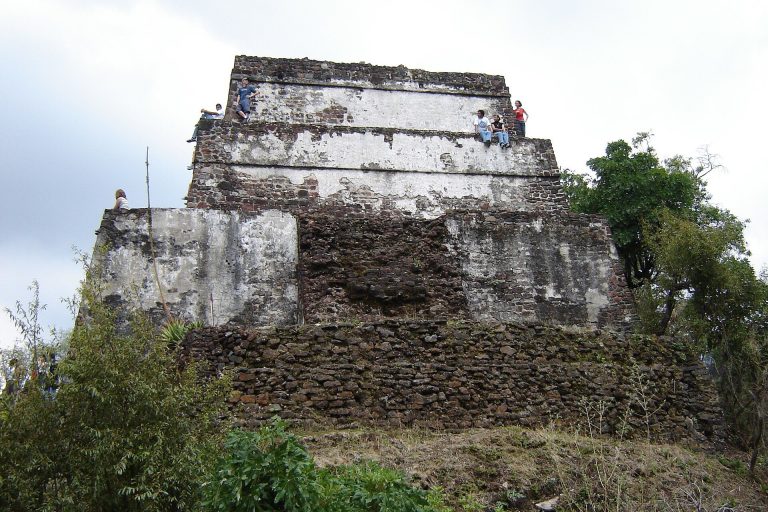
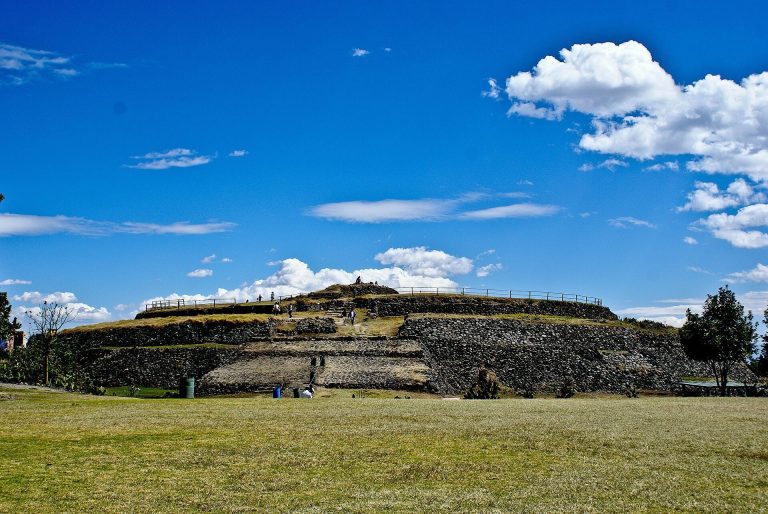
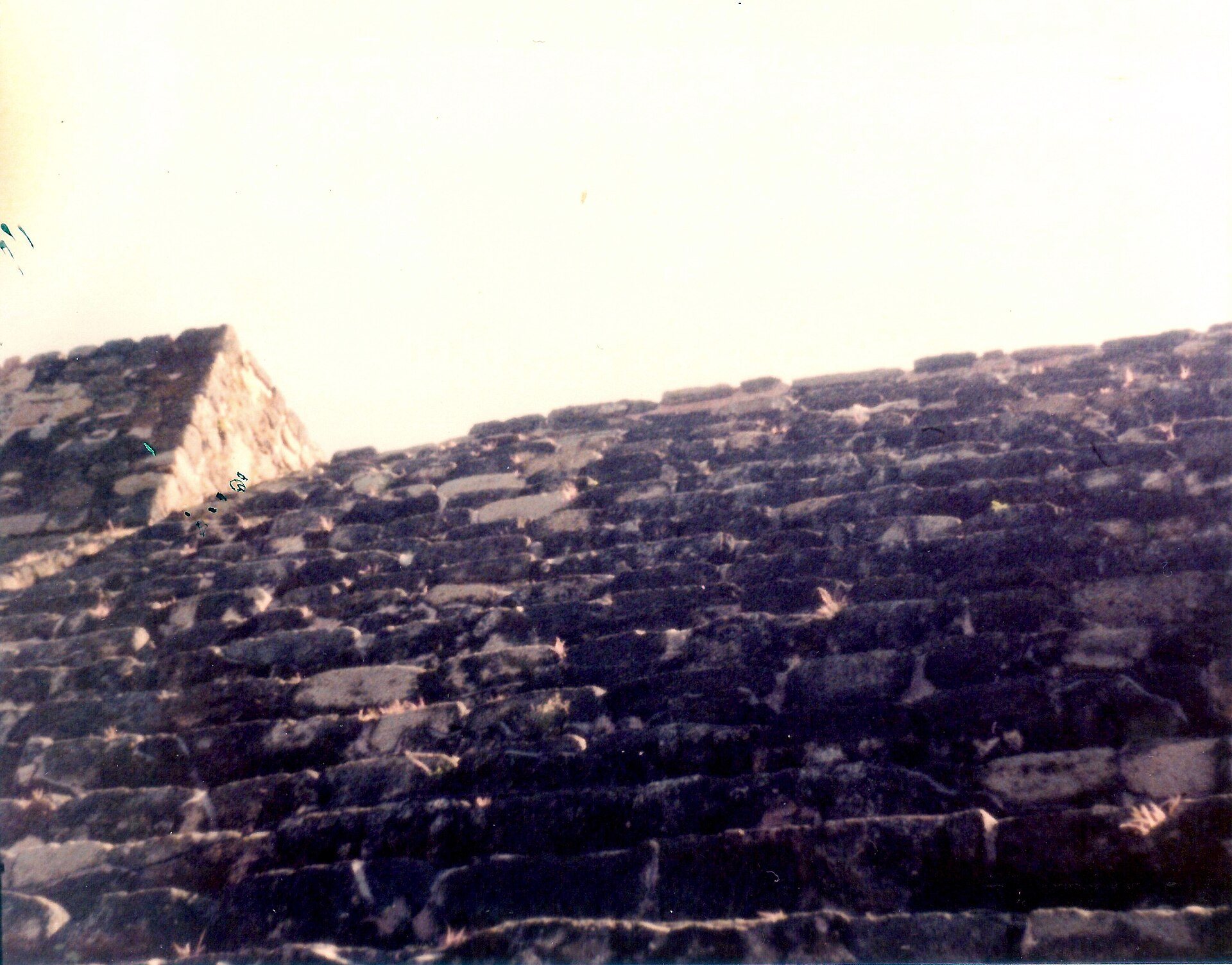
Teopanzolco’s ceremonial center occupies a hill formed by a lava flow produced by volcanic activity at the southern end of the Basin of Mexico. In pre-Columbian times, coniferous woodland surrounded the hill; the site is now incorporated into Cuernavaca. The surviving buildings were constructed mainly from local basalt, with some carefully worked corner stones and other elements. No original exterior stucco or painted finish survives, although the buildings were probably coated with painted plaster.
The central ceremonial platform
Great Platform and twin temples
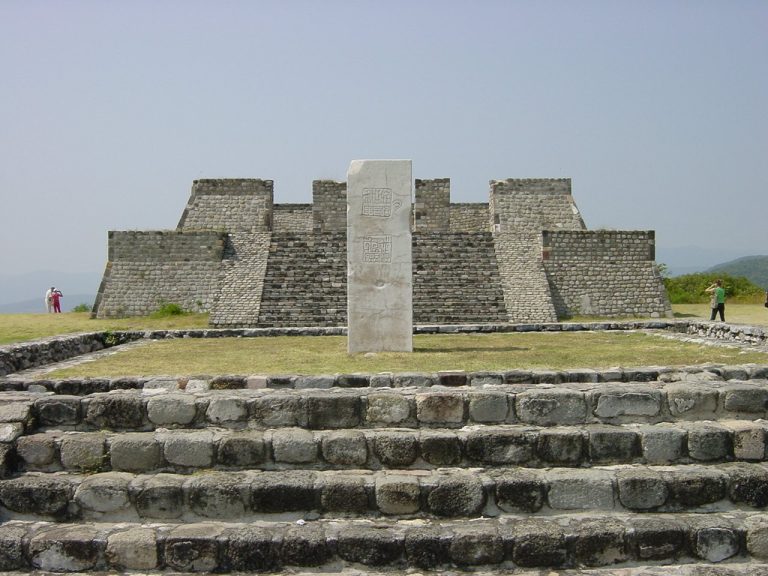
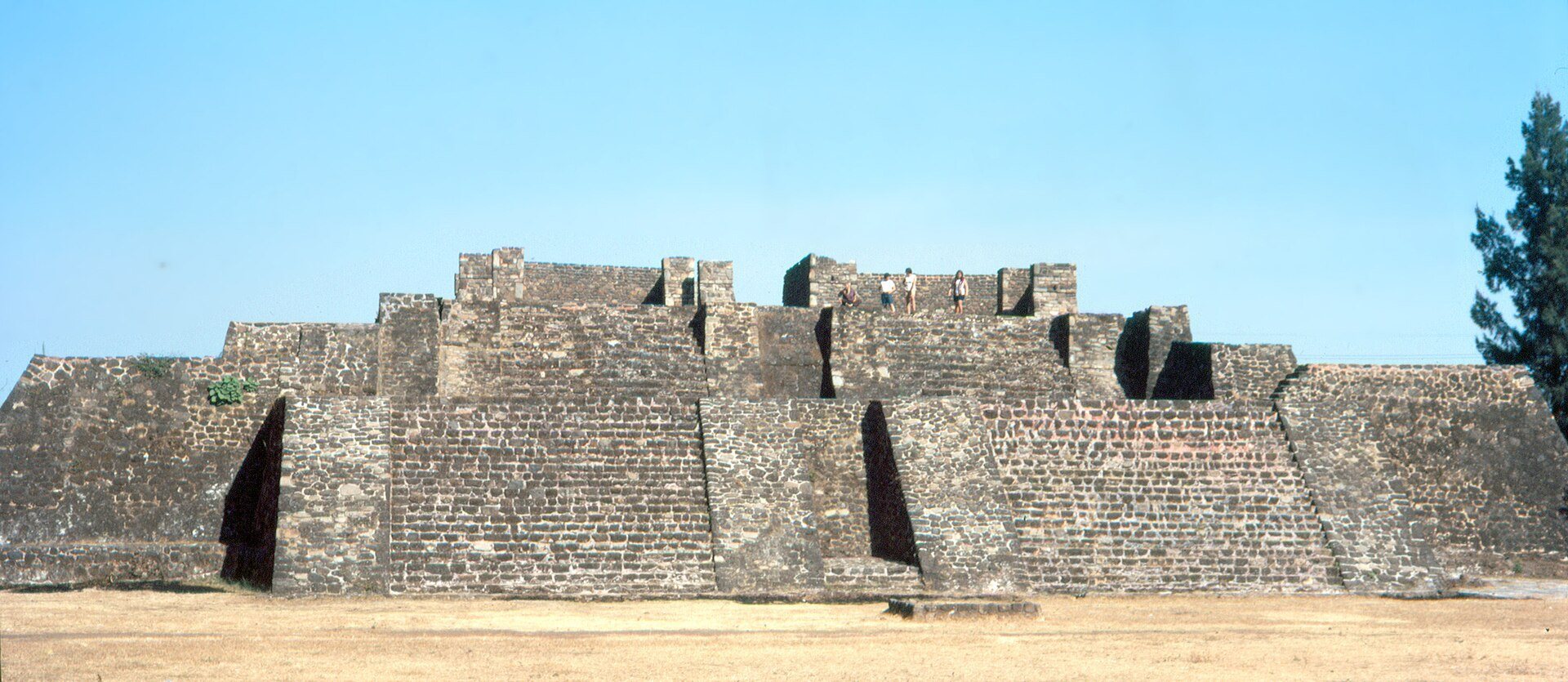
The principal monument is the Great Platform, also called Building 1, a large west-facing rectangular pyramidal base. It contains two superimposed construction phases separated by an architectural recess that reveals the different stages of building. The later phase was almost identical to the earlier one. Only the platform of the later phase survives, while portions of the earlier twin temples remain. Construction of the later phase appears to have been interrupted by the Spanish conquest.
Two parallel stairways on the western front led to the twin temples, an arrangement characteristic of Aztec architecture. The northern temple was dedicated to Tlaloc, while the southern temple belonged to Huitzilopochtli, the principal Mexica deity of war and the sun.
Temple of Tlaloc
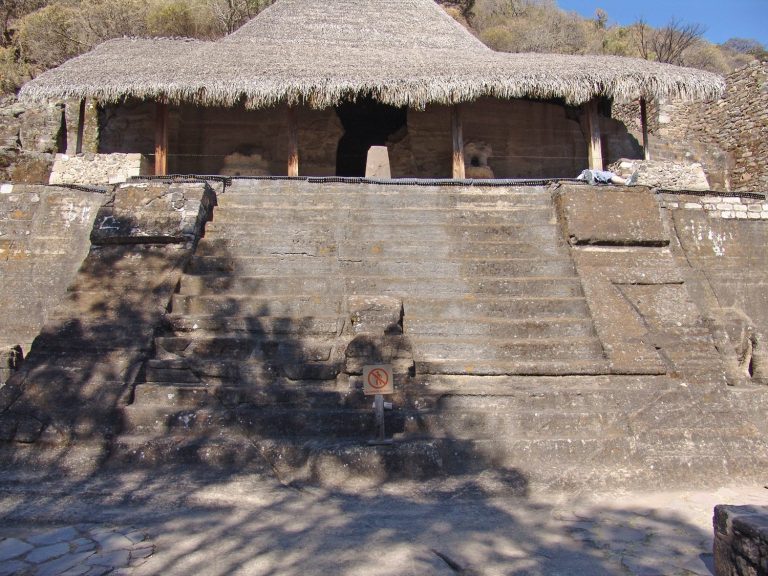
The Temple of Tlaloc consisted of a small enclosure with four pillars or pilasters. These probably supported a broad roof that extended beyond the enclosure. The structure forms the northern half of the twin-temple arrangement on the Great Platform.
Temple of Huitzilopochtli
The Temple of Huitzilopochtli was larger than the northern temple and contained two rooms arranged one behind the other. Remains of an altar survive in the inner room.
Inner temple
The smaller temple discovered within the main temple has stucco-covered walls, a bench, and a pilaster. Its possible association with Tlaloc and its proposed date of approximately AD 1150–1200 remain provisional.
Plaza and surrounding platforms
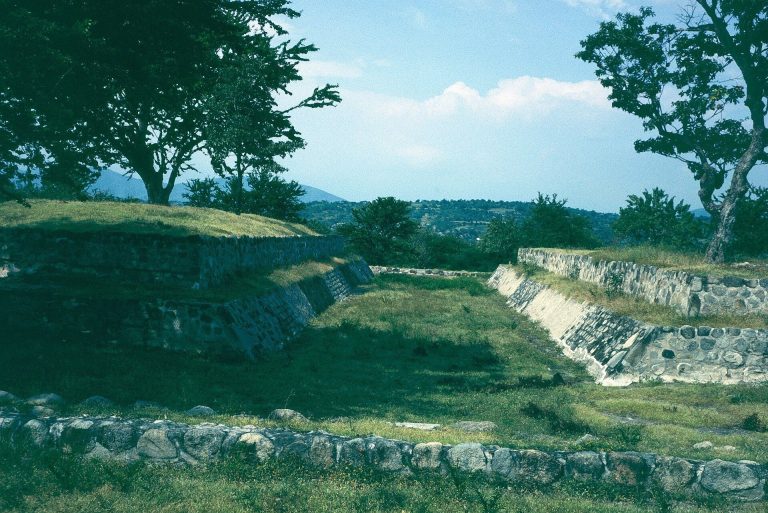
A broad rectangular plaza extended in front of the Great Platform. Building 2 stood to the south, Building 12 to the north, and Buildings 13 and 14 behind it on the eastern side. Other structures bounded the western side of the plaza. The platforms around the Great Platform probably served as altars or subsidiary ceremonial buildings.
Building 2
Building 2 is a low, irregular platform with a broad stairway facing north.
Building 3
Building 3 is a small rectangular or quadrangular platform with a stairway facing east.
Building 4
Building 4 is a broad, shallow rectangular platform with an east-facing stairway that lacks a border. A pit in the platform complex contained numerous human bones and two obsidian knives. The remains belonged to 35 people of both sexes who had been sacrificed and dismembered.
Buildings 5 and 6
Building 5 is a small rectangular or quadrangular platform with an east-facing stairway. Building 6 is a small rectangular platform with a stairway facing the same direction.
Buildings 7 and 9
Building 7 is a small, low circular platform with an east-facing stairway. It was a shrine to Ehecatl, the wind aspect of Quetzalcoatl. A sunken chamber inside it contained ceramic vessels and human skulls, probably belonging to sacrificial victims. Building 9 was another low circular shrine to Ehecatl and was slightly larger than Building 7.
Building 8
Building 8 is a very small rectangular platform with an east-facing stairway.
Building 10
Building 10 is a long rectangular platform extending east to west behind Buildings 3–6. It has two stairways facing east and another facing west. The platform was expanded several times.
Building 12
Building 12 is a large platform directly north of the Great Platform and aligned with it. Three stairways face west.
Possible Ehecatl-Quetzalcoatl platform
One platform has a rectangular front, a circular rear, and an eastward orientation. It may have been associated with Ehecatl-Quetzalcoatl in his manifestation as Tlahuizcalpantecuhtli, the Morning Star. This identification remains interpretive.
Eastern ceremonial structures
Temple of Tezcatlipoca
The Temple of Tezcatlipoca, or Building 13, stood directly east of the Great Platform. Tezcatlipoca was a major deity associated with night, rulership, conflict, and supernatural power. The lower level of the temple had a double stairway facing the Great Platform, while the upper level had a single broad stairway. The remains were extensively damaged by an artillery impact during the Mexican Revolution and by a large looters’ pit.
Building 14
Building 14 was one of the structures on the eastern side behind Building 1. It forms part of the group of buildings bordering the ceremonial center.
Southern platform and earlier residence
Platform 15
Platform 15 stood at the southern edge of the archaeological area and was excavated in 1997. It was a large platform in poor condition. Beneath it lay the foundations of an earlier residence whose occupants manufactured dyes. Hearths, tools, and traces of iron-oxide pigments were found there. The residence was demolished when the platform was built, while its foundations retained domestic human burials.
Several structures at Teopanzolco contained pits or chambers with human remains associated with sacrifice. Together with the excavated ceramics and the dominant architectural forms, these features reflect the strong Mexica character of the preserved ceremonial center while also preserving evidence of the earlier Tlahuica occupation.