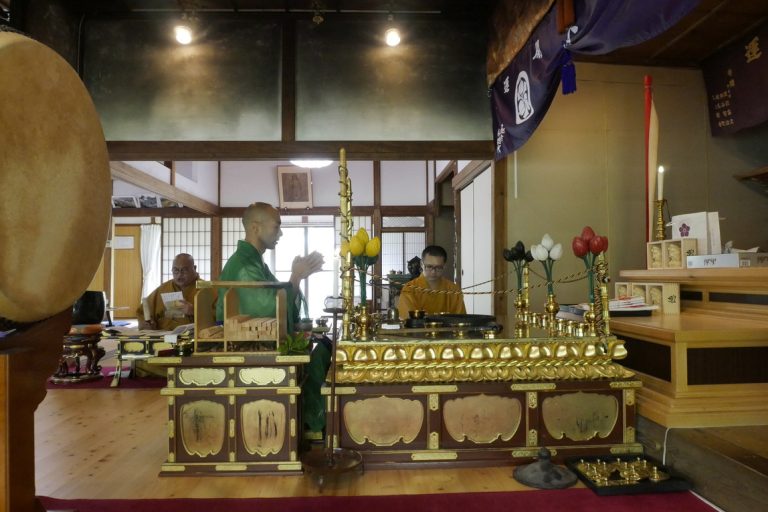
Tanjō-ji Temple: A Sacred Nichiren Buddhist Temple in Japan


Site at a Glance
- Rating
- 4.1
- Popularity
- Medium
- Country
- Japan
- Primary era
- Early Modern
- External website
- Open
- Eras represented
- Early Modern, Modern
- Civilizations
- Japanese, Tokugawa
- Site type
- Religious
- Remains
- Sanctuary
On this page14 sections
History
Tanjō-ji Temple is a major Nichiren Buddhist temple in Japan, located in Kominato, Kamogawa, Chiba Prefecture. Nichike, a disciple of Nichiren, founded it in October 1276 on the traditional site of Nichiren’s birthplace. The temple is also called Kominato Tanjō-ji and bears the mountain name Kominato-san. Along with Kuon-ji in Yamanashi Prefecture, Ikegami Honmon-ji in southern Tokyo, and Seichō-ji in Kamogawa, it is one of the four sacred places of Nichiren Buddhism.
Foundation and relocation
The original temple was destroyed by the Meiō earthquake of 1498. A later earthquake and tsunami in 1703 caused further destruction and prompted the temple to move inland, near the present Kominato fishing port. The former temple site and the traditional birthplace location are now offshore.
Edo-period reconstruction
During the Edo period, the era of Tokugawa rule from 1603 to 1867, the twenty-sixth chief priest, Nikkō, secured the protection of Tokugawa Mitsukuni. With that support, Tanjō-ji was rebuilt and expanded as a complex of seven buildings. A fire in 1758 destroyed the complex apart from the Niōmon, a Buddhist gate traditionally guarded by two protective deities.
The temple also faced institutional pressure during the Edo period. The authorities prohibited the Fushō Fuse movement, a branch of Nichiren Buddhism that rejected offerings or religious recognition for priests of other Buddhist schools. This policy threatened to force Tanjō-ji to affiliate with the Tendai school, a major Japanese Buddhist tradition that gives particular importance to the Lotus Sutra. Because of its connection with Nichiren’s birthplace, Minobu Kuon-ji took over the temple. Tanjō-ji consequently lost its status as a major head temple, which it regained in 1946.
Modern religious and cultural history
A memorial site was established at Tanjō-ji for prayers for the recovery of Emperor Taishō, who reigned from 1912 to 1926, during an illness. From the Shōwa period, the reign of Emperor Shōwa from 1926 to 1989, through the Heisei period, the reign of Emperor Heisei from 1989 to 2019, a lay organization’s “500,000-person association” supported the revival of the temple buildings. The effort culminated in a completion ceremony in May 1992.
Tanjō-ji belongs to the Nichiren school and is associated with the Chōshi religious lineage. Its principal object of worship is the Great Mandala of the Ten Spiritual Realms, a calligraphic mandala representing ten states of existence in Nichiren devotional practice. The temple also commemorates Nichiren through buildings, images, and devotional traditions connected with his life.
A legend that Nichiren revived his mother gave the temple’s image of Nichiren the devotional title “the Founder Who Fulfills Prayers for Revival.” The sea bream, or tai, is regarded as the messenger of this prayer-fulfilling image. The tradition continues through the temple’s sea-bream amulet, while many people in the surrounding area, including some who are not Nichiren Buddhists, traditionally avoid eating sea bream.
In October 2001, Tanjō-ji’s incense and sea breeze were selected for Japan’s “100 Fragrant Landscapes.” The novelist Natsume Sōseki also included a visit to Tanjō-ji and nearby Tai no Ura in Kokoro, where characters discuss Nichiren.
Remains
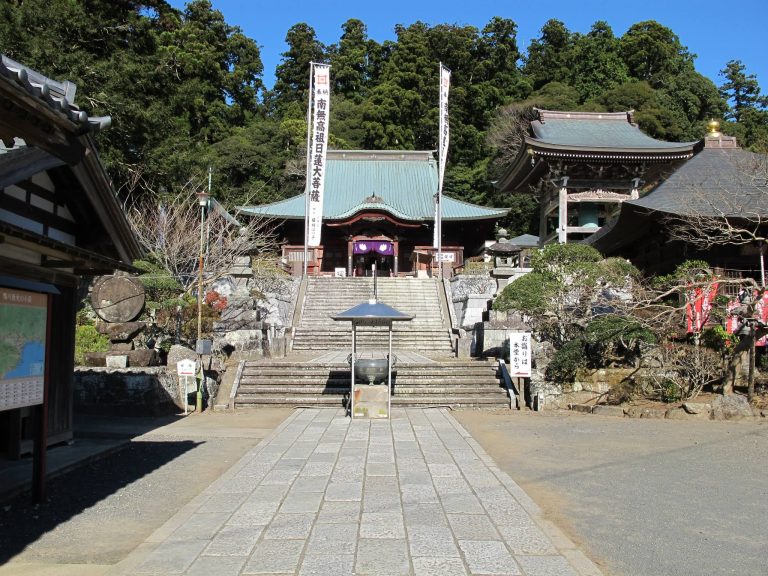
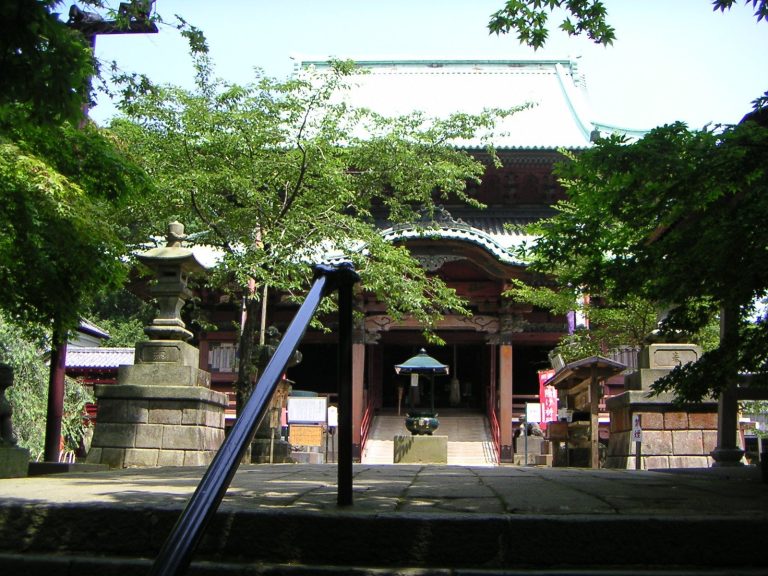
The present temple stands at Kominato 183 near the Kominato fishing port. Its grounds contain buildings and images associated with Nichiren, while the earlier temple site and traditional birthplace lie offshore. Surviving historic structures stand alongside halls, a pagoda, a treasury, and other buildings reconstructed or added in the modern period.
Historic buildings
Niōmon
The Niōmon dates to 1703 and is the surviving gate from the complex rebuilt under Tokugawa Mitsukuni’s patronage. Its name refers to the two protective Buddhist guardians traditionally associated with this type of entrance. The gate remains as the surviving element of that seven-building reconstruction.
Soshi-dō
The Soshi-dō, or Founder’s Hall, was rebuilt in 1842 by the forty-ninth chief priest. It houses a statue of Nichiren and is the principal surviving structure specifically associated with the nineteenth-century rebuilding. When the statue was dismantled for repair in 1991, manuscripts written by the fourth chief priest and medicinal herbs were found inside it. The manuscripts refer to the “living Founder” and give the time and place of Nichiren’s birth.
Inari Hall
A hall dedicated to Inari, the Japanese deity especially associated with rice, agriculture, and prosperity, was built in 1863. The Inari enshrined there had served as the guardian deity of Ōta Yasusuke, a military commander of the Sengoku period, the preceding age of conflict among regional warlords.
Modern buildings
Main Hall
The present Main Hall was completed in 1991 as part of the modern revival of the temple buildings.
Honshi-den Hōtō Pagoda
The Honshi-den Hōtō Pagoda was completed in 1988. A Hōtō is a Japanese Buddhist pagoda form associated with worship of the Lotus Sutra and Nichiren Buddhism.
Treasury and reception hall
The Treasury was completed in 1989, while the reception hall dates to 1933. Together with the newer Main Hall and Hōtō Pagoda, these buildings form part of the present temple complex.
Images and devotional objects
The temple grounds contain a statue of Nichiren as a child and other facilities connected with him, including the Tanjō-dō, the Bell Tower, and the Soshi-dō. Seven mandalas inscribed by Nichiren during the Kamakura period, which lasted from 1185 to 1333, are associated with Tanjō-ji. The “Prayer-Fulfilling Sea Bream” amulet is a devotional object connected with the sea-bream tradition surrounding the Nichiren image.