Fujisan Shimomiya Omuro Sengen Shrine: A Local Guardian Shrine of Mount Fuji


Site at a Glance
- Rating
- 4.4
- Popularity
- Low
- Country
- Japan
- Primary era
- Early Modern
- External website
- Open
- Eras represented
- Early Modern
- Civilizations
- Tokugawa
- Site type
- Religious
- Remains
- Sanctuary
On this page16 sections
History
Fujisan Shimomiya Omuro Sengen Shrine is a Shinto shrine in Japan, in Shimoyoshida, Fujiyoshida, Yamanashi Prefecture. Associated with worship of Mount Fuji and Konohanasakuya-hime-no-Mikoto, it serves as a local tutelary shrine for the northern foothills and as the chief guardian shrine of Kamiyoshida, Shimoyoshida, and Matsuyama. Mount Fuji itself is treated as the shrine’s sacred body, or shintai, the natural feature understood to embody or receive a deity.
Origins and relocation
Shrine tradition traces the foundation story to 793, when the general Sakanoue no Tamuramaro worshipped Mount Fuji from Yoshida and prayed for victory during his eastern campaign. After his victory, he is said to have built shrine buildings in 807 in gratitude for divine assistance. Early records referred to the institution simply as a shrine, while a village register of 1708 still called it Asama Shrine. Its earlier formal name was Fujisan Shimogu Asama Shrine.
The settlement of Shimoyoshida and the shrine were traditionally moved from an earlier location in what is now Shimoyoshida Higashimachi, near the present East Town Konpira Shrine. Repeated disasters caused by melting snow led to the relocation, with the new shrine placed against the Kenmarubi lava flow. A further tradition connects the precinct with Prince Moriyoshi, a fourteenth-century imperial prince and military leader during the Northern and Southern Courts conflict. On September 23, 1355, a retainer who claimed descent from Emperor Seiwa is said to have buried the prince’s head beneath the roots of the sacred katsura tree and left a prayer document there.
Warfare, temple connections, and changing names
In 1576, warfare between the Hojo and Oyamada clans brought the complete burning of Kamiyoshida and Shimoyoshida. During the Edo period, the shrine also acted as the guardian shrine of Gekkoji, then the largest temple complex in the northern Fuji foothills. Monks from Gekkoji performed Buddhist recitations at the shrine’s festivals until the Meiji period, when the government separated Buddhist and Shinto institutions.
An ancient cedar in the precinct was struck by lightning and burned on April 6, 1626. Part of the damaged tree was later fashioned into a hanging plaque for the worship hall. During the Meiji period, the shrine transferred its former parish area of Kamiyoshida to Kitaguchi Hongu Fuji Sengen Shrine and changed its name from Fujisan Shimogu Asama Shrine to Omuro Sengen Shrine. Several enshrined figures were consolidated into the single principal deity Konohanasakuya-hime-no-Mikoto, and the main crest changed from palm leaves to a double-flowered Yamato cherry. Amaterasu was transferred to the Gosha Shrine within the precinct, while Prince Moriyoshi was transferred to the Daito-gu Shrine.
Local worship and religious identity
The shrine’s character rests on local tutelary, parish, and guardian worship connected with everyday life. A ujigami is a local tutelary deity, while a chinju is a guardian deity of a place or community. These roles help explain the shrine’s concern with local welfare, agriculture, childbirth, and protection as well as with Mount Fuji. The traditional first visit for infants remains important, with families praying for a child’s safe growth after the child reaches one hundred days.
The name Shimogu has several explanations. It may have distinguished a shrine situated lower than Mount Fuji from later Asama shrines established elsewhere, or it may reflect the use of “lower” for the Yoshida area by people around Lake Kawaguchi. It has also been understood as a counterpart to the Omuro Sengen Shrine at Mount Fuji’s second station, although the shrine treats that final explanation as a popular theory rather than an established historical relationship.
Historical references distinguish this shrine from the former main shrine of Omuro Sengen Shrine in Fujikawaguchiko, now associated with the second station. Their traditions and origins were different. Evidence that the two jointly conducted the mounted-archery festival, or that the second-station shrine served as this shrine’s upper shrine, has not been established. Confusion also arose between the names Shimo Sengen and Shimogu Asama. A diagram from 1680 labels the present grounds of Kitaguchi Hongu Fuji Sengen Shrine as Shimo Sengen, while historical geographic writing from 1814 distinguishes that shrine from the Shimoyoshida Shimogu Asama Shrine. The modern use of “Upper Sengen” for Kitaguchi Hongu and “Lower Sengen” for this shrine developed later.
Festivals and divination
The annual Yabusame Festival takes place on September 19 and is designated as an intangible folk cultural property of Yamanashi Prefecture. Although yabusame generally means a mounted archery ritual in which riders shoot at targets, this festival focuses chiefly on horse-foot divination. Hereditary diviners interpret the tracks made by the horse to judge good and bad fortune, while ritual lots provide another system of divination. A week-long purification period called Kiribi forms part of the observance.
Tradition dates the revival of the mounted ritual to 1164, its formal establishment to 1176, its ritual procedures to 1192, and the fixing of its annual date to 1440. Parishioners formerly owned the festival horses. Families without horses borrowed them from households in their own or neighboring villages, but the shrine has maintained its own sacred horses since 1993 to preserve the horse-foot divination. The animals are kept for life, and deceased sacred horses are enshrined together at the Horse Shrine.
The festival cycle begins after the Tube Porridge Festival on January 15, with applications, selection, and divination concerning the horses. Horse gatherings take place on September 1, 9, and 15, followed by purification from September 13, attendance at the Tenjin Shrine and its Sanno Festival on September 18, the eve-of-festival rites, and the main mounted ritual on September 19. Post-festival rites continue from September 20.
The mounted ritual was once held near Nakano Chaya, approximately midway between the Mount Fuji trailhead and Umagaeshi. During the Warring States period, neighboring shrines conducted it jointly at Nagababa, between Lake Kawaguchi and Yoshida. Tradition holds that disputes among villages over control of the ritual led Itagaki Nobukata, a retainer of the Takeda clan, to order in 1530 that each village should conduct its own offering. The present Honcho-Nakamura horse ground was in use by the late Edo period, as shown by an 1848 festival picture. The Fuji Mountain portable shrine procession was revived in 2007 after an interruption of about half a century.
The Tube Porridge Festival runs from the night of January 14 into the early hours of January 15. Grains cooked in tubes are interpreted to forecast the year’s harvest of the five grains, weather, sericulture, and the number of pilgrims climbing Mount Fuji. The results are publicly announced. Wooden horse figures made from Chinese sumac wood are then placed on embers for a separate weather forecast, which is also published. The rite appears in the medieval chronicle Katsuyamaki, whose agricultural predictions broadly correspond to the present ceremony and included fourteen types of crops. A hereditary family of diviners known as the Yoshinoike Onsen lineage serves the ritual.
Modern continuity
The Change-of-Clothing Festival for the sacred body of Konohanasakuya-hime-no-Mikoto occurs once every sixty years. It was held in 1950 and again at 2:00 a.m. on September 19, 2010; the next observance is scheduled for 2070. Tradition holds that seeing the sacred body outside this ceremony brings misfortune.
The Horse Festival is held annually on May 5 in memory of working horses and former sacred horses. Known locally as a festival for horses and children, it forms part of a continuing religious tradition in which horses remain central to worship and community identity. The shrine’s horses are also used in children’s experiential riding activities.
In 1957, land in the precinct was exchanged with municipal land on Odateyama to allow expansion of the neighboring Shimoyoshida First Elementary School. That year the shrine was admitted to the Association of Shinto Shrines’ Beppyo category, now expressed in English as a Specially Listed Shrine. Its worship remains closely tied to local parish communities and an older form of Fuji worship integrated into residents’ daily lives. Because its relationship with the Omuro Sengen Shrine at Mount Fuji’s second station could not be demonstrated, it was not included as a candidate component of the World Heritage cultural property associated with Mount Fuji.
Remains
Main precinct
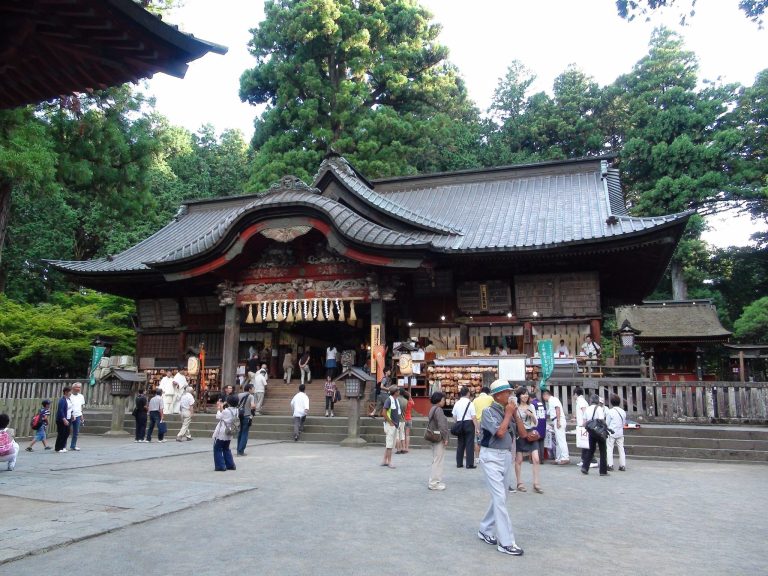
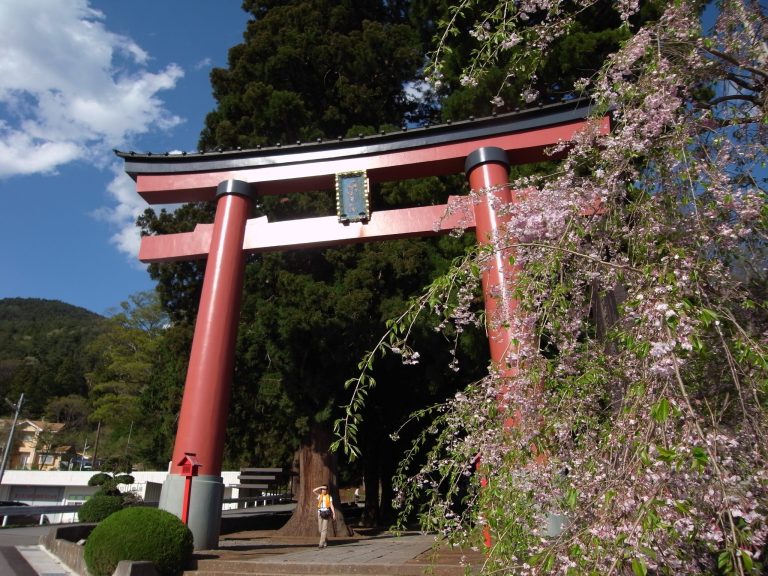
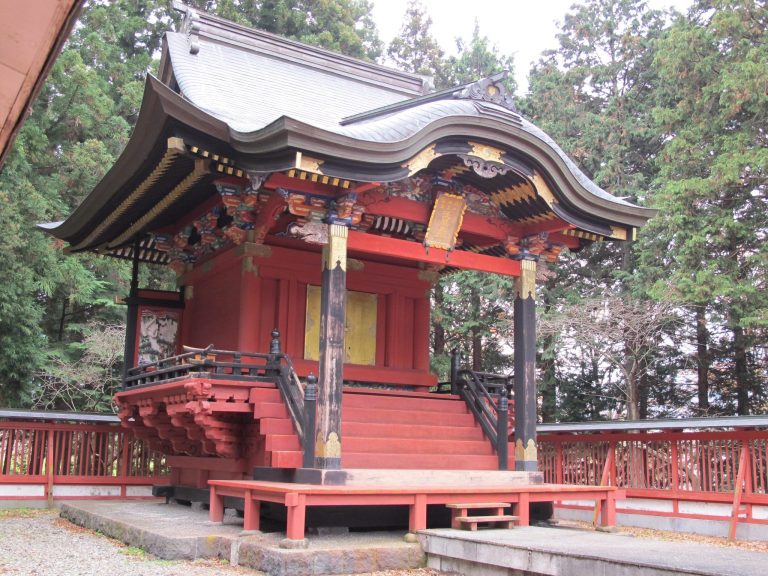
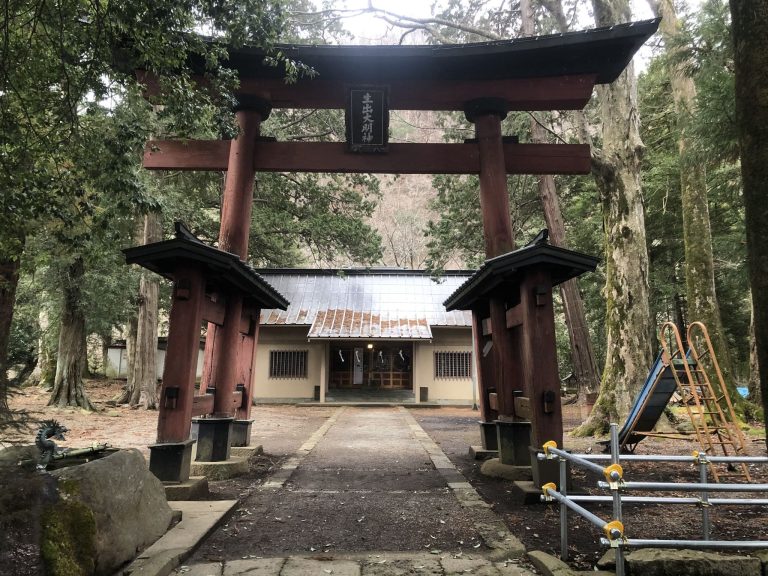
The main precinct is organized around a torii, a worship hall, the main sanctuary, and subsidiary shrines. The worship hall is traditionally dated to the Tensho period, approximately 1573 to 1593. The main sanctuary was built in 1767 by the Gunnai carpenters’ guild under its master carpenter, Kayanuma Yazaemon. It is a one-bay sanctuary, meaning that its principal front span is one structural bay wide, and is described as the largest example of its type in Yamanashi Prefecture. Its plans later served as models for main-sanctuary construction by carpenters in the surrounding district.
The worship hall displays a hanging plaque made from a section of the cedar burned by lightning in 1626. Beside the sacred katsura tree stand the Daito-gu and Hinazuru shrines, together known as the Ancient Site of Daito-gu Katsura. The katsura is approximately 800 years old and is designated as a natural monument of Fujiyoshida. The Daito-gu preserves the shrine’s association with Prince Moriyoshi after his enshrinement was transferred there during the Meiji period.
Subsidiary shrines and sacred animals
Horse Shrine
The Horse Shrine enshrines the sacred horse regarded as the mount of Konohanasakuya-hime-no-Mikoto together with the spirits of horses. A stable within the precinct houses the shrine’s sacred horses, several Kiso horses, and ponies. The animals are maintained for ritual use, and horses that die are enshrined together at the Horse Shrine, creating a continuing material memorial to successive sacred animals.
Gosha Shrine
The Gosha Shrine combines five shrines: the Great Shrine, Mountain Shrine, Tenno Shrine, Inari Shrine, and Tenjin Shrine. Its enshrined deities include Amaterasu, Oyama-tsumi, Susanoo, Okuninushi, Sukunabikona, Ukanomitama, and Sugawara no Michizane. Amaterasu is the Shinto sun deity traditionally regarded as the imperial ancestor. Susanoo is associated with storms, Inari with rice and agricultural prosperity, and Sugawara no Michizane with the deity Tenjin.
Other precinct shrines
The Hie Shrine contains a statue of a monkey, regarded as the shrine’s divine messenger. The Muromiya Ebisu Shrine houses an image of Ebisu painted by Ogata Korin, an influential Edo-period painter and designer associated with the Rinpa tradition. An Ebisu confraternity ceremony is held there on the night of November 19.
The Tainai Benten Shrine is a small older shrine incorporated into a lava-tree formation. Rounded stones piled around it are associated with stone worship and preserve a form of older Mount Fuji worship. The Arata Hachiman Shrine and Suitengu Shrine also stand within the precinct. Suitengu enshrines Amenominakanushi, Emperor Antoku, the former empress known as Kenreimon’in, and Taira no Tokiko, known as the Second-rank Nun.
Detached precincts
Konpira Shrine
The Konpira Shrine stands in Shimoyoshida Higashimachi, in the area formerly called the Koyoshida Mori district and traditionally identified as the shrine’s former site. During the Warring States period, this area and Gekkoji served as a place of ritual purification for pilgrims preparing to climb Mount Fuji. Pilgrims cleansed themselves with spring water.
A checkpoint once stood beside the shrine and collected passage fees. The stone monument called the First Barrier indicates that the location functioned as the starting point for the Yoshida-route pilgrimage. The Konpira Shrine also stands beside Gekkoji’s Aizen Jizo Hall, maintaining a physical association between the two religious sites.
Hakuo Shrine
The Hakuo Shrine stands on the middle slope of Odateyama. Its annual observance on August 6 includes the Insect Festival, an insect-expulsion rite seeking protection for fields, people, and households from harmful insects, pests, and epidemics. Ritual wands distributed during the ceremony are placed in fields or at household entrances.
The title Gongen in the shrine’s name reflects its connection with the former system of combined Buddhist and Shinto worship. Gongen was a Buddhist-Shinto title used before the modern separation of the two traditions. Until approximately the middle of the twentieth century, many worshippers climbed to Hakuo Shrine carrying torches on the day of its festival.
Ritual grounds and material traditions
The Honcho-Nakamura horse ground is the present setting for the mounted festival ritual. Its importance lies in the movement of the horse and the tracks left on the ground, which diviners interpret as signs of future conditions. The physical action of making the horse run explains the local designation of the ceremony more precisely than the general term Yabusame, which usually emphasizes mounted archery.
The shrine’s stable and Horse Shrine preserve the material side of this tradition. Sacred horses remain in the precinct during their lives, take part in ritual use, and are later enshrined after death. Together with the festival ground, these features preserve a form of worship in which horses connect divination, commemoration, and the religious identity of the surrounding communities.