Tales Castle: A Strategic Hilltop Fortress in Spain


Site at a Glance
- Rating
- 3.9
- Popularity
- Very Low
- Country
- Spain
- Primary era
- Modern
- Eras represented
- Medieval, Modern
- Civilizations
- Unclassified
- Site type
- Military
- Remains
- Castle
On this page7 sections
History
Tales Castle is a ruined hilltop fortress in Tales, Spain, probably built under Muslim rule during the twelfth century. Its precise date is uncertain because the remains are heavily ruined and little documentary information survives. The castle served as a strategic defensive position for the local settlement.
Early and medieval phases
The first construction phase formed the original core of the fortress and may belong to the Muslim period. A later medieval phase altered the site and strengthened its defenses. This work included two square towers, a third tower that stood nearly apart from the main structures, and changes in several areas, including the opening of windows.
Both the earliest and medieval work used stone masonry set in mortar, with an external lime-mortar coating extending across the curtain wall, the fortified wall linking defensive positions. These successive phases established the basic defensive arrangement that later builders adapted.
The Carlist War phase
The castle underwent a third construction phase in the nineteenth century during the Carlist War, a series of Spanish conflicts involving supporters of the Carlist claim to the throne and opposing political forces. Earlier structures were adapted for the use of rifles and artillery. Three semicircular towers, the walls of several rooms, and a medium-sized cistern were built over the remains of the preceding phase.
On 25 June 1985, Tales Castle was entered on Spain’s register of historically valuable monuments under registration number RI-51-0011527.
Remains
Hilltop enclosure
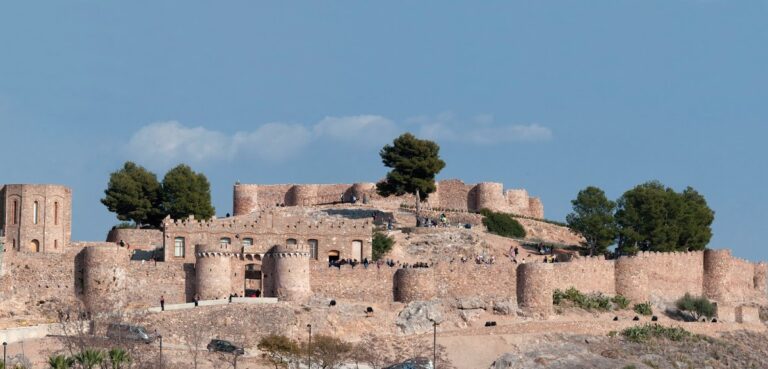
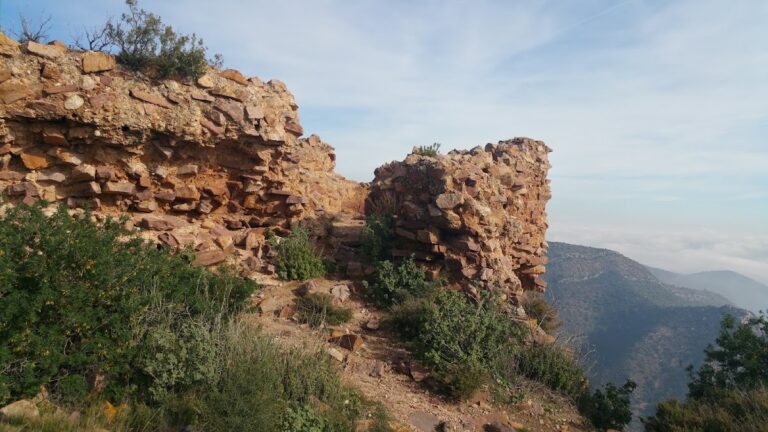
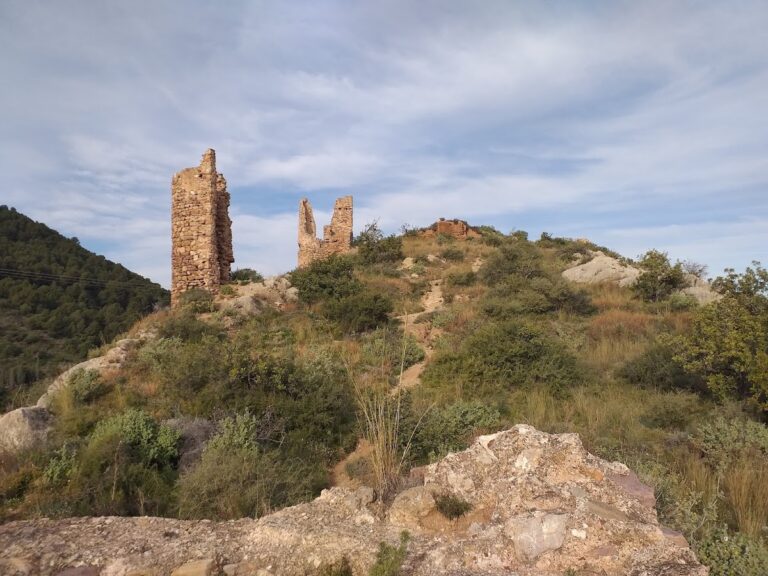
The ruins occupy the highest part of Tales’ urban center, on the summit of elevated ground. The small castle was reached by a narrow path leading from the Calvary to the hilltop. Its surviving fabric includes standing wall remains, the exterior parapet, and three towers. The masonry and lime-mortar coating associated with the earlier phases remain part of the visible structure.
Defensive structures
The enclosure preserves evidence of several defensive arrangements. The three surviving towers include the semicircular towers added during the nineteenth-century rebuilding, while the remains of an earlier entrance defense can also be seen. Entry apparently took place through a door that may have been protected by a turret, whose surviving traces remain visible. The nineteenth-century adaptation also left room walls constructed over the earlier fortress.
Cistern
A medium-sized cistern survives inside the enclosure. Such a tank was used to collect and store water, and its construction belongs to the nineteenth-century phase built over the remains of the earlier castle.