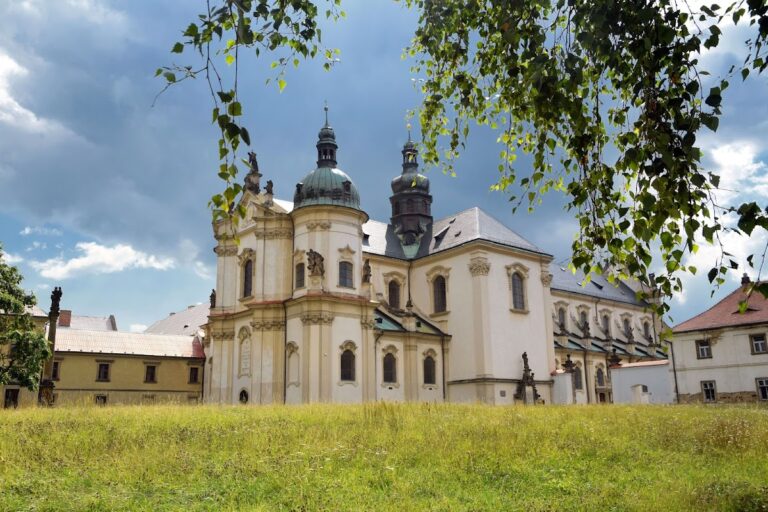
Světec Castle: A Baroque Castle and Municipal Heritage Site in Czechia


Site at a Glance
- Rating
- 4.6
- Popularity
- Very Low
- Country
- Czechia
- Primary era
- Early Modern
- Eras represented
- Early Modern
- Civilizations
- Habsburg, Holy Roman Empire, Kingdom of Bohemia
- Site type
- Domestic
- Remains
- Castle
On this page9 sections
History
Světec Castle is a Baroque castle in Czechia, built around the turn of the eighteenth century on the site of a former monastery. The building was designed by Antonio della Porta for Johann Joseph von Breuner, Archbishop of Prague, and the complex later developed into an architectural ensemble of castle, garden, park, and agricultural buildings.
The medieval monastery
Světec appears in records in 1209. A monastery of canonesses regular of the Order of the Holy Sepulchre stood on the site. This religious order was associated with the Church of the Holy Sepulchre in Jerusalem, while its canonesses regular formed its female branch. The order’s male branch had a convent in Prague.
The Hrabišice family brought the order to Bohemia in 1227 and helped establish both monasteries. Regional wars devastated the Světec monastery in 1278. It was later abandoned during the Protestant Reformation and had been demolished by 1580. Until that time, its possessions belonged to the Archdiocese of Prague, the Roman Catholic archdiocese responsible for ecclesiastical administration in Prague and surrounding territories.
The Baroque castle and its park
A new castle was erected on the former monastery site around the turn of the eighteenth century. Antonio della Porta was responsible for its design and construction, commissioned by Archbishop Johann Joseph von Breuner.
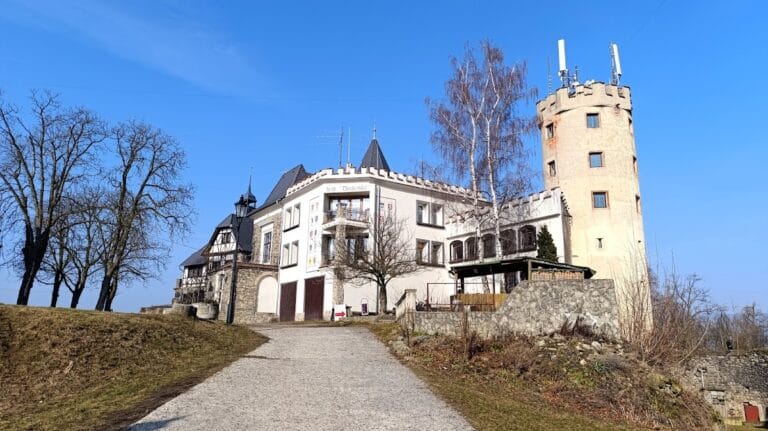
The park was established or enlarged under Prince-Archbishop Wilhelm Florentin von Salm-Salm. During the early nineteenth century, Archbishop Alois Josef Schrenk continued the work and linked the park by a promenade with the nearby Alois Heights. Their lookout tower belongs to this nineteenth-century development.
Modern use and protection
Since the second half of the twentieth century, the castle has served as the seat of Světec’s municipal administration. Reconstruction took place in 2003. The complex is protected in the Czech Republic as a national cultural monument under catalogue number 1000155614. A ceremonial hall is dedicated to Vojtěch Preissig, a Czech graphic artist, painter, and illustrator who resisted the German occupation of Czechoslovakia, was interned at Dachau concentration camp, and died there in 1944. The castle also contains an exhibition devoted to him.
Remains
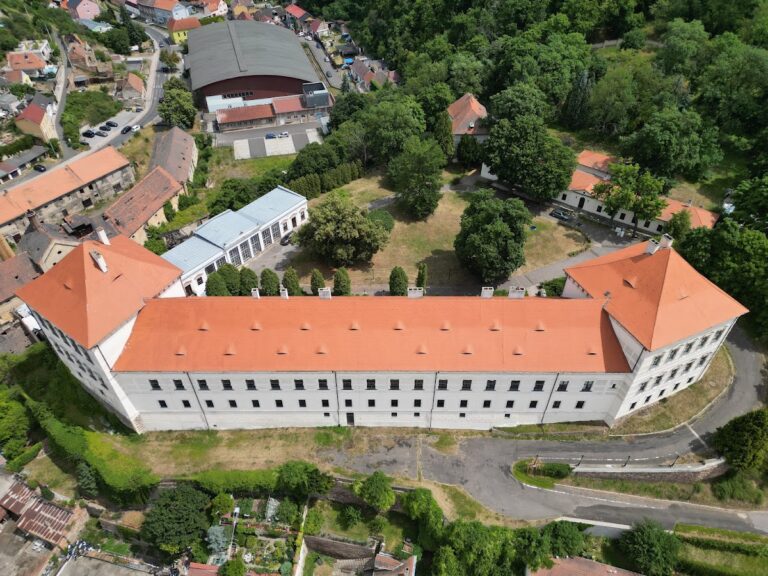
The surviving complex consists of an elongated, single-winged rectangular castle with several storeys, a garden beside the building, a larger park enclosed in part by low stone walls, a farmyard, and an agricultural building. The castle adjoins the Church of Saint James the Greater on its southern side. The park extends around the building, with a broad grassy area reaching west to northwest.
Castle building
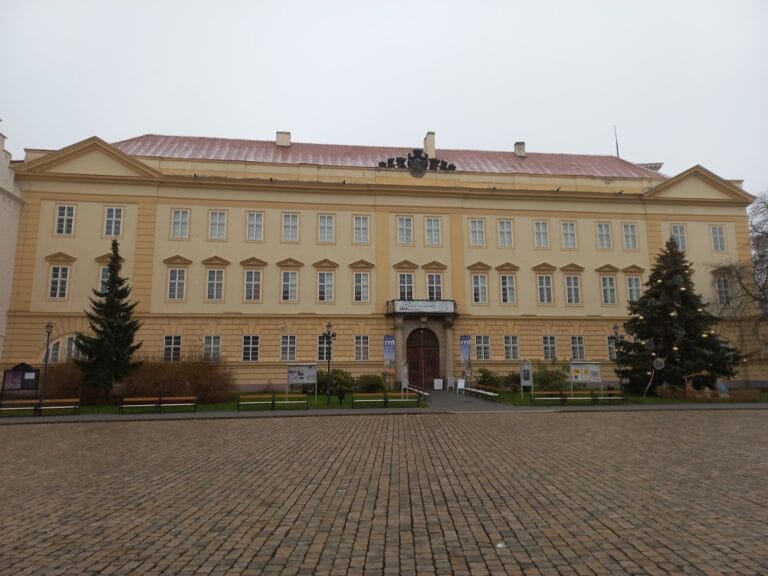
The Baroque castle has two staircases and a conventional double-pitched roof. Its eastern principal facade faces the courtyard of honour. Pilasters and cornices organize the facade, while rectangular ground-floor windows have shutters. The first-floor windows are also shuttered and framed by surrounds, cornices, and parapets containing rectangular two-wing infill. Approximately square windows on the second floor have framed parapets and shutters. Rectangular stucco panels fill the spaces between the storeys beneath the windows, and the entrance portal is crowned by a pierced pediment.
Garden and associated grounds
Garden and park
A garden lies immediately beside the castle. Beyond it, the large park is bounded in part by low stone walls and includes the broad grassy area extending west to northwest. The nearby Alois Heights contain a lookout tower associated with the park’s nineteenth-century development.
Farmyard and agricultural building
The protected complex also includes a farmyard and an agricultural building, which form part of the surviving castle ensemble alongside the main building, garden, park, and stone walls.
Nearby sites