Cartier Castle: A Mosan Château in Charleroi, Belgium


Site at a Glance
- Rating
- 4.1
- Popularity
- Very Low
- Country
- Belgium
- Primary era
- Early Modern
- External website
- Open
- Eras represented
- Early Modern
- Civilizations
- Holy Roman Empire
- Site type
- Domestic
- Remains
- Elite Residence
On this page9 sections
History
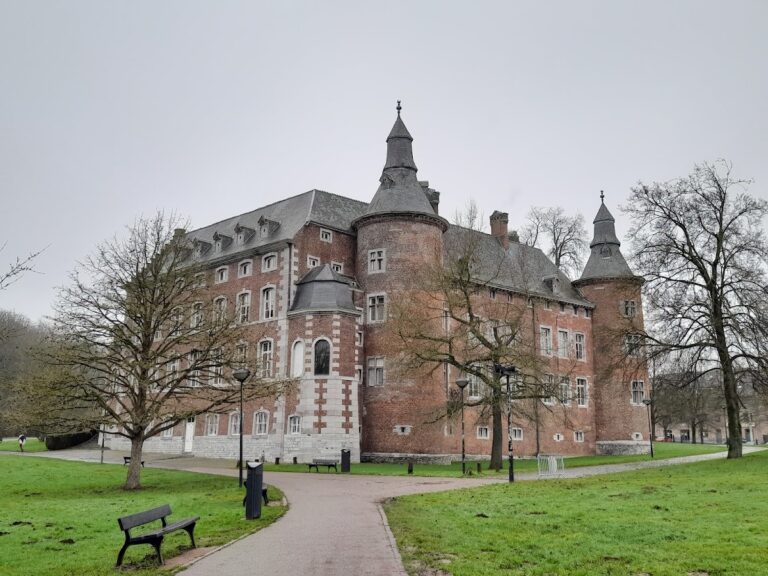
Cartier Castle, also known as Château Bilquin-de Cartier, is a seventeenth-century château in Belgium, in Marchienne-au-Pont, now part of Charleroi. Built in the Mosan style, the architectural tradition associated with the Meuse valley around Liège, it originated around 1635 on the bank of the Sambre, where a seigneurial manor had been destroyed on 21 July 1554.
Origins and the Bilquin ownership
The site had been granted to the Honoré family in 1593. By about 1635, the family had established a house with gardens and dependencies on the property. The castle was still unfinished when Guillaume Bilquin acquired it during the 1690s. A wealthy forge owner, Bilquin completed the building and enlarged it.
During the War of Devolution, the seventeenth-century conflict in which Louis XIV’s France fought Spain over succession and territory in the Spanish Netherlands, the castle served as a hospital in 1667 for French and Spanish soldiers. Marchienne lay in neutral territory under the authority of the Prince-Bishopric of Liège, a semi-independent ecclesiastical principality governed by a prince-bishop.
The Cartier de Marchienne family
In 1717, Guillaume Bilquin’s daughter Marie-Agnès Bilquin married Jean-Louis Cartier, whose father was the general treasurer of the prince-bishop of Liège. The marriage transferred the property to the Cartier de Marchienne family. During the early eighteenth century, the family also acquired seigneurial rights over Marchienne and Mont-sur-Marchienne.
The castle received the monk Saumery and the Liège-region draftsman Remacle Le Loup in 1740. Their book Les Délices du Pays de Liège praised the château, its adjoining farm, and its gardens and parks. A tradition associated with their visit says that Le Loup added smoke above the roofs in a drawing after the lord bought one of his sketches and offered hospitality to him and Saumery.
Pierre-Alexandre-Louis de Cartier was the last seigneur of Marchienne. He lived through the Liège Revolution, the French Revolution, the occupation of the region, and its annexation to France. His period therefore connected the castle’s seigneurial past with the political upheavals that transformed the area at the end of the eighteenth century.
Industrial change and twentieth-century preservation
Joseph de Cartier established the first steam mills in Belgium in 1838. Around the same period, the family abandoned the castle because it no longer suited contemporary tastes and preferred the White Castle, completed in 1836. The White Castle later became the town hall in 1900.
A fire in the attics severely damaged Cartier Castle in 1932. The ruined Cartier family then abandoned the property, which became municipal property in 1938, ending more than two centuries of Cartier ownership. Municipal services and libraries occupied the building until 1973, after which it continued in civic use.
Marguerite Yourcenar visited the castle in 1956 and commented on its poor condition. Her mother was related to the Cartier de Marchienne family, and Yourcenar later discussed this ancestry and the castle in her 1974 memoir Dear Departed: A Memoir. The building was legally protected as heritage in 1980. Phased restoration and rehabilitation followed between 1986 and 2001, addressing serious deterioration caused by dry rot, a fungal decay that weakens damp timber.
The surviving complex now accommodates the Marguerite Yourcenar Public Library on the ground floor and administrative services of the Walloon region on the first floor. The library also includes a section for Turkish-language books. The castle’s history was echoed abroad when Emile de Cartier de Marchienne, Yourcenar’s uncle and Belgian ambassador to China from 1910 to 1917, commissioned a replica for the Belgian legation in Beijing. Plans were prepared in Marchienne-au-Pont, and building materials were shipped from Belgium. The replica survives as the Zijin Guest House in Beijing’s Legation Quarter, although its original entrance has disappeared.
Remains
Cartier Castle is organized around an interior main courtyard in the Mosan style and stands beside the Sambre. The courtyard forms part of the Marchienne-au-Pont municipal park. The surviving complex preserves elements associated with its seventeenth-century construction and later Bilquin and Cartier ownership, while later urban development altered parts of the former estate.
Courtyard wings and entrances
Western entrance porch
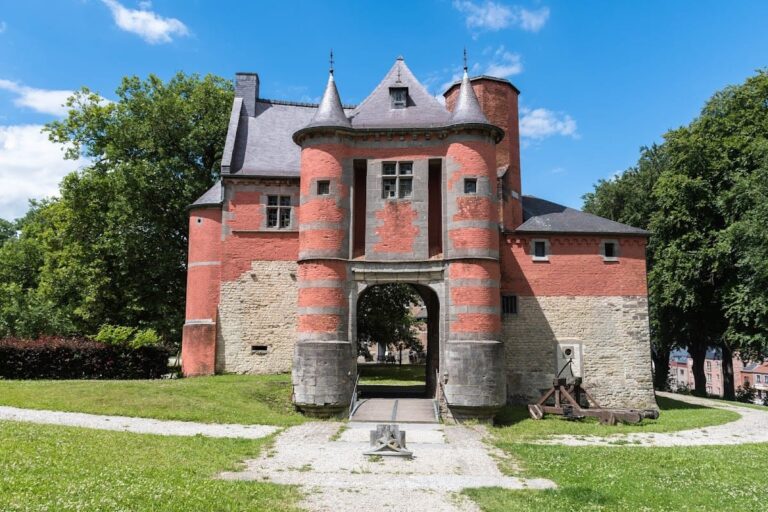
At the tip of the western wing, a stone entrance porch bears the arms of the Bilquin-Baillencourt family and an inscription dated 1699. The porch opening onto Beaumont Street also displays Guillaume Bilquin’s arms, represented by three forged nails. These carved details connect the entrance with the period when Bilquin completed and enlarged the unfinished castle.
Northern wing
The lintel above the northern wing’s door bears a scalloped key together with the arms of the Cartier family. The feature identifies the wing with the family that inherited the property through the 1717 marriage of Marie-Agnès Bilquin and Jean-Louis Cartier.
Former estate and riverside setting
The main building was formerly accompanied by gardens, parks, and an adjoining farm. A former barnyard was demolished, and the Marchienne-au-Pont municipal swimming pool now occupies that area. The southern courtyard wing was also demolished to create an entrance to the De Cartier station of the Charleroi metro.
On the Sambre embankment beside the castle stands a nineteenth-century grain elevator in the neo-Renaissance style, a revival of Renaissance forms and decoration. The castle’s surviving fabric was severely affected by the 1932 attic fire and later by dry rot before restoration. Its present civic arrangement places the public library on the ground floor and Walloon regional administrative services on the first floor.