Duchcov Chateau: A Baroque Aristocratic Residence in Czechia


Site at a Glance
- Rating
- 4.5
- Popularity
- Medium
- Country
- Czechia
- Primary era
- Early Modern
- External website
- Open
- Eras represented
- Medieval, Early Modern, Modern
- Civilizations
- Habsburg, Holy Roman Empire, Kingdom of Bohemia
- Site type
- Domestic
- Remains
- Elite Residence
On this page11 sections
History
Duchcov Chateau is a historic residence in Czechia, begun as a medieval castle in the thirteenth century and transformed into a Renaissance and then Baroque chateau. The original castle was built by the Lords of Hrabischitz in their market settlement of Hrabišin, the predecessor of Duchcov. It later passed to the related Lords of Ossegg and Riesenburg.
From medieval castle to Renaissance residence
In 1491, Paul Kaplirz de Sulewicz moved the seat of the Duchcov lordship from Riesenburg Castle to the fortress at Duchcov. Diepolt of Lobkowicz acquired the Riesenburg lordship as a pledge in 1523. In 1530, King Ferdinand I granted Diepolt’s sons both the Duchcov lordship and the abandoned Riesenburg as hereditary property. After 1570, Wenzel Popel of Lobkowicz commissioned a Renaissance chateau on the site of the earlier fortress.
The Waldstein estate and Baroque rebuilding
The Waldstein counts acquired Duchcov Chateau in 1642. Between 1675 and 1685, they rebuilt it in the Baroque style under Jean Baptiste Mathey, a French architect and artist active in Bohemia whose work was influenced by monumental Roman architecture. Side wings had been added by 1707, and further alterations followed after 1720 under František Maximilian Kaňka.
In 1680, Johann Friedrich von Waldstein made the Duchcov and Ober-Leitensdorf lordships a fideicommiss, an inheritable estate arrangement intended to keep property within a family line. He also granted the town of Duchcov its freedom. The estate included the Duchcov and Ober-Leitensdorf domains and, from 1713, the allodial estate of Maltheuer, which was held as ordinary inheritable property rather than under the family arrangement.
Johann Friedrich von Waldstein founded a hospital within the chateau precinct in 1694. Its endowment included 27,780 gulden secured on the Maltheuer estate, along with payments in kind. Johann Josef von Waldstein expanded the institution in 1716 for twelve men, twelve women, six orphaned boys, and six orphaned girls, while a hospital church dedicated to the Holy Cross was built at the same time. In 1775, Emanuel Philibert von Waldstein-Wartenberg transferred the twelve orphan places to a new orphanage at the cloth factory in Ober-Leitensdorf. Changed financial circumstances reduced the number of hospital beneficiaries to eight men and eight women at the beginning of the nineteenth century.
Casanova, Beethoven, and nineteenth-century events
Giacomo Casanova, the Venetian writer, adventurer, and memoirist, became librarian to Joseph Karl von Waldstein in 1785. He lived at Duchcov for the final thirteen years of his life, writing his extensive memoirs there. He died at the chateau in 1798 and was buried at Duchcov, although the location of his grave was later forgotten.
Ludwig van Beethoven gave a concert at Duchcov in 1812. He dedicated the piano work known as the Waldstein Sonata to Count Ferdinand Ernst von Waldstein. In 1813, Alexander I of Russia, Frederick William III of Prussia, and Francis I of Austria held political discussions at the chateau during the Napoleonic Wars, the European conflicts shaped by Napoleon’s campaigns and ambitions.
Between 1812 and 1818, the facade was remodelled in the Neoclassical style. The chateau also served as the seat of the manorial economic office for the Duchcov fideicommiss estate, including Ober-Leitensdorf and Maltheuer. The last owner sold the estate to the state in 1921.
Mining, conservation, and museum use
Coal mining later destroyed part of the park and the hospital, which was not rebuilt. In 1945, during the Second World War, the sculptural decoration of the associated Annunciation church was destroyed. Twentieth-century conservation included the relocation of the surviving Reiner fresco to a purpose-built park pavilion, opened in 1983. Parts of the garden were reconstructed during the 1960s with the help of historic plans, and part of the chateau was restored and converted into a state museum. Duchcov Chateau is protected as a cultural monument of the Czech Republic.
Remains
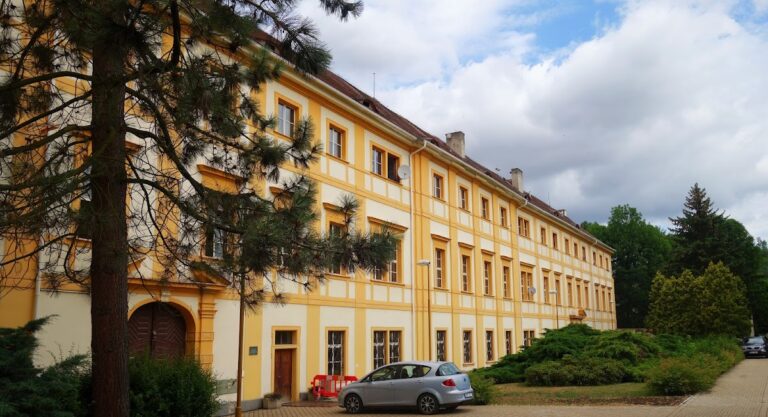
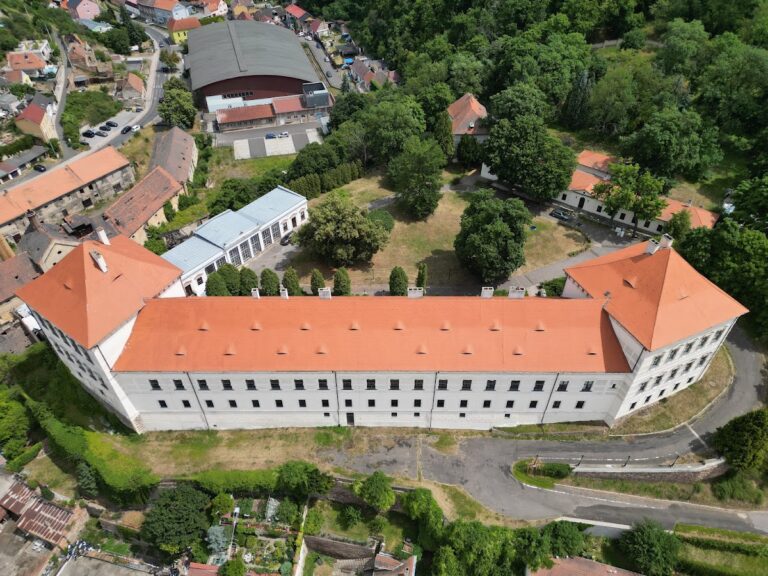
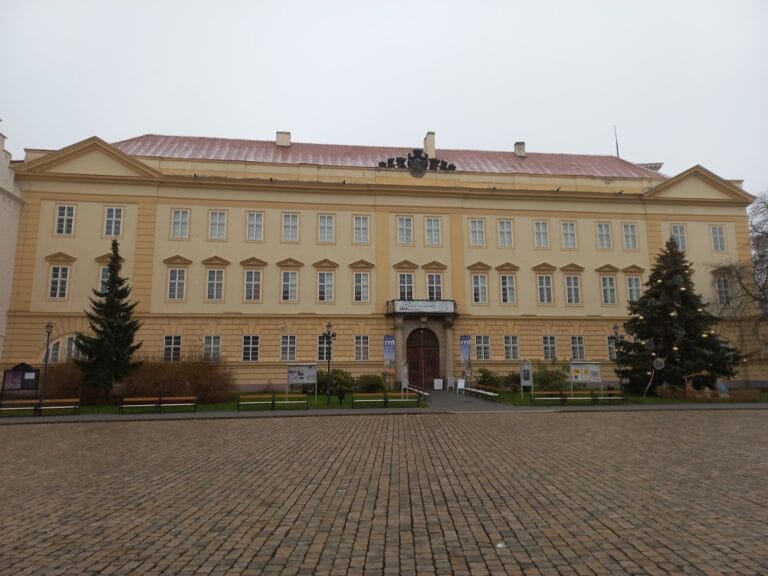
The chateau consists of two sections arranged around two courtyards and stands on a slight hill. By the mid-nineteenth century, the complex contained three halls and sixty rooms. Mathey’s Baroque rebuilding produced a U-shaped plan around an honor courtyard. A fence with Baroque sculptures on its pillars separated this courtyard from the surrounding area.
Building and courtyards
The main building has a central body with two side wings. It is built of brick covered with plaster and presents a two-storey front facade with a large portal set between pilasters. Hipped and mansard roofs cover the building. The garden-facing rear facade was designed to appear more monumental, with the Baroque garden extending behind it. Sculptures and vases based on ancient models stood before the honor courtyard. Matthias Bernhard Braun created these works, while Braun and Ferdinand Maximilian Brokoff also contributed to the interior sculpture. Both were major Baroque sculptors associated with the decoration of Bohemian churches, gardens, and aristocratic residences.
A metal basin occupies the middle of the second courtyard. Albrecht von Waldstein, also known as Wallenstein, had it cast in Nuremberg in 1630 from captured Swedish cannon. It was originally placed in the Waldstein Garden in Prague.
Halls, collections, and Casanova rooms
Wenzel Lorenz Reiner painted the ceiling of the Great Hall. The Great Family Hall contained portraits of Waldstein family members and history paintings showing episodes from the lives of the counts. Its ceiling painting depicts Heinrich Waldstein presenting his twenty-four sons and their twenty-four squires to King Přemysl Ottokar II of Bohemia in 1254. Reiner was a prominent Bohemian Baroque painter known for frescoes and large historical compositions.
The chateau’s collections include historical furniture, a Waldstein portrait and ancestral gallery with paintings and frescoes, European and Chinese porcelain, tapestries, and material relating to Casanova. The gallery includes a portrait of the Duke of Friedland by Anthonis van Dyck, the Flemish Baroque painter. A room dedicated to Casanova preserves his letters, maps of his travels, and literature about him. The former collections also included a natural-history and art cabinet, an arms collection, and a library of more than 12,000 volumes.
Garden and associated buildings
Baroque garden
Jan Ferdinand Schor, an Austrian engineer and garden designer, laid out the Baroque garden between 1716 and 1728. Its design included parterres, pools, fountains, allegorical sculptures, the hospital, and its Baroque chapel. A chapel vault was decorated with paintings by Wenzel Lorenz Reiner. At the beginning of the nineteenth century, the garden was redesigned as an English landscape park, while the park facade was simplified in the Neoclassical manner. Parts of the garden were reconstructed during the 1960s from old plans. The Reiner fresco from the hospital church is preserved in the park pavilion built for it and opened in 1983.
Annunciation and Holy Cross churches
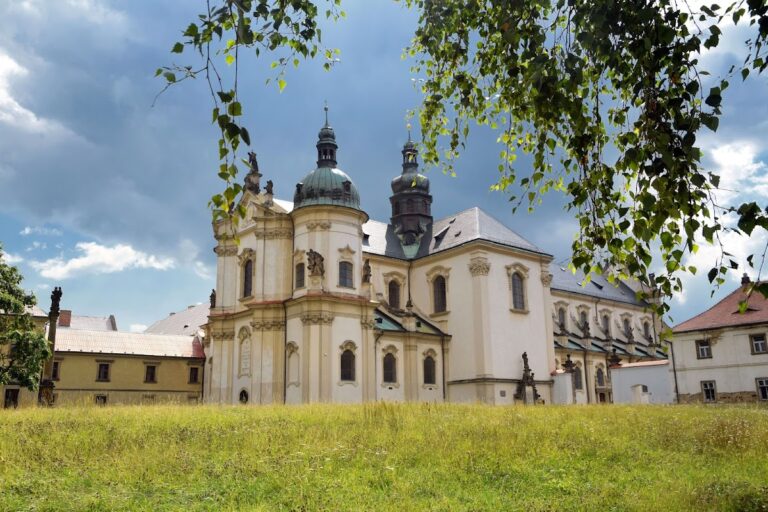
The associated Annunciation church had two towers that formed a prominent element of the nearby settlement’s silhouette. The hospital complex included the separate church dedicated to the Holy Cross, built during the hospital’s expansion in 1716. Sculptures produced by Braun’s workshop also decorated the associated church and garden.
Nearby sites