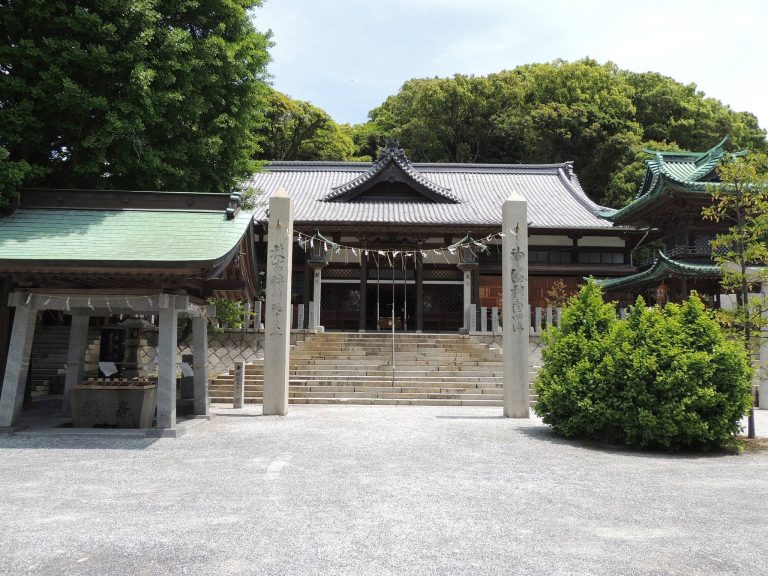
Sumiyoshi Shrine: The Principal Shrine of Former Nagato Province


Site at a Glance
- Rating
- 4.4
- Popularity
- Medium
- Country
- Japan
- Primary era
- Medieval
- External website
- Open
- Eras represented
- Medieval, Modern
- Civilizations
- Ashikaga shogunate, Japanese
- Site type
- Religious
- Remains
- Sanctuary
On this page23 sections
History
Sumiyoshi Shrine is a Shinto shrine in Shimonoseki, Japan, and the ichinomiya, or highest-ranking provincial shrine, of former Nagato Province. Built in its present form in 1370 in the nagare-zukuri architectural style, it is identified with the ancient Sumiyoshi Ara-Mitama Shrine and is counted among the Three Great Sumiyoshi shrines, alongside Sumiyoshi Taisha in Osaka and Sumiyoshi Shrine in Fukuoka.
Origins and ancient status
Shinto is Japan’s indigenous religious tradition, centered on reverence for kami, sacred presences associated with deities, ancestors, natural features, and historical traditions. Sumiyoshi Shrine’s principal deity is the ara-mitama, or rough and forceful aspect, of the three Sumiyoshi sea and voyage deities: Sokotsutsu-no-o-no-mikoto, Nakatsutsu-no-o-no-mikoto, and Uwatsutsu-no-o-no-mikoto.
The Nihon Shoki relates the shrine’s origin to Empress Jingū’s campaign against Silla. After receiving an oracle from the three Sumiyoshi kami, she was believed to have relied on their rough spirit to guide her fleet to victory. On her return, she ordered the spirit enshrined at Yamada in the district of Anato, with Anato no Atai Hondachi serving as chief ritualist. The present shrine stands about four kilometers east of the mouth of the Ayaragi River, within the area historically known as Yamada.
By 806, the shrine possessed 239 shrine households. The Engishiki, a tenth-century compilation of court regulations and ritual procedures, lists it among only three ancient state-recognized shrines in Nagato. It was the province’s only Myojin Taisha, a particularly prestigious shrine recognized in the ancient state ritual system. The same record notes that laborers from estate households formerly belonging to Sumiyoshi Taisha were assigned to Sumiyoshi Shrine.
The shrine’s court rank rose through several stages. It advanced from Junior Fifth Rank, Lower Grade, to Junior Fifth Rank, Upper Grade, in 859, then to Senior Fifth Rank, Lower Grade, and Junior Fourth Rank, Upper Grade, in 875 and 876. Further promotions brought it to Senior Fourth Rank, Lower Grade, in 886 and Senior Fourth Rank, Upper Grade, in 891. A later compilation gives additional promotions, ultimately reaching Senior First Rank in 1262, although those later entries belong to a post-medieval shrine record.
Provincial shrine and medieval estates
Sumiyoshi Shrine is first identified as Nagato’s ichinomiya in 1107. In 1185, after the Battle of Dan-no-ura, Minamoto no Yoritomo granted the shrine approximately 30 chō of rice land in Yoshinaga Estate. By 1320, the shrine estate was known as Ichinomiya Estate and included Ichinomiya and Yoshimo villages.
During the late Kamakura period, Ichinomiya Estate was donated to the Nagato military guard office and administered by the provincial military governor. The change weakened the shrine’s rituals and the position of its hereditary shrine families. The shrine petitioned for restoration of its estate in 1326, 1334, and 1336, and documents indicate that the estate had been recovered by 1380.
The medieval estate grew through grants and the conversion of other landholdings. It included the Anjō holding, which became shrine land after a dispute over unpaid ritual rice, as well as holdings in Toyoura and Toyohigashi districts and elsewhere. Ōuchi Yoshihiro, Ōuchi Morimi, and Ōuchi Mochiyo each made recorded donations. In the sixteenth century, the shrine’s domain was reported to include 7,500 koku of stored rice and land valued at 500 kanmon. Its estate later contracted from approximately 968 koku in 1589 to 110 koku by the end of the Edo period.
Warrior patronage and religious traditions
The shrine’s foundation tradition and its association with the ara-mitama gave it a strong reputation as a deity of warfare and maritime traffic. From the Kamakura period, successive military rulers supported it through land donations, including Minamoto no Yoritomo. Ōuchi Hiroyo prayed there during his war against the Koto clan. After destroying the clan in 1369, he built the shrine buildings in 1370 and personally attended the later ceremony transferring the sacred presence to the new structures.
The shrine temporarily declined during the Sengoku period, an era of prolonged warfare among regional powers, but the Ōuchi and Mōri families later supported its restoration. The Mōri rulers of Choshu Domain repaired its buildings during the Edo period. The medieval religious complex also included Shinpukuji, a Buddhist temple serving as the shrine’s jingūji, or temple historically attached to a Shinto shrine before the modern separation of Buddhism and Shinto.
The shrine was also connected with literary and archival activity. The renga poet Sōgi, a leading fifteenth-century Japanese linked-verse poet, visited in 1480, and Ōuchi Masahiro visited later that year. Chief priest Kada Sadakuni allowed Masahiro to examine the shrine’s ancient documents. In 1481, Masahiro copied them into seven manuscripts, added identifying inscriptions and authentication marks, and dedicated the set to the shrine.
Modern institutional history
After the Meiji Restoration, the political transformation that ended the Tokugawa shogunate and reorganized Japan’s government, Sumiyoshi Shrine was classified as a National Shrine of the Second Rank in 1871. It was promoted to an Imperial Shrine of the Second Rank in 1911. In 1948, it became one of the shrines listed in the Association of Shinto Shrines’ Beppyo, a separate list of designated shrines.
The shrine’s major observances preserve traditions associated with its foundation stories, agricultural rites, warfare, and purification. The December 15 grand festival is joined by the Wakame-Kari ritual, the Rice-Planting Festival, the Porridge Divination Festival, the Insect-Repelling Festival, the River-Crossing Festival, and the Purification and Seclusion Festival.
During the Wakame-Kari ritual, wakame seaweed is secretly cut from the waters of Dan-no-ura before dawn and offered to the deity. The rite derives from the tradition associated with Jingū, and the seaweed is later distributed to worshippers. The Rice-Planting Festival recalls Jingū’s traditional opening of the shrine’s rice fields and Hondachi’s performance of the planting ceremony. Descendants of the Yamada chief-priest family and other shrine families formerly conducted it. After a period of suspension, it resumed in 1934 and became part of Shimonoseki’s agricultural festival in 1953. Its ritual includes performances and planting by 50 young women and eight ritual maidens. The related tradition was also transmitted to Sumiyoshi Taisha, where it is recognized as an Important Intangible Folk Cultural Property.
The Porridge Festival preserves an older practice of using porridge to divine good and bad fortune and to protect against evil. The former Insect-Repelling Festival involved carrying a straw effigy containing agricultural pests through the local area before throwing it into the sea. The practice ceased after the technique for making the effigy was lost. The River-Crossing Festival commemorates Mōri Motonari’s prayer at the shrine before his campaign against the Amago clan and the soldiers’ victorious crossing of the Gōnokawa River. During the Purification and Seclusion Festival, sacred ropes encircle the precinct, public worship is prohibited, and the priests remain inside while performing purification and changing or making sacred objects.
Remains
The shrine precinct occupies approximately 15,864 to 15,868 square meters in two inventories. A larger historical register gives approximately 62,578 square meters, including about 36,364 square meters of land subject to a right of superficies held by Shimonoseki City. Woodland around the main sanctuary covers roughly 4,000 square meters, while additional shrine woodland outside the precinct is recorded at approximately 48,195 square meters. Within this setting, the main sanctuary, worship hall, gates, cloister, auxiliary buildings, sacred grove, and associated objects form a complex shaped by repeated rebuilding and repair.
Main sanctuary complex
Main sanctuary
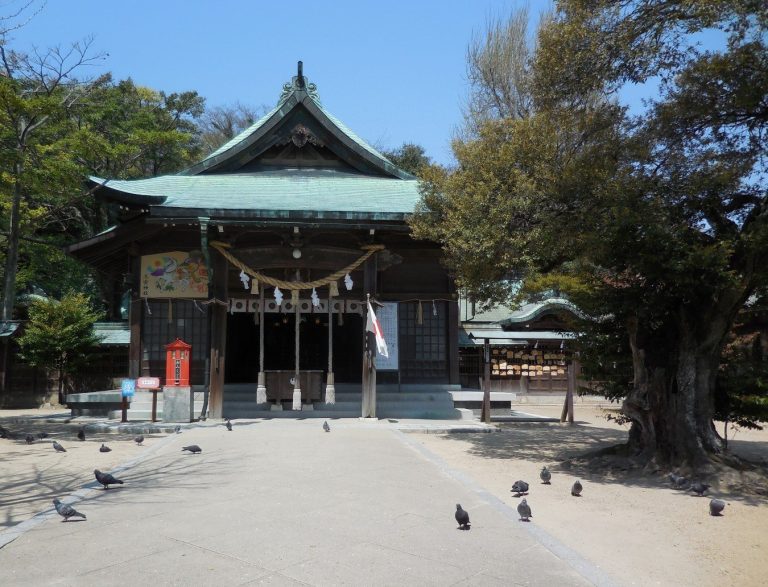
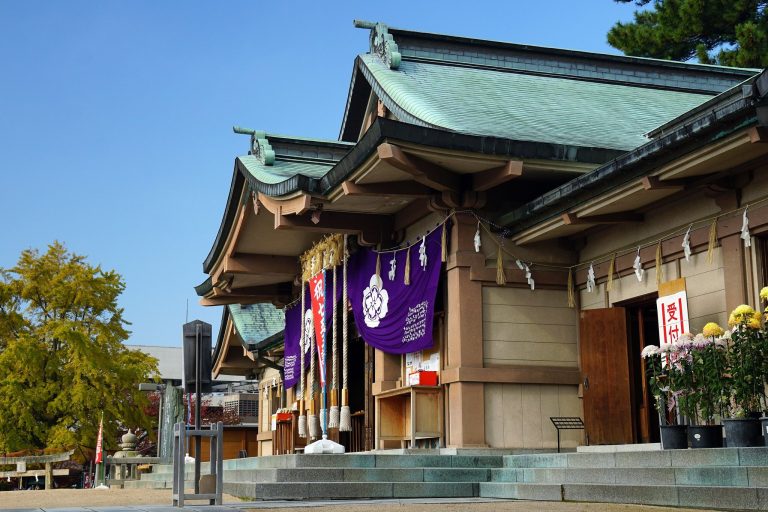
Built by Ōuchi Hiroyo in 1370, the main sanctuary is a nine-bay nagare-zukuri complex. This style has a gently curving roof that extends forward over the entrance. The building is approximately 22.8 meters long and 4.6 meters wide, and consists of five one-bay sanctuaries joined in a single row. Each has a small chidori-hafu gable, producing a front appearance that resembles Kasuga-zukuri, a style distinguished by a gabled front. The roofs are covered with cypress-bark shingles.
The five sanctuaries contain five inner sacred chambers, probably constructed at the same time as the main building. Each chamber is an irimoya-zukuri structure, a form combining a gabled roof with hipped sections, entered from the gable end and roofed with cypress bark. The main sanctuary has thirteen bays across the front and approximately two and a half bays along the side.
Colored paintings decorate the inner sanctuary walls. Birds and flowers appear on the central wall, sacred figures occupy the left wall, and the right wall formerly showed local Buddhist manifestations before the Meiji separation of Buddhism and Shinto. The wooden doors between the sanctuaries also bear seasonal bird-and-flower paintings that the shrine attributes to Sesshu.
Extensive repairs took place from December 1908 to November 1909, when the original front and side eaves were removed. The deities were transferred to the worship hall in August 1976 while the main sanctuary roof was renewed. The transfer ceremony took place on September 27, 1977.
Worship hall and Karamon gate
Mōri Motonari donated the worship hall in 1539. It is a three-by-one-bay, gable-ended building measuring approximately 6.9 by 4.9 meters. Its cypress-bark roof covers an open, low floor. A plaque on the front reads “Main Shrine of the Ara-Mitama of Sumiyoshi,” with an inscription written by Prince Arisugawa.
A Karamon gate stands between the worship hall and the main sanctuary, flanked by lattice walls. The gate was built in 1901 as a cypress-bark-roofed structure with a floor area of approximately 8.6 square meters. The lattice wall, constructed in 1909, is approximately 81.06 meters long and 1.68 meters high, while its corridor has a floor area of approximately 18.54 square meters. The gate, wall, and corridor were reroofed in 1977.
Two-story gate
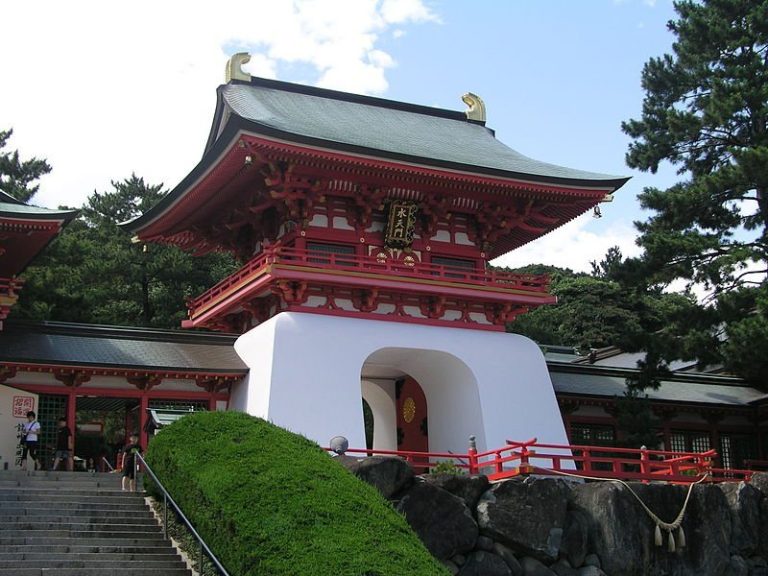
South of the worship hall is a two-story gate built in May 1901. It is an irimoya-zukuri structure with a cypress-bark roof and a floor area of approximately 40.4 square meters. Its roof was renewed in 1976. The earlier gate, built by Ōuchi Hiroyo in 1372, was dismantled in 1870.
Service and ritual buildings
Cloister and offering buildings
The cloister is a gable-ended structure with a tiled roof and a floor area of approximately 171.17 square meters. Records attribute its construction to 1539. The food-offering hall and prayer hall are both irimoya-zukuri buildings rebuilt in 1930. They have metal roofs and a combined recorded floor area of approximately 54.55 square meters.
Ancillary precinct buildings
Other buildings include a tiled-roof storehouse for ritual implements, measuring approximately 30.31 square meters, and a square tiled-roof assembly hall of approximately 72.4 square meters. A gable-ended ablution pavilion has a metal roof and a floor area of approximately 6.41 square meters. The irimoya-zukuri shrine office was built in 1924 and covers approximately 189.26 square meters. The bell tower, built in 1950, measures approximately 4.13 square meters, while the treasure house, built in 1952, measures approximately 42.98 square meters.
Torii and bridge
The precinct contains twelve torii, fourteen stone lanterns, and a concrete arched bridge. The principal front torii was erected in January 1831 and is approximately 5.21 meters high. The western torii, built in August 1931, is approximately 4.09 meters high.
Sacred grove and associated shrines
The shrine grove covers approximately 9,000 square meters and is a designated natural cultural property. About 80 mainly broad-leaved species grow there. The woodland is described as an essentially primeval evergreen forest dominated by Tsuburajii, unlike nearby natural woodland dominated by red pine. Other trees include camphor, red nanmu, Litsea acuminata, and yuzuriha. One of the grove’s small trees is recorded as having its only habitat in Yamaguchi Prefecture there. Shell ginger, ferns, and shrubs occupy the lower vegetation, while large trees include Tsuburajii, Nanaminoki holly, and yuzuriha.
Affiliated shrines within the complex include Wakamiya Shrine, Tenjin Shrine, Ebisu Shrine, Uchishimo Shrine, Inari Shrine, Tajiri Shrine, the Seven Kyoto Shrines, Kebiishi Shrine, Uneme Shrine, Itsukushima Shrine, Kifune Shrine, and Takamoto Shrine. Ebisu Shrine is said to have been established in the ninth year of Emperor Seimu and to have been the land deity before Sumiyoshi Shrine was founded. Uchishimo Shrine was invited from Omi Province in 1372 and later moved from level ground within the precinct to an adjoining terrace. Wakamiya Shrine was relocated from Akiné in Shimonoseki to the precinct in 1962.
Bell, ritual objects, and armor
Bronze bell
The bronze bell is a Silla-style Korean bell measuring 147 centimeters high and 78.3 centimeters in diameter. Its rim at the opening is approximately 7.4 centimeters thick. A dragon-shaped crown, lotus-petal and flowing-cloud decoration, and four flying celestial figures adorn its surface. It formerly hung in the bell tower. A local tradition says that Toyotomi Hideyoshi tried to requisition it during his invasions of Korea but returned it after it proved impossible to move at the pass.
Saddle and armor
A gilt-bronze openwork saddle is decorated with a peony arabesque and measures approximately 28.3 centimeters high and 27.6 centimeters long. It includes associated harness and stirrup fittings and uses Tang-style decorative motifs. Tradition attributes its donation to Ōuchi Yoshitaka.
A greenish-blue, silk-laced shoulder-white dōmaru is preserved with a helmet, large shoulder guards, face guard, throat guard, arm guards, and shin guards. A dōmaru is a type of Japanese cuirass that wraps around the torso and fastens at the side. The armor is designated as a cultural property of Shimonoseki.
Documents, votive paintings, and calligraphy
Document collection
The Sumiyoshi Shrine collection contains 117 documents: nine from the Kamakura period, eight from the Northern and Southern Courts period, 66 from the Muromachi period, and 34 from the Azuchi-Momoyama period through the early Edo period. The oldest is a donation document from 1247. The collection includes Ōuchi Masahiro’s seven-volume copy of shrine documents, dedicated in 1481, as well as 178 documents donated in 1955 by the Ichiki family. The family consisted of hereditary smiths and master craftsmen connected first with the Nagato provincial government and later with Chofu Domain.
Hundred-Poem Votive Strips
The Sumiyoshi Shrine Hundred-Poem Votive Strips were created after Sōgi gave thanks for completing the Shinsen Tsukubashū. Thirty poets, including Emperor Go-Tsuchimikado, Prince Katsuhito, court nobles, and leading poets, contributed poems from December 1495. The set was completed in March 1496 and dedicated in May. Related objects include a preface by Sanjonishi Sanetaka, supplementary documents signed by other officials, material about the authors of the Shinsen Tsukubashū, Sōgi’s strip box, and a lacquered strip box dedicated by Mōri Hidemoto.
Painted votive plaques
The wooden colored painting of a tethered horse is regarded as the oldest ema in Yamaguchi Prefecture. An ema is a wooden votive plaque offered at a shrine, often bearing a painted image or written prayer. Painted on Japanese cypress boards, this plaque measures approximately 43.5 by 59 centimeters, carries an artist’s signature, and is attributed to the sixteenth century. Much of its paint has peeled, although the ink outlines remain comparatively clear.
A group of six wooden colored votive paintings is attributed to Kanō Hōgai. The panels include two tethered horses and scenes of Takeuchi no Sukune casting a jewel, Han Xin passing between an enemy’s legs, Yu Rang tearing his clothing, and a galloping ox. The Yu Rang panel measures approximately 61 by 92 centimeters, was probably painted during the Keiō period, and was dedicated to the shrine in 1885. The galloping-ox panel measures approximately 37 by 58 centimeters. It was dedicated to Sugawara Shrine in 1864 and later deposited at Sumiyoshi Shrine.
Imperial calligraphy
Two calligraphic sheets by Emperor Go-Yōzei and Emperor Reigen are written in ink on paper and are recognized as nationally designated Important Art Objects.