Iminomiya Shrine: A Historic Shinto Shrine in Shimonoseki


Site at a Glance
- Rating
- 4.1
- Popularity
- Low
- Country
- Japan
- Primary era
- Unclassified
- External website
- Open
- Eras represented
- Unclassified
- Civilizations
- Unclassified
- Site type
- Religious
- Remains
- Sanctuary
On this page8 sections
History
Iminomiya Shrine is a Shinto shrine in Shimonoseki, Japan, traditionally identified with the site of Toyoura no Miya, a temporary imperial palace associated with Emperor Chuai’s campaign against Kumaso. The palace is said to have been built in 193, after Emperor Chuai reached the region in 192. The shrine’s history therefore brings together traditions of early imperial rule, religious worship, the introduction of silkworm eggs, and the later development of Chofu as a castle-town district.
Imperial traditions and the shrine’s origins
According to tradition, Emperor Chuai stayed at Toyoura no Miya during his campaign. A separate tradition recorded in the Nihon Sandai Jitsuroku states that Koma-o, described as an eleventh-generation descendant of Qin Shi Huang, arrived in Japan in 195 and presented silkworm eggs. Toyoura no Miya consequently became associated with the introduction of silkworm cultivation to Japan.
In 199, Empress Jingu is said to have established a shrine at the site to enshrine Emperor Chuai. The tradition connects his death with Kashii in Tsukushi, where he died after doubting an oracle associated with Amaterasu and the three Sumiyoshi deities. During the reign of Emperor Shomu, Empress Jingu and Emperor Ojin were also enshrined.
The shrine originally consisted of three separately established halls. Toyoura no Miya was dedicated to Emperor Chuai, Iminomiya to Empress Jingu, and Toyoake no Miya to Emperor Ojin. After a medieval fire, the three were consolidated at Iminomiya, and that name became the name of the combined shrine.
Religious status and medieval patronage
Iminomiya appears in the Engishiki Jinmyocho, the section of a tenth-century legal and ritual compendium that lists officially recognized shrines. It was listed as a small-ranking shrine in Toyoura District of Nagato Province, the historical province corresponding broadly to western Yamaguchi Prefecture. The shrine is regarded as the second-ranking shrine of the former province, a status expressed by the term Ninomiya. It was formerly classified as a Kokuheishosha, a shrine ranked and supported by the prewar national government, and is now a Beppyo shrine, meaning a specially recognized shrine within the Association of Shinto Shrines.
In 1336, Ashikaga Takauji prayed at Iminomiya for victory. Takauji founded the Ashikaga shogunate, which ruled Japan during the Muromachi period. In 1337, he dedicated horaku waka, Japanese waka poems offered as a religious dedication, at the shrine. The Chofu Mori family later provided the shrine with strong patronage.
Later associations and observances
Iminomiya’s traditional religious roles include those of a deity of literary and military prowess, victory, and safe childbirth. Its principal observances include the Kazukata Garden Festival, held from August 7 to 13, the Gosai Ritual, held from December 7 to 15, and the annual shrine festival on December 15.
Toyokou Shrine was established within the precincts to enshrine successive lords of the Chofu domain. It was later combined with Miyazaki Hachimangu Shrine near the Chofu coast, where it continues to be enshrined as Toyokou Shrine.
The shrine also developed a connection with the sumo wrestler Shoko Kaiketsu. He prayed for victory at Arakuma Inari Shrine during the Kyushu tournament and won the championship. This association led to his annual visit on November 3 during the shrine’s three-day sumo event. The observance remains part of the shrine’s later religious and sporting traditions.
Remains
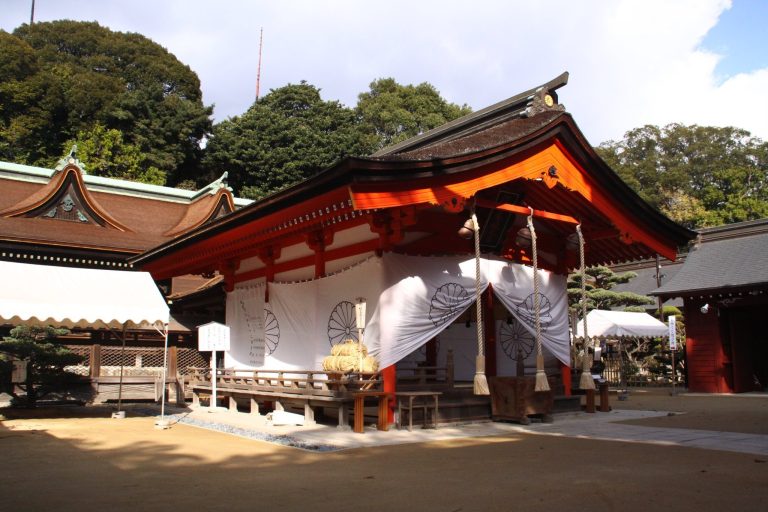
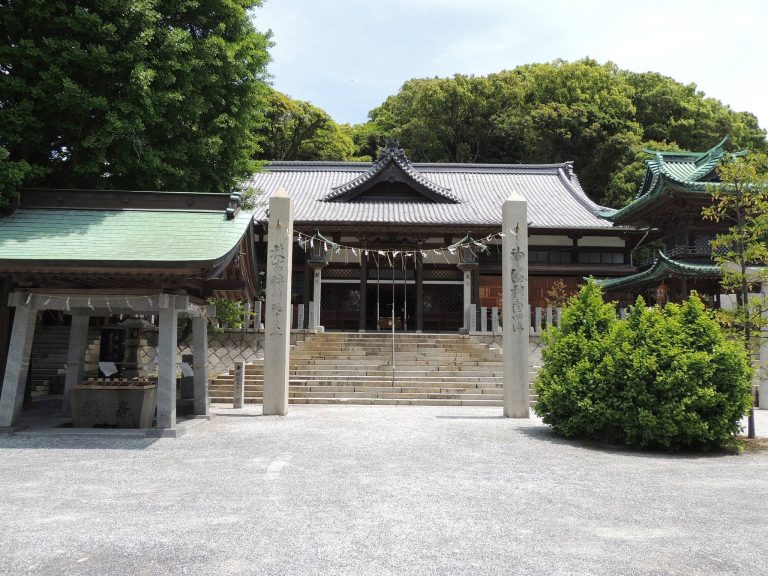
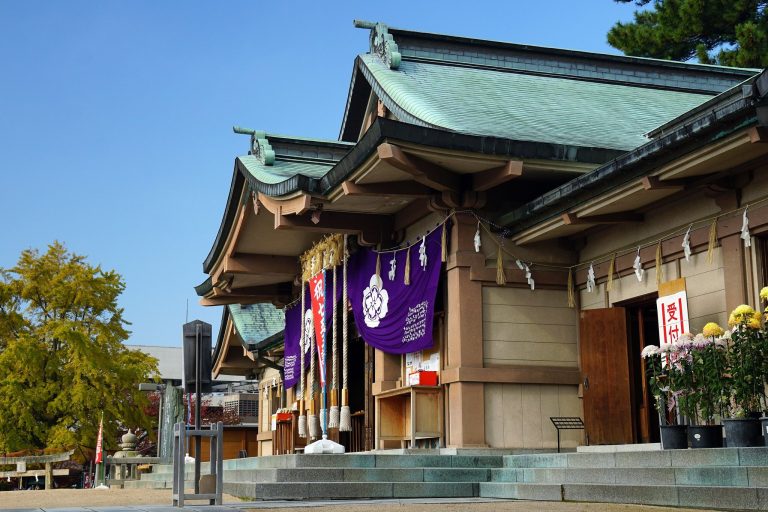
Iminomiya Shrine stands near the center of the former castle-town district of Chofu in Shimonoseki, Yamaguchi Prefecture. Its principal arrangement consists of three halls, with Emperor Chuai enshrined in the first, Empress Jingu in the second, and Emperor Ojin in the third. Smaller associated sanctuaries and detached shrine lands extend the religious complex beyond the main group of halls.
Principal halls and associated sanctuaries
The grounds include Wakamiya Shrine, dedicated to Emperor Nintoku, and Kora Shrine, dedicated to Takenouchi no Sukune, a legendary early court figure traditionally portrayed as a statesman and military leader. Yasaka Shrine enshrines forty-two deities, including Susano-o. Arakuma Inari Shrine is dedicated to Ukanomitama, a deity especially associated with food and agriculture, together with the three Munakata goddesses, who are connected with the sea and navigation. Soja Shrine is dedicated to the heavenly and earthly deities, a collective term for the kami of the celestial and terrestrial realms, while Morimiya Shrine is dedicated to Emperor Ojin.
Sumo museum and material collections
A sumo museum stands beside Arakuma Inari Shrine. Its displays include championship memorabilia associated with Shoko Kaiketsu and Kuniyasu Ono, including ceremonial aprons, a championship cup, and a large topknot. These objects relate the shrine’s modern sumo association to a specific physical collection within its precincts.
The shrine’s material holdings include a sword without an inscription traditionally attributed to Norimune, a name associated with Japanese swordsmiths. They also include a tachi, a long Japanese sword, bearing the inscription “Bishu Osafune Morimitsu” and a date in the 23rd year of the Oei era. A written poetic dedication known as the Toyoura no Miya horaku waka is associated with Ashikaga Takauji and the site.
Other holdings comprise twenty-eight scrolls and three books containing 372 shrine documents, together with a precinct plan accompanied by twelve volumes of shrine records. Taken together, these written materials preserve information about the shrine’s organization, lands, religious activity, and historical administration.
Detached island precincts
Manju Island and Kanju Island are detached precincts of Iminomiya Shrine, meaning separately located parcels of shrine land associated with the main shrine. Both islands are designated national natural monuments. Their status forms part of the shrine’s wider physical and religious landscape beyond the central Chofu precinct.