Saidai-ji Temple: A Koyasan Shingon Buddhist Temple in Okayama


Site at a Glance
- Rating
- 4.2
- Popularity
- Low
- Country
- Japan
- Primary era
- Early Modern
- External website
- Open
- Eras represented
- Early Modern, Modern
- Civilizations
- Japanese, Tokugawa
- Site type
- Religious
- Remains
- Monastery
On this page14 sections
History
Saidai-ji Temple is a Koyasan Shingon Buddhist temple in Okayama, Japan, established according to temple tradition in 751 and associated with the religious practices of esoteric Buddhism, which uses ritual, mantra, and mandala-based worship. Its mountain name is Kinryozan, its principal image is a Thousand-Armed Kannon, a form of the bodhisattva of compassion, and its main temple establishment, Kannon-in, holds the status of a special head temple.
Foundation and medieval development
The temple’s traditional history begins when a woman of the Fujiwara family from Kuga Estate in Suo Province enshrined an image of Kannon at Kanaoka in what is now eastern Okayama. In 777, the monk Anryu is said to have established halls at the present site. The institution was first known as Rhinoceros-Bearing Temple, because the ground was believed to have been pacified after a rhinoceros horn was buried there. It later took the name Saidai-ji, reportedly following a prayer text associated with Retired Emperor Go-Toba, who ruled as a retired emperor during the late twelfth and early thirteenth centuries.
A temple origin record from 1507 states that fire destroyed the complex in 1299. The buildings listed in that account included a main hall, a hall for constant religious practice, a three-story pagoda, a bell tower, a sutra repository, and a Nio Gate. This inventory places Saidai-ji among the substantial regional religious institutions of medieval Bizen Province.
Saidai-ji stood near the mouth of the Yoshii River, at an important port of Bizen Province. This position helped the temple attract wide popular devotion and contributed to the development of Eyo, the annual festival for which the institution is especially known. Saidai-ji remains part of the Koyasan Shingon school and serves as the first pilgrimage station of the Thirty-Three Kannon Sites of the Chugoku region. In the pilgrimage network linking the Chugoku, Shikoku, and western Kyushu Kannon routes, its main hall is station 1 and the Nankai Kannon is station 2.
The development of Eyo
Eyo, also called the Naked Festival, grew from Shusho-e, a New Year prayer service. Jitchu, a senior disciple of the Todaiji priest Ryoben, founded the service, and Anryu transmitted it to Saidai-ji. It was formerly held for fourteen days beginning on the first day of the lunar New Year.
The present form of Eyo is traditionally linked to 1510. On the final day of the prayer service, the monk Chua is said to have thrown protective talismans over a crowd seeking them. Participants removed their clothing to move more freely while competing for the talismans, and this practice came to be regarded as the origin of the naked ritual.
Eyo is recognized as one of Japan’s three major unusual festivals and as an Important Intangible Folk Cultural Property. The main event takes place each year on the third Saturday of February, after preparatory rites that begin three weeks earlier. These include receiving sacred wooden rods from Nyohoji Muryoju-in in Hirotani, shaving the rods on the following day, and conducting fourteen days of Shunie prayer.
During the concluding rite, participants compete for two incense-scented wooden rods wrapped in Go-o paper. A participant who obtains a rod and reaches outside the Nio Gate becomes the year’s lucky man. Competition beyond the Kannon-in precinct is now prohibited. The successful claimant submits the rod for verification at a temporary holding site established in the Saidaiji branch of the Okayama Chamber of Commerce and Industry. After authentication, he takes it to the year’s sponsor for a blessing and a certificate. The sponsor customarily enshrines the rod for about one year.
Participation in the main festival is open, subject to advance registration, to men of middle-school age and older who have no tattoos and have not been drinking. Since 2010, the rods have been thrown at exactly 10 p.m. rather than midnight, a change made to mark the festival’s five-hundredth anniversary. A children’s Naked Festival is also held for elementary-school children and younger participants. Women strike all the drums announcing the event, while at about 7 p.m. women in white garments perform cold-water purification at the precinct’s purification place and pray for the success of the men’s ritual. The struggle has sometimes caused injuries and recorded fatalities, including incidents in 1987, 2007, and 2026.
Modern heritage status
The temple’s heritage includes the Korean bell, designated an Important Cultural Property of Japan. The main hall and three-story pagoda are designated Important Cultural Properties of Okayama Prefecture. Together, these designations identify the principal heritage status associated with Saidai-ji.
Remains
The precinct combines a sequence of gates, halls, ritual spaces, a pagoda, a sutra repository, and bell structures. Its present buildings represent several rebuilding periods, including the Nio Gate of 1740, the three-story pagoda rebuilt in 1675, the main hall rebuilt in 1863, and the Go-o-sho Hall complex constructed in 1880.
Gates, halls, and ritual buildings
Nio Gate and main hall
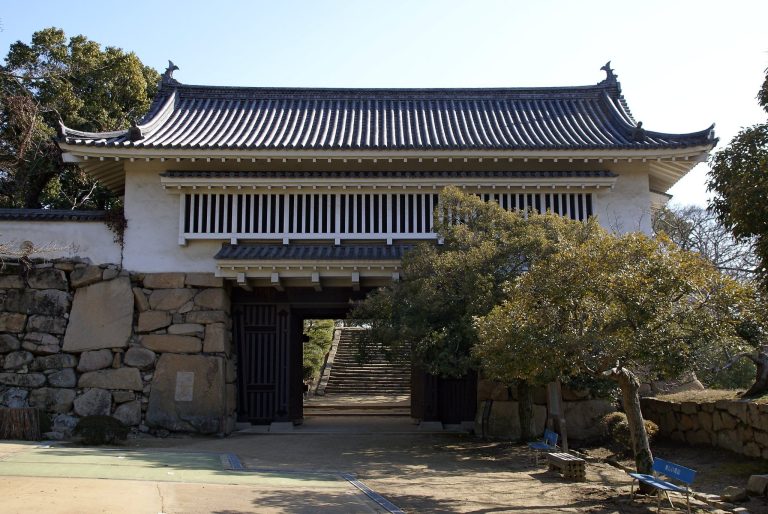
The Nio Gate is a two-story structure rebuilt in 1740. It is also the point associated with the concluding competition of Eyo, when a claimant carrying one of the sacred rods must reach outside the gate. The main hall, rebuilt in 1863, is the first station in the Kannon pilgrimage network associated with the temple.
Go-o-sho Hall complex
Built in 1880, the Go-o-sho Hall complex contains a worship hall, a connecting hall, a main hall, and an inner hall. The central altar holds the front image of Go-o-sho Daigongen, the temple’s protective deity, represented by the Five Great Wisdom Kings, powerful guardian figures of esoteric Buddhist ritual. Fudo Myoo and Bishamonten occupy the side positions. The right side position contains Konpira Daigongen together with Fudo Myoo and Bishamonten, while the left side position contains Hakugyoku Monju Bosatsu and Shomen Kongo. The inner hall houses the hidden image of Go-o-sho Daigongen.
Senju Hall and Ko-so Hall
The Senju Hall contains a seated Thousand-Armed Kannon measuring 2.5 meters in height. A Thousand-Armed Kannon is conventionally shown with many arms to express expansive powers of aid. The Ko-so Hall is traditionally dated to the late eighteenth century and enshrines Kobo Daishi, the posthumous religious name of Kukai, who is traditionally regarded as the founder of Shingon Buddhism in Japan.
Reception hall and sutra repository
The precinct also includes a reception hall and a hexagonal sutra repository. These buildings form part of the temple’s surviving institutional and ritual layout alongside the principal halls and gates.
Pagoda and bell structures
Three-story pagoda
The three-story pagoda was rebuilt in 1675. It houses Dainichi Nyorai, the cosmic Buddha of esoteric Buddhism, in the Womb Realm, one of that tradition’s two principal mandalas.
Stone Gate and Dragon Bell Tower
The Stone Gate is associated with the Dragon Bell Tower, built in 1819. The precinct’s purification place lies beyond the gate, where the women’s cold-water purification rite takes place during Eyo.
Bell-Tower Gate and Korean bell
The Bell-Tower Gate is traditionally dated to the late eighteenth century. Its Buddhist bell is known as the Bell of Bringing Good Fortune and is identified as the Korean bell. The bell is estimated to have been cast on the Korean Peninsula during the early Goryeo period, around the tenth century. It is 111.5 centimeters high and has a mouth diameter of 65.2 centimeters. Cast figures of celestial beings playing music and dancing decorate its surface.
The bell bears no inscription. Its date is estimated through comparison with a bell formerly kept at Naminoue Shrine in Okinawa. That bell, destroyed during the Second World War, shared the Saidai-ji bell’s design and carried an inscription dated 956. The Saidai-ji bell is therefore considered approximately contemporary with it.