Kameyama Hachimangū: A Shinto Hachiman Shrine in Shimonoseki


Site at a Glance
- Rating
- 4.3
- Popularity
- Low
- Country
- Japan
- Primary era
- Modern
- External website
- Open
- Eras represented
- Modern
- Civilizations
- Japanese
- Site type
- Religious
- Remains
- Sanctuary
On this page8 sections
History
Kameyama Hachimangū is a Shinto Hachiman shrine in Shimonoseki, Japan, traditionally founded in 859 during the ninth century. Hachiman is a major Japanese religious tradition centered on a kami associated with the imperial lineage, warfare, and the protection of communities. The shrine became a guardian of the Kanmon Strait, the chief guardian shrine of Shimonoseki, and the Third Shrine of Nagato Province.
Foundation and regional guardianship
The shrine’s foundation tradition appears in the Bōchō Shaji Yurai. In 859, the Buddhist monk Gyōkyō traveled from Usa toward Iwashimizu to transfer the Hachiman deity. When he anchored at Kameyama, then an island, a divine message identified the mountain as a pure place where the deity should be worshipped temporarily. A temporary shrine was consequently established there.
The enshrined figures are Emperor Ōjin, Emperor Chūai, and Empress Jingū, with Emperor Nintoku and Takeuchi no Sukune also included. Emperor Ōjin is traditionally identified with Hachiman, while the other figures belong to early Japanese imperial tradition. Successive local lords, including the Ōuchi and Mōri warrior houses, revered the shrine as a protector of the strait.
Institutional status and religious observances
Kameyama Hachimangū was classified as a village shrine in 1874 and elevated to prefectural-shrine status in 1890. In 1968, it was added to the Beppyo list of the Association of Shinto Shrines, a category for shrines regarded as especially significant within that organization’s system.
The annual festival takes place on October 15 and includes Kameyama Noh. Noh is a traditional Japanese masked theater form using stylized movement, music, chant, and drama. The Five Grains Festival and the Seki Lantern Festival are also principal religious observances at the shrine.
Barber tradition and contemporary practices
A tradition associated with the precincts concerns a samurai of the late Kamakura period who had served Emperor Kameyama. After taking responsibility for the loss of a treasured sword, he moved from Kyoto to Shimonoseki with his son. He later learned hairdressing and opened a shop in Nakanocho, where the shrine stands. The business became known by the trade name “barber shop” because a splendid altar occupied its alcove.
A monument commemorating the origin of the barber shop was erected in the shrine precincts in 1995. The Yamaguchi Prefecture Barbers’ Sanitation Trade Association holds an annual hair memorial service there. The shrine also receives high-school baseball players seeking victory and students praying for success in examinations. These visits are associated with a baseball that has remained lodged in the shrine’s torii name plaque since around 1958.
Remains
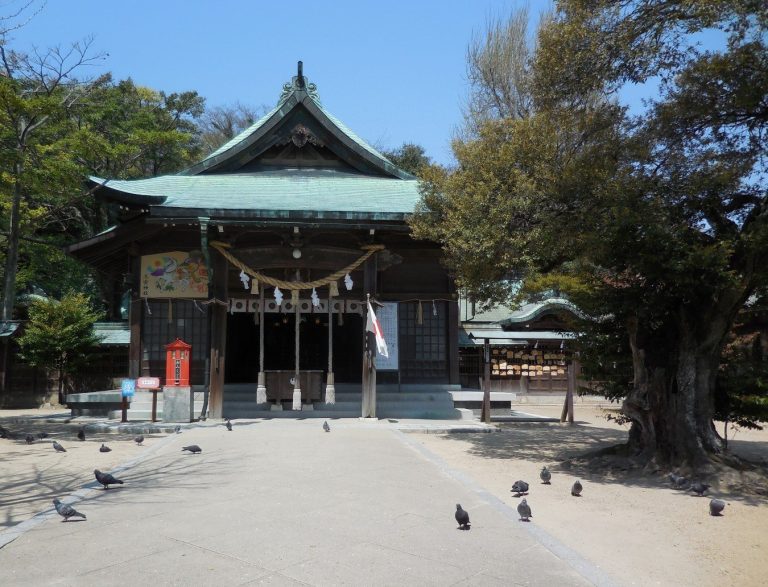
The precincts contain the shrine’s torii, worship hall, and monuments connected with the historic Sanyō Road and the local barber tradition. The Sanyō Road was a major route along the southern side of western Honshu, and its endpoint monument identifies the road’s terminal point.
Precinct structures and monuments
Torii and worship hall
The torii and worship hall form the principal built elements identified within the shrine precincts. The torii’s name plaque has a baseball lodged in the lower-left part of the character meaning “mountain.” The ball became stuck around 1958 and remains in place, giving the entrance a physical feature closely connected with the shrine’s continuing baseball and examination-success traditions.
Sanyō Road and barber-shop monuments
A monument in the precincts marks the endpoint of the Sanyō Road. Another, erected in 1995, commemorates the origin of the barber shop associated with the late Kamakura-period samurai tradition. Together, these monuments preserve historical associations between the shrine, regional transport, and a local trade custom.