Stutensee Palace: A Baroque Hunting Lodge in Germany
Site at a Glance
- Popularity
- Medium
- Country
- Germany
- Primary era
- Early Modern
- Eras represented
- Early Modern
- Civilizations
- Holy Roman Empire
- Site type
- Domestic
- Remains
- Elite Residence
On this page7 sections
History
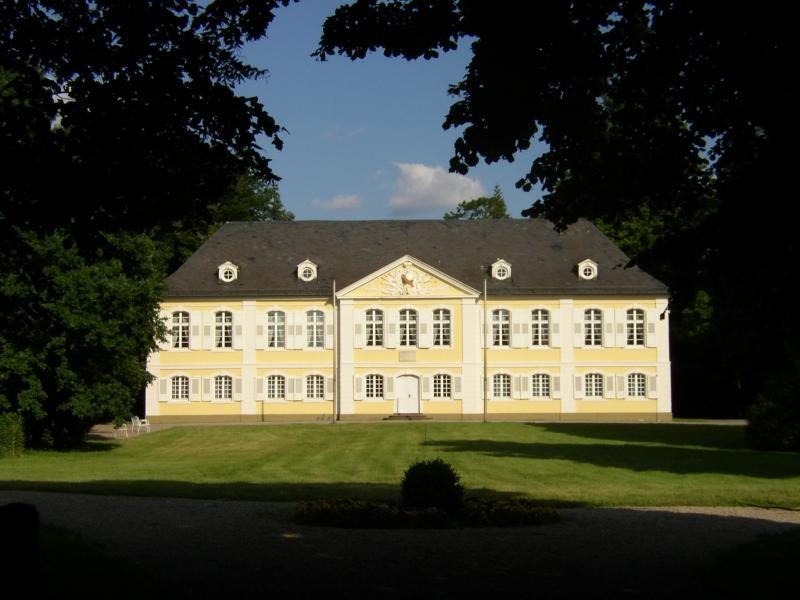
Stutensee Palace is a hunting lodge in Stutensee, Germany, built in 1749 under Karl Friedrich, a margrave (German territorial ruler) of Baden. Its design combines the Baroque, a European artistic and architectural style, with French Classicism, which favored classical forms, symmetry, and order.
Fishponds and stud farm
Around 1560, Margrave Karl II of Baden-Durlach created the Zwingelsee for fish farming, following the model of Gottesaue, a former Benedictine monastery in Karlsruhe. In 1652, Margrave Friedrich V of Baden-Durlach founded a stud farm nearby to support agriculture and territorial defense. The name Stutensee derives from this farm. Its stables were substantially expanded from 1669, and in 1677 Margravine Augusta, a woman of equivalent rank to a margrave, enlarged the farm by acquiring land and expanding the stables.
French forces destroyed Staffort’s moated castle in 1676 and 1689. Troops commanded by the French military leader Ezéchiel du Mas, comte de Mélac, blew up the castle, after which it was released for demolition. Stone from its ruins was later reused at Stutensee Palace.
Hunting lodge and palace
In 1721, Margrave Karl Wilhelm of Baden-Durlach built a hunting lodge between the stables. It was a square half-timbered building with an octagonal dome. In 1749, Margrave Karl Friedrich had the lodge renovated to plans by an Italian architect, and the palace was built as a pleasure pavilion or hunting lodge.
Municipality and present use
In 1975, Blankenloch, including Büchig, Friedrichstal, Spöck, and Staffort united as a municipality and adopted the name Stutensee. In summer 2004, ownership of the palace passed in equal shares to Karlsruhe District and Rhein-Neckar District. Karlsruhe District is now the sole responsible body for the Stutensee Palace Youth Facility, a charitable limited-liability company that provides care and educational support for girls and boys with socially related behavioral difficulties and impaired performance. Its staff includes educators, teachers, special-education professionals, social workers, and therapists. A unit in the Heinrich-Wetzlar-Haus supports young people who have committed offenses as they develop personal and vocational prospects as an alternative to the harmful effects of pretrial detention. The palace garden’s oaks are registered as natural monuments.
Remains
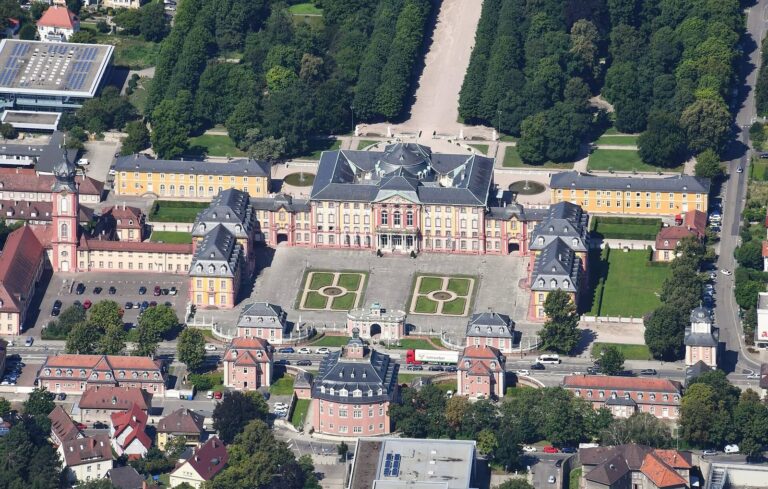
The site comprises the palace and ancillary buildings, a garden, and an associated fish-farming landscape. The palace stands near the geographic center of Stutensee and reflects the Baroque style of French Classicism.
Palace
The earlier hunting lodge was a square, half-timbered structure with an octagonal dome, positioned between the stables. Stone from Staffort Castle was reused in the palace’s construction, and ancillary buildings were added.
Garden and fishpond landscape
The palace garden contains old trees, including numerous oaks. The oldest oak is estimated to be about 900 years old. The Zwingelsee is a fish-farming lake associated with the stud farm’s setting near fishponds.