Karlsruhe Palace: The Baden Residence and State Museum in Germany


Site at a Glance
- Rating
- 4.6
- Popularity
- High
- Country
- Germany
- Primary era
- Early Modern
- External website
- Open
- Eras represented
- Early Modern, Modern
- Civilizations
- German, Holy Roman Empire
- Site type
- Domestic
- Remains
- Palace
On this page16 sections
History
Karlsruhe Palace is a late-Baroque palace in Karlsruhe, Germany, founded in 1715 as the new residence of Margrave Charles William of Baden-Durlach. Its foundation stone was laid on 17 June 1715, the same day Charles William founded Karlsruhe. The palace became the center of a city whose avenues spread outward in a fan-shaped plan, recalling the rays of the sun and placing the ruler’s residence at the heart of the new capital.
Foundation of Karlsruhe
A traditional story says that Charles William dreamed while hunting of a palace shining like the sun, surrounded by radiating streets. Behind this legend lay practical political and military circumstances. From 1709, the margrave had faced conflict with the inhabitants of Durlach. His earlier residence, Karlsburg, had been destroyed during the Nine Years’ War, and an attempt to rebuild it was abandoned in 1703 because the site offered too little space. The new capital gave Charles William room to establish a residence and to present his authority through a carefully planned urban setting.
The first palace was constructed between 1715 and 1718 under the architect Jakob Friedrich von Batzendorf. It served as the official residence of the margraves of Baden-Durlach and later of the grand dukes of Baden. When Baden became a grand duchy during the Napoleonic Wars, the palace retained its role as the dynastic residence until the end of the German monarchies in 1918.
Eighteenth-century rebuilding
A major transformation began during the reign of Charles Frederick of Baden. Friedrich von Kesslau directed the principal work, which followed designs associated with Leopoldo Retti and Balthasar Neumann. Philippe de La Guêpière became building director after 1771. The campaign continued from the mid-eighteenth century until 1781. The external work was completed around 1770, while the interiors were finished in 1775, giving the palace the form that defined its later appearance.
Charles Frederick and his wife, Caroline Louise of Hesse-Darmstadt, maintained a court shaped by Viennese etiquette and strong French cultural preferences. Parisian furniture was acquired in large quantities, private apartments were arranged in the west wing, and summer apartments were created in the northeast pavilion. The gardens were later partly redesigned in the English manner. Court life included major celebrations and visits by Goethe, the prominent German writer, and Voltaire, the prominent French writer.
Napoleonic and nineteenth-century changes
During the Napoleonic Wars, Baden became a grand duchy and annexed numerous territories. French interference in state affairs and economic difficulties weakened the country, while the palace continued to serve as the seat of the ruling family. Friedrich Weinbrenner restored the palace chapel in 1801 and remodeled the throne room in 1806. After Stéphanie de Beauharnais, a French-born member of the Napoleonic imperial family, moved into the palace as grand duchess, further work between 1811 and 1814 introduced apartments in the Empire style associated with the Napoleonic period.
Grand Duke Leopold was temporarily forced to leave the palace with his family during the Revolution of 1848–1849, a wave of political unrest that challenged established European monarchies. The palace remained the dynastic seat until 1918. That year, the German monarchies were abolished, Friedrich II abdicated as the last grand duke of Baden, and the grand-ducal family left Karlsruhe.
Museum and reconstruction
The palace became a museum in 1919, and the Badisches Landesmuseum has occupied it since 1921. The state museum presents collections covering approximately 5,000 years of history. Its presence transformed the former residence from a dynastic seat into a public institution devoted to historical and archaeological collections.
On 27 September 1944, a British bombing raid set the palace on fire, and it burned for two days. The museum collections had been evacuated beforehand, but the Baroque and Neoclassical interiors were destroyed. The surviving exterior walls made reconstruction possible, and work began in 1955. Reconstruction continued until 1966. It restored the external appearance while inserting new concrete floors and museum exhibition spaces rather than recreating the historic enfilades, a sequence of rooms aligned through connecting doorways, or the ceremonial interiors.
The facade later underwent comprehensive renovation before Karlsruhe’s 2015 city anniversary. The palace and gardens remain the historical center of Karlsruhe’s fan-shaped urban plan. The nearby Schlossbezirk also contains the Federal Constitutional Court of Germany, the country’s highest court for constitutional matters.
Remains
Palace layout and exterior
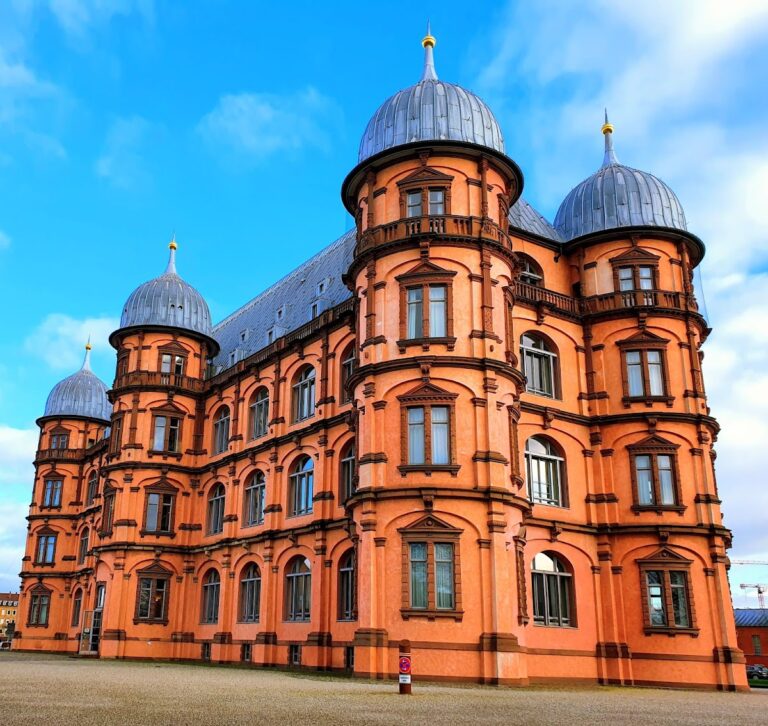
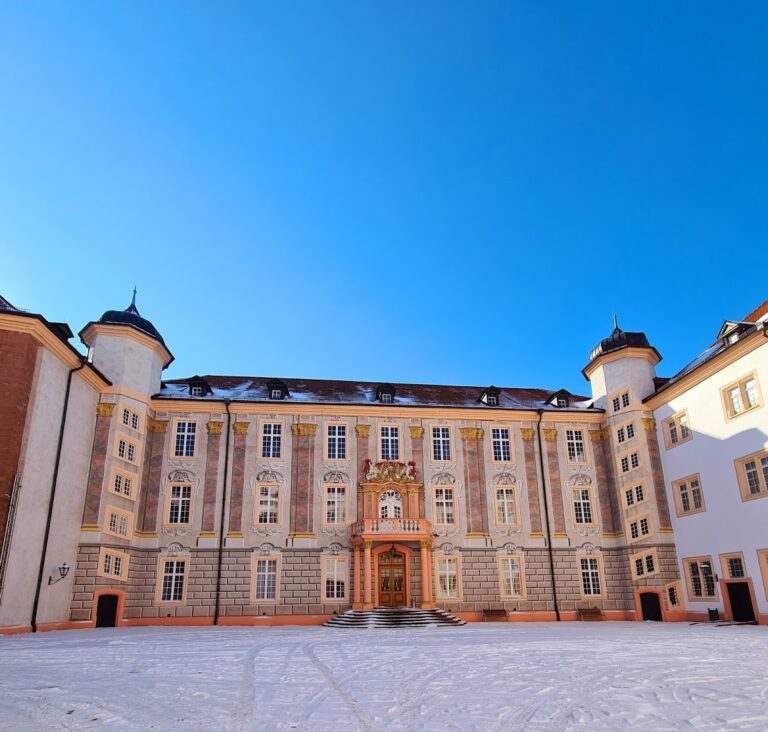
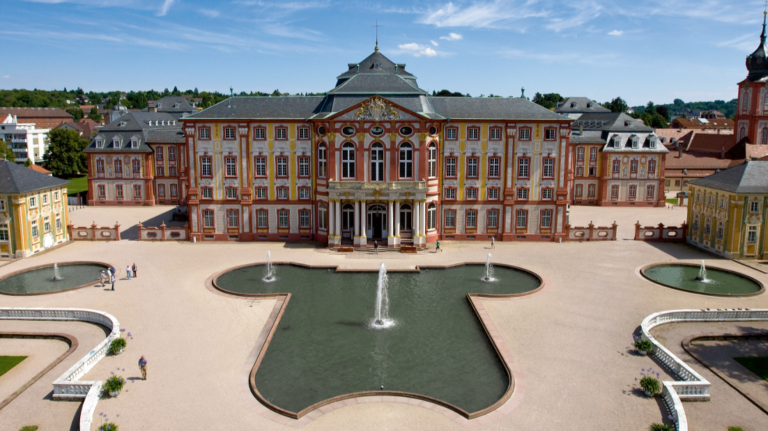
Karlsruhe Palace is a three-wing late-Baroque complex organized around a central corps de logis, the principal block of a palace, with two long oblique side wings. The first building had two stories, a mansard roof, and half-timbered construction concealed behind stucco and plaster. During the eighteenth-century rebuilding, much of the palace was reconstructed in stone. The later design retained the basic arrangement while adding two pavilion buildings between the central block and the side wings, larger windows and doors, and a Baden coat-of-arms relief on the ceremonial courtyard facade.
Palace tower
A seven-story tower originally stood free of the central block on its north side and was linked to the palace by open wooden galleries. It rises approximately 51 meters. Its viewing platform, associated historically with the name Bleiturm, stood about 42 meters above ground and offered views toward Karlsruhe, the Black Forest, and the Palatinate Mountains. The tower was shortened and crowned with a dome in 1785 in work associated with Wilhelm Jeremias Müller. Before that alteration, it was the only major element of the earlier structure retained unchanged.
Historic interiors
The palace interiors combined Rococo rooms, an eighteenth-century style known for light ornament and elaborate decoration, with later Empire-style apartments. Principal spaces included the Garden Hall on the ground floor of the tower wing, the Marble Hall on the upper floor of the central wing, and the court chapel in the east wing. The chapel was built between 1719 and 1723 by Johann Michael Ludwig Rohrer.
Marble Hall
The Marble Hall extended through two stories and took its name from walls faced with imitation marble made from stucco. It served official occasions and had additional reception rooms on both sides. Court painter Joseph Melling created its ceiling painting, which depicted the birth of Venus. The fire of 1944 destroyed the historic Baroque enfilade and the principal ceremonial interiors. Photographs, particularly those made by former court photographer Wilhelm Kratt, preserve evidence of their prewar appearance.
Royal furnishings and regalia
The Baden throne moved among different rooms at different periods. The Baden throne and the Baden crown jewels survived the wartime destruction and are kept in the palace. The reconstructed building now accommodates the museum’s exhibition spaces rather than a recreation of the former ceremonial sequence.
Palace gardens and surrounding features
The north side of the palace opens toward the palace gardens, which occupy the northern half of the circle forming Karlsruhe’s central plan. Christian Thran laid out the gardens between 1731 and 1746 in the French Baroque manner, with strong geometric organization and controlled planting. During the eighteenth century, parts of the grounds were converted into an English landscape garden under Grand Duke Charles Frederick, introducing a more naturalistic composition.
Garden structures
The gardens were renewed and extended for the 1967 Federal Horticultural Exhibition. They contain rare tree species, sculptures, monuments, fountains, and Chinese pavilions, together with structures from several periods. These include the grand-ducal funeral chapel, the Karlsruhe Botanical Garden, and the Karlsruhe Palace Garden Railway, which began operating in 1967.
Park connections and public art
Since 2001, a band of 1,645 blue majolica tiles has extended from the palace tower to the majolica manufactory at the edge of the palace park. Majolica is decorated earthenware, often brightly glazed for architectural or artistic use. Other buildings associated with the park include the majolica manufactory, Wildparkstadion, buildings of the Karlsruhe Institute of Technology, and the Federal Constitutional Court complex. The palace square contains a copy of Hercules and the Dragon, based on a sculpture made in 1767 by Ignaz Lengelacher.
Museum collections
The Badisches Landesmuseum occupies the reconstructed palace and presents material from prehistoric times through later European and non-European history. Its displays include Roman galleries, medieval collections, Byzantine, Etruscan, Greek, and Early Christian objects, a former margravial cabinet of curiosities, and an armory.
Turkenbeute
The museum also holds the Turkenbeute, or “Turkish Spoils,” consisting mainly of weapons and horse equipment taken by a margrave who participated in an Ottoman war. These objects form part of the palace’s surviving material collections and connect the former court residence with the military and collecting history represented by the museum.