Church of Saint John the Baptist in Budva: A Catholic Co-Cathedral


Site at a Glance
- Rating
- 4.7
- Popularity
- Medium
- Country
- Montenegro
- Primary era
- Medieval
- Eras represented
- Medieval, Early Modern, Modern
- Civilizations
- Byzantine, Habsburg, Serbian, Venetian
- Site type
- Religious
- Remains
- Cathedral
On this page10 sections
History
The Church of Saint John the Baptist in Budva, Montenegro, is a medieval Gothic Christian church whose origins reach back to the early Christian period. A church stood on the site by the seventh century, while another dating places its earliest construction in the eighth or ninth century. The present cathedral was erected around AD 1200, probably in the late twelfth or early thirteenth century.
Budva’s Medieval Cathedral
Between AD 1089 and the middle of the twelfth century, Budva became the permanent seat of a bishop, and the Church of Saint John the Baptist became its cathedral. Sylvester, recorded around AD 1143, was the first known bishop of Budva. The creation of the bishopric led to a jurisdictional dispute between the archbishoprics of Bar and Dubrovnik.
The church remained the seat of the Budva bishopric until the bishopric was abolished in 1828. Saint John the Baptist, the Christian prophet and religious figure to whom the church is dedicated, was also regarded as Budva’s patron. Before Venetian rule, his image appeared on the city’s coat of arms and flag. The Budva statute required the payment of 100 perpera and four denarii to the emperor on the saint’s feast day.
Damage, Restoration, and Episcopal Use
The building was damaged repeatedly by earthquakes and also suffered during the Ottoman conquest. The earthquake of 1667 caused major destruction, followed by extensive repair and restoration. Much of the appearance seen today probably reflects that seventeenth-century work, although the exact sequence of the earlier construction and rebuilding remains poorly understood.
A relief inscription on the west facade states that the cathedral acquired its present appearance in 1640. Its operation soon afterward is associated with the tombstone of the apostolic vicar Franje Cruta, a cleric appointed to govern a Catholic community on behalf of the pope. He died on 30 November 1645. His tombstone was first placed in the main body of the cathedral and was later moved to the sacristy.
During the last quarter of the seventeenth century, Andrija Zmajević, Archbishop of Bar, administered the Diocese of Budva. During his administration, a fragment of the True Cross and other sacred relics were reportedly found in Budva and placed in the church. The True Cross is the Christian relic traditionally identified as part of the cross on which Jesus was crucified.
Relics and Later Catholic History
A document dated 3 May 1719 describes a sealed chest containing relics and a second turquoise wooden chest decorated with gold stars. The latter held a piece of wood inscribed “Lignus Sanct Crucis.” The turquoise chest no longer survives, but the True Cross fragment remains in the cathedral inside a gilded-silver, cup-shaped reliquary, a container made to preserve and display a religious relic.
The same 1719 document listed two pewter vessels containing holy oil, two crucifixes, a tabernacle, a marble statue of the Virgin Mary, a wooden statue of Christ, a gilded throne, a Holy Sepulchre, and a canopied throne left by Budva captain Giovanni Corner. These listed objects no longer survive.
In 1807, shortly before Napoleon’s army arrived, the icon known as Madonna in Punta was transferred into the church. The episcopal residence remained the seat of the bishops of the Primorska diocese, the historical Catholic diocese of the coastal region, until 1828. The church is now a Roman Catholic co-cathedral of the Diocese of Kotor, meaning that it shares cathedral status with another church, and it serves as the seat of the Budva Deanery, an administrative district grouping several parishes under a dean.
The cathedral was placed under state protection in 1948 and entered Montenegro’s special cultural-monuments register in 1961. It remains an active Catholic church and a cultural monument of Montenegro.
Remains
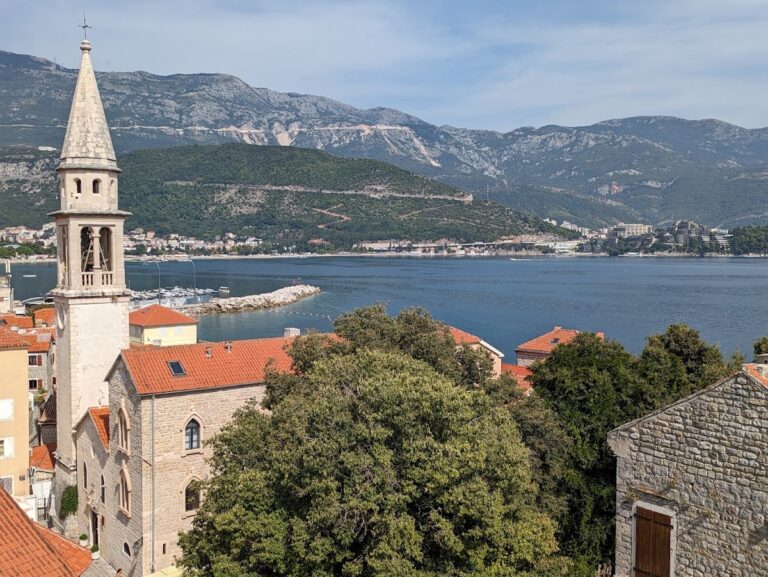
The church stands in Budva’s Old Town beside the largest square in the historic city, now called Trg Starogradskih Crkava. The complex forms the largest religious building in the Old Town and is associated with the churches of the Holy Trinity, Saint Sava, and Santa Maria in Punta. The main building is a medieval Gothic basilica, a church with a long central space and side aisles, constructed in brick. Its oldest surviving building material dates from the eleventh century.
Church Layout and Episcopal Palace
The church is described as a three-aisled building with a nave, two side altar chapels, a sacristy, and a choir. An episcopal palace is attached to the complex. It rises above the southern side chapel in two additional stories, with its view facing toward the Citadel. Together, these elements preserve the relationship between the cathedral church and the former episcopal residence.
Bell Tower
The square-plan bell tower stands north of the church. Built in 1867 to designs by the Tyrolean architect Lucchini, it rises 36 metres and contains bells and a clock on its facade. The tower visually dominates the surrounding Old Town and forms a later addition to the medieval church complex.
Frescoes and Altars
The interior was once decorated with frescoes, and fragments survive in the lower parts of the walls. They include fourteenth-century paintings attributed to Greek painters. A tombstone dated 1330, found in the presbytery, the area around the main altar reserved traditionally for clergy, supports the dating of this phase of interior decoration.
The southern part of the church contains the altar of Our Lady of Health, with a seventeenth-century image of that dedication, as well as the altar of the Holy Cross. The latter holds an image of the Baptism of Christ painted in 1835 by Florian of the Venetian school, the influential painting tradition associated with Venice. The work formerly belonged to the main altar.
The Budva Madonna
A marble altar in the northern chapel holds the icon known as Sancta Maria in Punta, Sancta Maria Buduensis, Madonna in Punta, or the Budva Madonna. It shows the Virgin Mary with Christ and is regarded as miraculous. The icon is considered one of the oldest and most venerated icons in Montenegro and the surrounding region. Probably dating from the twelfth or thirteenth century, it is thought to have been made in Greece or southern Italy. It was formerly kept in the nearby monastery church of Santa Maria in Punta and is now held in a silver frame.
Mosaic and Relic
Behind the main altar is a surviving mosaic measuring about 40 square metres. Made from Murano glass, it depicts Saint John the Baptist with raised hands in the pose of a preacher. The mosaic was painted by the Croatian artist Ivo Dulčić.
The church also preserves the True Cross fragment in its gilded-silver, cup-shaped reliquary. Its present container preserves the relic described in the 1719 inventory, while the turquoise wooden chest in which the fragment was then recorded has disappeared.
Nearby sites