Podlastva Monastery: A Serbian Orthodox Monastic Center in Montenegro


Site at a Glance
- Rating
- 4.8
- Popularity
- Low
- Country
- Montenegro
- Primary era
- Medieval
- Eras represented
- Medieval
- Civilizations
- Serbian
- Site type
- Religious
- Remains
- Monastery
On this page11 sections
History
Podlastva Monastery is a Serbian Orthodox monastery in Montenegro, at Lastva Grbaljska, whose foundation in 1350 is traditionally attributed to Emperor Stefan Dušan. Associated with the medieval Nemanjić dynasty and Byzantine rite, it was established as a male monastery dedicated to the Mother of God on the site of an earlier Christian church believed to date from the fifth century.
Medieval foundation and regional role
In the early fourteenth century, King Stefan Uroš II Milutin transferred the Grbalj region to Kotor. Local tradition connects the monastery’s foundation with Stefan Dušan, the Nemanjić ruler who was proclaimed emperor in 1346. Podlastva was first mentioned in written documents in 1417, and the Grbalj Statute was written there in 1427.
The monastery served as a gathering place for the people of Grbalj and became a religious, cultural, and political center. Important political and religious decisions were made there. Its activities also included a local school, while its extensive library supported the intellectual life of the community.
Destruction and restoration
During a series of uprisings and revolts in Grbalj, the monastery was repeatedly pillaged and destroyed. It was probably destroyed in 1452, the year when the Monastery of Saint Michael the Archangel on Prevlaka also suffered destruction. Located in a malarial area on the edge of Mrčevo Polje, Podlastva remained in ruins for a long period. Its popular name refers to its position below or downhill from the village of Lastva and was formerly written as “Pod-Lastva.”
The monastery was restored in 1700 and again became the Orthodox spiritual center of the region. During the Napoleonic Wars, Metropolitan Peter I Petrović-Njegoš, the ruler and metropolitan of Montenegro, negotiated with the French army there. In 1736, the Herceg Novi goldsmith Radić made a gilded silver vessel with five loaves for the monastery, and an abbot named Georgije was recorded there in the same year.
Mitrofan Ban served as a monk and abbot-administrator from 1867 to 1869. Austrian soldiers burned the monastery in 1869 during the Bokelj Uprising, an uprising against Austrian rule in the Bay of Kotor region. The complex was rebuilt in 1874 but suffered severe damage again during the First World War.
Twentieth-century rebuilding and current community
In 1930, Boško Strika called for the ruined monastery to be restored. It was rebuilt and resettled by monks in 1936. Protosyncellus Varnava, a senior cleric with administrative responsibility, served as its superior, and Archimandrite Dionisije Miković was transferred there from Banja at the beginning of 1941.
An earthquake severely damaged the monastery in 1979. The damage was partly rehabilitated in 1984, followed by further rebuilding. Konstantin Knežević served as abbot from 1968 to 1991. In 1992, Serbian Patriarch Pavle attended a funeral in the monastery courtyard for 80 people from Grbalj, Maini, Budva, Pobori, and Paštrovići who had been killed by their own compatriots in 1944.
Residents of Grbalj founded the Society for the Restoration of Podlastva Monastery in 1996. The former male monastic community is now a women’s monastery under the Metropolitanate of Montenegro and the Littoral and affiliated with the Serbian Orthodox Church. Doroteja Delić, formerly of Duži Monastery, served as abbess. Since 8 July 2023, Father Justin Mrenović has been the superior, with the sisterhood under his leadership. The monastery remains an active religious institution.
Remains
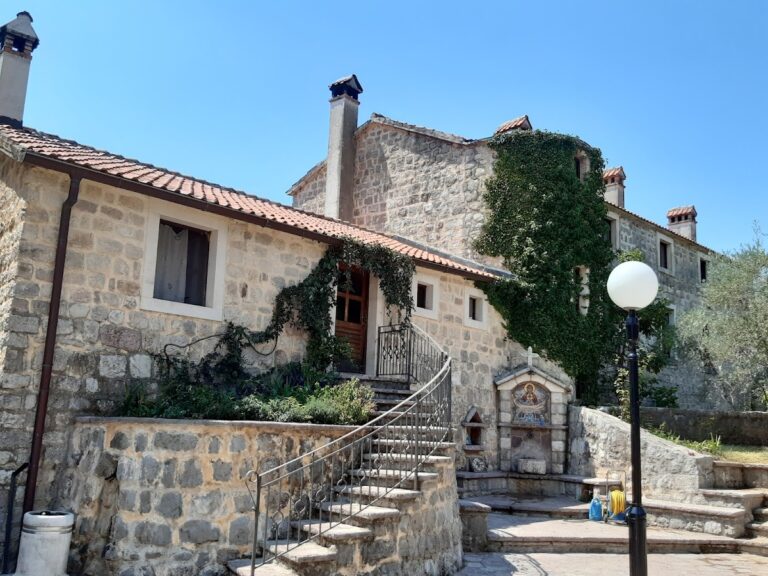
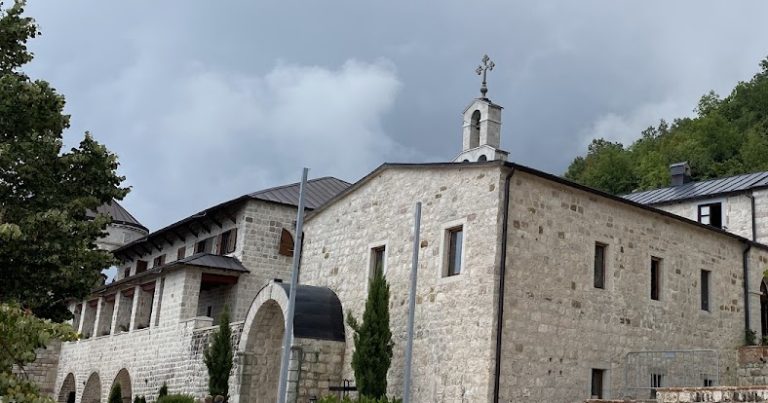
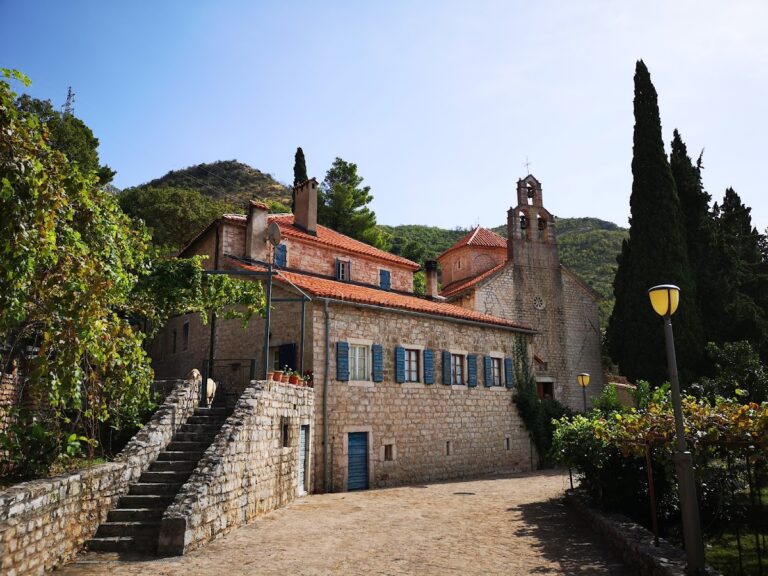
The surviving complex centers on a simple single-nave stone church beneath a tiled roof. Its eastern end has a semicircular apse, while the western front is formed by a portal, a bell tower, and a separate narthex, or entrance vestibule. The narthex is structurally connected to both the nave and an adjoining monastery building, linking the church to the wider complex.
Church and monastic buildings
Church of the Nativity of the Theotokos
The church is dedicated to the Nativity of the Theotokos, the Christian feast commemorating the birth of Mary, the mother of Jesus. Stone masonry forms the walls, and both the nave, the main congregational space, and the narthex have barrel vaults, continuous tunnel-like ceilings. The building’s present form reflects repeated rebuilding after destruction caused by conflict and natural disaster.
Monastic quarters
The monastery buildings include residential quarters, traditionally called konaks, which formerly housed a school. Their connection with the church forms part of the surviving monastic complex and recalls Podlastva’s earlier educational role in the Grbalj region.
Interior features
Iconostasis
The church’s iconostasis, the screen of icons separating the sanctuary from the nave in Eastern Christian churches, was painted in 1747 by Đorđe Dimitrijević. The present iconostasis includes modern icons.
Frescoes
The church formerly contained notable frescoes dating from the fifteenth and seventeenth centuries. The 1979 earthquake destroyed these historic paintings, while the monastery itself was rebuilt after the disaster and partly rehabilitated in 1984.