Stanisław Żółkiewski Memorial: Commemorating His Death in 1620
Site at a Glance
- Popularity
- Medium
- Country
- Moldova
- Primary era
- Early Modern
- Eras represented
- Early Modern, Modern
- Civilizations
- Ottoman, Principality of Moldavia, Russian
- Site type
- Civic
- Remains
- Obelisk
On this page6 sections
History
The Stanisław Żółkiewski Memorial stands on Saucii Hill in Moldova, marking the place where the Polish-Lithuanian commander was killed in 1620.
The battle and the memorial’s creation
The conflict followed the 1617 Treaty of Bușa. The Polish-Lithuanian Commonwealth, a state joining the Polish Crown and the Grand Duchy of Lithuania, agreed to give up Khotyn, avoid interference in Moldavia, Wallachia, and Transylvania, and curb Cossack raids into Ottoman territory. Moldavia was a historic principality in the area of present-day Moldova and Romania. The Ottoman side promised to stop Tatar raids into Polish lands. Neither side fulfilled the terms, and the Ottoman Empire declared war in 1620.
At the Second Battle of Cecora, the Polish-Lithuanian army, led by the hetmans (senior military commanders) Żółkiewski and Koniecpolski, was defeated. Its roughly 10,000 soldiers included a small detachment led by Moldavian ruler Gaspar Graziani. As the survivors retreated toward the Dniester, Tatars harassed them. Near Sauca, less than 10 km from the river, the force camped for the night and was ambushed. Żółkiewski was killed. His head was sent to the Ottoman court, displayed in Constantinople, and ransomed two years later.
Żółkiewski’s widow funded a memorial at the place of his death, and their son Jan undertook its construction in 1621. He brought stonemasons from Mogilev under the guard of his armored cavalry. Construction had unofficial consent from the Moldavian ruler of the territory and commanders of nearby Ottoman garrisons. Żółkiewski’s remains were buried at the parish church in Żółkiew, not at the memorial.
Recognition, destruction, and rebuilding
In 1837–38, military governor Pavel Fiodorov ordered an inventory of Bessarabia’s historical monuments. Bessarabia is a historic region now divided mainly between Moldova and Ukraine, and the memorial was included in the inventory. By then, the inscription was difficult to read and some letters were missing. Architect F. Gasket attached an early drawing to the report. The memorial was among the earliest structures in what is now Moldova to be recognized as a historical monument.
In 1868, a resident of a nearby village destroyed the monument while searching for supposed treasure and also dug into the mound beneath it. A social committee formed in 1903 to rebuild it. Reconstruction took place from 1908 to 1912 and was probably completed in 1912. Meanwhile, Żółkiewski’s tomb at the parish church was reopened in 1905, and his remains were placed in a new sarcophagus there in 1908.
The memorial later deteriorated for lack of protection, and restoration was completed in 2003. It is recognized in Moldova as a historical monument of national importance.
Remains
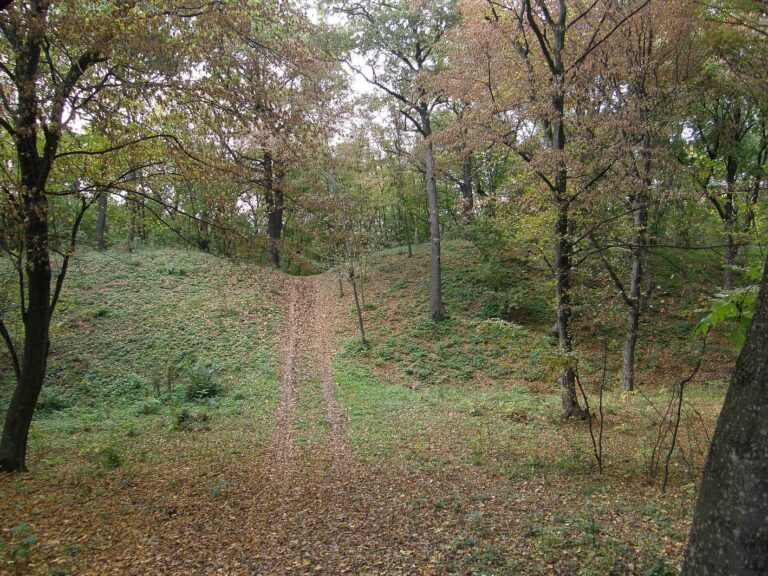
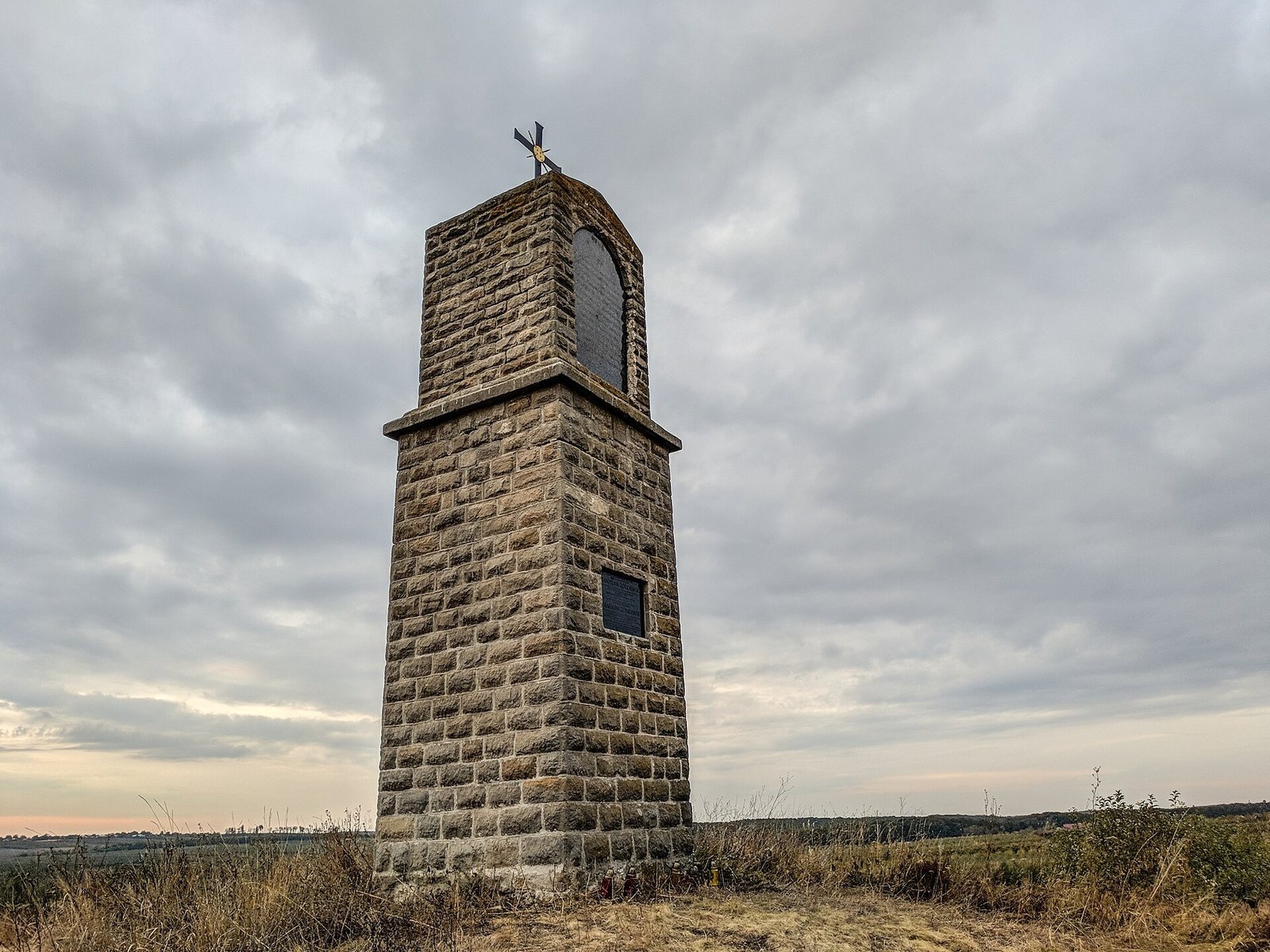
The memorial occupies Saucii Hill, about 500 m south of the edge of Berezovca and 2.3 km east of Sauca. Because Berezovca was founded only in 1928, the locality was earlier associated with Sauca or Sudarca. The present monument stands on a mound, with an obelisk and cross rising above it.
The original column and mound
The original monument was a four-sided stone column on a small burial mound containing the remains of people killed at the Battle of Cecora. A plaque listed Żółkiewski’s service to his homeland and bore the Latin motto Quam dulce et decorum est pro patria mori, meaning “How sweet and fitting it is to die for one’s country.” A drawing by nineteenth-century artist Napoleon Orda records the column’s appearance.
The present obelisk
The current monument is an obelisk 8.45 m high, topped by a forged cross measuring 1.40 m. It stands on a mound 20 m in diameter and 2 m high. The monument carries a Latin plaque installed in 1912 and another plaque with text in Polish and Romanian.