Lyadova Monastery: A Rock-Hewn Orthodox Monastery in Ukraine


Site at a Glance
- Rating
- 4.7
- Popularity
- Low
- Country
- Ukraine
- Primary era
- Medieval
- Eras represented
- Medieval, Early Modern, Modern
- Civilizations
- Kievan Rus, Polish–Lithuanian Commonwealth, Russian
- Site type
- Religious
- Remains
- Monastery
On this page11 sections
History
Lyadova Monastery is a male monastery of the Ukrainian Orthodox Church in Lyadova, Ukraine, dedicated to the Beheading of Saint John the Baptist. Tradition attributes its foundation in 1013 to Saint Anthony of the Caves, an eleventh-century Eastern Christian monk associated with the origins of the Kyiv Cave Monastery, who was supposedly returning from Mount Athos and Constantinople to Kyiv. The monastery’s first recorded chronicle reference dates to 1159, in an account of Prince Ivan Berladnyk’s campaign in the Lower Dniester region.
Medieval and early modern phases
The monastery remained connected with the religious and political history of the region. In 1649, its abbot Pavel and the hieromonk Nikifor became the first envoys sent by Bohdan Khmelnytsky to Tsar Alexei Mikhailovich of Moscow. Khmelnytsky was the Cossack leader whose uprising established a Cossack polity in central and eastern Ukraine, while Alexei Mikhailovich ruled Russia from 1645 to 1676.
Following the Ottoman conquest of Podolia in 1672, the monastery ceased operating for 27 years. After the Ottoman forces were expelled, two new rock churches were consecrated there, dedicated to the Beheading of Saint John the Baptist and Saint Paraskeva Pyatnitsa. During the eighteenth century, the monastery entered into ecclesiastical union with Rome and belonged to the Basilians, an Eastern Catholic monastic order serving Byzantine-rite communities. It was closed in 1745.
Restoration and destruction
The monastery was restored as an Orthodox institution during the nineteenth century. By that time, its ensemble comprised three cave churches dedicated to the Beheading of Saint John the Baptist, Saint Paraskeva Pyatnitsa, and Saint Anthony of the Caves. In the late nineteenth century, the caves were enclosed by a new parish church dedicated to Saint Nicholas. The monastery was then renowned for an ancient wonder-working icon depicting the Finding of the Head of John the Baptist.
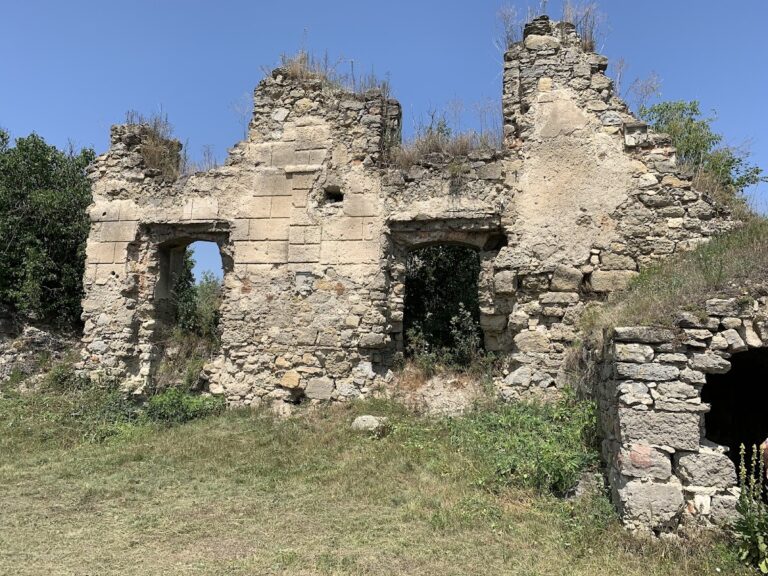
During the 1930s, the Bolsheviks, the communist faction that seized power in Russia in 1917 and established the Soviet government, destroyed and desecrated the monastery’s main churches. Some books and icons were transferred to the church in Sloboda-Yaryshivska. Other objects were looted and permanently lost, including unique icons painted by the Kyiv artist Dudkevych on zinc plates.
In 1998, a group of monks from the Pochaiv Lavra, a major Orthodox monastic complex in western Ukraine, revived the monastery. On 22 October 2022, during a large-scale Russian missile attack on Ukraine, a monk was killed by the blast wave from one of the missiles that had been shot down. The blast also damaged parts of the monastery’s interior. Lyadova Monastery is listed in Ukraine’s National Register of Immovable Monuments.
Remains
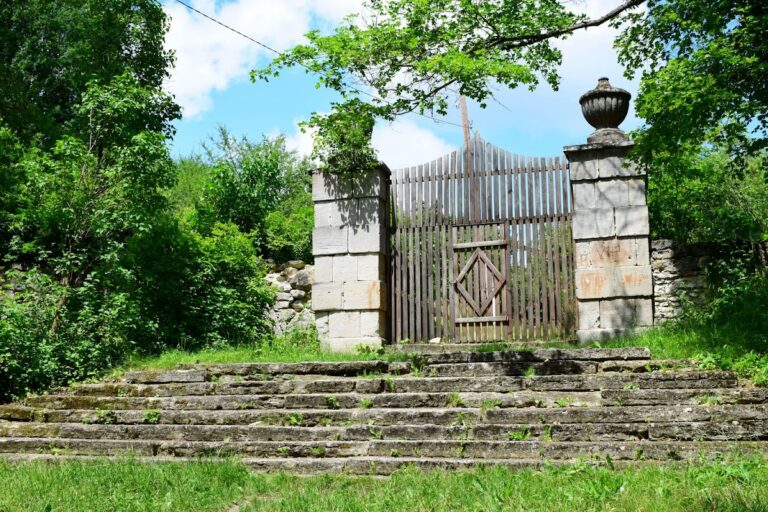
The monastery occupies a rock terrace on a mountain rising 90 metres above the left bank of the Dniester, near Lyadova and beside a bend in the river. Its physical character is shaped by caves and churches cut into or established within the rock. The principal grotto churches occupy adjoining cavities and are linked by a passage, while later buildings were constructed around the earlier rock-hewn spaces.
Rock-hewn churches and caves
Anthony’s cell
According to tradition, Saint Anthony of the Caves carved a cell for himself into the rock. Known by his name, the cell is regarded as one of the monastery’s most venerated places, and its exterior is said to have remained unchanged for roughly a millennium. An associated spring is known as Anthony’s Spring. Springs in the monastery’s surroundings are reputed to have healing water.
Churches of Saint John and Saint Paraskeva
The churches of Saint John the Baptist and Saint Paraskeva Pyatnitsa occupy two adjoining grottoes with complex ground plans. A passage connects the two spaces, joining the churches within the rock terrace. In 1848, a side chapel was added to the Church of Saint John the Baptist, and its upper level served as a bell tower.
Church of Saint Anthony
The grotto church of Saint Anthony of the Caves stood beside the churches of Saint John the Baptist and Saint Paraskeva Pyatnitsa. It is dated to 1894 and formed part of the nineteenth-century arrangement of the monastery’s cave churches.
Parish church and associated objects
Church of Saint Nicholas
The late-nineteenth-century parish church of Saint Nicholas was a two-storey square building with a low octagonal upper structure. It enclosed the earlier caves, placing the rock-hewn sacred spaces within a later architectural shell.
Icons and interior damage
The monastery’s associated objects included the ancient wonder-working icon of the Finding of the Head of John the Baptist. The collection also included icons painted by Dudkevych on zinc plates, although these were looted and permanently lost during the destruction of the 1930s. The 2022 blast wave shattered windows, damaged the iconostasis, the screen separating the sanctuary from the main worship space, and dislodged a chandelier used in the church.
Nearby sites