St. Vitus (Langweid am Lech): A Roman Catholic Parish Church in Bavaria

Site at a Glance
- Rating
- 4.7
- Popularity
- Very Low
- Country
- Germany
- Primary era
- Early Modern
- External website
- Open
- Eras represented
- Medieval, Early Modern
- Civilizations
- Holy Roman Empire
- Site type
- Religious
- Remains
- Church
On this page8 sections
History
St. Vitus (Langweid am Lech) is a Roman Catholic parish church in Germany, rebuilt in the early Neoclassical period between 1776 and 1777. Dedicated to Saint Vitus, an early Christian martyr traditionally honoured as one of the Fourteen Holy Helpers, it stands at the highest point of the village, where its position protected it from flooding.
Roman and medieval origins
Modern excavations have confirmed that the Romans established a military station near Langweid during the first century AD to guard the Via Claudia Augusta. Since the Early Middle Ages, a church dedicated to Saint Vitus is thought to have occupied the site of the present building, although details of this earlier church are unknown.
A papal bull of 1143 lists Langweid among the possessions of the Augsburg Cathedral Chapter. This corporate body of clergy governed the cathedral and its endowment. Through donations and purchases, it enlarged its holdings in Langweid and exercised manorial authority there until secularization in 1803, when many ecclesiastical properties and rights passed to secular authorities. The chapter also held the right of patronage over the church. In 1551, Marquard II, who later became provost of Augsburg Cathedral and bishop of Augsburg, led the Langweid parish for two years.
Baroque changes and rebuilding
The medieval church was a chancel-tower church, a form in which the tower rises over or beside the eastern part containing the main altar. It received a new high altar in 1677, a new pulpit in 1694, and new side altars in 1741. In 1727, the master mason Hans Socher of Gersthofen extended the nave.
From 1776 to 1777, most of the medieval church was demolished and replaced under the direction of Johann Martin Pentenrieder, the prince-bishop’s court architect. The square lower part of the tower and the foundations of the nave were incorporated into the new structure. The church was solemnly consecrated in 1778. Reconstruction of the Langweid rectory began in 1781.
Modern conservation
Repairs and renovation took place from 1959 to 1961 and again in 1978. More extensive renovation and restoration followed between 2007 and 2010. St. Vitus is protected as an architectural monument in Bavaria.
Remains
Plan and tower
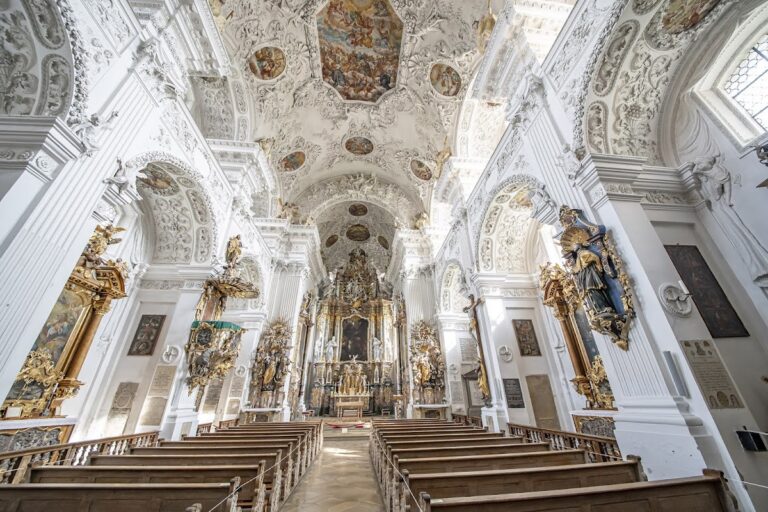
St. Vitus has a centrally planned layout shaped by the rebuilding of 1776 and 1777. A strongly projecting central section is covered by an illusionistic false dome, a painted representation of a dome rather than a structural one. The square choir and square western annex also carry frescoed false domes, while the western annex contains a double gallery.
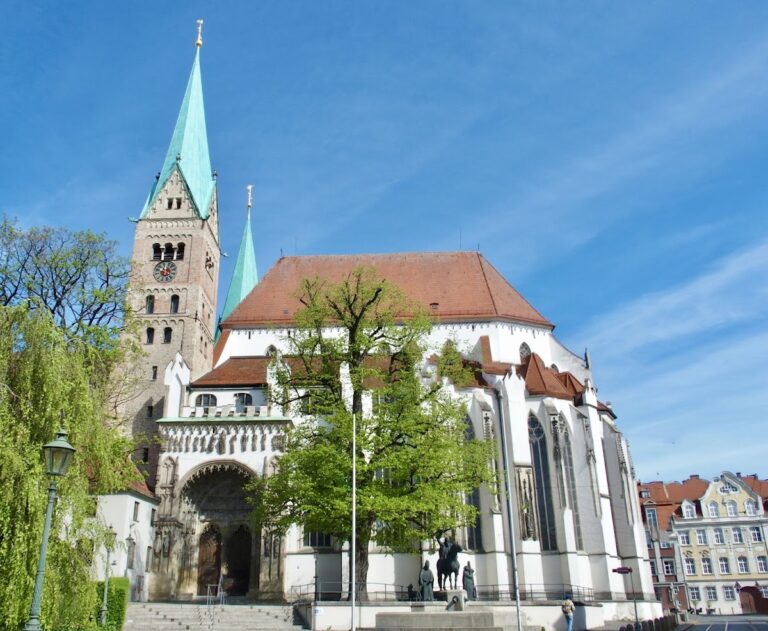
The bell tower rises on the eastern side of the church. Its lower section is square and incorporates the surviving lower part of the medieval tower. Above it, an octagonal section supports a pointed helmet roof.
Frescoes and devotional images
Johann Joseph Anton Huber painted the ceiling frescoes in 1777. The choir scene shows angels with a monstrance, the vessel used to display the consecrated Eucharistic host, and a thurible for burning incense. The nave fresco depicts the martyrdom of Saint Vitus, while the painting above the gallery shows the glorification of the church’s patron.
The painted scenes in the nave niches represent Saint George, the Archangel Michael, Mary Magdalene, and the Apostle Peter. Huber also painted the figures of Mary, Mary Magdalene, and the Evangelist John in the high-altar niche. The church preserves a carved Pietà from around 1510 to 1520, showing the Virgin Mary mourning over the dead Christ, as well as a figure of Saint Vitus in an oil cauldron dating from around 1550.
Furnishings and organ
The baptismal font bears the year 1661. Its broadly projecting, chalice-shaped basin rests on a Tuscan column. Philipp Jakob Einsle made the pulpit in 1778, the choir stalls in 1779, the carved communion rail in 1784, and the altars between 1783 and 1786.
Joseph Weinmüller created the crucifix in the niche behind the high altar’s tabernacle. Painted figures of Mary, Mary Magdalene, and the Evangelist John accompany it. The organ was built by the Sandtner brothers in 1964, has 17 registers, and was overhauled in 2008.