St. Stephen’s Abbey: A Benedictine Monastery and Educational Foundation in Augsburg


Site at a Glance
- Rating
- 4.4
- Popularity
- Very Low
- Country
- Germany
- Primary era
- Early Modern
- External website
- Open
- Eras represented
- Early Modern
- Civilizations
- Holy Roman Empire
- Site type
- Religious
- Remains
- Monastery
On this page11 sections
History
St. Stephen’s Abbey is a historic religious and educational complex in Augsburg, Germany, founded on 23 April 969 at a church dedicated to Saint Stephen outside the city’s northern walls. Saint Stephen was an early Christian martyr traditionally regarded as the first deacon of the Christian church. The foundation developed through the donation of estates by Archdeacon Amalrich, his nephew Walther, and Elesinde, who had established an ascetic cell at the church. Bishop Ulrich of Augsburg appointed Elesinde as the first abbess and allowed the nuns to choose her successor.
Foundation and medieval changes
Elesinde has traditionally been identified as a daughter of Count Hupald of Dillingen and a sister of Bishop Ulrich, but that identification is considered highly doubtful. Her dates of birth and death are unknown, and the rule followed by the original women’s community has not survived. The historian Placidus Braun later suggested that it may have followed the Benedictine Rule.
The monastery suffered fires in 1059 and 1205. During the thirteenth or fourteenth century, it adopted a new constitution and became a community of Augustinian canonesses. These women followed the Rule of Saint Augustine but did not take religious vows. The precise date of the change and the identity of the abbess who oversaw it are unknown, although a papal bull of 1335 establishes the latest possible date for the transformation.
Around 1300, the area north of Augsburg’s episcopal city was enclosed and incorporated into the city as the Lower City. The nearby gate was first called St. Gallentor and later, from the middle of the fifteenth century, Stephingertor. It has since disappeared. Around 1380, a defensive ditch between Oblattertor and Einlass reduced the land held by the monastery.
Secular collegiate foundation
During the fifteenth century, the community became a secular collegiate foundation for noblewomen. A papal bull of 1421 describes it in this form, while tradition associates the change with Abbess Agnes von Ostenheim during the Council of Constance. The canonesses came from the Swabian nobility. They were no longer subject to monastic enclosure, could own private property, and could marry. Only the abbesses were forbidden to marry.
The foundation burned again in 1458 or 1459. During the Augsburg Reformation, Abbess Anna von Freiberg and the chapter rejected the regulations imposed by the Lutheran magistrate. In 1537, they were forced to leave both the foundation and the city. The community lived at Höchstädt an der Donau for eleven years and returned in 1548 to a damaged foundation.
Early modern discipline and rebuilding
In 1581, Bishop Marquard II vom Berg and Cathedral Dean Johann Otto von Gemmingen required the noblewomen to sleep in a common dormitory, although they could use their private apartments during the day. After Abbess Euphrosina died in 1596, Johann Otto, by then bishop, imposed stricter regulations. Private apartments were abolished, uniform house dress and communal choral prayer were introduced, and leaving the foundation required the abbess’s permission. A woman who wished to marry had to depart, while the abbess herself became subject to the cathedral dean.
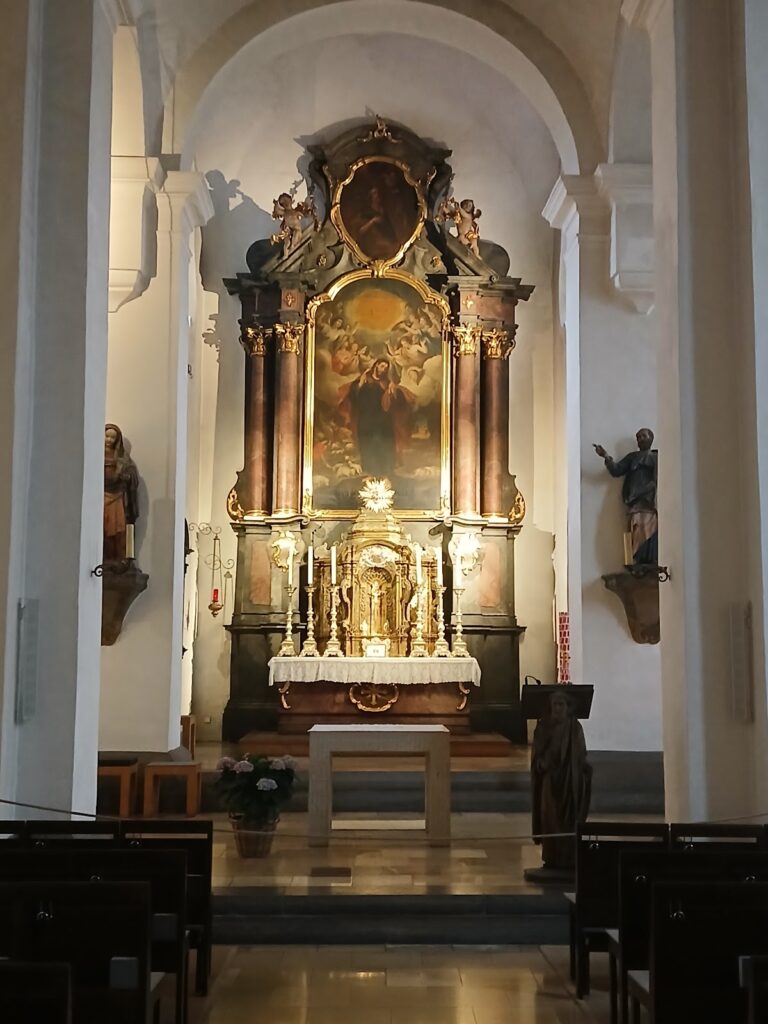
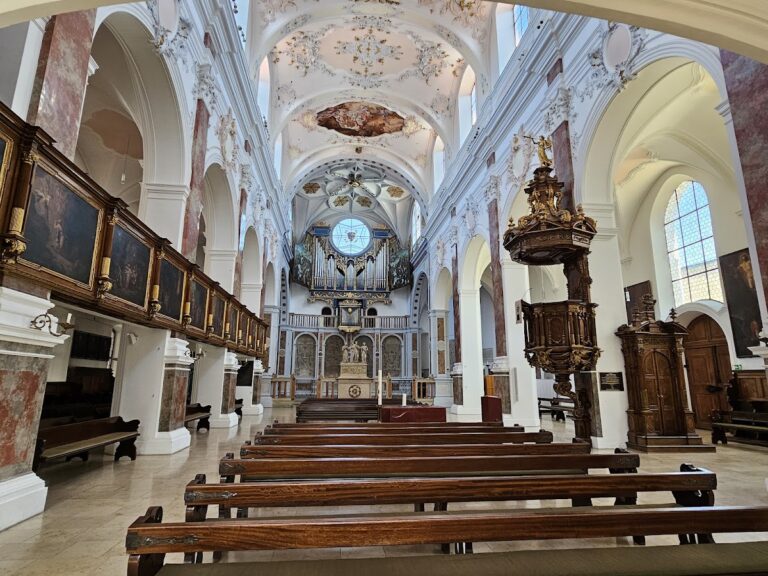
St. Stephen flourished again in the eighteenth century. Its church was rebuilt between 1755 and 1757 under the court architect Franz Xaver Kleinhans in the Rococo style, an eighteenth-century fashion known for light, asymmetrical, and highly ornamental forms. In 1789, the canonesses voluntarily reformed their constitution. In 1796, Abbess Maria Antonia von Welden began a complete reconstruction of the convent accommodation.
Secularization and Benedictine revival
Secularization, the early nineteenth-century dissolution or transfer of church institutions and their property to secular authorities, ended the women’s foundation in Bavaria in 1803. The city of Augsburg received its property, and the buildings were cleared in 1807. The army used them from 1816 as a store for military clothing and equipment. The military also removed the baptismal chapel and replaced it with a long glasshouse, while constructing a large storage wing beside Karmelitenmauer along the garden wall.
After secularization, Augsburg citizens promoted the revival of St. Stephen because they wanted the formerly combined Protestant St. Anna and Catholic St. Salvator schools to regain their independence. One citizen contributed 30,000 gulden, Bishop Ignaz Albert von Riegg supported the plan, and King Ludwig I authorized the purchase of the former foundation’s buildings for a Catholic educational institution. The institution opened on 20 November 1827 under the patronage of Saint Stephen. A school and seminary were operating there by 1828.
Ludwig I declined to restore the Jesuits and instead entrusted the institution to the Benedictine order, reviving Benedictine life in Bavarian Swabia. The Benedictines continued the educational tradition associated with the former Jesuit institution rather than that of the earlier Abbey of St. Afra and St. Ulrich. Barnabas Huber, formerly a monk of Ottobeuren, became the first abbot and received his abbatial blessing on 20 April 1835. This was described as the first such Benedictine blessing in Bavaria and Germany after secularization.
Huber and Bishop Riegg recruited monks from Benedictine houses in Austria and Switzerland. Nineteen Austrian and three Swiss priests joined the community, together with five priests from the re-established Abbey of Metten. The monastery was constituted on 5 November 1835, when five novices were clothed. Ottobeuren was re-established as a priory, a dependent Benedictine house below the rank of an independent abbey, while Ottobeuren and Metten initially came under St. Stephen’s authority before becoming independent abbeys again. The refoundation, the appointment and blessing of the abbot, and Ludwig I’s private endowment of 46,000 gulden had not received papal authorization.
Education, war, and continuing life
Differences between the monks’ regional origins and traditions created disciplinary and organizational difficulties during the early years. The educational institution comprised a Latin school, a Gymnasium, a German secondary school preparing pupils for higher education, a lyceum that later became a philosophical college and continued until 1969, and a boarding institution. Benedictines have continued to direct the school and boarding facilities while undertaking teaching, pastoral work, youth work, adult education, and related activities.
Anglo-American bombing destroyed many of the buildings in 1944. Reconstruction took place between 1950 and 1966, including the abbey church. St. Stephen belongs to the Bavarian Benedictine Congregation, a federation of Benedictine monasteries in Bavaria, and served as the mother house of the neighboring priories of Ottobeuren and Metten. The community remains associated with the Gymnasium bei St. Stephan to the north. The most recent account places the community at twelve Benedictines, working at the school, the St. Joseph day-boarding institution, adult education, pastoral services, and practical and care-related activities. Theodor Hausmann has been abbot since 2009, after serving as prior-administrator from 2006.
The St. Joseph study seminary opened in 1828 for boarders and day pupils and came under Benedictine direction in 1835. It was expanded in 1874 to 1876 and again in 1907 to 1909, temporarily closed during the Second World War, and reopened in 1947. Its former form ended in 2005, after which it continued as a day-boarding institution. In 2013 and 2014, former residents publicly alleged severe corporal punishment and sexual abuse by Benedictines during the 1950s and 1960s.
Landholdings and scientific observation
The former foundation held estates and jurisdiction in several settlements. At Batzenhofen, it owned seven properties in 1401, acquired the vogtei, or local authority over an estate, and lower-court jurisdiction in 1530, and issued a civil and criminal court ordinance in 1531. Batzenhofen became the center of the foundation’s rural possessions, and a summer residence for the canonesses was built there in 1750. In 1774, the foundation established a hospital endowment for poor and sick subjects at Hausen. Its manorial rights passed to the Electorate of Bavaria during secularization.
Between 1812 and 1837, Augustin Stark made daily weather observations from his residential tower beside St. Stephen and published them in annual meteorological yearbooks. After his death, the monks continued the observations. The station joined the Bavarian Academy of Sciences’ observation network in 1866 and has remained at the same location, producing one of Europe’s longest homogeneous series of Augsburg weather data. The measurements stopped for one week after the February 1944 air raid because the instruments had been destroyed.
Remains
The surviving complex combines the abbey church, reconstructed convent buildings, educational and residential facilities, and a large garden south of the monastery. The buildings destroyed in 1944 were rebuilt between 1950 and 1966. The complex now includes the Gymnasium bei St. Stephan, the St. Joseph boarding institution, a guesthouse, and rooms used by a private art academy.
Church and convent buildings
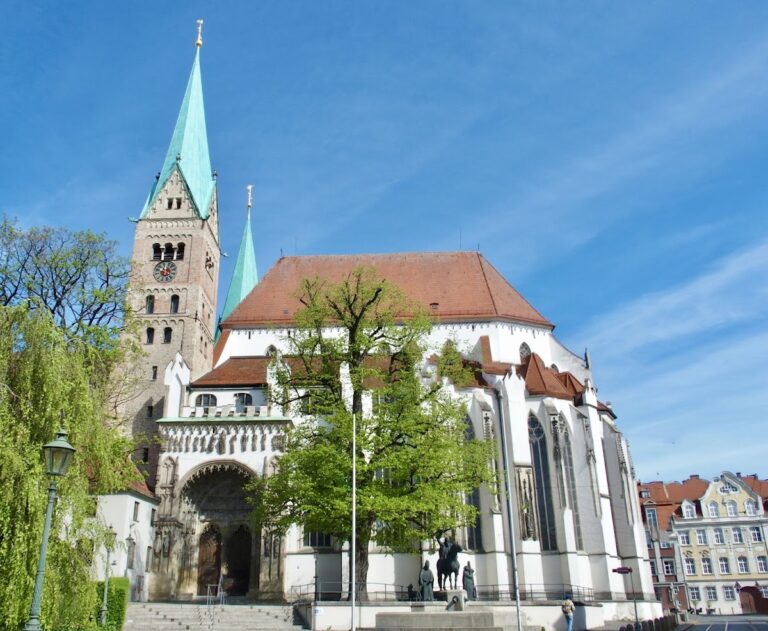
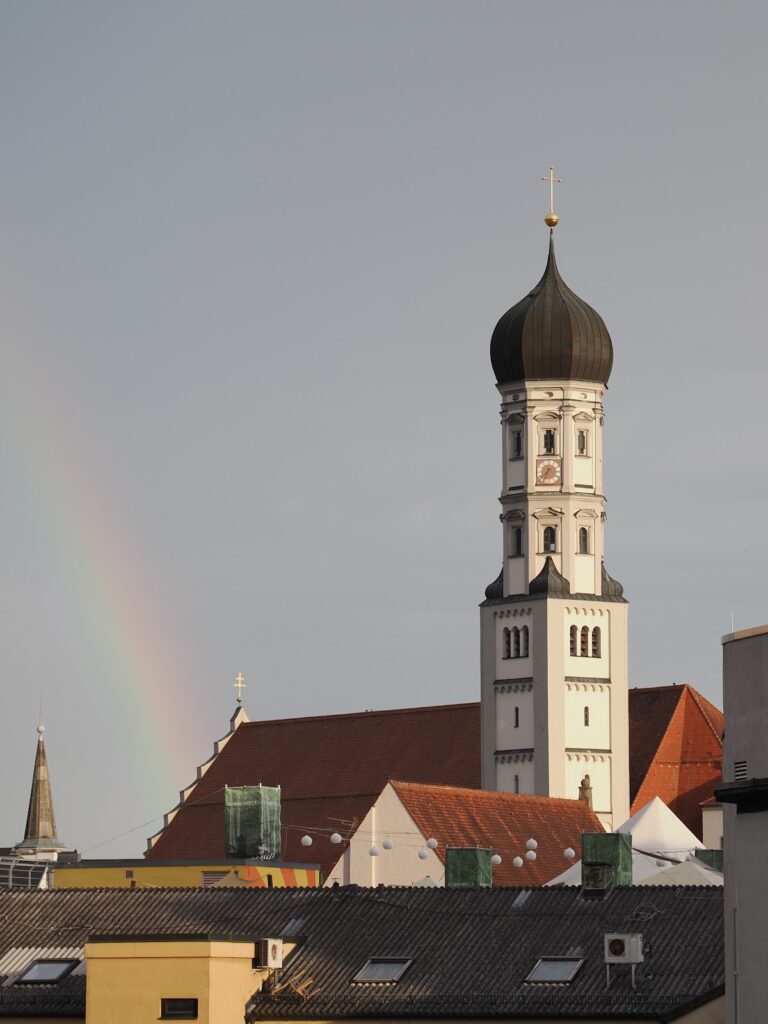
The original foundation centered on a church dedicated to Saint Stephen outside Augsburg’s northern walls. A large abbey church was later erected, and the present church derives from the Rococo rebuilding of 1755 to 1757 under Franz Xaver Kleinhans. It was constructed without interior pillars. During Abbess Dorothea von Schwendi’s tenure, the church tower collapsed; the tower was reconstructed and the church renovated, with that work completed in 1620. The church was rebuilt again after its destruction during the Second World War and now forms part of the monastery complex.
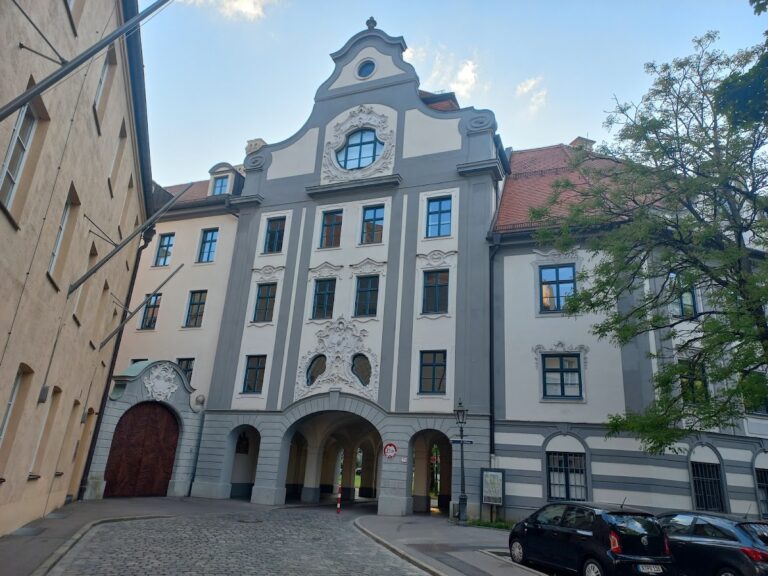
The convent accommodation underwent comprehensive rebuilding from 1796 under Abbess Maria Antonia von Welden. Later military use altered the complex by removing the baptismal chapel, inserting a long glasshouse, and adding a storage wing along the garden wall beside Karmelitenmauer. The reconstructed abbey buildings preserve the institutional setting in which the monastery, school, boarding facilities, guesthouse, and other educational uses continue.
Monastery garden
A roughly one-hectare garden extends south of the monastery beyond Karmelitenmauer. It has served as a garden since the early Middle Ages, and archaeological finds indicate that a broad Roman road once crossed the area. Its present arrangement includes a rectangular network of paths enclosed by a wall, an octagonal pavilion, and an eighteenth-century Marian grotto on the eastern wall. A Marian grotto is a grotto-like devotional structure dedicated to the Virgin Mary. The garden also contains beehives used for monastery beekeeping and an observatory used by the Gymnasium bei St. Stephan.
The garden parcel belonged to the Augsburg Carmelite monastery founded in 1638. After that monastery was secularized in 1802 and cleared in 1807, the garden was assigned in 1851 for use by St. Stephen’s monastery and boarding institution. Legal ownership remained with the Catholic study foundation, administered by the City of Augsburg’s foundation office. The garden and its enclosing features are protected as historic monuments.
Wieselhaus and associated facilities
The Wieselhaus stands at the southeast corner of the garden. Its completely walled garden can be viewed from the building’s upper floors. Together with the church, convent buildings, school, boarding institution, guesthouse, art-academy rooms, and garden structures, it forms part of the surviving physical setting of St. Stephen’s Abbey.
Nearby sites