Chiesa di Sant’Antonio Abate (Nembro): Parish Church of Lonno
Site at a Glance
- Rating
- 4.5
- Popularity
- Very Low
- Country
- Italy
- Primary era
- Early Modern
- Eras represented
- Medieval, Early Modern, Modern
- Civilizations
- Italian, Venetian
- Site type
- Religious
- Remains
- Church
On this page8 sections
History
Chiesa di Sant’Antonio Abate is the principal Catholic church of Lonno, a hamlet of Nembro in Italy. Built during the second half of the fifteenth century, it served a settlement outside Nembro’s central area and was dedicated to Saint Anthony Abbot, an early Christian ascetic traditionally associated with the protection of animals and agriculture. The dedication reflected the predominantly agricultural character of the surrounding community.
Foundation and parish status
The church was elevated to parish status in 1458. A decree issued by Ludovico Donato, Bishop of Bergamo, on 17 December 1468 also granted it parish status. The church may have been consecrated in 1478 by Giacomo, Bishop of Lodi, although that attribution does not fit the known chronology of the Diocese of Lodi unless construction had begun earlier.
From the sixteenth to the twentieth century
Carlo Borromeo, the Catholic cardinal and Archbishop of Milan known for ecclesiastical visitation and reform, visited the church on 20 October 1575. At that time, it belonged to the parish church district of Nembro. Confraternities of Saint Mary of the Rosary and of the Blessed Sacrament administered the corresponding altars, and the church continued to be associated with the Nembro district until the seventeenth century.
In 1664, Daniele Giustiniani transferred the church from Nembro to the vicariate of Alzano Maggiore. A vicariate was an administrative grouping of parishes. The church returned to the vicariate of Nembro in 1939, after the Alzano Maggiore vicariate was suppressed by decree on 27 May of that year.
Structural problems may have led to a major rebuilding campaign that began in 1734 and continued for approximately twenty years. A further bay was added in 1899, and the enlarged church was consecrated on 16 September 1900 by Gaetano Camillo Guindani, Bishop of Bergamo. An external chapel belonging to the fifteenth-century church later became the small Church of Our Lady of Lourdes. That church was built in 1900 and restored in 1990.
Remains
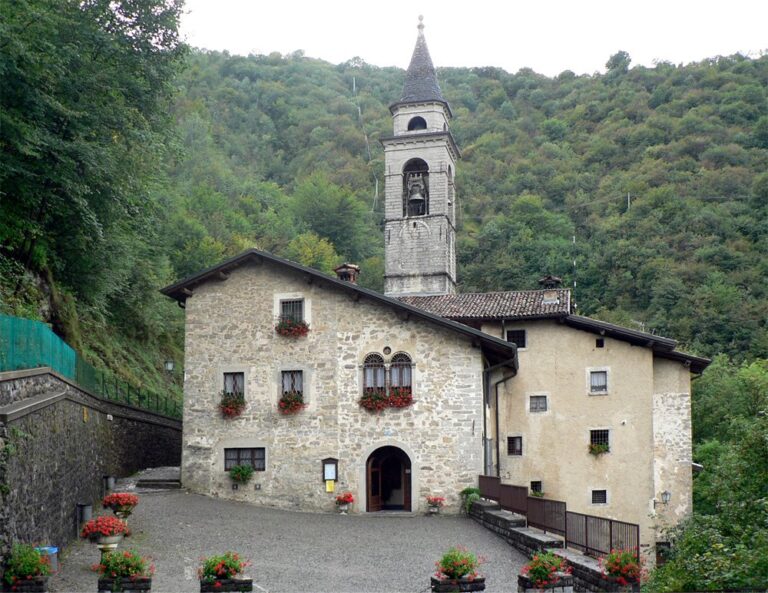
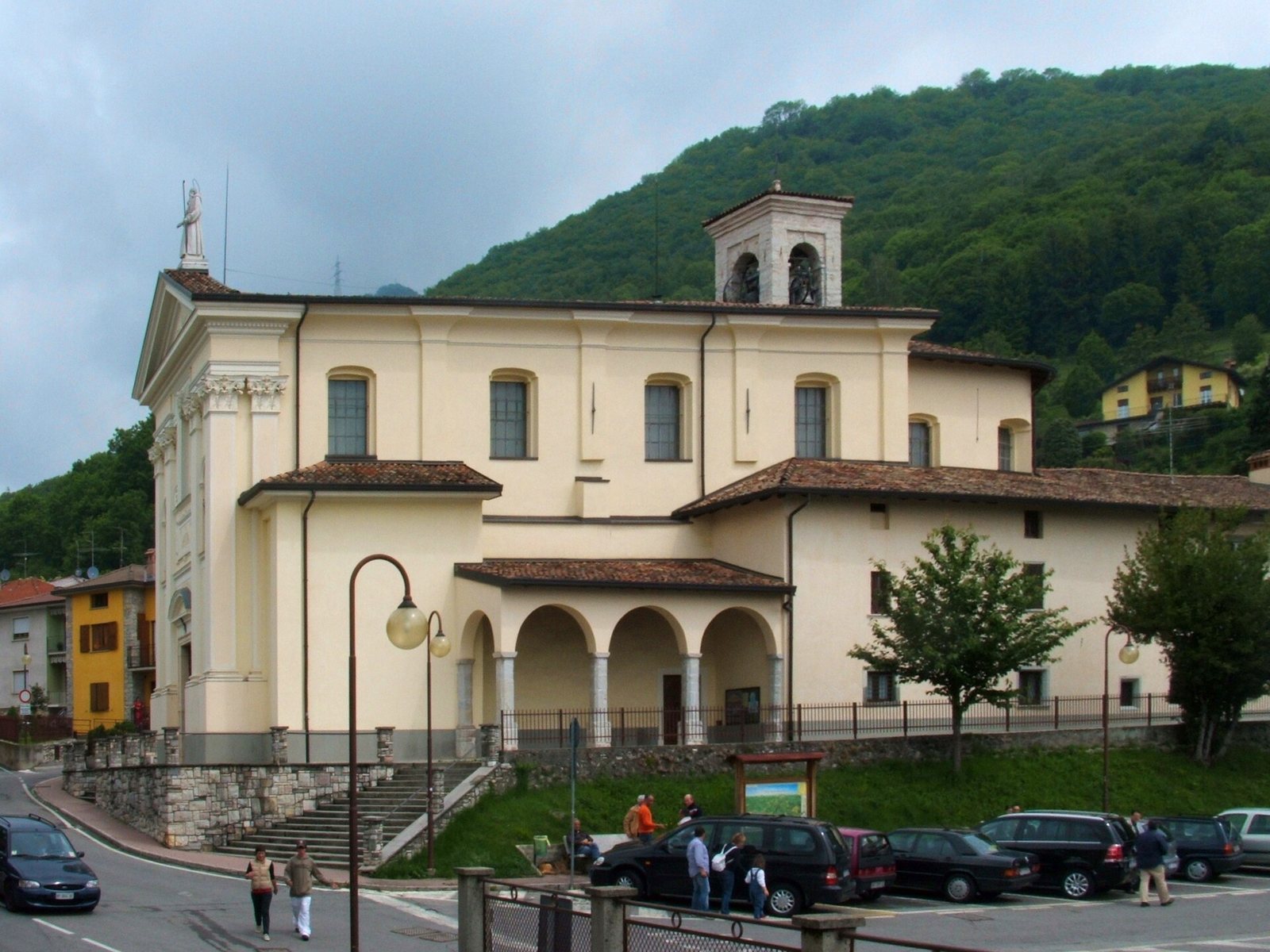
The present church stands beyond a churchyard reached by a concrete stairway and retains the traditional eastward orientation. Its principal building has a single nave, while the facade and interior preserve architectural and artistic elements from the later phases of the church’s development.
Sant’Antonio Abate
Facade and interior
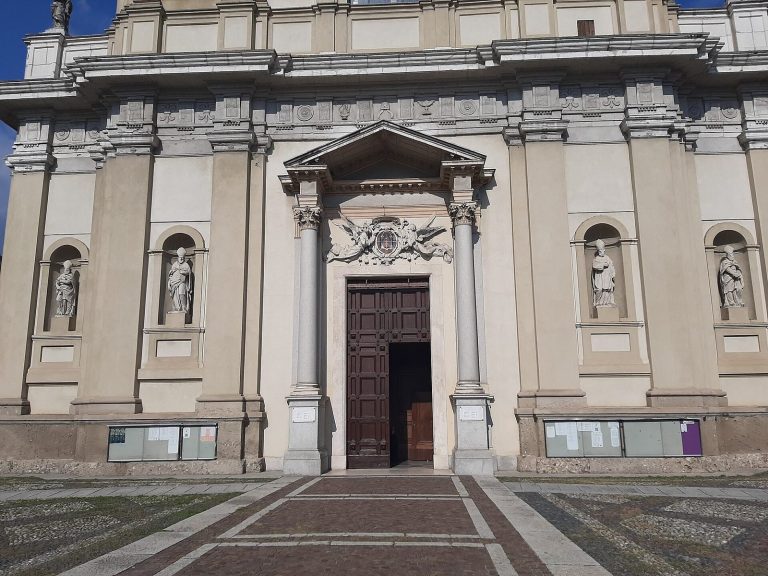
The facade is divided into three sections by masonry pilasters set on high bases and finished with Corinthian capitals. Above them, a projecting moulded triangular pediment crowns the front. The main doorway has white-marble surrounds and a shaped curved pediment in painted concrete. Niches beside the entrance contain statues of Saints Peter and Paul. Inside, the single nave has four niches on each side and contains several altarpieces, paintings placed behind or above altars.
Paintings and organ
The high altar contains Giulio Licinio’s 1553 painting of Saint Anthony with Saints Peter, Paul, Stephen, Joseph, and Bernardino, together with the Mystical Marriage of Saint Catherine, a Christian subject representing the saint’s symbolic marriage to Christ. The left altar has a copy of Luca Giordano’s Deposition of Christ, while Giovan Battista Moroni’s Madonna and Child with Saints Barbara and Lawrence is also preserved in the church. Other works include Di Palma the Younger’s Annunciation, Mauro Pellicioli’s Mystical Marriage of Saint Catherine of Alexandria, and anonymous seventeenth-century paintings of the mysteries of the Rosary.
Carlo Innocenzo Carloni’s 1775 fresco of Heliodorus Expelled from the Temple occupies the counterfacade. During the creation of the new nave, the fresco was detached from the wall, transferred onto canvas, and returned to its former position. The church also contains an organ made by the Serassi firm in 1875. Above the entrance to the Lourdes chapel is Romeo Bonomelli’s painting of the Holy Family.
Church of Our Lady of Lourdes
The small Church of Our Lady of Lourdes continues the facade line of Sant’Antonio Abate and is built in the Neo-Gothic style. Its central entrance is set slightly back beneath a pointed arch, an arch formed by two curves meeting at an apex. Two recessed lateral windows have the same pointed form. Inside, the small chapel has an apse oriented northeast. A large grotto recalling the grotto at Lourdes fills the presbytery, with statues of the Madonna and Bernadette. The grotto stands within a Gothic-style structure whose four concrete columns support pointed arches.