St. Trudpert’s Abbey: A Historic Benedictine Monastery in Germany
Site at a Glance
- Rating
- 4.6
- Popularity
- Low
- Country
- Germany
- Primary era
- Early Modern
- External website
- Open
- Eras represented
- Medieval, Early Modern, Modern
- Civilizations
- German, Habsburg, Holy Roman Empire
- Site type
- Religious
- Remains
- Monastery
On this page17 sections
History
St. Trudpert’s Abbey is a former Benedictine monastery in Münstertal, Germany, with medieval origins traditionally linked to Saint Trudpert and later shaped by Baroque reconstruction. Benedictines are members of the Order of Saint Benedict, a Western Christian monastic order organized around communal prayer, work, and observance of the Rule of Saint Benedict.
Origins and medieval development
Medieval tradition attributes the foundation of the site to Saint Trudpert, an Irish missionary and martyr active in the first half of the seventh century. According to this tradition, he established a hermitage in Münstertal. The religious community probably developed into a monastery during the ninth century, and by about 900 at the latest it was supported by the Alsatian noble family of the Liutfride.
The community renewed the monastery in 902 and again before 962, possibly after a Hungarian incursion in the early tenth century. The translation of Saint Trudpert’s relics to the monastery is recorded in 901 and again shortly after 965. These events helped establish the abbey as a religious centre in the southern Black Forest.
On 3 April 1144, Pope Lucius II placed the abbey under papal protection and confirmed its liberties and possessions. Earlier connections with the Diocese of Strasbourg continued into the thirteenth century through episcopal patronage rights. The abbey’s landed lordship extended chiefly across Münstertal, the Breisgau, the Ortenau, and Alsace. It acquired the local lordship of Tunsel and held the parishes of Münstertal, Grunern, Krozingen, Tunsel, Laufen, Biengen, and other communities. Tunsel supplied the monks with agricultural produce and wine.
Lordship, mining, and medieval rebuilding
The abbey benefited from the medieval silver-mining industry. The mining settlement of Münster grew below the monastery, but armed forces from Freiburg destroyed it and Scharfenstein Castle in 1346. A subsequent stream flood caused further damage. The economic decline of the later fourteenth century was overcome during the abbacy of Paul I, who led the community from 1435 to 1455.
The lords of Staufen held advocacy rights over the abbey by an uncertain date, while a reliable record of their role begins in 1218. A Vogt was a lay protector or legal steward of a church institution. From 1277, the Habsburgs’ higher advocacy is documented, with the Staufen family acting as their subordinate advocates until its extinction in the early seventeenth century.
Through its Habsburg connection, St. Trudpert became part of Vorderösterreich, or Further Austria, the group of Habsburg territories west of the principal Austrian lands. The abbey became a Habsburg landed monastery and was represented among the Breisgau estates. New cloister buildings and a Gothic long choir, an elongated eastern choir area, were added in the fifteenth century.
War, destruction, and Baroque reconstruction
The abbey was plundered during the German Peasants’ War in 1525, a widespread early sixteenth-century revolt involving rural communities and towns in parts of the German lands. Swedish forces destroyed the monastic buildings during the Thirty Years’ War in 1632. A provisional rebuilding followed, and the complex was later reconstructed on a major Baroque scale.
Between 1712 and 1722, the Gothic choir was re-vaulted and furnished in the Baroque manner, while the tower was partly demolished and rebuilt. Peter Thumb subsequently rebuilt the nave between the tower and choir. The nave was dedicated in 1727, and Thumb received a commission in 1737 to redesign the church façade and monastery. Francesco Antonio Giorgioli painted the frescoes, while Michele Angelo de Prevosti and Carpoforo Caratti-Orsatti created delicate stucco decoration under a contract concluded with the abbot in September 1716. Johann Joseph Christian later produced elaborate stucco work on the high altar.
Secularization and modern religious use
St. Trudpert was secularized in 1806 and transferred to the Grand Duchy of Baden. Secularization was the transfer of ecclesiastical institutions and property into secular ownership or administration, commonly involving the dissolution of monasteries and redistribution of their assets in the German states around 1800 to 1806. The former abbey church became the public parish church of St. Peter and Paul, and the former complex subsequently passed into private aristocratic ownership.
In 1918 and 1919, the Sisters of Saint Joseph of Saint Marc acquired the surviving parts of the abbey complex and established their religious house there. The site became the principal house of the congregation. During the 1920s, the sisters expanded the complex to approximately its eighteenth-century scale and added new convent buildings. The former tithe barn was converted in 1922 and 1923 into a novitiate and retreat house, later serving as an old people’s home and, since 1998, as the St. Joseph Educational Centre.
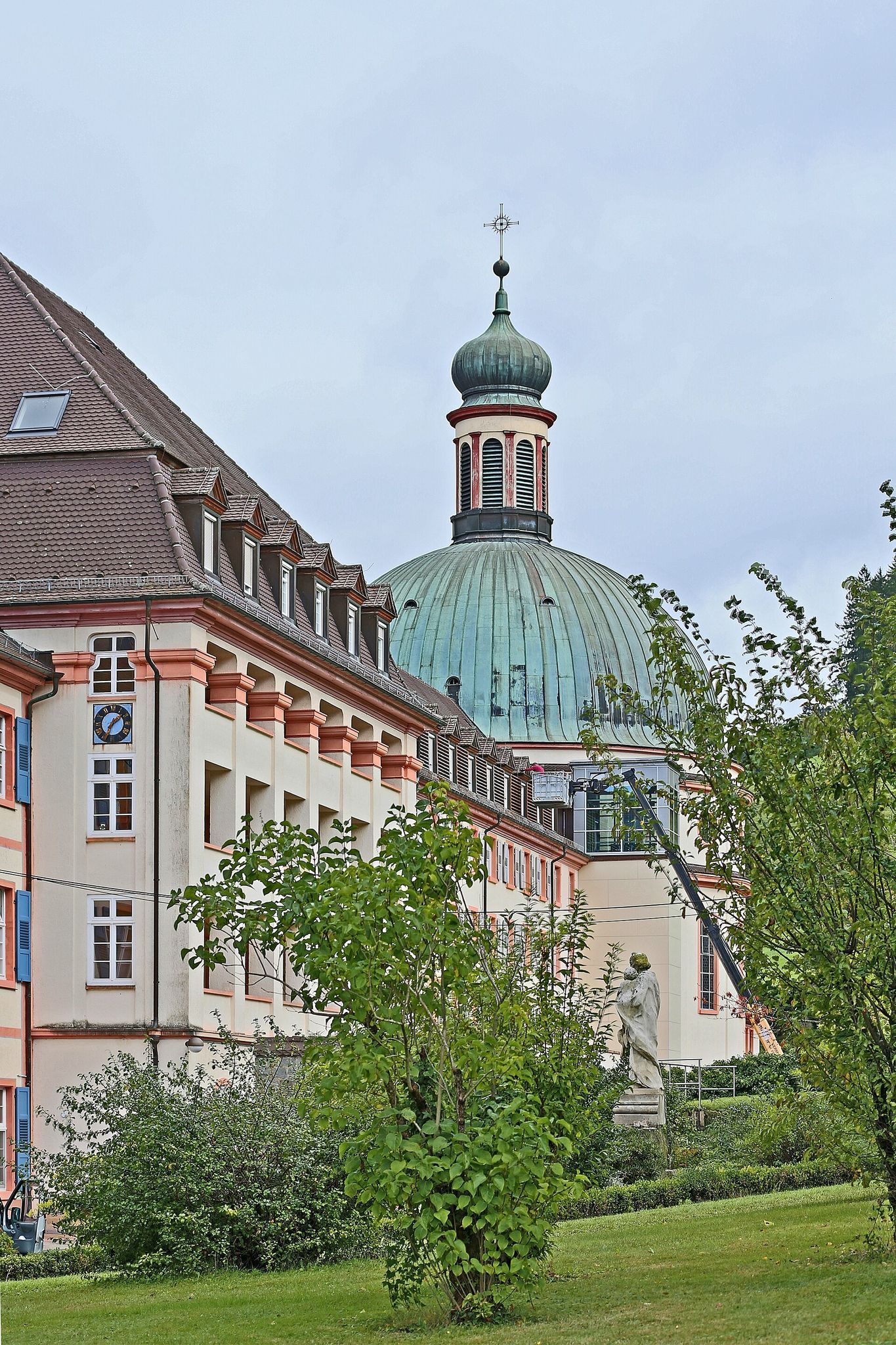
The sisters also built a new convent and mother-house block with a 120-metre-long main wing of four to five storeys. Construction of a new domed convent church began in 1929, but a financial crisis following the New York stock-market crash halted the work for about thirty years. Interior work resumed in 1961 under Superior Gnädinger, and the church was consecrated on 9 May 1965.
A severe hailstorm on 17 August 1986 damaged the abbey complex, including the roofs of the rectory and parish church and the greenhouse. Repairs continued until 1988 and 1989, using about 300,000 roof tiles. In 2006, the complex was entered in Baden-Württemberg’s register as a cultural monument of special importance because of its documentary value and its importance to regional, artistic, and architectural history.
Remains
Churches and convent buildings
Parish Church of St. Peter and Paul
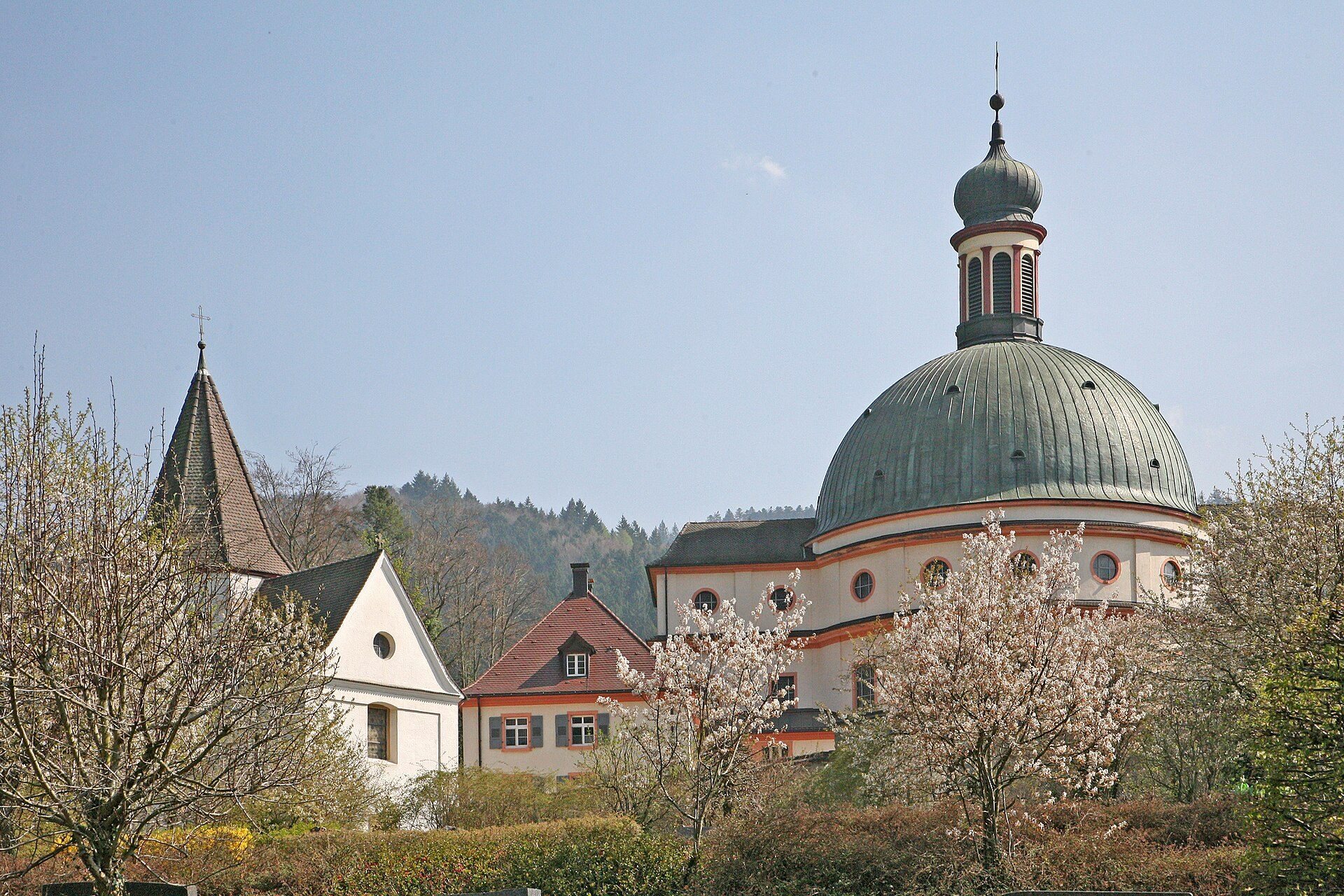
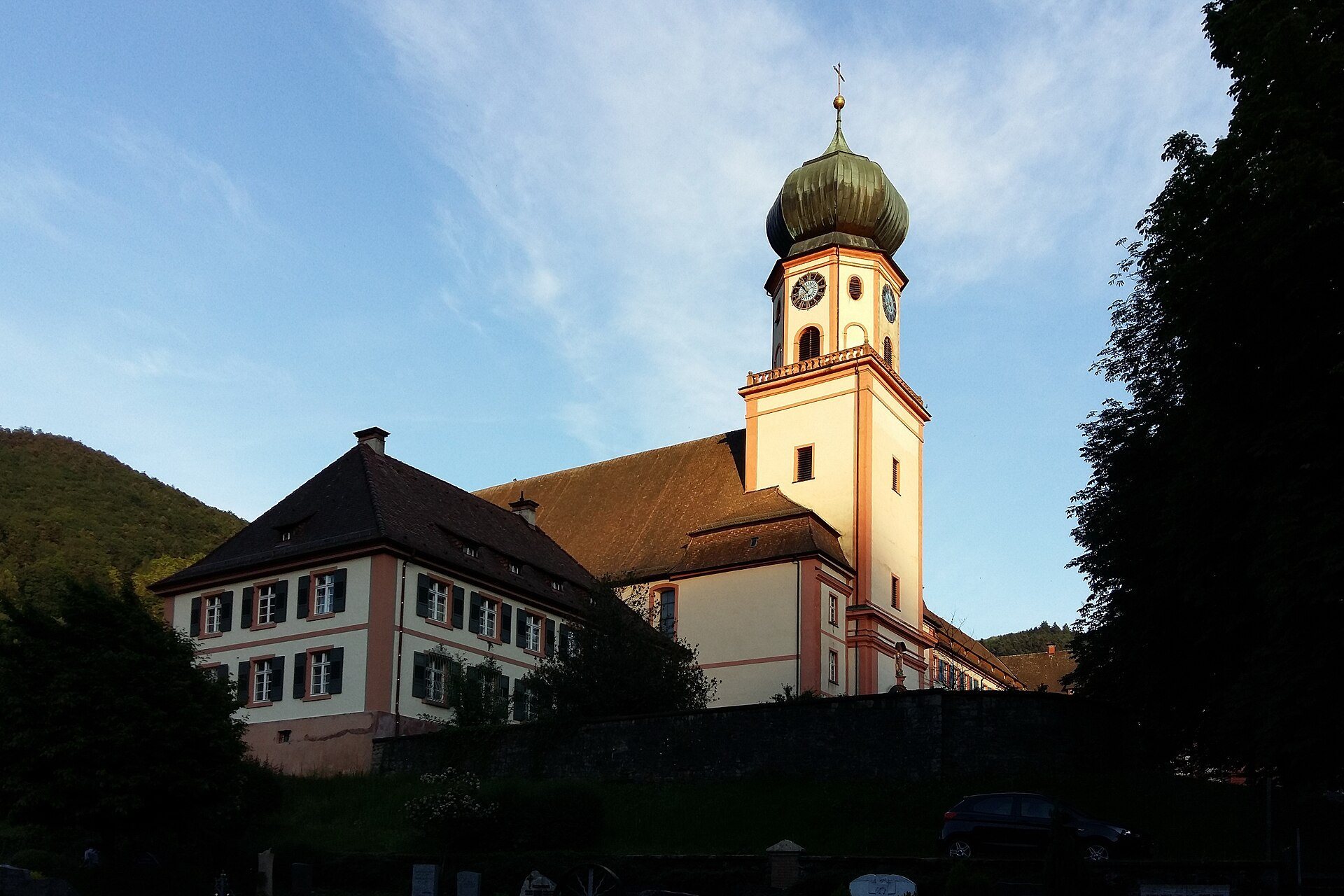
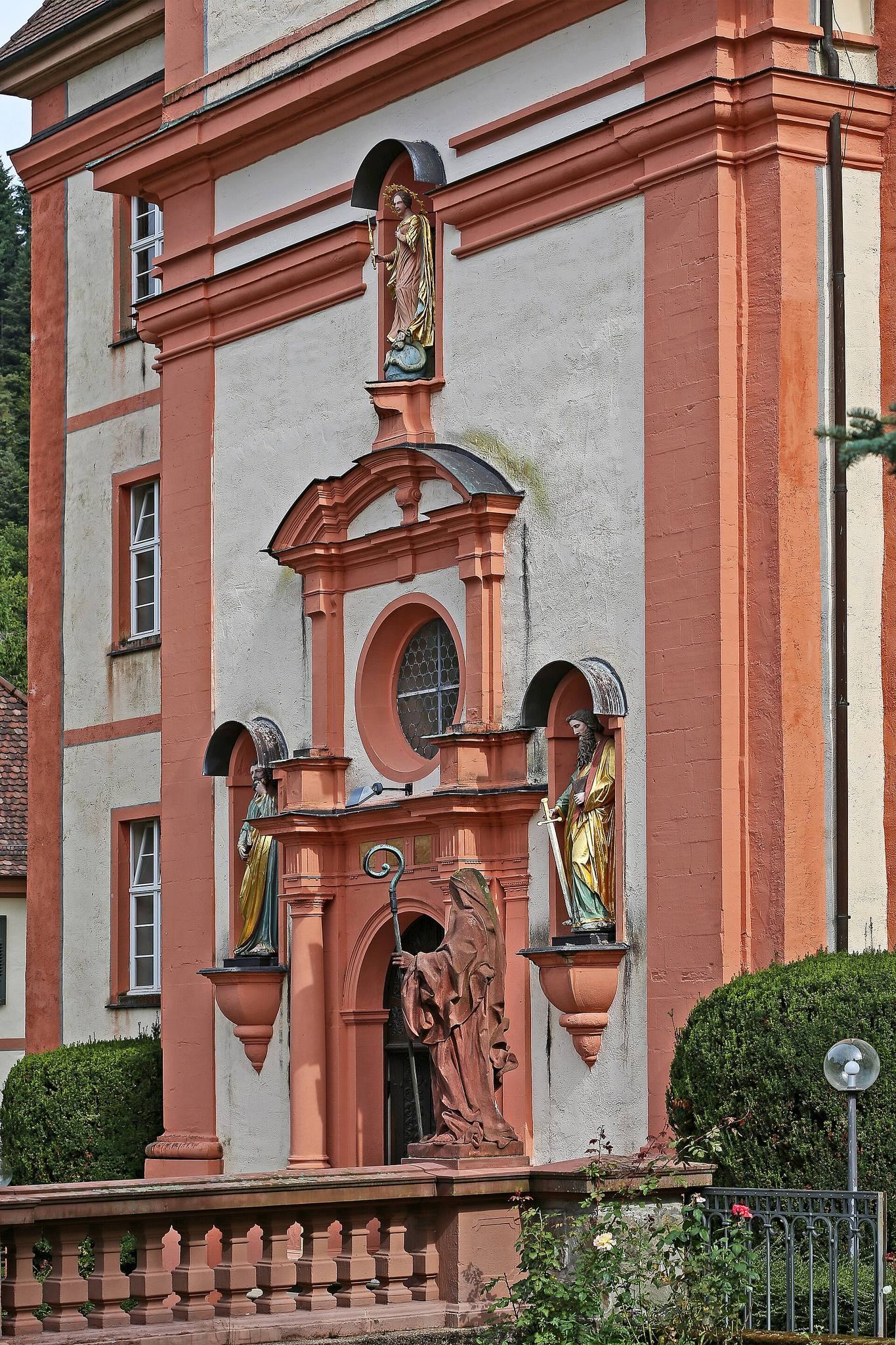
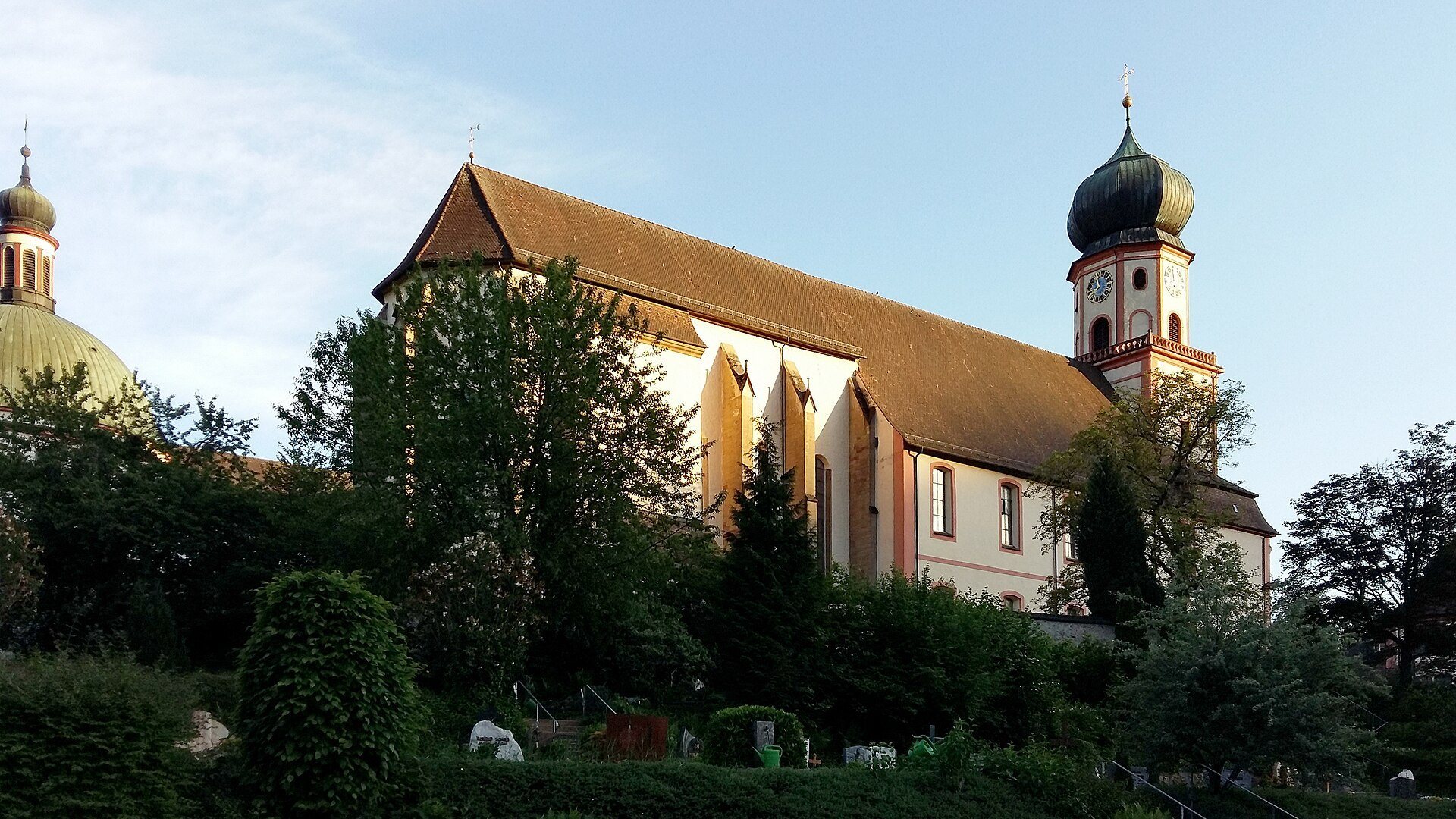
The former abbey church, now the parish church of St. Peter and Paul, preserves the principal medieval and Baroque church phases. The medieval building was a three-aisled basilica with a westwork added around 1100. A westwork is a monumental western entrance or building complex attached to a medieval church. The later nave, rebuilt by Peter Thumb, is divided by wall piers and side chapels and covered by an elliptical plaster vault. Its entrance façade incorporates a prominent west tower crowned by an onion dome.
The church’s Baroque decoration includes frescoes by Francesco Antonio Giorgioli and stucco by Michele Angelo de Prevosti and Carpoforo Caratti-Orsatti. Johann Joseph Christian contributed stucco work to the high altar. Seven bronze bells hang in the tower. The church also contains three organs. Johannes Klais installed the main organ in 1963 in an older case; it has 38 stops on three manuals and pedal. Egbert Pfaff built the 19-stop choir organ in 1988, and Hermann Weber made the mobile four-stop chest organ in 1998. The earlier organ, made by Joseph Schütt of Laufenburg with 22 stops, first sounded in 1722, while its ornate surviving case dates from about 1760.
Convent Church
The new convent church is a domed circular building constructed for the Sisters of Saint Joseph. Its foundation stone was laid on 20 August 1929, and the shell was completed by the end of January 1930. The interior was completed and consecrated in 1965. The lower working-day church remains an internal prayer space, while the upper church serves as the principal worship space.
A 25-stop Klais organ built in 1964 has two manuals and pedal. Two bells cast by Andreas Hamm in 1954 hang in the roof turret of the cupola.
Grounds and associated buildings
Tithe Barn and convent infrastructure
The protected complex occupies an exposed position at the entrance to the upper Münstertal. Its buildings include the old tithe barn with a vaulted cellar, the convent buildings, former agricultural structures, and the 1927 new rectory. The tithe barn’s conversion into a novitiate and retreat house formed part of the twentieth-century expansion of the religious community.
Gardens, cemetery, and chapels
Other surviving elements include a curved external staircase with balustrades, a terraced garden enclosed within the monastery wall, and the cemetery wall with historic gravestones. The cemetery also contains a large cross, a war memorial, the Trudpert Chapel, and the Markus Chapel.
Medieval manuscripts and sacred objects
St. Trudpert Hohelied
A manuscript from the former medieval library dates from the second half of the fourteenth century and contains the St. Trudpert Hohelied, a twelfth-century Lower Alemannic text sometimes described as the first book of German mysticism. Despite its title, the work is now believed to have originated at Admont Abbey in Styria rather than at St. Trudpert.
Niello Cross of St. Trudpert
The older Niello Cross of St. Trudpert, probably made in southwestern Germany around 1175 to 1180, is preserved at the site and belongs to the parish. It is a silver cross-reliquary decorated with niello, a technique in which a dark metallic compound is inlaid into engraved lines in silver or another metal. Its donor inscription names Gottfried and may refer to Gottfried von Staufen, who died after 1177.
Gothic processional cross
A partly gold Gothic processional cross that formerly held a relic of the True Cross was transferred to Mariastein Abbey in Switzerland in 1805 in anticipation of secularization. It later passed through the Basilewsky collection and entered the Hermitage in Saint Petersburg in 1885. Probably made in Freiburg around 1280, it shows the crucifix accompanied by freestanding figures of Mary and John. Its square cross ends depict the risen Christ, Ecclesia, and Synagoga, personifications traditionally used in Christian art for the Church and the synagogue.
Romanesque chalice
A richly decorated Romanesque chalice with a paten and two drinking tubes was made in Freiburg around 1250. Its decoration includes nielloed figures of the apostles and typological scenes. The object left the abbey’s former treasury through the art trade and entered the Cloisters Collection of the Metropolitan Museum of Art in New York in 1947.