Burg Badenweiler: A Medieval Hill Castle in Germany

Site at a Glance
- Rating
- 4.6
- Popularity
- Low
- Country
- Germany
- Primary era
- Medieval
- External website
- Open
- Eras represented
- Medieval
- Civilizations
- Holy Roman Empire
- Site type
- Military
- Remains
- Castle
On this page15 sections
History
Burg Badenweiler is a medieval hill castle in Badenweiler, Germany, built on an elevated site and generally dated to around 1080. The hill had already been occupied before the castle’s earliest documentary mention in 1122. The castle later protected the silver-mining interests of the Zähringen family and became the administrative center of the lordship of Badenweiler.
Early fortifications and the Zähringen period
Archaeological interpretation places an earlier Roman fort on the hill, built to protect Aqua Villa. The Alamanni later established a hilltop fortification there, which was subsequently taken over by the Franks. These earlier phases preceded the medieval castle and show that the elevated site had a defensive role before Burg Badenweiler entered the written record.
From 1122, the castle belonged to the Zähringen family, a major dynasty controlling territories in southwestern Germany. The knight Adalbert of Baden, recorded in 1148 as a retainer of Duke Conrad I of Zähringen, took his name from the castle. Heinrich and Rudolf of Baden are recorded in 1152, linking the Baden name to the site during this period.
Dynastic transfers and administrative use
The castle passed to the Welfs as part of a marriage dowry in 1147. An exchange brought it to the Hohenstaufen in 1157, and inheritance transferred it to the Counts of Freiburg in 1268. Through marriage, it came to the Counts of Strassberg in 1303. During the fourteenth century, continuing disputes with neighboring lordships led to the addition of outer fortifications.
In 1363, inheritance transferred the castle to the princely Fürstenberg family. It later returned to the Counts of Freiburg and was also temporarily held by the Habsburgs. Soldiers of Humbert of Neuchâtel, Prince-Bishop of Basel, damaged the castle in 1409, after which it was rebuilt.
Following the Council of Constance, a church council held between 1414 and 1418, the castle again came to the Counts of Freiburg. In 1444, the last Count of Freiburg donated it to the Margraves of Hachberg-Sausenberg. In 1503, it passed to the Margraviate of Baden, a margravial territory in southwestern Germany. Until its destruction, the castle served as the administrative center of the lordship of Badenweiler and remained occupied by bailiffs, officials who administered the territory on behalf of its successive lords.
French occupation and destruction
The castle was drawn into the Dutch War, the European conflict of 1672 to 1678 between France and the Dutch Republic and their supporters. After Freiburg capitulated to French forces on 16 November 1677, French troops under General Joseph de Montclar reached Badenweiler on 20 November. They demanded permission to establish a garrison in the castle. Baden-Durlach officials accepted on 21 November after the French threatened to destroy the surrounding area, but the garrison did not respect the agreed conditions.
On 6 April 1678, French troops leaving the castle under the supreme command of Marshal François de Créquy set fire to it and partially blew it up. Residents later removed building materials from the ruins, and the castle was never rebuilt. Its destruction ended its long function as a continuously occupied administrative seat.
Modern preservation and the castle hill
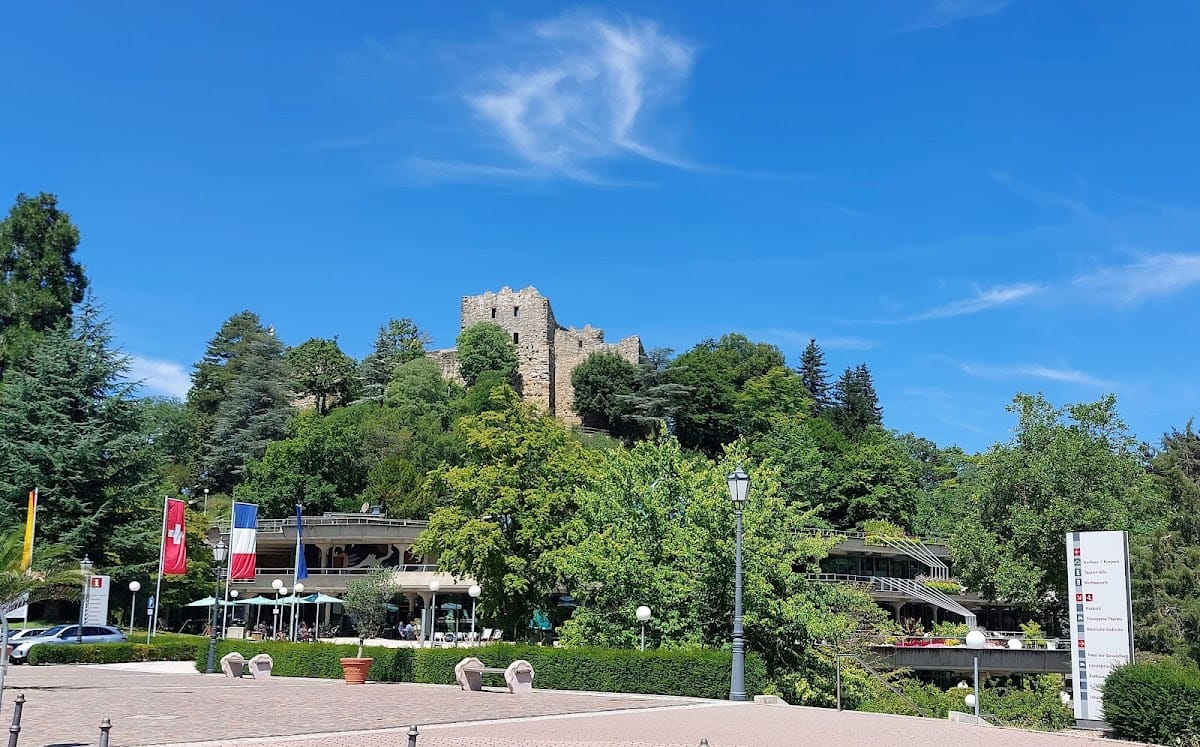
In the modern period, the ruins were restored to prevent further deterioration and make them accessible. Burg Baden is owned by the state of Baden-Württemberg and administered by the State Palaces and Gardens of Baden-Württemberg. The castle hill now forms part of Badenweiler’s spa park, where later buildings, monuments, and gardens preserve memories of the area’s changing political and cultural history.
The palace at the foot of the hill was built in 1587 as an administrative building for the Margraves of Baden. It served intermittently as the seat of the chief administrative office until 1689, and that function ended when the office moved to Müllheim in 1727. Grand Duke Frederick I of Baden converted the building into a grand-ducal summer residence in 1887 and 1888. It is now used for art exhibitions.
Anton Chekhov, the Russian physician and writer, died in Badenweiler in 1904. A monument to him was erected on the castle hill in 1908, but it was lost during the First World War in a metal-collection campaign. The present monument dates from 1992. A commemorative plaque preserves the memory of the earlier monument, while a symbolic cherry garden planted on 15 July 2004 marked the centenary of Chekhov’s death and expressed the idea of a peaceful Europe associated with his work.
Remains
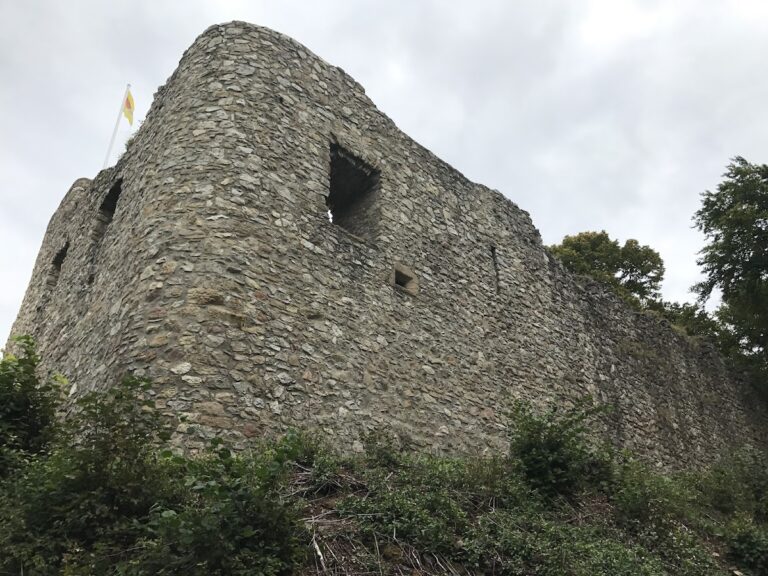
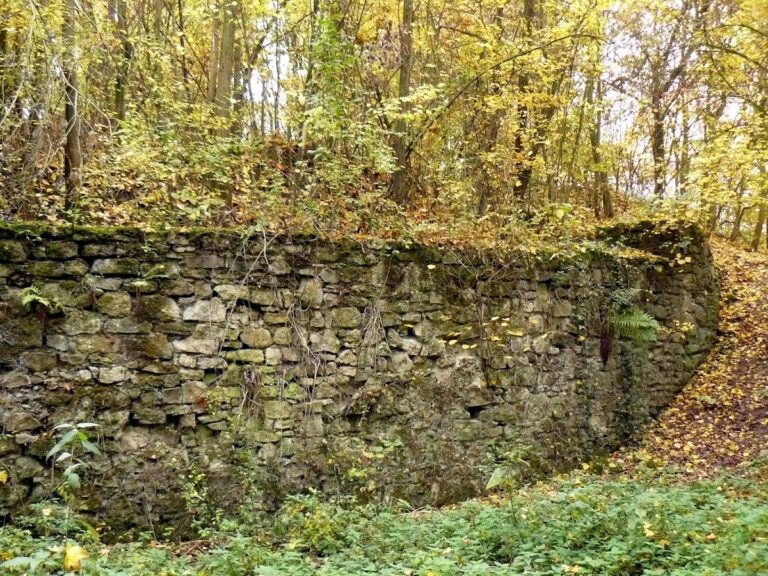
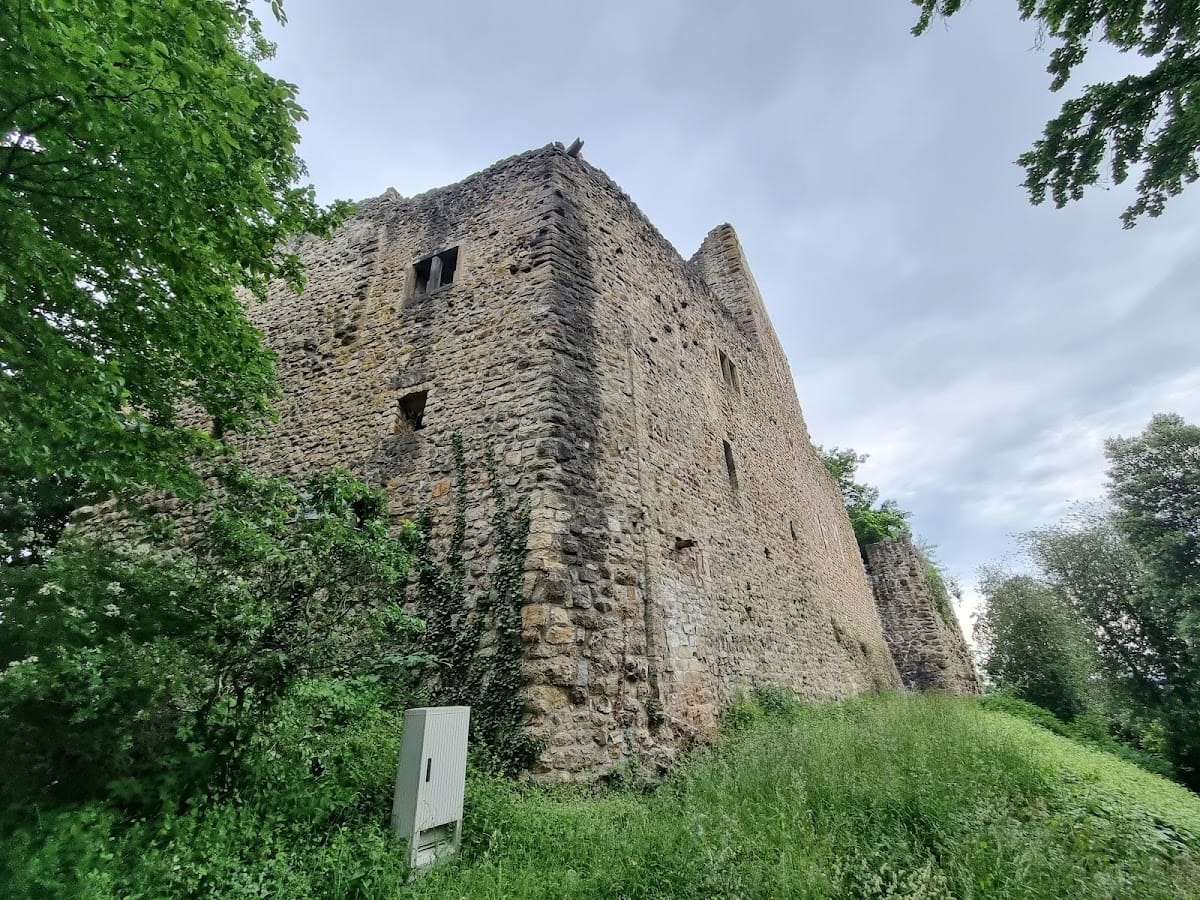
Burg Baden is a hilltop ruin on a 454.6-metre-high hill above Badenweiler’s spa park. The surviving castle remains include the keep, foundation walls, the route of a steep walled approach, and parts of the residential buildings. The ruin is distinct from the nearby ruin of Neuenfels Castle. Later structures and commemorative features occupy parts of the surrounding castle hill.
Medieval castle remains
Keep and approach
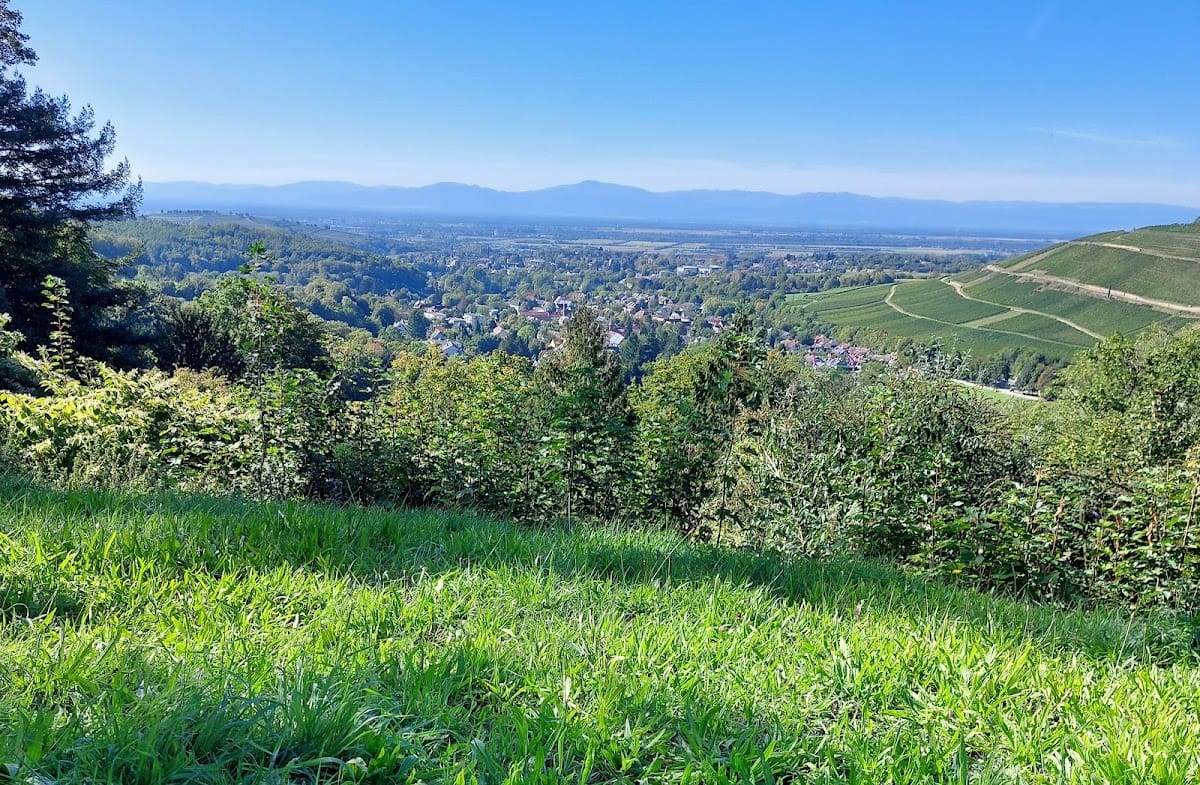
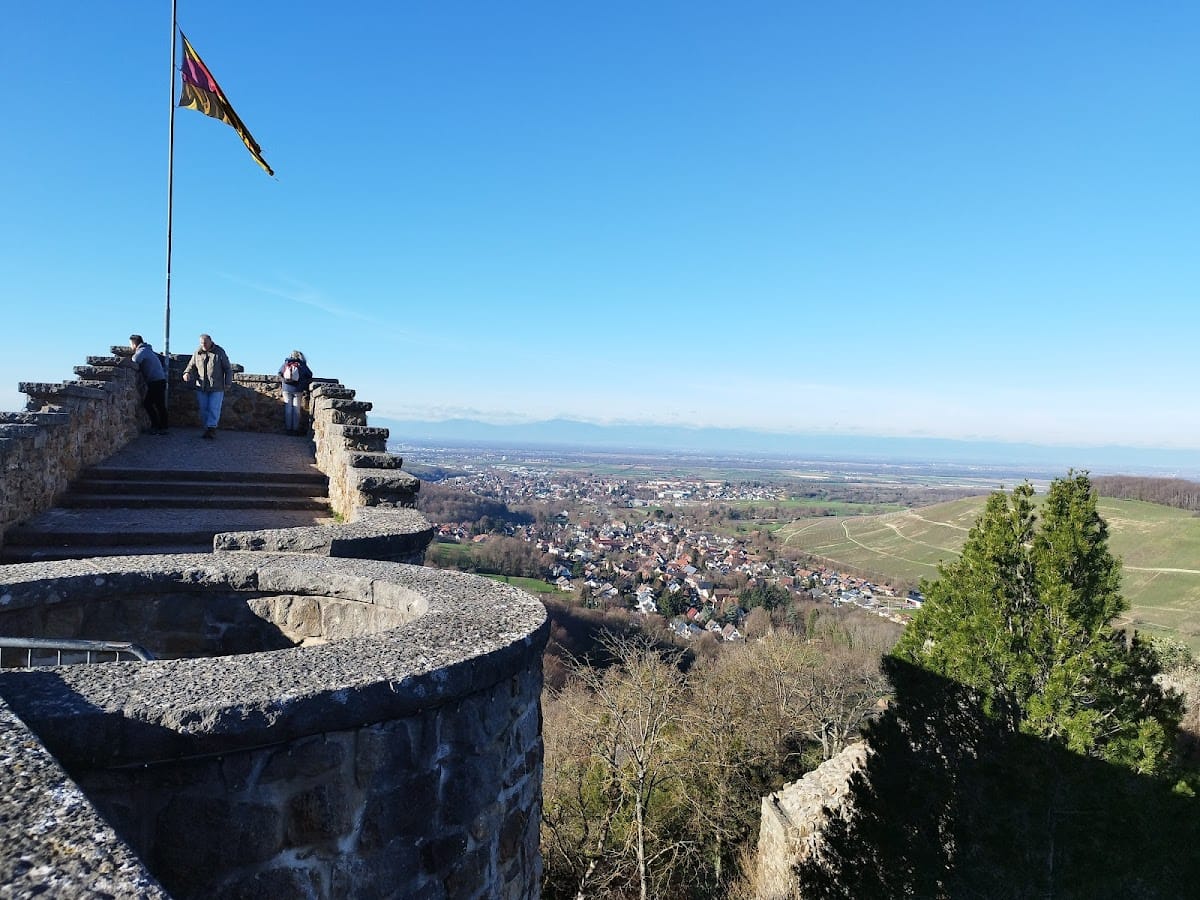
The keep, the castle’s principal strong tower, survives as one of the defining elements of the ruin. It can be climbed as a viewing platform. A steep access path bordered by walls passes the round tower, preserving part of the fortified approach through the complex. From the keep, the landscape extends across Badenweiler, east toward the Black Forest, and west toward Müllheim, the Rhine plain, and the Vosges.
Palas and residential buildings
In the northeastern part of the complex, the foundations and remains of the palas, the main residential and representative building, are divided into three sections. Their arrangement indicates a building with several stories and multiple rooms. The forms of its windows have survived, providing evidence of the character of the former residential structures within the castle.
Structures and features of the castle hill
Belvedere
The Belvedere was built between 1811 and 1816 according to plans by Friedrich Weinbrenner, a prominent Baden architect. It served as an aristocratic tea and pleasure house before being used successively for worship, as a local-history museum, as a painter’s studio, as a gymnasium, and for exhibitions.
Frederick monument
On the western side of the promenade around the castle hill stands a monument to Grand Duke Frederick I of Baden at a place called the Coffee Mill, facing the Vosges. Karl Friedrich Moest, a sculptor and professor associated with the Karlsruhe Academy of Art, created it in 1912. The monument was initially erected on the castle hill. It is Badenweiler’s largest monument and also commemorates the period when Baden existed as an independent state.
Chekhov memorial
The present Chekhov monument faces the Vosges and dates from 1992. Nearby, the plaque recalls the earlier monument erected in 1908, and the symbolic cherry garden planted in 2004 forms part of the commemorative landscape around the castle hill.
Medicinal and grape gardens
The Hildegard of Bingen Garden, within the spa park, contains beds of medicinal plants along the retaining wall. The adjoining Gutedel Garden is a botanical display garden presenting varieties of the Gutedel grape.
Wandelbahn
The Wandelbahn was built in 1882 and 1883 on the site of the present Kurhaus. This cast-iron hall measured 45.5 metres in length and 4.5 metres in width, and was designed for promenading in bad weather. Part of the structure was re-erected in 1969 at the New Vosges View.
Nearby sites