Burg Staufen: A Medieval Hilltop Castle in Germany


Site at a Glance
- Rating
- 4.6
- Popularity
- Medium
- Country
- Germany
- Primary era
- Medieval
- External website
- Open
- Eras represented
- Medieval
- Civilizations
- Holy Roman Empire
- Site type
- Military
- Remains
- Castle
On this page6 sections
History
Burg Staufen is a ruined hilltop castle in Germany, north of Staufen im Breisgau, built by the Lords of Staufen in the early twelfth century. Archaeological evidence indicates that a Roman watchtower had stood on the hill before the medieval castle was established. The site became part of a changing network of noble, urban, and territorial power in the Upper Rhine.
Origins and early ownership
The castle probably originated in the early 1100s. Adalbert of Staufen is said to have erected the castle house around 1100, establishing the main residence associated with the family. Burg Staufen was first explicitly mentioned in 1248, when the Üsenberg family, a medieval noble lineage, was identified as the landed lord. The Üsenbergs never occupied the castle.
During the fourteenth century, financial problems and unsuccessful feuds involving the Lords of Staufen allowed the nearby city of Freiburg to extend its influence. Freiburg acquired shares in the castle in 1327 and 1337 and enforced an opening right. This legal arrangement required the castle to remain accessible to Freiburg’s forces and prevented its other owners from using it for military action against the city. The owners also had to support Freiburg and keep the castle open to its troops.
Territorial change and the Faust association
In 1359, Otto of Staufen pledged half of the castle and the town to Konrad Schnewlin. The feudal supremacy of the Counts of Freiburg was acknowledged in 1370, and around 1400 Staufen became part of Further Austria, the Habsburg territory in the Upper Rhine and neighboring regions rather than the Austrian core lands.
Burg Staufen is also associated with Johann Georg Faust, the Renaissance-era alchemist and miracle healer later known as Doctor Faustus. An alchemist sought to transform substances and develop processes such as the production of gold. Faust was probably employed as a goldmaker by Anton of Staufen. In 1539, he apparently died in a chemical explosion in his room at the Gasthaus zum Löwen in Staufen.
Destruction and later preservation
The Lords of Staufen became extinct in 1602 with Georg Leo of Staufen. The castle and town then reverted to Austria, and the castle was no longer inhabited by 1607. From 1628 to 1722, the lordship of Staufen, including the castle, was pledged to the Barons of Schauenburg.
The undefended castle was occupied by Swedish troops during the Thirty Years’ War, the major European conflict of 1618 to 1648 involving religious, dynastic, and political struggles across the Holy Roman Empire and neighboring states. In 1632, the troops burned and destroyed Burg Staufen. The City of Staufen acquired the ruins from the Mentzingen family in 1896 and arranged their renovation. Further renovations followed in 1954 and 1960.
Remains
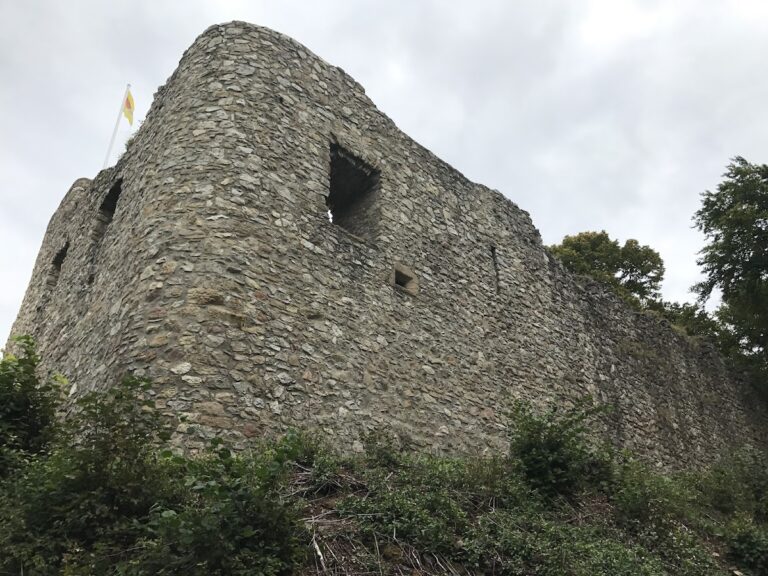
Burg Staufen survives as the ruin of a noble hilltop castle in an exposed position on the Schlossberg, a hill approximately 375 metres above sea level. The visible remains preserve parts of the castle’s enclosing walls, together with a tower and the castle entrance. The castle house, associated with the foundation phase around 1100, formed part of the early medieval complex.
Castle structures
The surviving wall sections define portions of the former enclosure, while the tower and entrance mark important elements of its defensive and access arrangements. These remains belong to a site whose present form is shaped by medieval construction, the destruction of 1632, and the renovations carried out after the City of Staufen acquired the ruins in 1896, with additional work in 1954 and 1960.