St. Peter’s Parish Church: A Roman Catholic Church in Ljubljana
Site at a Glance
- Rating
- 4.8
- Popularity
- Medium
- Country
- Slovenia
- Primary era
- Early Modern
- Eras represented
- Medieval, Early Modern, Modern
- Civilizations
- Austria-Hungary, Habsburg, Habsburg Austria, Holy Roman Empire
- Site type
- Religious
- Remains
- Church
On this page15 sections
History
Early church and medieval parish
St. Peter’s Parish Church is a Roman Catholic church in Ljubljana, Slovenia, dedicated to St. Peter, an apostle and early leader of the Christian church whom tradition regards as Rome’s first bishop. Among Ljubljana’s oldest churches, it served as the center of the city’s early parish and is now the seat of the Ljubljana–St. Peter parish.
An earlier church is thought to have stood near Ljubljana’s city walls around the turn of the ninth century. It may have been established on the order of Paulinus II, the Carolingian-era patriarch of Aquileia. Records refer to the church in 1163 and 1227. A document dated 23 February 1262 names Ludovik as parish priest and archdeacon of Carniola and the Slovene March. The church became a parish church on 7 October that year.
A church on the site is dated to 1358, though it may have existed earlier. During the fourteenth century, the building was rebuilt in the Gothic style. The cemetery around it served Ljubljana and nearby communities as the town’s principal burial ground until it was abandoned in 1779. Turkish raids repeatedly burned and damaged the church during the fifteenth century.
Restoration and Baroque rebuilding
Bishop Tomaž Hren arranged a restoration in 1618, when the church had a single bell tower. The present church was built in the early eighteenth century in the Baroque style, a European artistic and architectural movement known for richly ornamented interiors. It was blessed before completion in 1728 and finished in the early 1730s.
The plan is attributed to Carlo Martinuzzi and drew on San Giorgio Maggiore in Venice, a Renaissance church designed by Andrea Palladio. Giovanni Fusconi prepared a model and gave technical advice, while Gregor Maček Jr. served as master builder. Construction took place while Dr. Nikolaj Ivan Kraškovec was vicar. To pay for completion, the parish priest sold all the church’s land.
Alterations and restoration
After the 1895 earthquake, architect Raimund Jeblinger oversaw renovations. The facade was altered, the presbytery and sacristies were enlarged, and transept chapels were added or enlarged. In the late 1930s, Ivan Vurnik remodeled the facade. His wife, Helena Vurnik, contributed new interior decoration and mosaics.
Construction of a new road and the Fabiani Bridge led the City of Ljubljana and the Ministry of Culture to arrange restoration work in 2011. Sculptor Peter Mali led the project, while painter Jasna Radšel and colleagues cleaned and retouched paintings on the presbytery ceiling and in the apse. The bell-tower clocks were refurbished in November 2012.
Trubar Street was called St. Peter’s Road until 1952. A nearby bridge over the Ljubljanica and a former barracks at Vraz Square also took their names from the church.
Remains
Plan and exterior
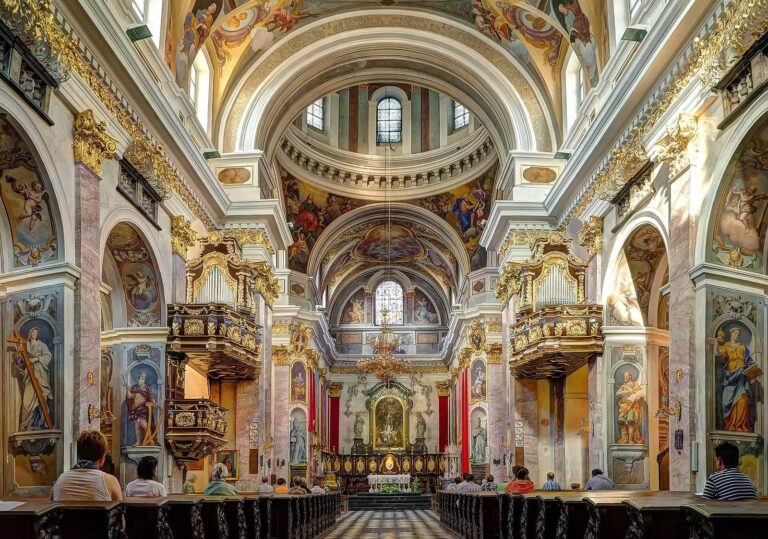
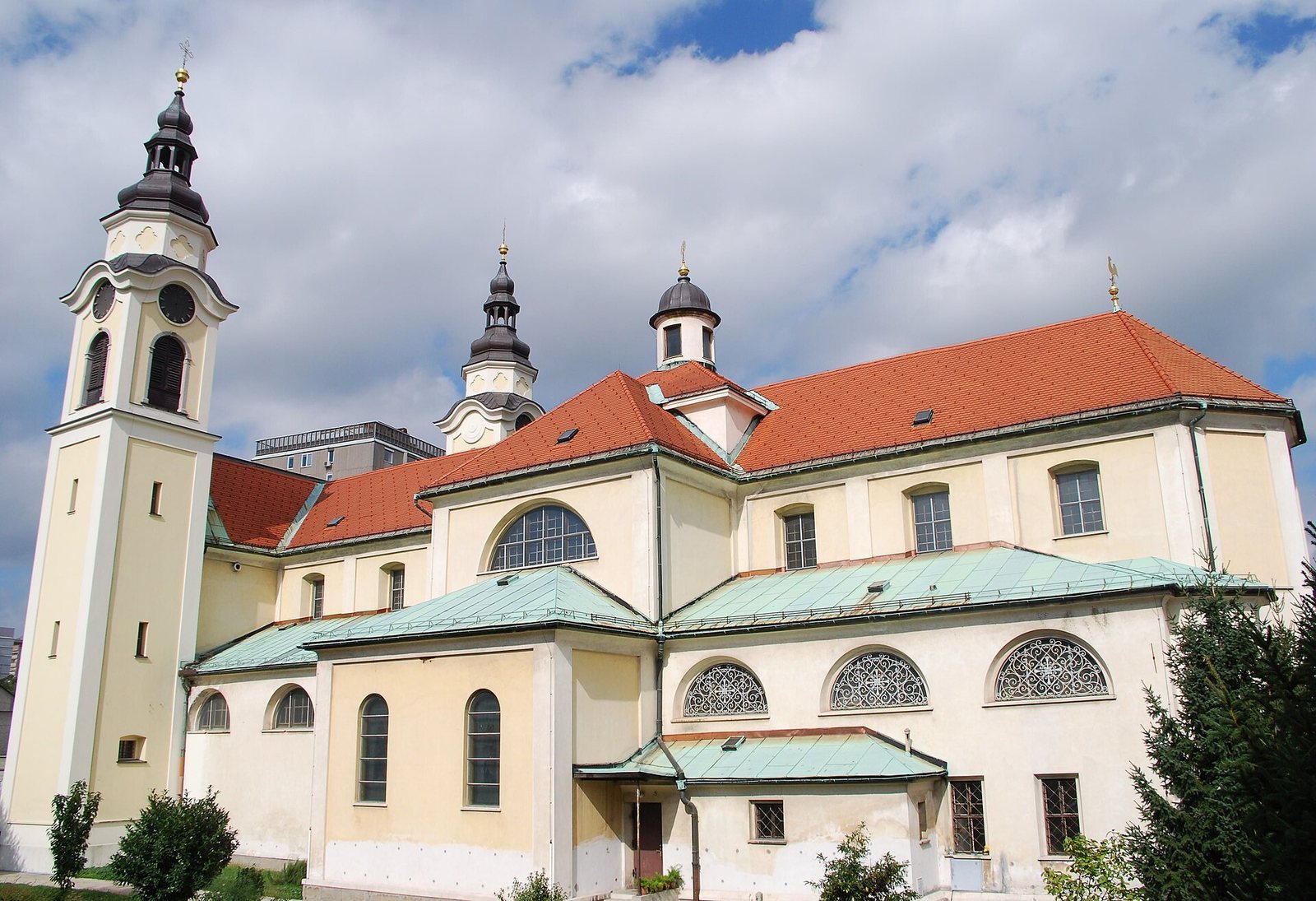
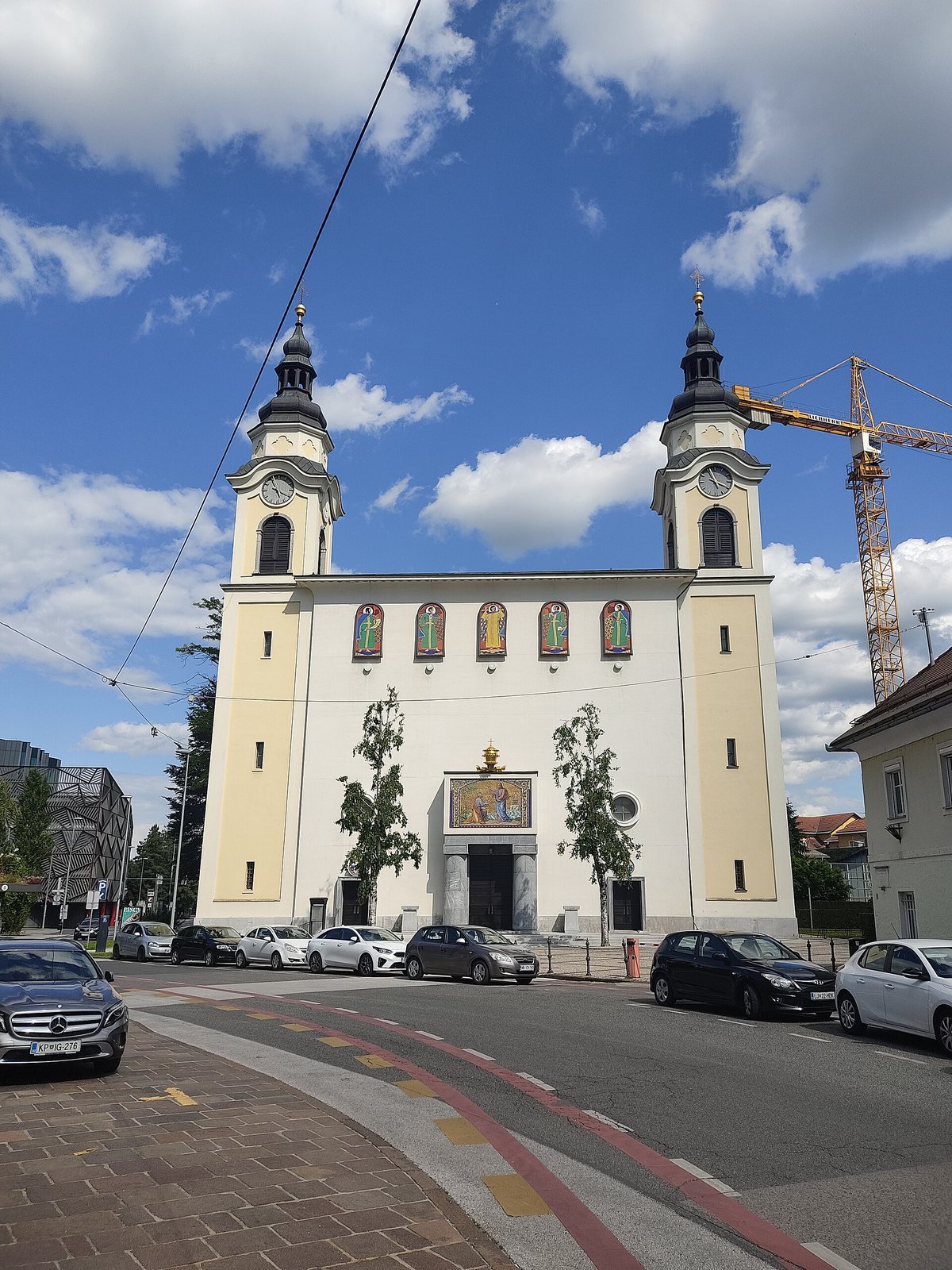
The church is a three-aisled basilica, a long building with a central nave and side aisles, with a dome above the transept, the crosswise section of the church. Its presbytery, the area around the altar, ends in an apse, a rounded or polygonal termination. The interior’s divisions have remained almost unchanged, and the building has two bell towers. It stands at the corner of Trubar, Njegoš, and Zalog streets, near Croatian Square and the University Medical Centre Ljubljana.
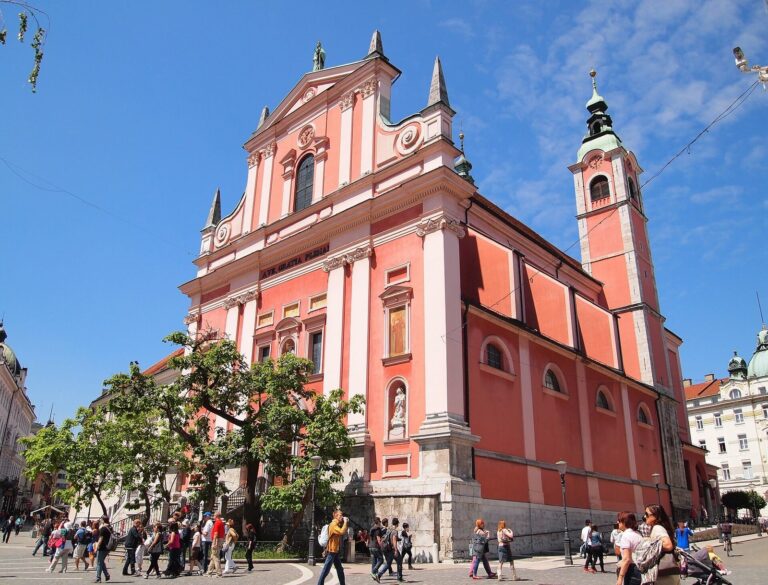
The facade has been altered since the Baroque rebuilding, and later remodeling left it with little of its earlier Baroque character. Its smooth surface carries five upper mosaics showing Christ and the four Evangelists, as well as a mosaic at the main entrance. Decoration and arcades were added at the top of the facade during the post-earthquake changes.
Painted decoration
Dome and vaults
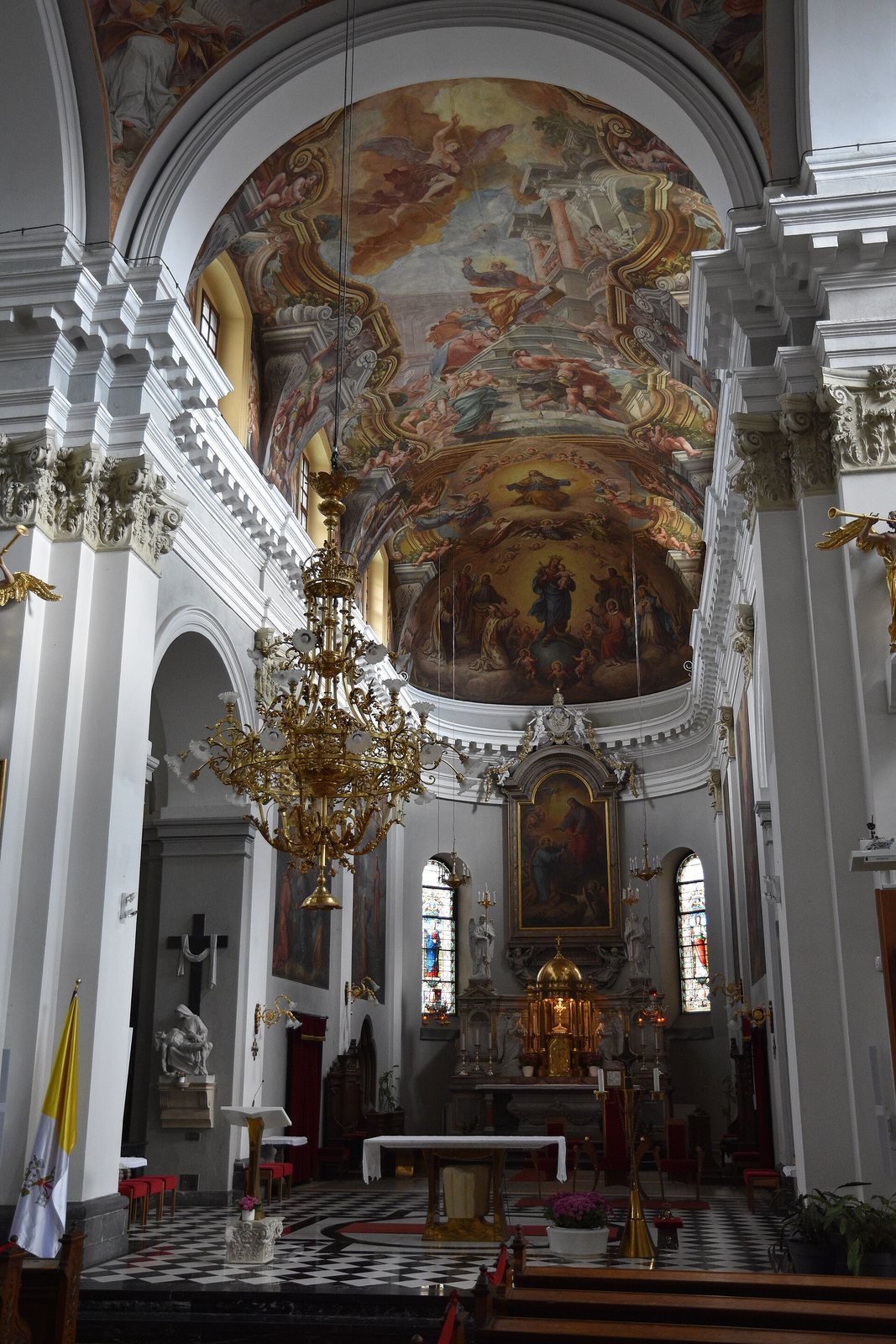
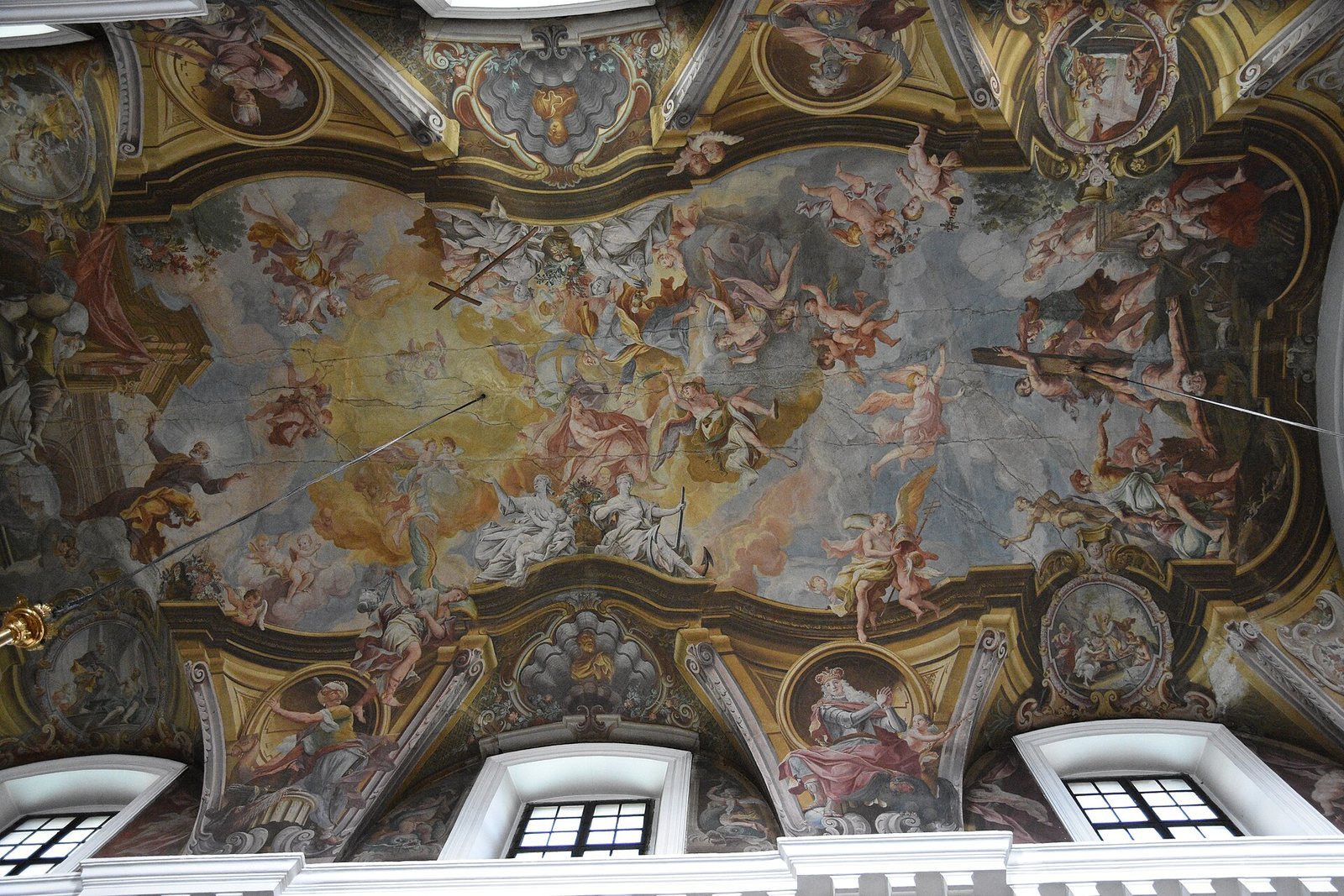
Franc Jelovšek painted the dome and vaults between 1731 and 1734. The polychrome work, using several colors, depicts episodes from St. Peter’s life, the four Evangelists, personifications of virtues, and the four continents.
Apse
Paintings by Jožef Kastner decorate the apse.
Altars and furnishings
Altars and sculpture
Most of the altars and the church’s stone-carved furnishings are Baroque. Altar paintings by Valentin Metzinger include the Crucifixion of St. Andrew, Christ on the Cross and St. Mary Magdalene, St. Ursula, St. Florian, The Vision of St. John of Nepomuk, and The Coronation of Mary. Wooden angels stand on the altar of St. Mary Magdalene. The altar of St. Ursula includes sculptures of St. Barbara and St. Lucy attributed to Henry Michael Löhr.
Pulpit and baptismal font
Carlo Bombasi made the pulpit in 1747. It was transferred here from the demolished Franciscan Church of the Annunciation of the Virgin Mary, and its stairs were added later. In the presbytery stands a baptismal font given by Bishop Tomaž Hren in 1611.
Former entrance statues
Statues of St. Peter and St. Paul, made by sculptor Toman in 1850, once stood beside the main entrance. They were removed near the end of the twentieth century because they had deteriorated.
Bell towers and bells
The north tower holds the church’s largest bell, while the south tower contains four bells. A smaller bell once hung beneath the south tower’s roof; it is now kept inside the church as a memento. Elija Sombrak cast it in the seventeenth century.
Entrance inscription
An inscription near the entrance records the church’s burning in 1472.