Ljubljana Cathedral: The Roman Catholic Cathedral of St Nicholas
Site at a Glance
- Rating
- 4.5
- Popularity
- High
- Country
- Slovenia
- Primary era
- Early Modern
- Eras represented
- Classical, Medieval, Early Modern, Modern
- Civilizations
- Austria-Hungary, Austrian Empire, Habsburg, Habsburg Austria, Holy Roman Empire, Roman
- Site type
- Religious
- Remains
- Cathedral
On this page17 sections
History
Medieval church and cathedral
Ljubljana Cathedral is a Roman Catholic church dedicated to St Nicholas in Ljubljana, Slovenia. It serves as the cathedral of the Archdiocese of Ljubljana and as the parish church of the Cathedral Parish of St Nicholas. The present Baroque building dates to the early eighteenth century, but a church on the site is mentioned in 1262. Built by the city’s boatmen and fishermen in honour of their patron saint, that church served as a secondary church alongside the older Parish of St Peter. The boatmen and fishermen formed one of Ljubljana’s more powerful medieval guilds.
During the second half of the fourteenth century, a Gothic sanctuary was built where the earlier church’s main and northern apses had stood, and a bell tower was added beside the main entrance. A fire destroyed the church in 1361, after which it was repaired in the Gothic style. When the Diocese of Ljubljana was established in 1461, the church became its cathedral. Its medieval building was altered: the nave walls were raised, wooden ceilings were replaced with vaulted ones, and the three naves received a new roof. Another fire devastated the cathedral in 1469. Arson was suspected, possibly by Ottoman Turks.
Between 1476 and 1484, a gallery was built above the main entrance. A passage through the bell tower connected it with the bishop’s palace, while extra columns supported the new structure.
Baroque rebuilding
By the latter half of the seventeenth century, the cathedral had badly deteriorated. Its dean and vicar general, Janez Anton Dolničar, advocated replacing it. Other church-building projects in Ljubljana had increased the price of materials and the wages of workers. In 1700, with Dolničar’s initiative and the involvement of the Academia Operosorum Labacensium, a learned society in Ljubljana, Capuchin friar Florentianus Ponnensis, from Milan or Bologna, designed a new church in the Baroque style. In 1702, Jesuit architect Andrea Pozzo revised and enlarged the design. Pozzo did not oversee construction, and the builders adapted his plans as work proceeded.
The old cathedral was taken down between 8 April and 14 May 1701. Foundations for its replacement were finished on 6 June, and roof construction began on 28 September. Francesco Bombassi and Mihael Zamerl led the building work. Bombassi replaced Francesco Feratta after a few months, and Peter Janni also helped carry out the design. Master builder Pavel Jugovic died in March 1704; Gregor Maček the Elder succeeded him. The new church was completed in 1706, and worship began there in August. It was consecrated on 8 May 1707. A bell cast by Gasparo de Franchi, paid for by Baron Codelli, was installed that October.
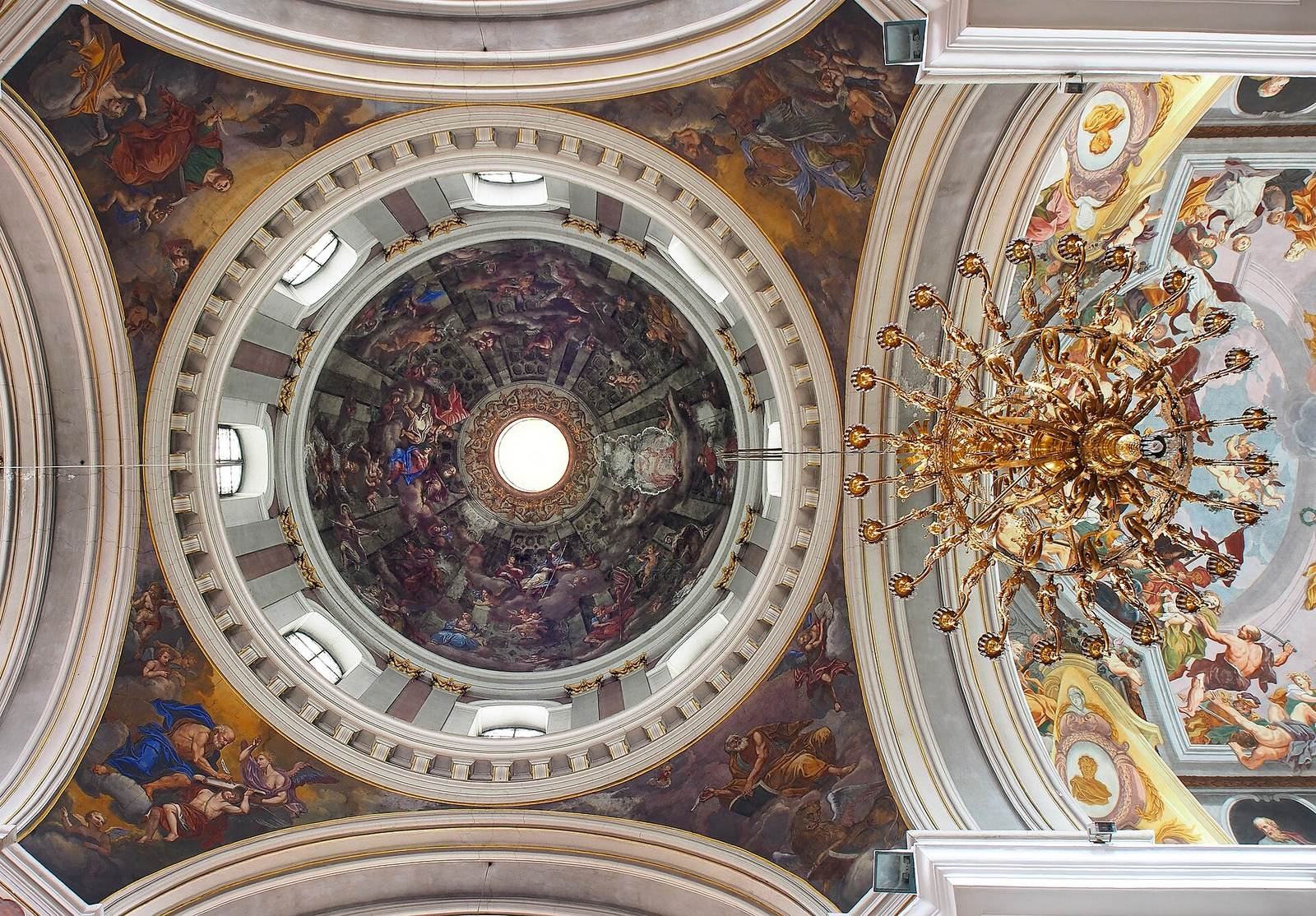
The original design called for a masonry dome, but limited funds and a lack of suitable expertise led to a wooden framework attached to the roof with iron rods. In 1836, cathedral authorities proposed replacing it with a masonry dome, concerned that fire could cause serious damage. Two frescoes by Giulio Quaglio from the earlier dome were restored by Jožef Kalasanc Erberg and taken to Dol pri Ljubljana. One was incorporated into the staircase vault of his mansion; the other was kept in a museum there. A masonry dome was built in 1841 by Matej Medved, with carpentry by Jurij Pajk. Benedikt Müller is credited with its design and worked closely with Medved, who also contributed ideas. Matevž Langus painted the dome between 9 June and 18 September 1844. The technically demanding project brought Medved considerable acclaim.
Decoration and later changes
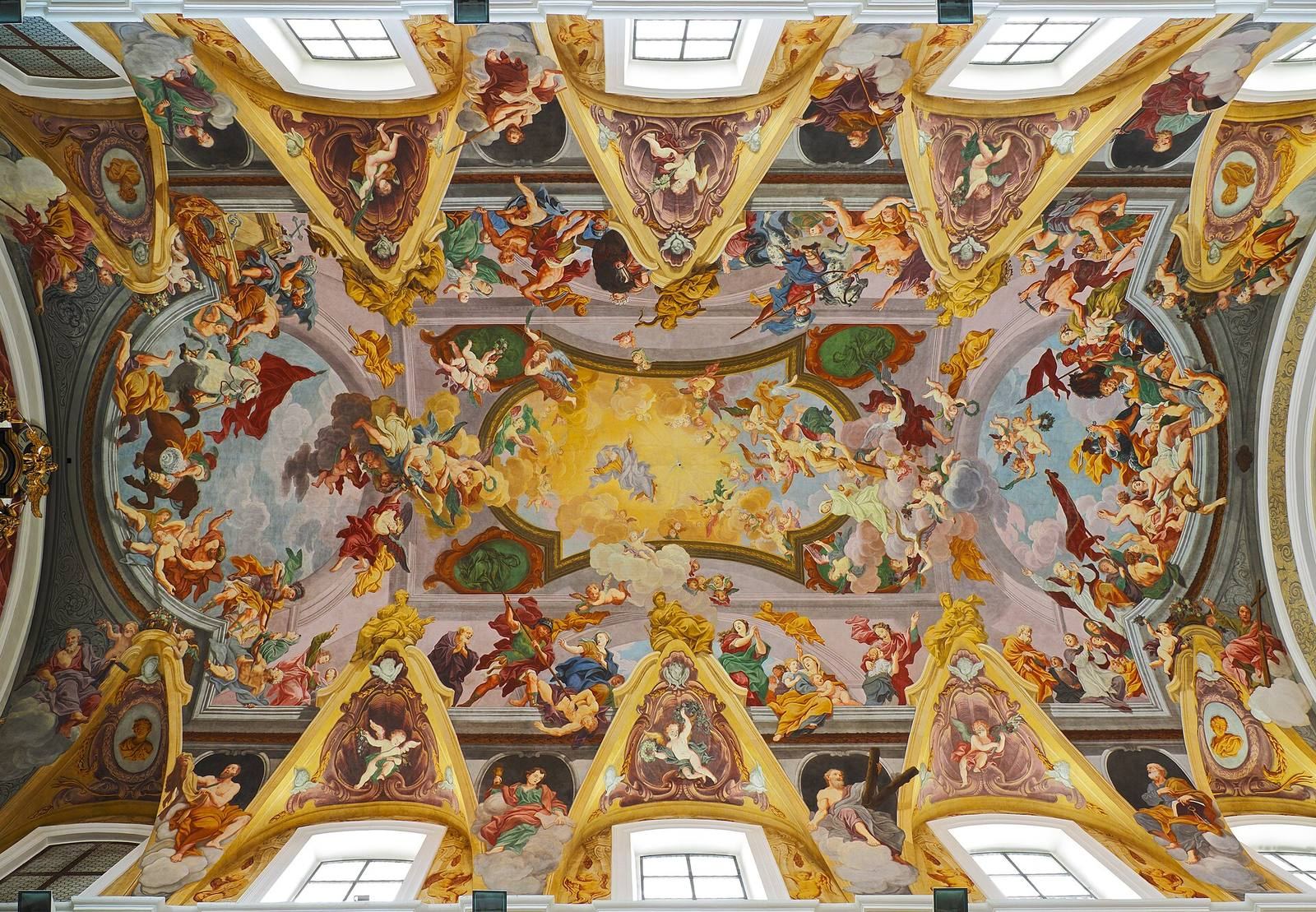
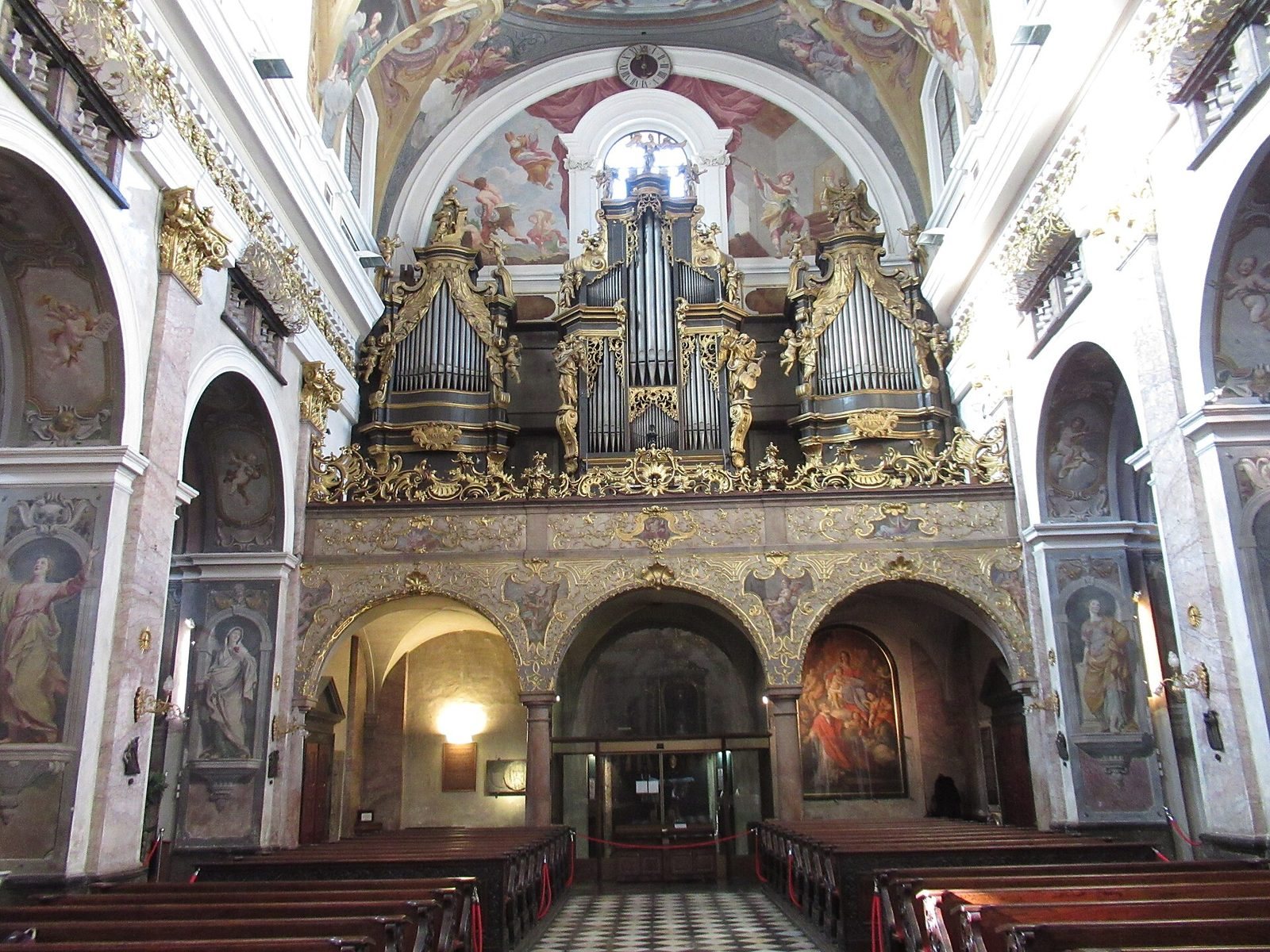
Quaglio began work on the cathedral’s paintings in 1703. His frescoes date to 1703–1706 and 1721–1723, with contributions from assistants and, later, Langus. Tomaž Ferrata carried out the stucco work in 1704. Sculptors Francesco Robba, Angelo Putti, and brothers Paolo and Giuseppe Groppelli also contributed to the church’s decoration and furnishings. In 1859, an extensive interior renewal included cleaning frescoes, covering walls with marble, restoring gilding and repairing the organ. Around the cathedral’s two-hundredth anniversary, it received new windows and benches, as well as a new Milavec organ fitted into older Baroque cases.
In 1943, women gathered outside the cathedral after Italian occupation authorities arrested or deported their relatives to prisons and camps. After unsuccessful demonstrations elsewhere in Ljubljana, they hoped Bishop Gregorij Rozman would help. A memorial pillar was placed near the cathedral’s southwest corner in 1953. It was removed to a restoration workshop in 1991 and not returned; a different memorial, bearing a revised inscription, was later installed at Pogačar Square.
Further work altered both the church’s appearance and interior. Ivan Vurnik designed renewed windows in 1948, while Stane Kregar designed the coloured window in the rear wall of the sanctuary. The exterior was repainted, the bell towers reroofed and their finial apples restored in 1961. From 1969 to 1971, work guided by Anton Bitenc’s plans reorganised the sanctuary. France Gorše added a miniature relief of the Stations of the Cross, and Jože Plečnik designed and paid for the bishop’s official seat. Plečnik had also prepared a design for a new bishop’s throne in 1952. He later contributed a small baptismal font and work on the Chapel of the Holy Cross.
The cathedral’s bronze entrance doors were made in 1996 to mark 1,250 years of Christianity in Slovenian territory. Pope John Paul II blessed them during his first visit to Slovenia, from 17 to 19 May that year. Conservation and restoration of Quaglio’s frescoes began in 2002 and concluded in 2007, combining research, treatment and documentation. Tombstones of several bishops and their bronze portraits were added in the southern chapels in a later phase. The cathedral was declared a Slovenian monument of national importance in 2008 and is included in the national cultural heritage register. It remains in active religious use and also hosts cultural events.
Remains
Plan and construction
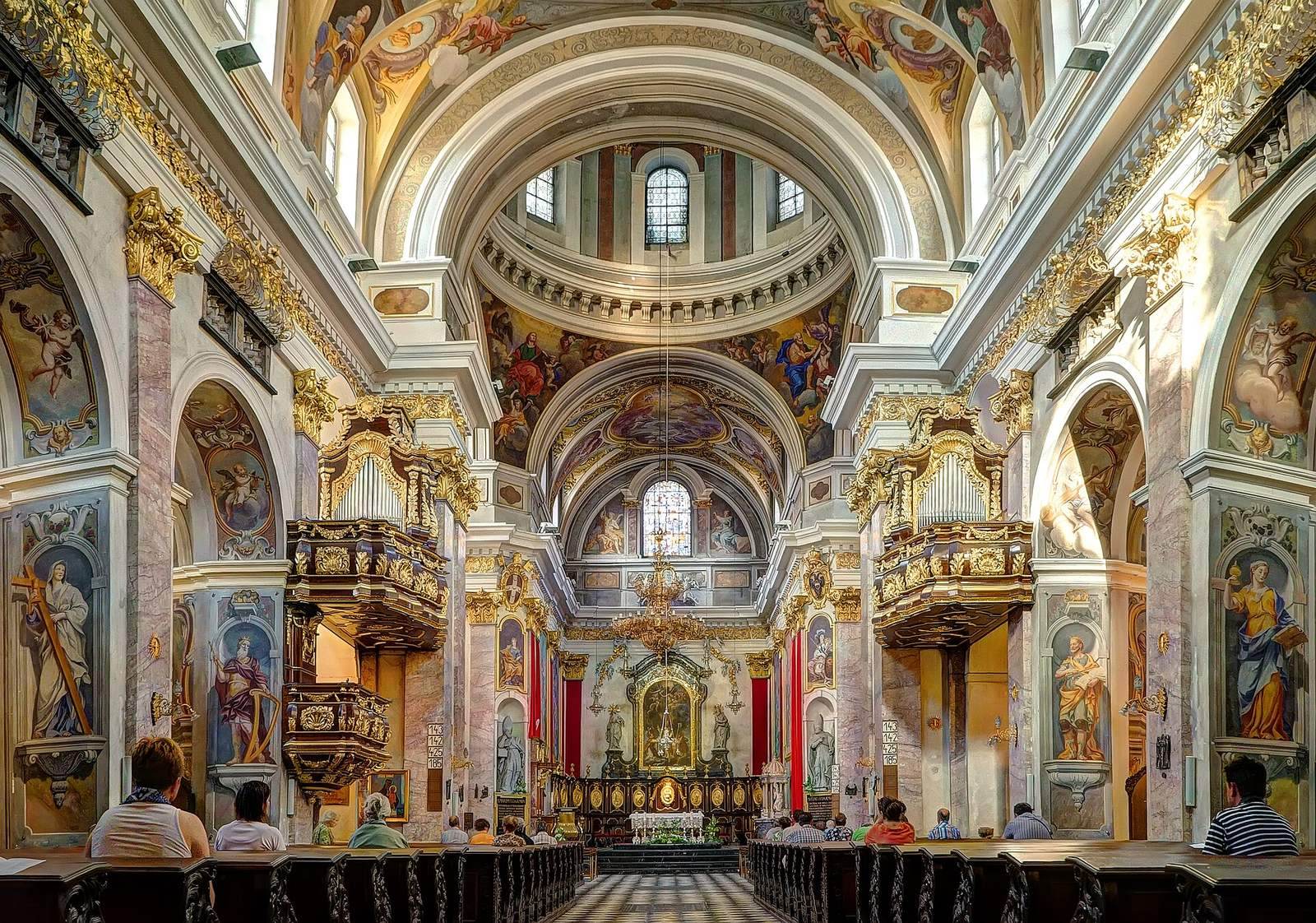
The cathedral stands beside Dolničarjeva Street and Ciril-Metodov Square, between Mestni Square and Ljubljana Central Market. It is slightly raised above Pogačar Square and set apart from the street frontage. Its east-facing plan has a single vaulted nave, side chapels and a transept, the crosswise arm of a church. The transept meets the main body at the crossing, which is covered by a dome; a flat-ended sanctuary lies to the east. Pozzo’s design drew on Vignola’s Roman church of Il Gesù. A dome over the crossing was a novel feature for Ljubljana churches.
The dome rises 24 metres externally. Its drum, the supporting structure beneath the dome, is cylindrical inside and octagonal outside, and the vault rests on sixteen ribs. Builders mixed wine into the lime used for the walls, intending to strengthen and preserve them. Lightweight, porous stone from near the foot of the castle hill was used in the vaults. A few reused stone pieces from the former church were incorporated into the replacement.
Exterior and entrances
Bell towers and gable
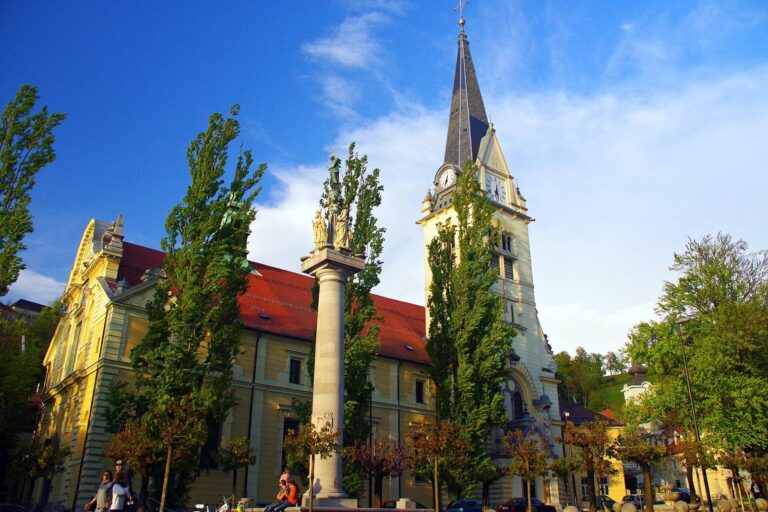
Two bell towers stand at the western end of the church, replacing an older tower that had stood for about 300 years. The old tower was demolished in 1704, and its replacements were finished in 1706. Their copper finial apples were gilded, and the towers held relics and parchment inscriptions. The bells include one dated 1326, described as Slovenia’s second-oldest, the 1706 bell cast by Gasparo de Franchi, and bells from the Strojne Livarne factory. Between the towers is a segmented, semicircular gable. After the 1895 Ljubljana earthquake, Franz Faleschini built a triangular replacement to Raimund Jeblinger’s plans. The earlier Baroque shape was reconstructed in 1989.
Façade paintings and sculpture
Frescoes of the Annunciation appear on the south, east and north façades. Quaglio painted the north and south works; Janez Wolf restored them in 1872 and painted the eastern one. Six sandstone statues of bishops and saints occupy façade niches. Franc Ksaver Zajec made the south-side figures of St Hermagoras and St Fortunatus in 1872. Ivan Pengov carved Thomas Aquinas and St Bonaventure for the west façade in 1912, then Sigismund von Lamberg and Bishop Thomas Chrön for the north in 1913. Lamberg was Ljubljana’s first bishop.
A Gothic Pietà, a depiction of Mary mourning the dead Christ, on the south façade copies a sculpture from the former cathedral. It probably came from an altar there and was likely made in 1448 by a Ljubljana workshop. Nearby is a sundial dated 1826, with Roman numerals and the Latin motto meaning You do not know the day or the hour; it was restored in 1989. To the right of the main entrance, a copy of a Gothic vault stone shows Christ’s head. The original, dating to about 1380, is inside the cathedral and once joined the ribs of the former church’s sanctuary vault. A relief tombstone for Bishop Martin of Pićno, who died in 1456, is set into the south façade. It shows his staff beneath a three-lobed arch, with his coat of arms below and a simple mitre above.
Roman stones and records of the former cathedral
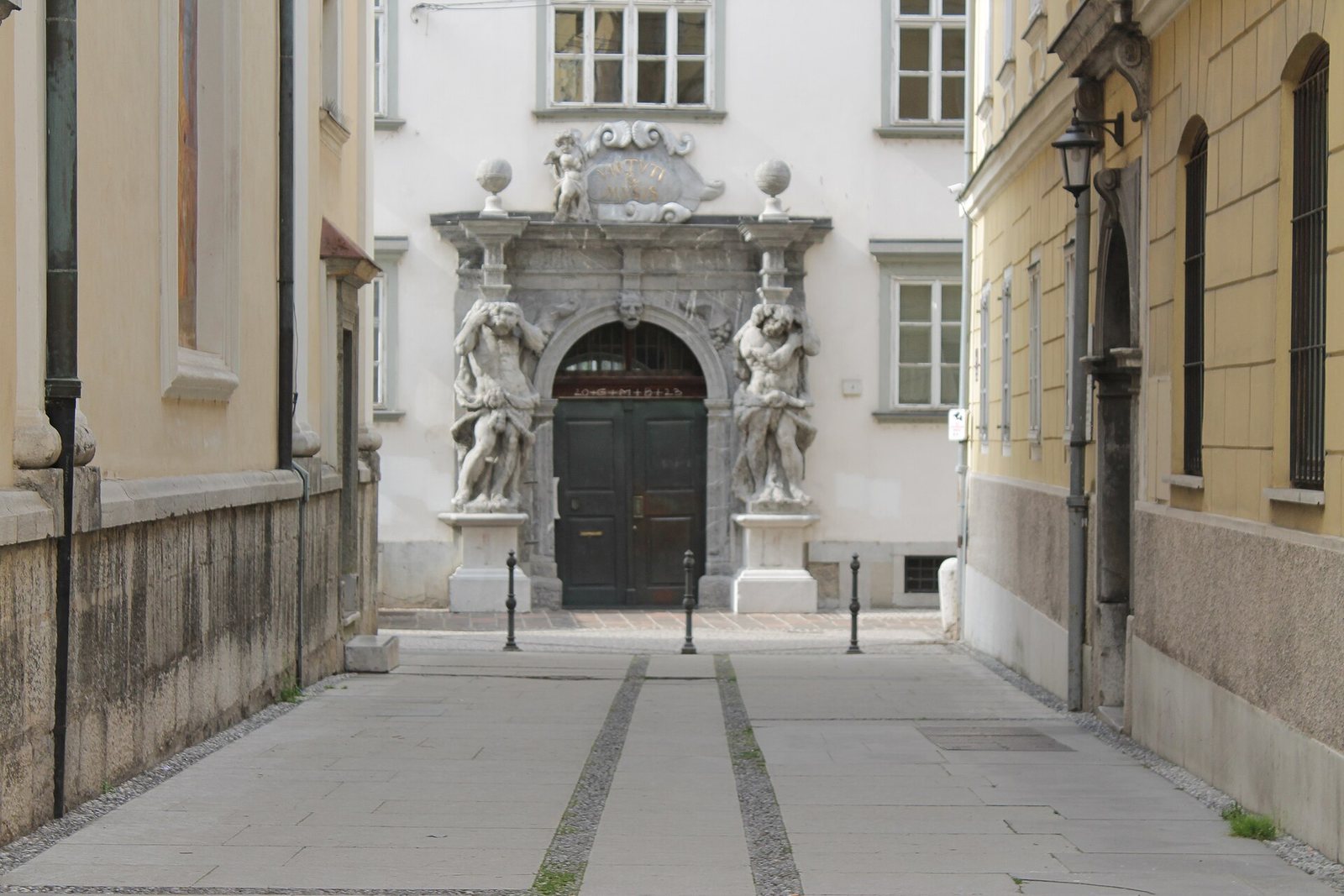
Roman tombstones and inscriptions are set into the south wall. Most were found at Ig or in Ljubljana and belong to the Dolničar lapidary, a collection of stone monuments and inscriptions installed in the cathedral and neighbouring seminary through Janez Gregor Dolničar’s initiative. The collection recalled Emona, a Roman settlement in the area of modern Ljubljana. Its pieces include a dedication to Hercules; two tombstones are probably forgeries, and an uninscribed fragment may come from an altar. Dolphins, a common funerary image, represented a fortunate passage from life to the next world.
Before the medieval cathedral was demolished, architect Carlo Martinuzzi drew its plan and recorded its tomb monuments and inscriptions. His record included tombs of the Auersperg, Ursini, Lamberg, Barb, Rauber, Seirbiach, Trautson, Saurau, Moscon, Wernek and Schayer families, among others. It also preserved epitaphs for bishops including Martin of Pićno, Žiga Lamberg, Tomaž Hren and Jožef Rabatta.
Bronze doors
Tone Demšar made the relief on the main, or Slovene, door, which presents episodes from Slovenian history. Its imagery ranges from archaeological finds of the Situla period, an Iron Age artistic tradition, and Roman times to a linden tree representing the Slovenian people. It shows the Carantanian princes Gorazd and Hotimir being baptised, a gathering at the Prince’s Stone, and the church at Gospa Sveta with figures associated with the spread of Christianity. Other scenes refer to the Freising Manuscripts, religious orders, knightly riders, peasant uprisings, Ottoman raids, Protestantism, independence, the world wars and the pilgrimage church at Brezje. At the top, John Paul II reaches toward the door. A carnation offered to him expresses gratitude to the Vatican for being among the first to recognise Slovenian independence.
Mirsad Begić redesigned the side, or Ljubljana, doors with portraits of twentieth-century bishops. The arrangement centres on a suffering Christ, with the bishops leaning toward him in a composition resembling a Pietà; they are not shown in chronological order. They include auxiliary bishop Stanislav Lenič; Anton Bonaventura Jeglič, bishop from 1898 to 1930; Gregorij Rozman, bishop from 1930 until formally 1959; Anton Vovk, bishop from 1959 to 1963; Jožef Pogačnik, bishop from 1963 to 1980; and Alojzij Šuštar, bishop from 1980 to 1997. Jeglič shaped religious, cultural and political life in the diocese and founded the Škofovi zavodi. Vovk became Ljubljana’s first archbishop in the twentieth century. Rozman led the diocese during the Second World War, left with refugees in May 1945, and died and was buried near Chicago; his remains were later transferred to the cathedral. Pogačnik oversaw the implementation of the Second Vatican Council, while Šuštar contributed to Slovenia’s democratisation and international recognition. Begić also made a relief of the Holy Trinity for the arched panel above a portal.
Interior decoration and furnishings
Sanctuary paintings
Quaglio’s frescoes in the sanctuary depict miracles of St Nicholas. In a scene of people receiving bread, he included a self-portrait in the upper-right corner. The ceiling painting represents the founding of the Diocese of Ljubljana. Beside a window are allegories of the Fire of Divine Love and Religious Fervour, with Longing and Vigilance below; Faith appears over the altar, and Charity and Hope beside the window. Frescoes flanking the ceiling scene show Emperors Rudolf and Maximilian.
Dome and crossing
Langus’s dome decoration centres on the Holy Spirit surrounded by angels. Gilded candelabra fill the spaces between the windows and lantern, while white marble angels support the ledge below them. Recesses have ornaments against gold backgrounds, and Byzantine-style gold ornament covers the upper dome. Seen from the main entrance, the paintings show the Coronation of Mary, with St Nicholas, St John the Baptist and allegories of Carniola and Emona below. Other figures include St Joseph, St Agnes, St Hermagoras, St Fortunatus, St George, St Teresa, St John, St Valeria, St Vitalis, Pelagius, St Achatius, St Charles Borromeo and St Anthony of Padua.
Above the altar of Our Lady of Brezje, an altarpiece shows Christ in Limbo consoling souls. The ceiling depicts the Assumption of Dismas, with his crucifixion to the left and the Flight into Egypt to the right. Penance and Innocence flank a window. Four Evangelists appear on the curved supports that carry the dome over the square space below. Beneath them are the arms of Pope Pius II, Emperor Frederick III, Count Sigismund Herberstein and Count Ferdinand Kuenburg, alongside figures representing Justice, Courage, Wisdom and Temperance.
Nave, choir and sacristy
The nave ceiling depicts the glorification of St Nicholas and the persecution of Christians under Emperors Nero and Diocletian. The spaces between its windows contain the twelve apostles, other saints and figures representing virtues. The choir paintings also show miracles of St Nicholas. In the main sacristy, a painting depicts the punishment of King Uzziah.
Altars, sculpture and furnishings
The side altars are dedicated to St Barbara, the Virgin Mary, the Holy Trinity, the Holy Eucharist, St Dismas and Mary Help of Christians, John of Nepomuk, Christ the Saviour and Mary Magdalene. Paolo and Giuseppe Groppelli made angels for the altar on the right side of the nave, while Francesco Robba made those on the left. Robba also carved two Carrara-marble cherubs for the Holy Eucharist altar in the north transept. Angelo Putti made statues of the Emona bishops Maxim, Florian, Castus and Gennadius for niches beneath the dome, a 1715 bust of dean Janez Anton Dolničar, and angel reliefs in the curved supports at the Holy Trinity altar. Bishop Franc Karl von Kaunitz commissioned the bishop statues.
Langus also painted an altarpiece of St Nicholas. An earlier Baroque painting, regarded more highly, was removed for several decades. Plečnik’s bishop’s seat, called a cathedra, stands to the left of the high altar and incorporates a symbolic Prince’s Stone, a carved Roman column base used in medieval ceremonies installing dukes in Carinthia. Plečnik also added a small baptismal font and restored the Chapel of the Holy Cross, opposite the side entrance beside the pulpit, decorating its Gothic crucifix.
Organ and relic
The organ installed by Ivan Milavec in 1911 has three keyboards, 52 stops and pneumatic action. A bone relic of Blessed Alojzij Grozde is also associated with the cathedral.