St. James’ Church in Ljubljana: A Baroque Jesuit Parish Church
Site at a Glance
- Popularity
- Medium
- Country
- Slovenia
- Primary era
- Early Modern
- Eras represented
- Medieval, Early Modern, Modern
- Civilizations
- Austria-Hungary, Habsburg, Habsburg Austria, Holy Roman Empire
- Site type
- Religious
- Remains
- Church
On this page24 sections
History
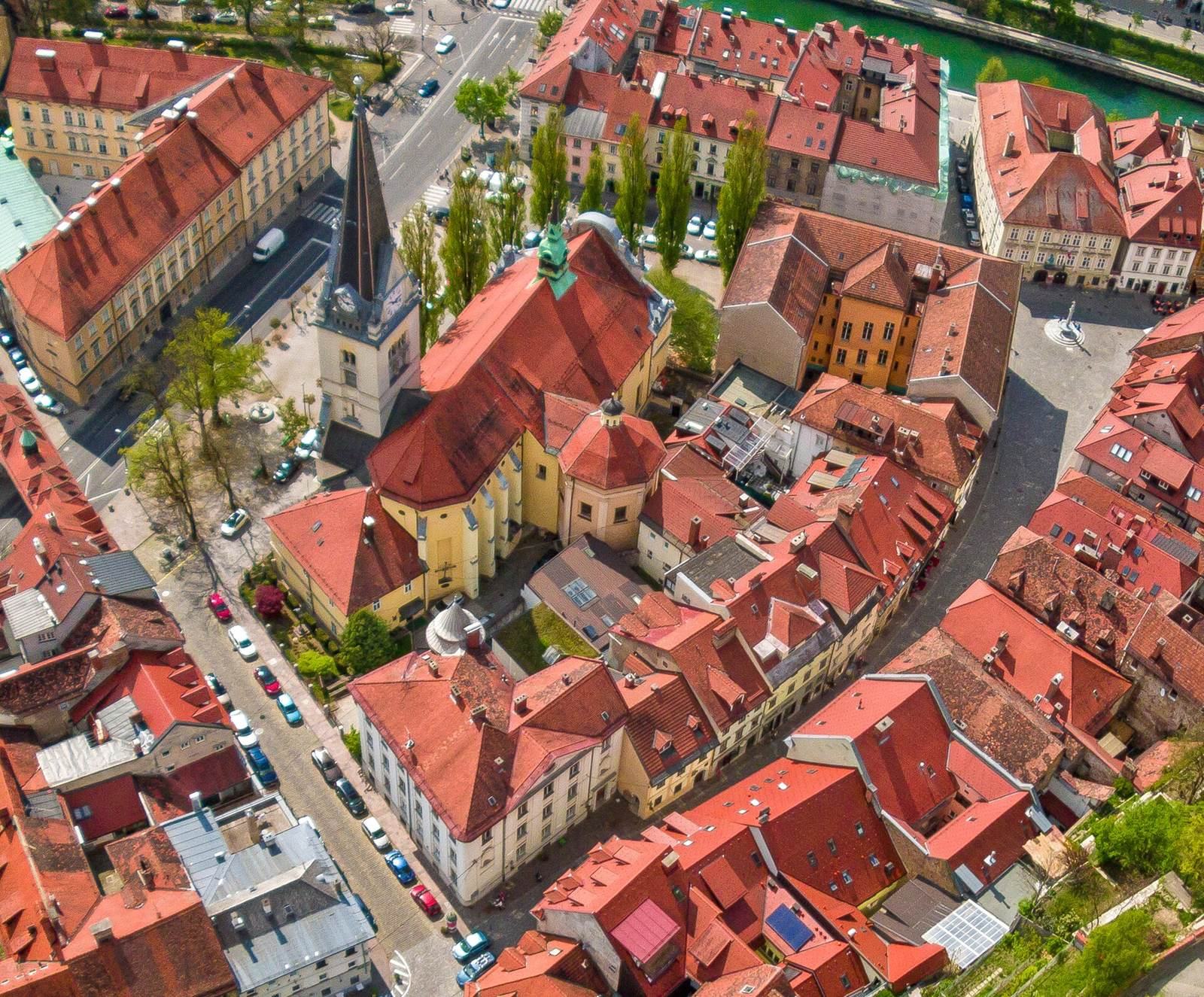
St. James’ Church in Ljubljana is a Roman Catholic parish church in Ljubljana, Slovenia, dedicated to St. James the Greater, one of Jesus’s Twelve Apostles. The Jesuits built the present early Baroque church in 1613–1615. It was the first Jesuit church in the Slovene lands and an early local example of a post-Tridentine design, shaped by Catholic reforms following the Council of Trent.
Medieval church and interrupted rebuilding
A church is recorded at the site in 1383. It may have replaced a Romanesque church in the Stari trg area. In the fifteenth century, the Augustinians, a Catholic religious order that follows the Rule of St. Augustine, built a Gothic church there as part of their monastery.
The earthquake of 1511 destroyed that church. Bishop Krištof Rauber began rebuilding in 1513, but the work stopped after completion of the Gothic presbytery. The nave, or main body of the church, remained unfinished and without a roof. After the Augustinians left Ljubljana in 1555, their monastery and the church’s temporarily roofed nave were adapted as a hospital for poor people and disabled miners from Idrija.
Jesuit church and Baroque renewal
Bishop Tomaž Hren brought the Jesuits, a Catholic order devoted to religious education and missionary work, to Ljubljana. They took possession of the site in 1597 and built a new monastery between 1598 and 1602. Their church followed in 1613–1615 on the site of the Gothic building. During the seventeenth century, the Jesuits altered its interior, added a sacristy to the presbytery, and covered the nave with a cross-shaped vault. They also built the Chapel of St. Francis Xavier on the north side in 1667–1670.
Later in the century, the Confraternity of Christ’s Agony, a religious brotherhood, acquired space for chapels dedicated to the Holy Cross and the Sorrowful Mother of God. The southern chapel received stucco decoration and an altar in 1678; a statue was placed in the northern chapel the following year.
Earthquakes in 1691 and 1699 preceded extensive modernization as part of Ljubljana’s Baroque renewal. In 1701, builder Francesco Ferrata directed work that raised the nave walls and added galleries. The church also received new ceiling decoration and a redesigned façade, associated with stonemason and sculptor Luka Mislej.
Parish church and later changes
The Jesuit order was dissolved in 1774. That year, a major fire destroyed the church’s painted and stucco decoration, but the building was retained and restored. In 1785 it became the seat of a newly established Ljubljana parish.
The 1895 earthquake damaged the bell tower and led to a thorough exterior renovation under Austrian architect Raimund Jeblinger. The damaged tower was lowered to the height of the nave, and a new tower was built on the south side. The interior was also redesigned after the earthquake. New bells were made during the late nineteenth-century works; the oldest, cast in 1896 by Albert Samassa, is no longer in use.
The square in front of the church was redesigned by Jože Plečnik in the late 1920s and by Boris Kobe in the early 1950s. St. James’ remains a Roman Catholic parish church within the Archdiocese of Ljubljana.
Remains
Layout and Gothic presbytery
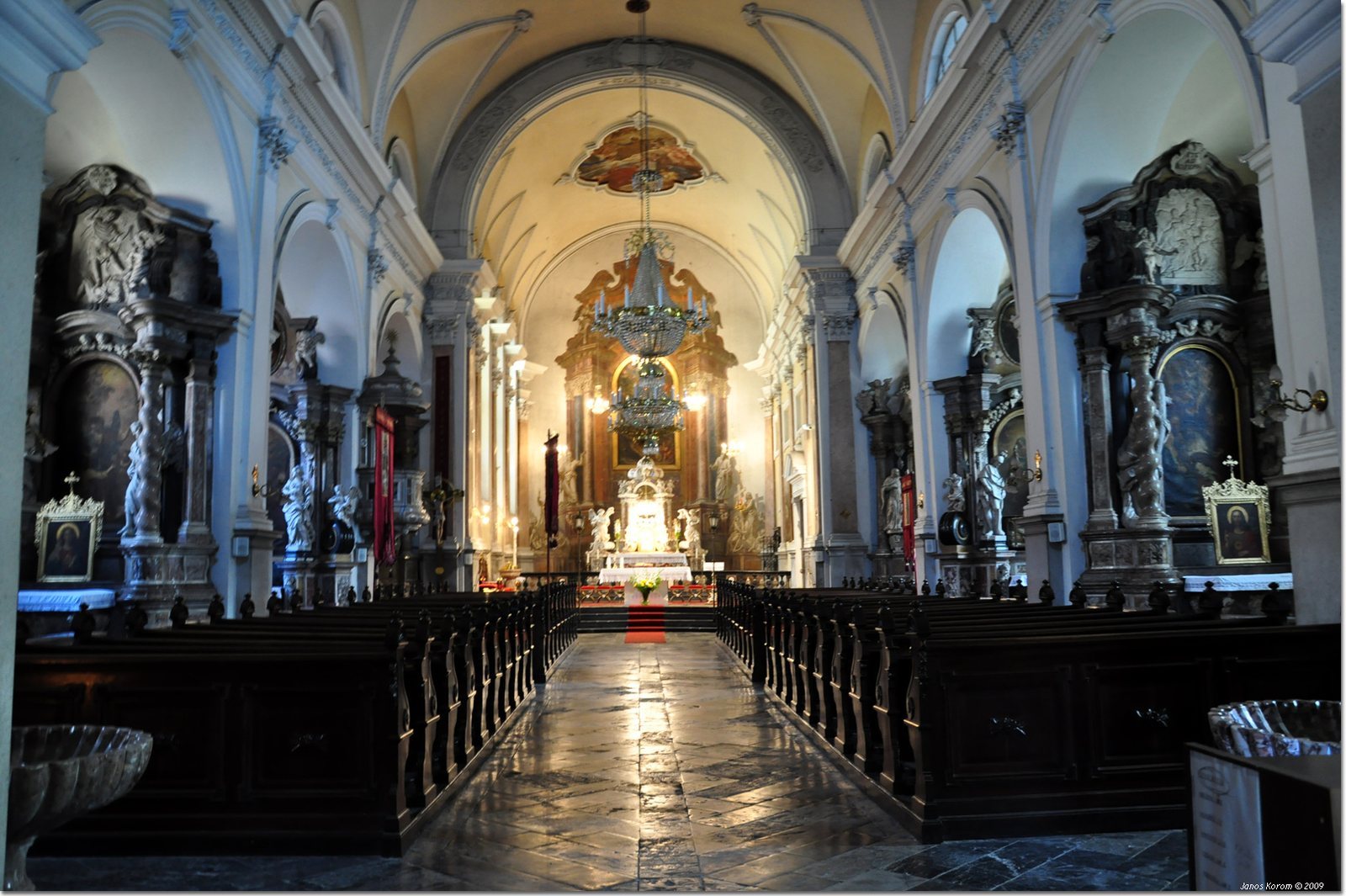
The church has an early Baroque single-nave plan with side chapels. Its arrangement recalls Rome’s Il Gesù, a Jesuit church whose single nave and flanking chapels became an influential model. Interior supports help separate the chapel and altar spaces. The long presbytery, the area around the main altar, preserves the earlier Gothic structure. It ends in three sides and has supporting structures on its exterior.
The later nave and presbytery have barrel vaults, continuous tunnel-shaped ceilings. The Gothic presbytery and the raised Baroque nave walls preserve the contrast between the church’s medieval and early modern fabric.
Façade and tower
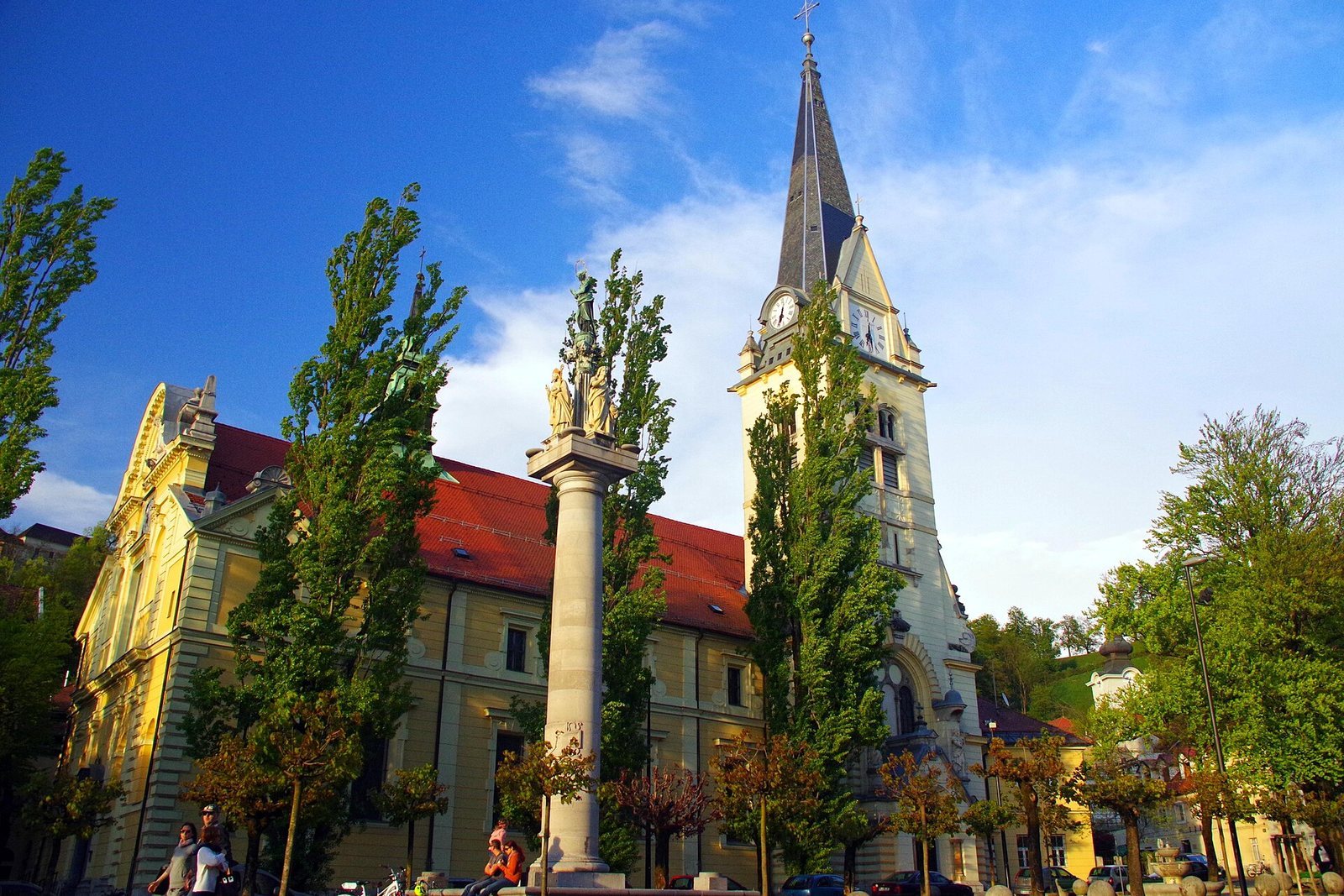
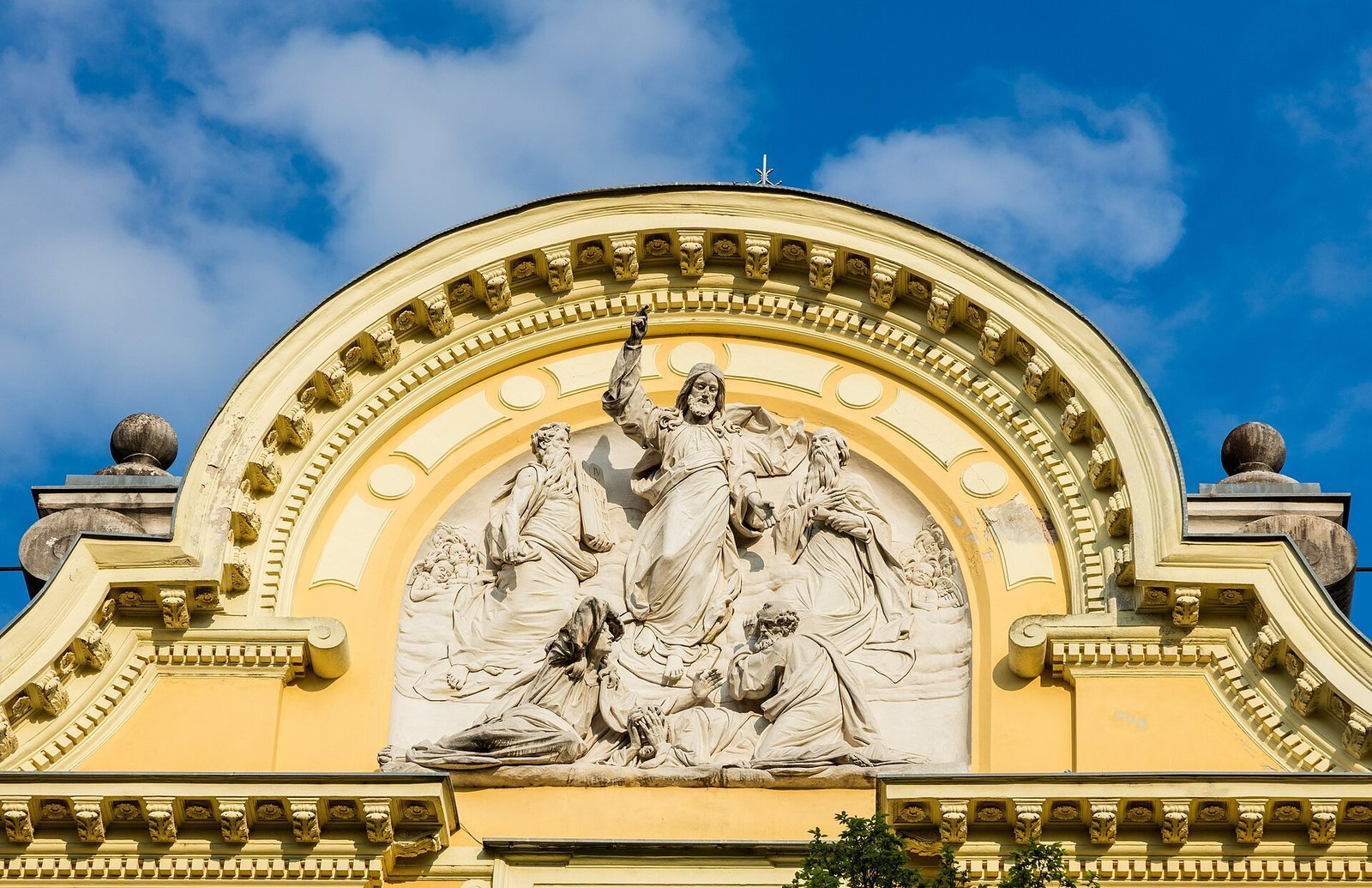
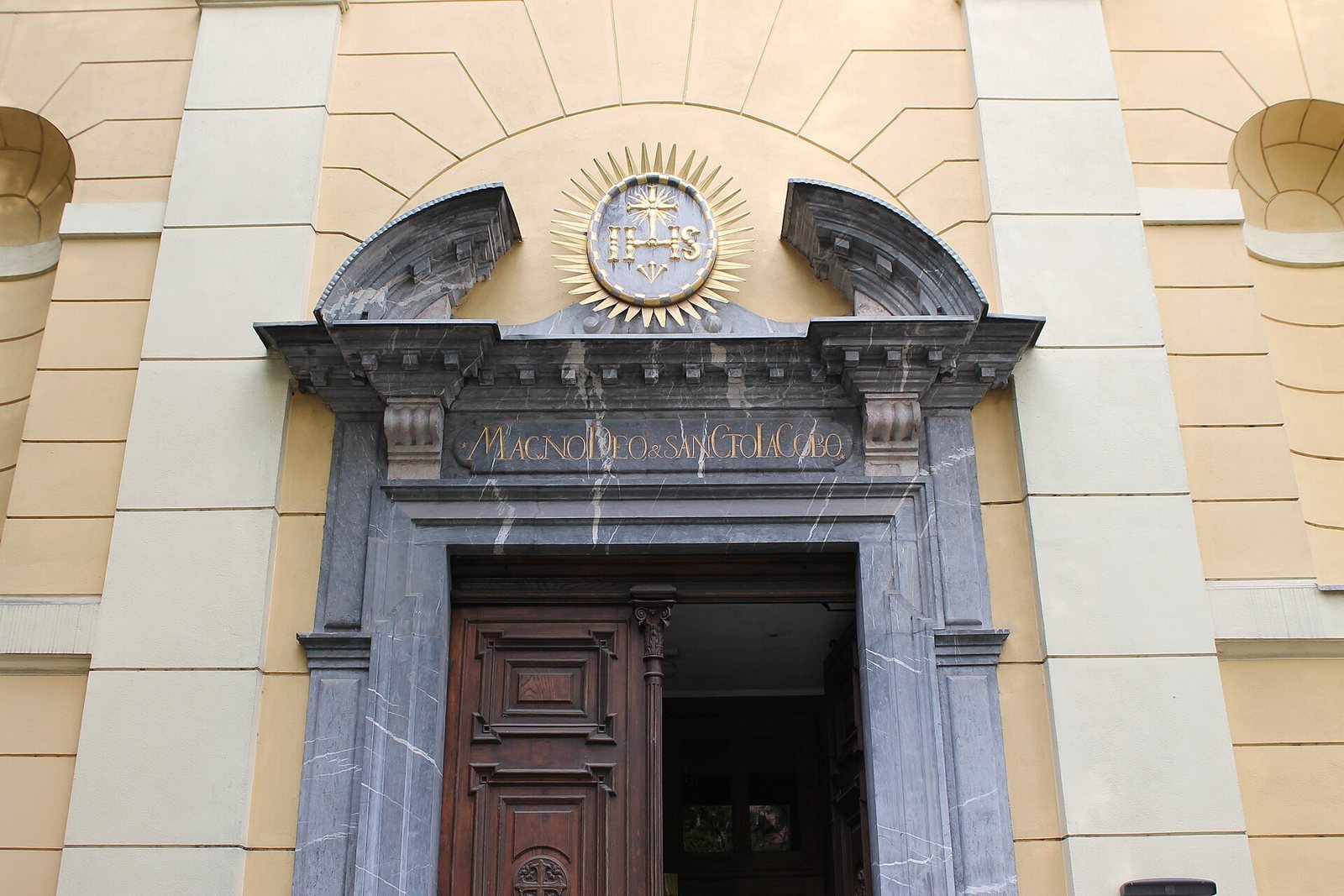
The façade combines features from different periods. Its Baroque design uses shallow attached columns and an upper section with an inscription encoding the 1701 renovation date. A stone portal frames the entrance. The late nineteenth-century exterior work added niches, surrounds around the windows, and an upper façade section decorated with obelisks.
The south-side tower rises to 65 metres and was described as the tallest in the city. The church has five bells. Its oldest, cast by Albert Samassa in 1896, is no longer used.
Main altar
Robba’s sculptural altar
The main altar stands in the presbytery and combines sculpture with a painted setting. Francesco Robba made its sculptural centerpiece between 1728 and 1732; it was unveiled on 24 July 1732, the eve of the church’s patronal feast. An inscription identifies Robba and the year 1732. The altar’s central structure resembles a tabernacle, the container for the consecrated bread and wine used in Communion. Its base of red marble has white plant ornament and a red-breccia panel. Small childlike figures support the upper structure on yellow-marble cushions, while angels kneel on spiral forms beside it. Ionic columns frame decorated doors bearing a Crucifixion scene, with further figures of Christ and angels above. A bell-shaped marble canopy with colored ornament shelters the composition. A trumpet-bearing angel crowns it, while other angels play musical instruments.
Painted setting
The painted background was designed as an altar-like scene. Its original arrangement placed Saints Peter, John the Evangelist, Paul, and Jude Thaddeus around a central image, with the Assumption of Mary above. The original central painting was replaced in 1767 and destroyed in the 1774 fire. The surviving image of St. James as a pilgrim is an eighteenth-century work by Viennese painter Johann Karl Auerbach. It shows the saint’s hat and staff set aside and his beheading in the background. Matevž Langus repainted it in 1822; it was cleaned in 1869 and restored by Greta Wanisch in 1936.
North-side chapel
Chapel of St. Francis Xavier
The Chapel of St. Francis Xavier is attached to the church on its north side. Its octagonal plan rises to an octagonal dome topped by a lantern, a small structure that admits light. Italian artists provided the later seventeenth-century stucco ornament, including acanthus forms. Wall paintings show episodes from Xavier’s life.
Chapel altar and paintings
Commissioned by Carolus Enders, rector of the Ljubljana Jesuit college, the chapel’s marble altar was made between 1709 and 1722. Its monumental sculptural group includes more than ten Baroque marble figures. Matthias Hendrichx made the central statue of Xavier, while the other figures include an angelic seraph and cherub, the figures known as the “White Queen” and “Black King” by Jacopo Contieri, and a trumpet-bearing angel by Angelo Putti. The chapel also contains six large oil paintings dated 1726 and Pavel Kühnl’s Apotheosis of St. Francis Xavier, painted in the mid-nineteenth century.
Side-chapel altars
Altar of St. Ignatius of Loyola
Installed in 1714 in the first chapel to the right of the main altar, the St. Ignatius altar is paired with the Assumption altar opposite. Its pale pink marble frame has two columns on each side of the central opening. Angelo Putti carved the figures of St. Stanislaus Kostka and St. Aloysius Gonzaga, with a group representing the Trinity above. The painting shows Ignatius wearing a vestment marked with a traditional monogram for Jesus. Angels hold a book bearing the words “For the greater glory of God.” A separate painting of Aloysius sits on the altar table.
Altar of St. John of Nepomuk
The altar in the second chapel to the right was begun in 1738 and completed in 1764. Made of colored and black stone, it is paired with the St. Anne altar. Franc Rotman carved its figures of Saints Florian and Roch; thirteen further statues form part of the assembly. The large painting of the Virgin Mary with John of Nepomuk dates to 1721 and is by an unidentified painter. A painting of Japanese martyrs occupies the upper section, and relics of St. Felix were added in 1858.
Altar of St. Joseph
Dating to 1716, the St. Joseph altar occupies the third chapel to the right and pairs with the Guardian Angels altar across the nave. It combines colored and black stone with white marble. Twisted columns rise from projecting bases, with Putti’s statues of St. Dismas and St. Barbara behind them. The painting of the dying St. Joseph is by Franz Karl Remb and is dated either 1702 or 1710. Above it, the words “Go to Joseph” accompany a marble relief of Mary’s betrothal and two angels.
Holy Cross altar
The Holy Cross altar occupies the fourth chapel on the right and is paired with the Sorrowful Mother of God altar. Made of black stone, it is an early Baroque work resembling pieces associated with stonemason Mihael Kuša. The figure of Christ on the cross dates to the nineteenth century, while the accompanying angels are from the mid-eighteenth century. Beneath the altar table, a concealed marble relief shows the dead Christ being mourned; it is probably by Matthias Hendrichx. The chapel also holds Josef Plank’s 1860 painting of the Sorrowful Mother of God. The theologian and historian Janez Ludvik Schönleben is buried there.
Altar of the Sorrowful Mother of God
The paired altar stands in the fourth chapel on the left and was probably made in 1680 or 1681. Its early Baroque structure is of black stone with colored ornament, tall plain columns, and a three-sided opening containing a nineteenth-century statue of the Sorrowful Mother. Three angels from the mid-eighteenth century stand above. Josef Plank’s 1860 painting of the Rosary Madonna is placed below the altar.
Guardian Angels altar
Installed in 1723 in the third chapel on the left, this altar is paired with the St. Joseph altar. It combines colored and black stone with white-marble sculpture. Two twisted columns stand on curved projecting bases. Francesco Robba carved the archangels Gabriel and Raphael; a relief of Michael the Archangel and two kneeling angels occupy the upper section. The altar painting, dated 1732, is by Venetian painter Bartolomeo Liberi.
Altar of St. Anne
The St. Anne altar in the second chapel on the left is made of colored and black stone and has a dynamic composition. White-marble figures of Mary Magdalene and Catherine of Alexandria are by Francesco Robba. Bartolomeo Liberi painted Anne teaching the young Mary to read; three angels and an oval image of St. Ulrich appear above. Ivan Grohar’s 1901 painting of the death of St. Ursula is beneath the altar. This arrangement replaced an earlier altar of St. Ulrich in 1724, erected by Johannes Ulrich de Cromlouiae et Eggenberg.
Assumption altar
Installed in 1721 in the first chapel to the left of the main altar, this pale pink marble altar was completed in a little over two months. Pairs of columns flank its central opening. Jacopo Contieri carved the statues of Mary’s parents, Saints Joachim and Anne, in 1720; the crowning group showing Mary’s Coronation in heaven is attributed to Robba. Matej Langus painted the altarpiece in 1822.
Other interior artworks and furnishings
Jurij Šubic painted scenes from the life of St. James on the church vaults in 1886. The interior also has Pavel Kühnl’s Stations of the Cross paintings from 1849 and a pulpit made by stonemason Ignac Toman between 1864 and 1867.
Marian column
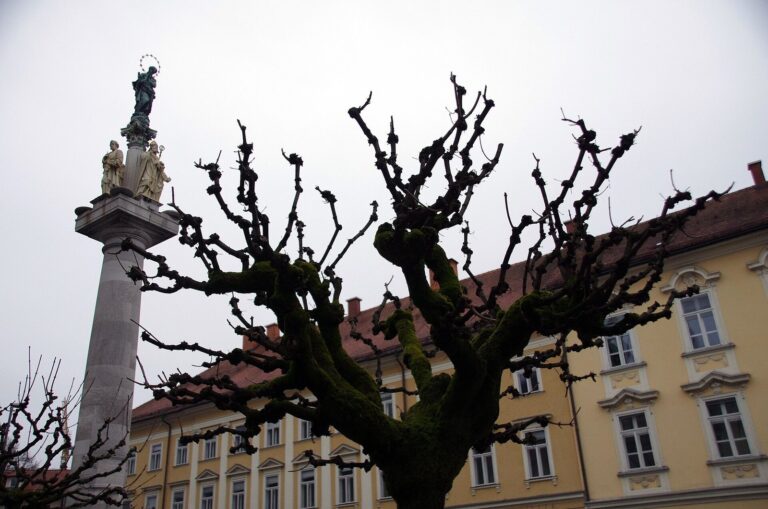
A column south of the church commemorates the Habsburg victory over the Ottoman Turks at the Battle of Saint Gotthard. Erected in 1681–1682, it originally carried a brass statue of the Virgin Mary, cast by bell-founder Christoph Schlag to a model by Wolf Weisskirchner. Stone figures of Saints Joseph, Leopold, Ignatius of Loyola, and Francis Xavier stood around it. In 1870, cast zinc-alloy figures replaced the stone statues, and limestone replaced most of the marble apart from the capital. Jože Plečnik redesigned the monument in 1938, adding a new pedestal and limestone column while retaining a marble section, four pewter figures, and the statue of the Virgin.