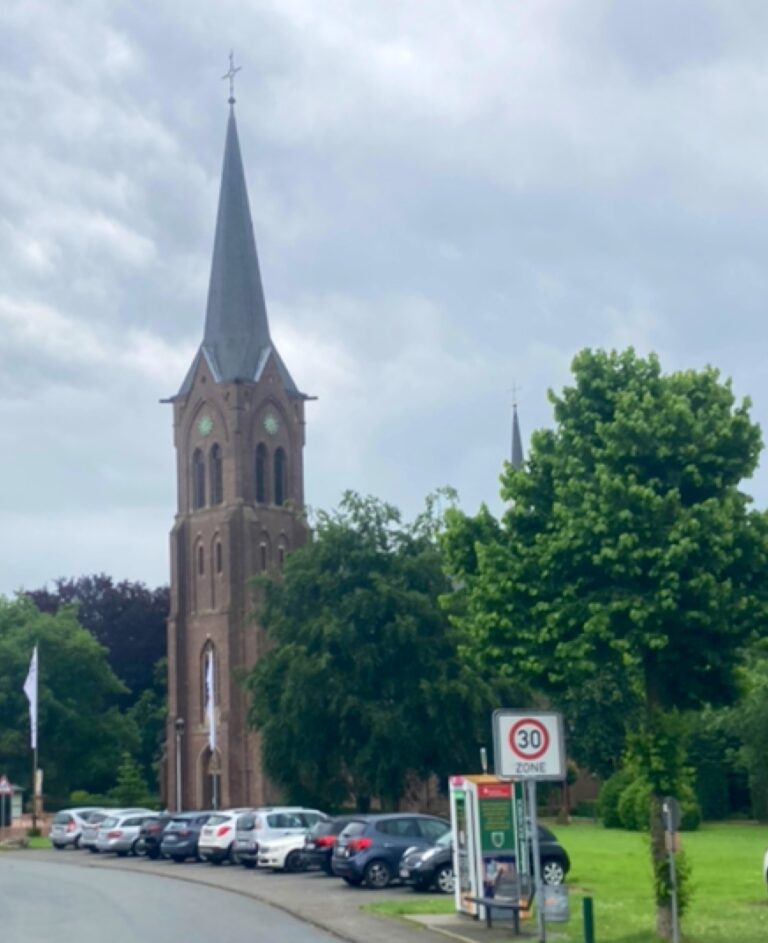
St. Nicholas Church: A Gothic Hall Church in Kalkar, Germany


Site at a Glance
- Rating
- 4.6
- Popularity
- Low
- Country
- Germany
- Primary era
- Medieval
- External website
- Open
- Eras represented
- Medieval, Early Modern, Modern
- Civilizations
- Brandenburg-Prussia, Duchy of Cleves, German, Holy Roman Empire
- Site type
- Religious
- Remains
- Church
On this page16 sections
History
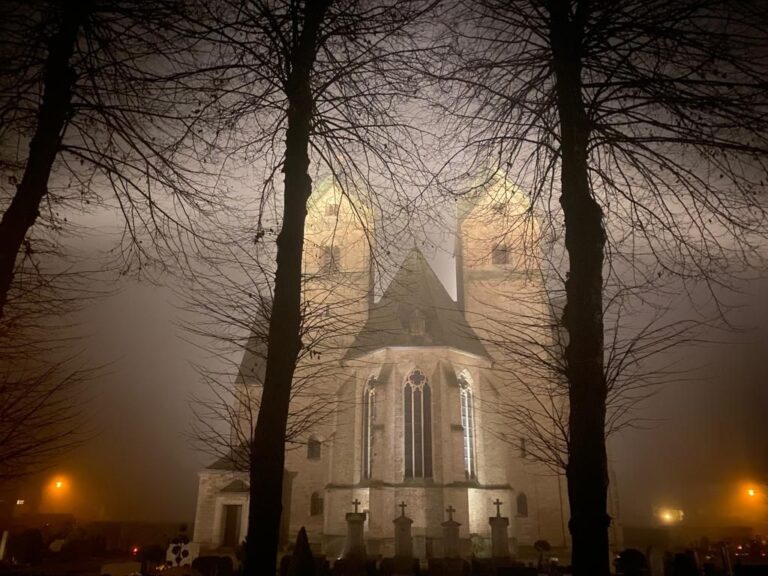
St. Nicholas Church is a Roman Catholic church in Kalkar, Germany, dedicated to Saint Nicholas, the third-century bishop traditionally associated with Myra and venerated as a patron of sailors, merchants, and children. It is a Gothic hall church with three aisles, rebuilt principally between 1409 and 1450 after its predecessor was destroyed by fire.
Origins and reconstruction
The predecessor church was probably begun around 1230. A fire destroyed it in 1409, after which the present building was reconstructed in several stages under Johann Wyrenberg, the ducal architect of Cleves. The choir received its vault in 1421, and the nearly completed church was consecrated in 1450.
The rebuilding produced a three-aisled hall church with two parallel choirs and a single tower integrated at the west end. In a hall church, the main aisles are approximately equal in height, creating a unified interior rather than a high central nave flanked by lower aisles.
Guilds, confraternities, and the medieval furnishings
Religious confraternities and medieval guilds endowed the church with a large collection of altars. A confraternity was a voluntary religious association whose members could commission, maintain, and support an altar. At least sixteen altars originally stood in the church, associated with confraternities dedicated to Mary, Saint Nicholas, Saint Anne, Saint Vincent, and the Rosary confraternity of the Dominican monastery.
The furnishings were produced largely between the late fifteenth and early sixteenth centuries. Among the artists connected with them were Master Arnt, Jan van Halderen, Ludwig Jupan, Jan Joest, Henrik Douverman, Hendrik Grotens, Ferdinand Langenberg, Derick Baegert, Ludwig Juppe, Kerstken van Ringenberg, Arnt van Tricht, and Master Rutger.
The high altar was begun in 1488 by Master Arnt, also known as Arnt of Zwolle or Arnt the Sculptor, a major late-Gothic woodcarver of the Lower Rhine and Dutch border region. Arnt died in 1492, leaving the work unfinished in his workshop at Zwolle. The unfinished sections were taken to Kalkar, where Jan van Halderen completed some groups in 1498 and Ludwig Jupan completed the retable between 1498 and 1500. Jan Joest painted its wing panels from 1506 to 1508.
The church confraternity obtained timber for the high altar in Amsterdam, Kampen, Nijmegen, and the Cleves forest. Arnt prepared the carved blocks at Zwolle, shaping them to fit the planned retable. The Seven Sorrows Altar was later commissioned by the church’s confraternity of Our Lady and made by Henrik Douverman between 1518 and 1521. It is the only work by Douverman whose attribution is documented.
Later changes and damage
By 1818, the church could no longer retain all of its altars. Several were sold so that the building and its remaining furnishings could be preserved. Nine carved and painted retables survive, including works transferred from the Dominican monastery. These transfers included the Saint Anne Trinity retable, figures of the Virgin and Saint John from a rood screen, individual statues by Arnt and Douverman, and a Tomb of Christ by Arnt.
The church underwent extensive restoration around 1900 and further restoration between 1997 and 2000. During the Second World War, it suffered severe damage. Roofs were partly stripped, the roof over the south aisle was destroyed, three vaults collapsed, and the tower masonry was damaged. The roofs had been repaired by 1949, followed by work on the masonry and vaults.
Modern windows and organ
Between 2000 and 2020, Karl-Martin Hartmann redesigned the church’s stained-glass windows after the earlier windows had been destroyed and the openings left undecorated. The Derix glass studios fabricated the new windows. Their imagery joins the traditional religious role of church windows with modern scientific ideas about the origin of the universe.
The present organ was built by the Seifert organ-building firm of Kevelaer in 1967 and 1968. It replaced a Romantic organ made by A. Tibus of Rheinberg in 1870 and enlarged in 1904 by the Müller firm of Rheinberg. The earlier instrument is no longer preserved, but the present organ stands in its elaborately ornamented Neo-Gothic case and has electric key and stop actions.
Remains
St. Nicholas Church survives as a Gothic hall church with three aisles, two parallel choirs, and a west tower incorporated into the building. Its principal interior features are the surviving retables, choir stalls, Marian chandelier, stained-glass windows, religious paintings, polyptychs, and the Seifert organ. Nine retables remain: the High Altar, Seven Sorrows Altar, Saint George Altar, Virgin Mary Altar, Saints Crispin and Crispinian Altar, Trinity Altar, Saint John the Baptist Altar, Saint James Altar, and Saint Anne Trinity Altar.
Major carved and painted altars
High Altar
The High Altar has a carved wooden retable, an elaborate altarpiece placed behind or above an altar, with a central Passion cycle and painted side wings. When open, it presents scenes from the life and Passion of Christ. The sequence begins in the predella, the lower section of an altarpiece, with the Entry into Jerusalem and the Last Supper, then continues through the Crucifixion, Resurrection, Ascension, Pentecost, and the Death of the Virgin.
The central sculptural composition is assembled from individually carved pieces. Its crowning scene is the Crucifixion, while other principal scenes show the Carrying of the Cross, Christ in Gethsemane, Judas with the soldiers, the Betrayal of Judas, the swooning Virgin, Veronica with the sudarium, the soldiers’ quarrel over Christ’s clothing, the Deposition, and the Entombment. The scenes are read from left to right, descending on the left and ascending on the right.
The closed wings contain the Annunciation, a scene in the Temple, the Baptism and Transfiguration of Christ, Christ with the Samaritan woman, and the Raising of Lazarus, which takes place in Kalkar’s market. The uppermost paintings show the Sacrifice of Abraham and Moses with the Brazen Serpent. Jan van Halderen carved the Entry into Jerusalem and the Last Supper in the predella, while Ludwig Jupan completed the other unfinished sections.
The retable was never given the colored finish customary for many carved altarpieces of its period. The unpainted wood makes the separately assembled sections particularly visible. Detailed clothing folds and hairstyles, together with individualized facial expressions, distinguish the sculptures.
Seven Sorrows Altar
The Seven Sorrows Altar is a retable approximately seven meters high. Its compartmented architectural design reflects Antwerp retables, while its exuberant decoration has parallels in southern Germany, especially Ulm. The predella depicts Jesse, the ancestor of Christ. Carved branches rise around the ancestors of Jesus and the central shrine, culminating in a radiant aureole. This almond-shaped frame, called a mandorla, formerly held a devotional statue and now contains a Neo-Gothic Virgin and Child in Glory.
The left pinnacle shows the Tiburtine Sibyl, a prophetic figure from Christian legend, pointing out the Virgin in Glory to Emperor Augustus. The right pinnacle shows John of Patmos with the Angel of the Apocalypse. The central compartment contains a Pietà, the grieving Virgin holding the dead Christ, made by Ferdinand Langenberg in 1902 to replace an earlier figure.
The three compartments on the left depict the Flight into Egypt, Christ among the Doctors in the Temple, and the Way to Calvary. On the right are the Presentation of Christ in the Temple, the Entombment, and the Descent from the Cross. The Flight into Egypt includes an unusual acrobatic performer on a column. A small harlequin emerging from the performer’s body conceals much of the Virgin and Child.
The figures wear clothing based on late-medieval fashion, including the swaddling of the Christ Child in the Presentation in the Temple. The three crucified figures are painted white, while most of the retable remains untreated wood. The side-wing paintings were made in 1636 by Hendrik Grotens of Kalkar.
Saint George Altar
The Saint George Altar combines a retable on an altar base, a fully carved central panel, painted side wings, and a three-compartment carved predella. Master Arnt created the central panel between approximately 1480 and 1492. It contains nine scenes from the legend of Saint George in a continuous landscape, divided into three sections by two narrow twisted columns.
The central scene shows Saint George on horseback defeating the dragon. The rescued princess Aja kneels beside him, while her threatened father, the king, appears above them. These central figures are larger and treated almost fully in the round. The other scenes depict the saint’s torture and martyrdom, including the preparation of poisoned drink, stakes driven into his body, immersion in molten lead, the cutting off of his hands, and his final beheading.
The early-sixteenth-century predella contains the Lamentation, the Mass of Saint George, and the Martyrdom of Saint Erasmus. Its lower section, with painted images of Christ and saints made around 1490 by Derick Baegert, originally belonged to a Saint Sebastian retable. The upper predella, made in Ludwig Jupan’s workshop between 1506 and 1508, also came from another altar. The inside of the side wings shows two scenes from the legend of Saint Ursula, while the exterior shows Saint George fighting the dragon and Saint Christopher.
Other surviving retables
Ludwig Jupan made the Virgin Mary Altar. The Saints Crispin and Crispinian Altar is attributed to Kerstken van Ringenberg. Arnt van Tricht made the Trinity Altar and the Saint John the Baptist Altar, while the Saint James Altar is associated with Master Rutger and a pupil of Master Arnt. The Saint Anne Trinity Altar was made by an unknown artist and was among the furnishings transferred from the Dominican monastery in 1818.
Chandelier, choir stalls, and other furnishings
Marian chandelier
The Marian chandelier, or Marienleuchter, was commissioned from Henrik Bernts in 1508 and completed by Kerstken van Ringenberg. Its pedestal supports figures and metal candleholders, above which a double image of the Virgin stands on a crescent moon. A sunburst mandorla surrounds the figure, and an encompassing Jesse Tree represents Christ’s genealogy descending from Jesse. Henrik Douverman and Arnt van Tricht later modified the chandelier. It remains a well-preserved example of a formerly common type.
Choir stalls
Henrik Bernts made the choir stalls, modeling them on stalls installed by Master Arnt in 1474 at the Minorite Church in Cleves. Their side reliefs and misericords use an elegant courtly visual vocabulary associated with Arnt. A misericord is a small ledge beneath a folding choir seat, often carved with figurative or ornamental decoration.
Paintings, sculpture, and organ
The church contains religious paintings and polyptychs, including a Crucifixion and a Death of the Virgin. The transferred Dominican furnishings include statues by Arnt and Douverman and Arnt’s Tomb of Christ, as well as the Saint Anne Trinity retable and figures from the former rood screen, a partition traditionally separating the choir from the nave and surmounted by a crucifix.
The Seifert organ has electric key and stop actions and occupies the richly ornamented Neo-Gothic case inherited from the preceding instrument. Together with the surviving altars and other furnishings, it forms part of the church’s layered interior, in which late-medieval works stand alongside later restorations and twentieth- and twenty-first-century additions.
Stained-glass windows
Karl-Martin Hartmann’s windows include Feynman diagrams, graphic models of particle interactions, images of three-jet events in which three particle jets are produced, spectroheliograms that record the Sun at selected wavelengths, a depiction of Comet Hale-Bopp, and a photograph of the galaxy cluster Abell 2218 showing gravitational lensing. Gravitational lensing is the distortion and magnification of light by the gravity of a massive object. These images connect the church’s traditional religious imagery with contemporary representations of physical phenomena.