Heilig-Geist-Kirche: A Historic Roman Catholic Parish Church in Munich


Site at a Glance
- Rating
- 4.7
- Popularity
- Medium
- Country
- Germany
- Primary era
- Medieval
- External website
- Open
- Eras represented
- Medieval, Early Modern, Modern
- Civilizations
- German, Holy Roman Empire
- Site type
- Religious
- Remains
- Church
On this page14 sections
History
Heilig-Geist-Kirche is a Roman Catholic parish church in Munich, Germany, whose origins reach back to a hospital chapel founded around 1208. Its surviving building combines a medieval Gothic church with an eighteenth-century Baroque transformation and later Neo-Baroque additions. The church is dedicated to the Holy Spirit and is one of Munich’s oldest surviving church buildings.
Hospital foundation and medieval parish
Around 1208, Duke Ludwig I the Kelheimer, a thirteenth-century duke of Bavaria whose byname was associated with Kelheim, founded a hospital immediately outside Munich’s old city wall, in front of the Talburg Gate. The hospital included a Romanesque chapel dedicated to Saint Catherine of Alexandria, probably erected when the hospital was established.
The chapel appears in a protective letter issued by Pope Innocent IV in 1250. The document called it “ecclesia sancti spiritus de Monacho,” a name probably connected with the hospital. The building continued to be known as Saint Catherine’s Chapel until the fourteenth century. In 1271, the Holy Spirit Hospital became Munich’s third parish, and its chapel assumed the role of parish church.
Gothic rebuilding and Baroque transformation
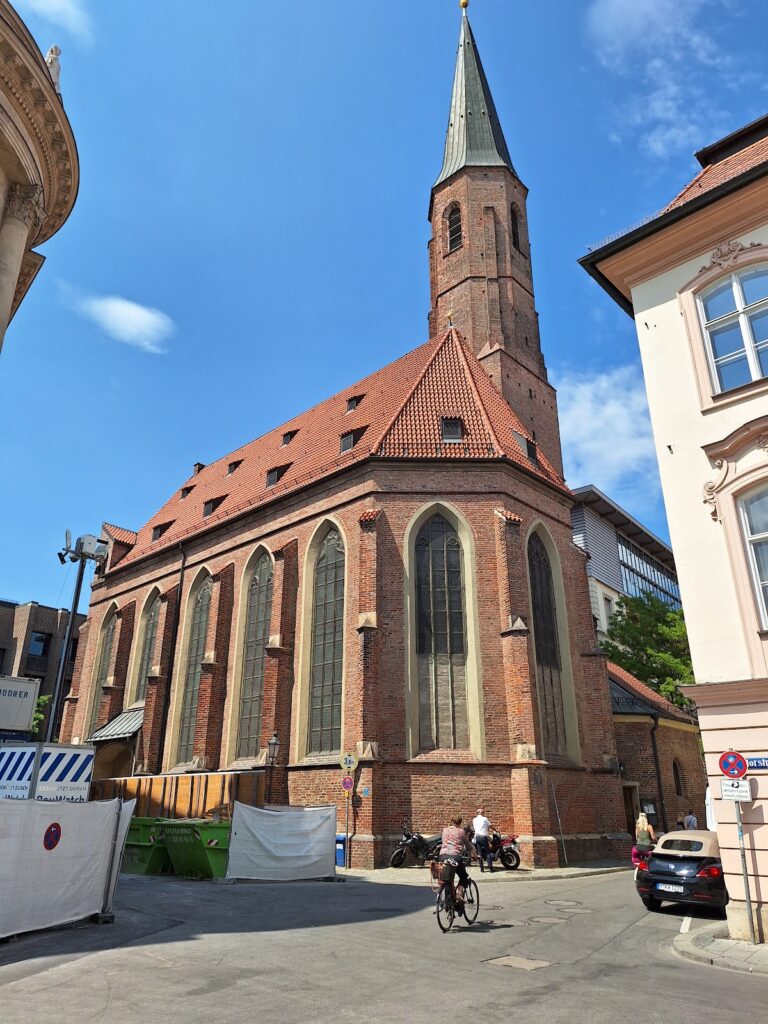
A major fire in Munich in 1327 destroyed both the hospital and Saint Catherine’s Chapel. A new Gothic church was built afterward, and Gabriel Ridler completed it in 1392. The medieval building later underwent a substantial redesign between 1724 and 1730, when Johann Georg Ettenhofer and the Asam brothers transformed the interior and furnishings in the Baroque style. The church was rededicated in 1731, and a tower was added beside the eastern choir in 1729.
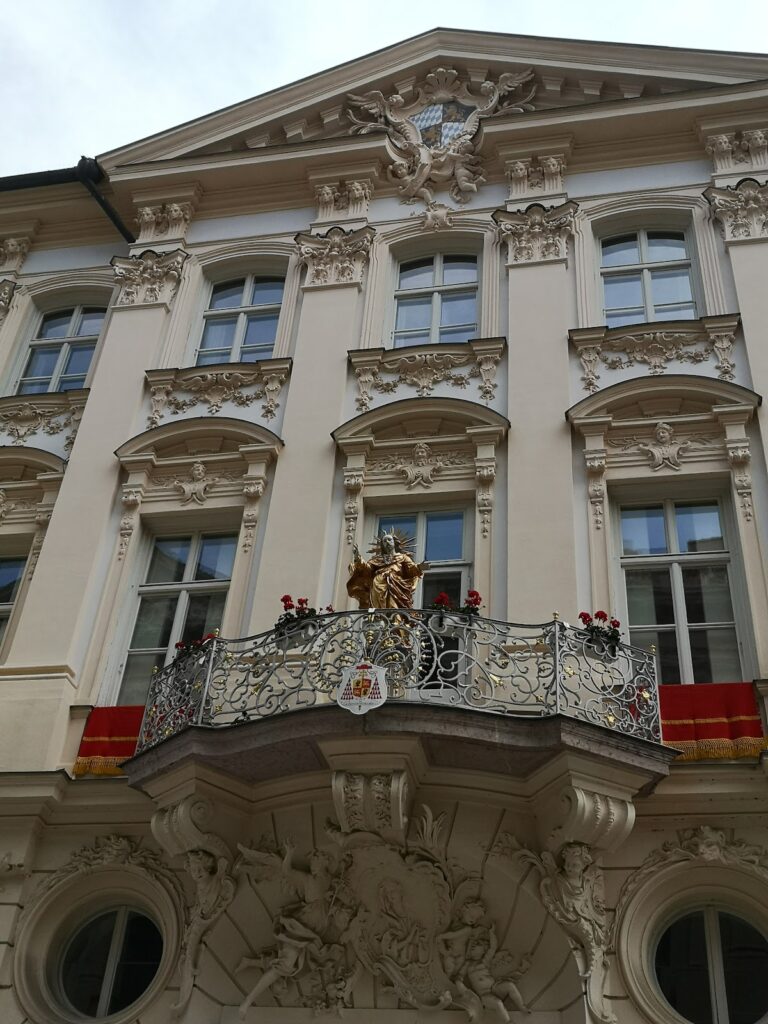
The building remained a hospital church until 1806. Secularization then brought the end of the hospital’s ecclesiastical administration, and the hospital itself was demolished to create the Viktualienmarkt. The church was enlarged westward between 1885 and 1888 under building official Friedrich Löwel. Three bays were added on the site of the former hospital, together with a Neo-Baroque west facade influenced by Giovanni Antonio Viscardi’s work. A southern porch followed in a major renovation of 1907–1908.
War damage and reconstruction
Air raids in 1944–1945 destroyed the church’s interior and left only its outer walls substantially standing. Reconstruction began in 1946. The high altar was reconsecrated in 1955, and the Baroque tower cupola was restored in 1957–1958. From 1973, Erwin Schleich directed work on the Asam frescoes, the high altar, and the interior. Karl Manninger reconstructed the nave frescoes between 1971 and 1975 and again in 1990. The postwar rebuilding continued to be described as incomplete.
Heilig-Geist-Kirche is recognized as a Bavarian architectural monument. After 2020, its parish was administered jointly with the parishes of the Frauenkirche and St. Peter. The medieval Brezenreiter tradition of the Holy Spirit Hospital is commemorated by a bell installed in 2012 and also appears in the church’s eighteenth-century ceiling frescoes.
Remains
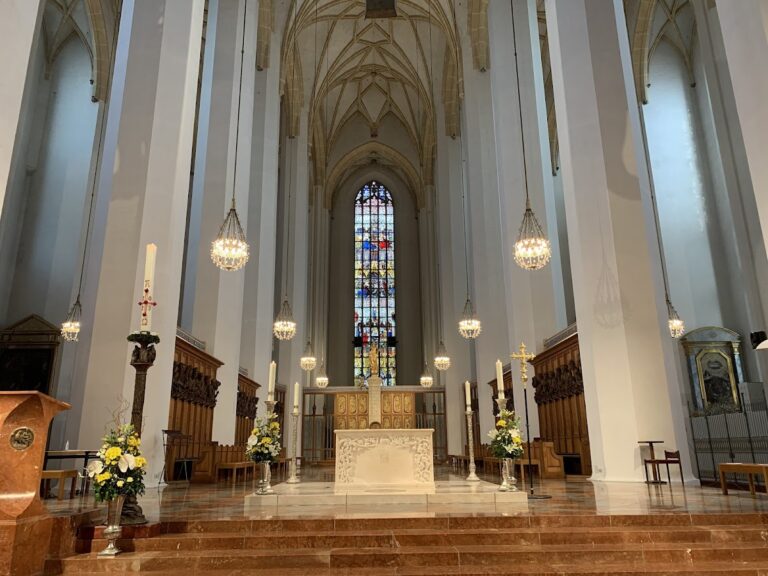
Heilig-Geist-Kirche is a three-naved Gothic hall church, meaning that the nave and side aisles are approximately equal in height and form a unified interior space. An ambulatory, or passage curving around the sanctuary, surrounds the choir. The eastern choir ends in a 9/16 polygonal plan, a termination formed from nine sections of a sixteen-sided figure. The present appearance brings together Gothic construction, Baroque decoration, and Neo-Baroque extensions.
Church fabric and exterior additions
The nave is covered by a barrel vault with small vaults over the windows, while the side aisles have groined vaults formed by intersecting barrel vaults. The choir buttresses and the north wall of the nave belong to the original Gothic fabric. The western extension of 1885–1888 added three bays and a Neo-Baroque facade whose forms were influenced by Viscardi’s Trinity Church. Beside the eastern choir stands the tower built in 1729, topped by a lantern cupola, a dome with a smaller open structure that admits light.
Baroque interior
Stucco and frescoes
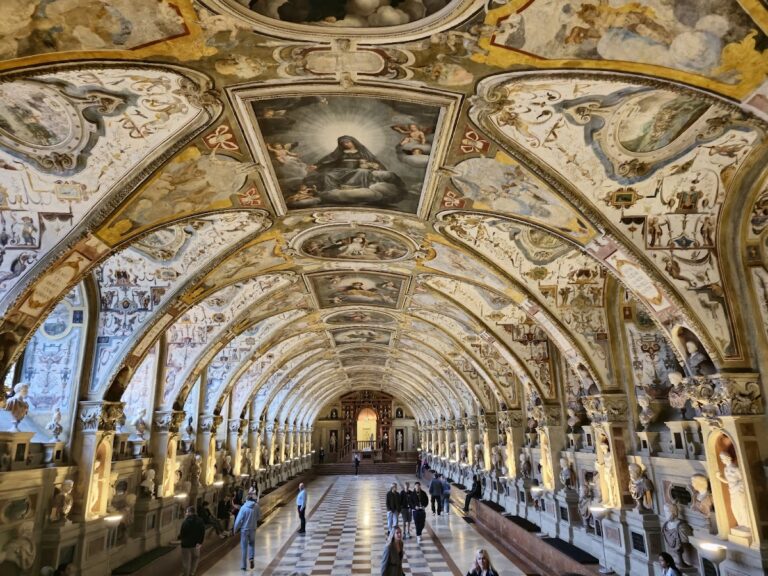
The central nave contains Régence stucco, an early eighteenth-century decorative style transitional between Baroque and Rococo, made by Egid Quirin Asam. Matthias Schmidtgartner produced the stucco in the side aisles, while Georg Biehl decorated the western extension. His work includes the richly ornamented spiral staircase leading to the gallery, whose doors were made by Anton Riesenhuber.
Cosmas Damian Asam painted the central-nave frescoes between 1724 and 1730. Their subjects include King David with a harp, the founding of the Holy Spirit Hospital, the angels’ praise of God, and, in the choir, the Seven Gifts of the Holy Spirit. The frescoes in the western extension were painted by Ludwig Glötzle and show Pope Leo XIII with Mary and the saints, as well as Saint Cecilia, the patron of church music. These paintings were reconstructed after wartime destruction. The former side-aisle vault frescoes by Nikolaus Gottfried Stuber were lost.
High altar
The high altar was made between 1728 and 1730 from Tegernsee marble after a design by Nikolaus Gottfried Stuber. Antonio Matteo executed the stonework, and Johann Georg Greiff completed the carving in 1730. Its central painting, The Effusion of the Holy Spirit by Ulrich Loth, dates from 1644 and was transferred from the former high altar of 1661. A tabernacle, the secure liturgical container for consecrated Eucharistic bread, is accompanied by adoring angels made by the Mayer Court Art Institute in 1902. The altar was largely restored to its original form in 1952–1953 after wartime damage.
Altars and devotional paintings
The Saint Joseph, or Fourteen Holy Helpers, Altar was probably donated by Carl Anton Josef Freiherr von Barth zu Harmating, who died in 1751. Its late Baroque figure of Saint Joseph dates from approximately the second quarter of the eighteenth century. The Fourteen Holy Helpers are saints traditionally invoked together in Catholic devotion during illness and danger. The associated altarpiece was painted and signed by Johann Heinrich Schönfeld, probably in 1666–1667. It has been in Heilig-Geist-Kirche since 1724 and uses an unusual two-zone composition that gives particular prominence to Saint Vitus.
Peter Jakob Horemans painted six works in 1753 for the side aisles. The southern aisle contains paintings representing wisdom, understanding, and counsel, while the northern aisle contains complementary images of strength, piety, and fear of God. Horemans’s painting of knowledge was destroyed during the war and recreated by Karl Manninger around 1990.
On the northeast side of the ambulatory, the Sacrament or Sacred Heart Altar was assembled in 1960 from parts of the high altar’s festival furnishings. Its Sacred Heart painting by Joseph Hauber dates from around 1800. The southeast side of the ambulatory contains the Immaculate Conception Altar, whose altarpiece was painted around 1710 by Andreas Wolff. On the rear of the high altar is a small eighteenth-century altarpiece with a painting of Saint John Nepomuk and four silvered relief busts made around 1750 by Johann Michael Roth.
Memorials and transferred works
A large Crucifixion-group painting by Joseph Hauber, dating from around 1800, hangs in the niche of the eastern window blocked when the tower was built in 1730. Beside the north portal stands the Marian Altar, made in 1956 by Max Grübl and Jakob Heinlein. It incorporates the Hammerthaler Madonna, a sculpture from around 1440 that formerly stood in the secularized parish church of Tegernsee.
Grübl and Heinlein also made the Trinity Altar in 1957. Above it is a group representing the Coronation of Mary, dated 1681 and formerly located on the high altar of the Trinity Chapel at the Holy Spirit Cemetery, secularized in 1802. The attached Neo-Baroque War Memorial Chapel contains a late Gothic crucifix, probably associated with the Leinberger school and dated 1510.
The Chapel of Our Lady of Sorrows was built on the southwest side in 1909–1910. It contains an expressive Pieta by Johann Huber. On both sides of the west portal are sections of bronze funerary monuments made by Hans Krumpper in 1608 for Duke Ferdinand of Bavaria. Nearby, two large allegorical wall paintings from around 1750 by Joseph Ignaz Schilling and Joseph Weiss the Elder represent groups of virtues. The northern painting shows hope, charity, faith, patience, courage, and peace; the southern one shows temperance, prudence, joy, justice, and mercy.
Organ and bells
Organs
Franz Borgias Maerz built an organ in 1885 with twelve stops on two manuals and a pedal. Willibald Siemann replaced it in 1921 with a pneumatic cone-chest organ of seventy-nine stops on four manuals and a pedal. A cone-chest organ uses cone valves to control its pipes, and Siemann’s instrument was the largest produced by his firm. It was destroyed during the Second World War.
After the war, an organ made by Carl Schuster and Son was installed. In 1976, the parish acquired an instrument originally built as a house organ for a Roman villa from the estate of Reinhard Raffalt. Ludwig Eisenbarth rebuilt and greatly enlarged it in 1977. The present organ has a mechanical slider chest, in which sliding boards connect pipes with stops and keys, and contains twenty-seven stops on two manuals and a pedal.
Bells
The church formerly had six bells, but only two remained after the two world wars. The largest and oldest surviving bell is the Holy Spirit Bell of 1860. It bears a representation of the Holy Spirit and was probably recast from an older bell of 1729. After the Second World War, it returned to the church from the “bell cemetery.”
A fourth bell, the Brezenreiter Bell, was hung in the tower on 27 May 2012. It commemorates the medieval charitable tradition associated with the Holy Spirit Hospital. Beneath a large pretzel, it carries an inscription from Matthew 25:35: “For I was hungry and you gave me food; I was thirsty.” The church’s furnishings, decorations, artworks, bells, and reconstructed frescoes therefore represent successive Gothic, Baroque, nineteenth-century, wartime, and postwar phases rather than one period of construction.