St. Michael’s Cathedral, Veszprém: A Historic Cathedral in Hungary


Site at a Glance
- Rating
- 4.7
- Popularity
- Low
- Country
- Hungary
- Primary era
- Modern
- External website
- Open
- Eras represented
- Medieval, Early Modern, Modern
- Civilizations
- Habsburg, Hungarian
- Site type
- Religious
- Remains
- Cathedral
On this page10 sections
History
St. Michael’s Cathedral is a historic cathedral in Veszprém, Hungary, whose Christian foundation reaches back at least to 1001 and whose present form is chiefly Neo-Romanesque. Built and developed within the medieval Hungarian Christian kingdom, the church has been associated with the foundation of the Diocese of Veszprém and was later rebuilt through Romanesque, Gothic, Baroque, and modern revival phases.
Early church and the foundation of the diocese
A church already stood on the site by 1001, when it appeared in the foundation charter of Pannonhalma Abbey. Later charters repeatedly called it Hungary’s oldest cathedral. The church’s foundation is traditionally linked with Queen Gisela, the wife of King Stephen I and a figure venerated in the Catholic tradition as Blessed Gisela. She may have founded the cathedral or given it particular attention, although the evidence does not establish this conclusively. King Stephen I, Hungary’s first crowned Christian king and later a saint, is also identified as its builder.
The northern part of the present basilica incorporates the site of an earlier rotunda, a centrally planned and usually circular building. This structure stood there during the time of Prince Géza, the tenth-century ruler of the Hungarian principality and father of Stephen I. It may first have served as a private chapel and may later have become a place associated with the veneration of a relic of Saint George, possibly after a war with the Bulgarians. A palace building stood against its northern side. Its precise purpose is uncertain: it may have been Géza’s residence or Hungary’s first episcopal palace.
The dedication to Saint Michael reflects the archangel’s role as protector and leader of the heavenly armies. The medieval Diocese of Veszprém included areas connected with the difficult Christianization of the population, including the region around Koppány, a prominent dynastic claimant who opposed Stephen I as the Christian kingdom was consolidated.
Romanesque and Gothic transformations
After Stephen I’s reign, the original Romanesque cathedral, with three aisles, was enlarged by the addition of two towers. A major fire at Veszprém in 1380 led to another rebuilding, this time in the Gothic style. The cathedral was consecrated in 1400. Most of the building was later destroyed during the period of Ottoman rule, but the Gothic crypt survived.
Baroque rebuilding and Neo-Romanesque revival
Reconstruction began in the early eighteenth century, when the church received a Baroque exterior. Between the eighteenth and nineteenth centuries, the cathedral also hosted concerts featuring works by European composers such as Wolfgang Amadeus Mozart, Joseph Haydn, and Ludwig van Beethoven.
Between 1907 and 1910, the cathedral was rebuilt in the Neo-Romanesque style, a modern revival of Romanesque forms, to reflect its presumed original appearance. The Gothic sanctuary and crypt were retained. The cathedral’s stained-glass windows were destroyed during the Second World War, and the present windows were made by Lili Árkayné Sztehlo.
Modern ecclesiastical status and restoration
In 1981, Pope John Paul II raised the church to the rank of basilica minor, a papal honorific for a church of particular religious or historical importance. In 1993, it became the metropolitan cathedral of the Archdiocese of Veszprém. That year it also received relics of Queen Gisela from Niedernburg Abbey, the historic Benedictine convent in Passau associated with the preservation of her relics.
Further restoration began in September 2005 with work on the two towers. By 2010, state-supported restoration had renewed both the exterior and interior of the church.
Remains
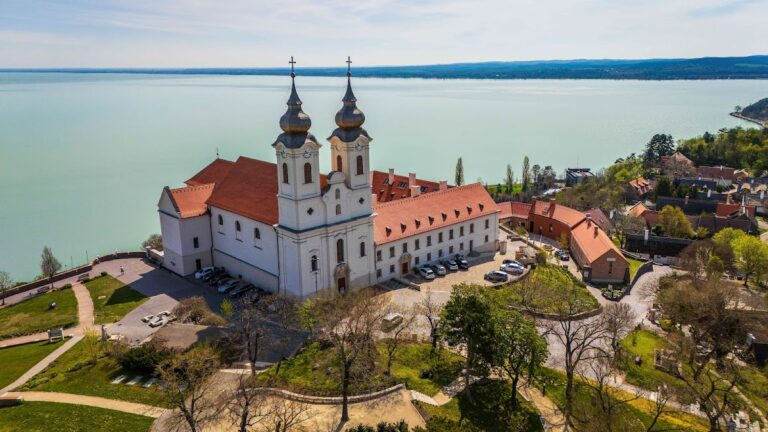
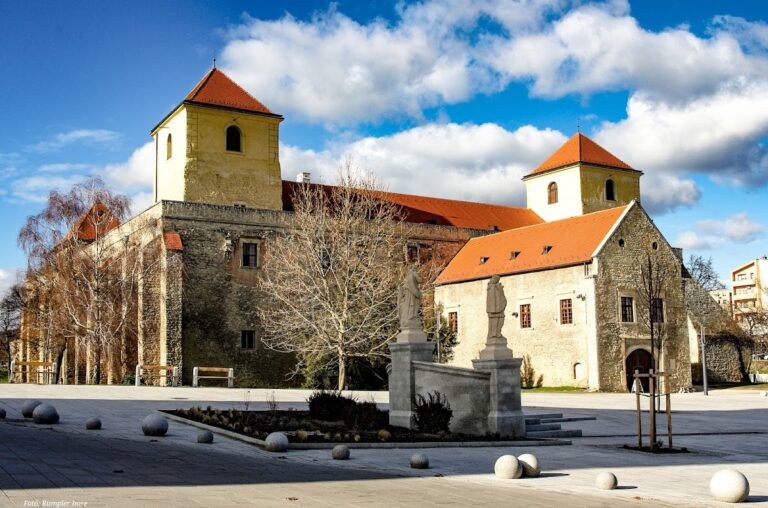
The Neo-Romanesque cathedral stands in the Veszprém Castle district on the north side of Trinity Square. Its two towers form the principal external features of the building. Inside, the modern revival fabric incorporates the Gothic sanctuary and the surviving Gothic crypt, creating a structure in which medieval remains are preserved within the early twentieth-century reconstruction.
Early foundations and medieval fabric
The early rotunda occupied the northern part of the present basilica and was oriented differently from both the cathedral and the later octagonal chapel built on its site. This difference in orientation supports its early date. The Romanesque cathedral that followed had three aisles and two towers. Its surviving medieval elements include the Gothic sanctuary and the crypt, including the crypt’s principal chamber and a small adjoining room.
Nave, chapels, and decoration
The main nave has a flat coffered ceiling. Its capitals were designed during the 1907 to 1910 rebuilding in imitation of carvings associated with the Árpád period. The northern side aisle, to the left of the main entrance, contains altars dedicated to the Assumption of Mary and Saint George. The southern side aisle, to the right, contains the altars of Saint Anne and Saint Emeric.
Wall paintings by Antal Szirmay include representations of saints from the Árpád dynasty, Pope Gregory the Great, Saint John of Nepomuk, Saint Augustine of Hippo, and the four Evangelists. The stained-glass windows depict Saint Stephen, Saint Margaret, Blessed Helen, Queen Gisela, Saint Joseph, and Saint Gerard. The cathedral also preserves the right forearm bone of Blessed Queen Gisela as a relic.
Crypt and episcopal memorials
The Gothic crypt contains the tombstones of the Veszprém bishops László Bánáss and Péter Beriszló. Its small adjoining room holds the Baroque tomb monument of Bishop Márton Padányi Biró, made in 1762. These elements preserve memorials from different periods within the medieval crypt retained by the later rebuilding.
Bell towers
The cathedral has five bells, with one in the north tower and four in the south tower. The north tower holds the 3,500-kilogram Holy Trinity great bell, cast in Vienna in 1725 by Franz Ulrich Scheichel. It measures 177 centimeters in diameter and has a fundamental pitch of H0. It is the cathedral’s only original bell. Because it could not be removed through the tower, it was not requisitioned during wartime. It is described as the oldest among Hungary’s great bells and as the country’s oldest bell weighing more than 20 metric quintals.
The south tower contains the 969.5-kilogram Saint Stephen bell, cast in Budapest in 1937 by master bell-founder László Szlezák; the 700-kilogram Beöthy-Saint Joseph bell, cast in Őrbottyán in 1974 by Lajos Gombos; the 220-kilogram Saint Anne bell, cast in Budapest in 1937 by Szlezák; and the 125-kilogram soul bell, also cast in Budapest by Szlezák in 1937. Their lower diameters are 125, 110, 79, and 63 centimeters, with pitches of D-sharp1, F1, C-sharp2, and D-sharp2 respectively.
Before the Second World War, the cathedral had six bells, including the bells cast by Szlezák in 1937. Two bells, weighing 1,700 and 500 kilograms, were requisitioned. The heavier bell has not been replaced.
Nearby sites