Piazza Armerina Cathedral: Diocesan Cathedral and Minor Basilica in Sicily
Site at a Glance
- Rating
- 4.6
- Popularity
- Low
- Country
- Italy
- Primary era
- Early Modern
- Eras represented
- Medieval, Early Modern, Modern
- Civilizations
- Crown of Aragon, Kingdom of Sicily, Spanish
- Site type
- Religious
- Remains
- Cathedral
On this page14 sections
History
Piazza Armerina Cathedral, formally the Basilica Cathedral of Maria Santissima delle Vittorie, is a cathedral in Italy and the seat of the Diocese of Piazza Armerina. The present church developed through seventeenth- and eighteenth-century rebuilding in a combination of Gothic, Catalan-Gothic, and Sicilian Baroque forms. It became the diocesan seat when the Diocese of Piazza Armerina was established in 1817.
Norman Origins and Marian Tradition
A tradition connects the cathedral’s dedication to a banner bearing the Virgin Mary, supposedly given by Pope Nicholas II to Roger I, the Norman ruler known as the Great Count, during the conquest and Christian reorganization of Sicily. The banner was associated with the campaign against Muslim rule, and later images of the Virgin were linked to it, sometimes together with Saint Luke. This tradition has no direct or indirect supporting evidence.
According to the same tradition, local notables concealed the banner in a wooden chest in 1161, fearing that royal reprisals after a baronial revolt would lead to its seizure and removal to Palermo. They were said to have buried it inside the Hermitage of Santa Maria in the district of Piazza Vecchia. In 1163, King William I’s forces burned and buried the original Norman settlement while suppressing a revolt led by Roger Sclavo. The settlement was later rebuilt about three miles away, traditionally on the orders of William II, and became known as New Piazza.
During the plague of 1348, dreams and revelations were traditionally said to have led to the rediscovery of the hidden Marian image. It was carried in procession to San Martino, then the mother church, and the infection foci were said to have diminished and disappeared. The tradition helped shape the later religious identity of the church and its dedication to Maria Santissima delle Vittorie.
The Mother Church and Its Rebuilding
The predecessor church was built in the Gothic-Catalan style under the title of Santa Maria Maggiore. Between the fifteenth and sixteenth centuries, it gained a substantial bell tower and a marble arch in the baptistery made by the Gagini workshop, examples of Sicilian Renaissance art. In 1516, Panfilia Spinelli, Baroness of the fiefs of Scalisa and Malocristianello, donated those fiefs and 60,000 scudi to the mother church for restoration and enlargement. She later became a religious at the Benedictine monastery of San Giovanni Evangelista.
The church was seriously damaged, probably in the earthquake of 1542. In his 1598 will, Baron Marco Trigona made Piazza’s principal church his universal heir and assigned revenues for its enlargement. The present cathedral’s construction began in 1604. Sections of the earlier building were then demolished and rebuilt, including the apse in 1627 and the nave in 1705.
Between 1626 and 1627, Bishop Innocenzo Massimo of Rome sought to resolve the prolonged dispute over reconstruction after at least three projects had failed. The architect Orazio Torriani accepted the proposal and designed a new building over the ruins of the former mother church. The surviving bell tower and Gagini marble work were retained, while Maria Capelletti of Milan and Domenico Costa of Messina assisted with the work, which began on 24 October 1627.
Rebuilding was interrupted for approximately forty years between 1666 and 1705. The dome was completed in 1719, and the cathedral was structurally finished and inaugurated in 1742. Craftsmen continued to work on the building afterward, contributing to its furnishings and decoration.
Diocesan Cathedral and Basilica
When the Diocese of Piazza Armerina was created in 1817, the church became its cathedral. Pope John XXIII raised it to the status of a minor basilica in February 1962. A minor basilica is a church granted a special papal title while remaining distinct from the seat of a bishop. The principal Marian feast takes place on 15 August, preceded by the Palio dei Normanni, a historical pageant associated with the city’s Norman heritage, from 12 to 14 August.
Remains
Exterior and Medieval Fabric
Bell Tower
The cathedral occupies the highest point of Piazza Armerina and presents a combination of medieval and Baroque elements. The former church’s late Gothic-Catalan bell tower survives within the present complex. Dating from the fifteenth century, it rises approximately 40 to 45 metres and is one of the principal surviving parts of the earlier building. The Gagini marble work in the baptistery is the other major remnant retained from the predecessor church.
Staircase and Portal
A monumental staircase leads to the cathedral. It was built in 1881 to a design by Giuseppe Giunta Bartoli, a local architect. The eighteenth-century portal incorporates features of Sicilian Baroque, the regional form of Baroque architecture that became especially prominent in church building after the earthquakes of the seventeenth century.
Dome
The crossing is dominated by a dome approximately 76.5 metres high and 13.88 metres in diameter. Completed in 1719, it is described as the highest dome in Sicily and forms a major element of the cathedral’s profile across the city.
Art and Liturgical Furnishings
Cross and Baptistery
A large painted cross hangs from the triumphal arch. Dated 1485, it is painted on both sides, with the Crucifixion on one face and the Resurrection of Christ on the other. The work is conventionally attributed to the Master of the Piazza Armerina Cross.
The baptistery inherited from the earlier church includes the Gagini marble arch made by Antonuzzo Gagini in 1594. Antonuzzo belonged to the Gagini family of sculptors, whose workshops produced Renaissance sculpture and architectural decoration in Sicily.
High Altar and Marian Image
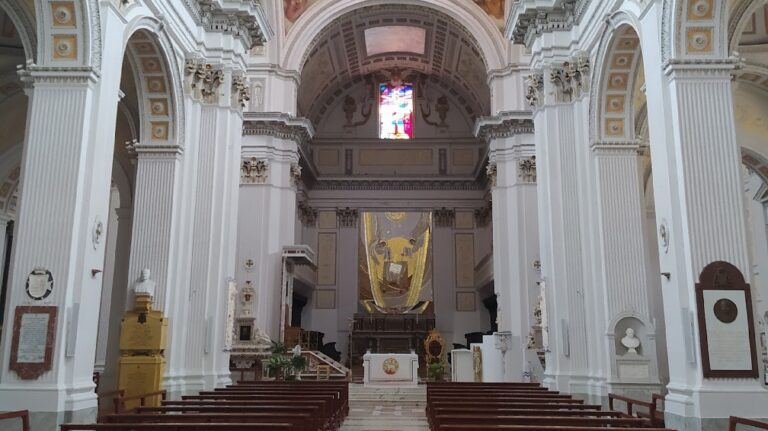
The high altar combines lapis lazuli, hard stones, and Sicilian marble. Its altar floor and the balustrade of the apse were made by Filippo Pinistri of Palermo from a design by Giuseppe Venanzio Marvuglia. The altar superstructure contains a repoussé silver tabernacle dated 1625. A reliquary is a container made to preserve or display a relic, while repoussé is a technique in which metal is shaped by hammering from the reverse.
The tabernacle contains the image of Maria Santissima delle Vittorie, patron of the city and diocese. Giuseppe Capra, a silversmith from Caltagirone, chased the image in 1627. Its protective covering, made of gold, silver, and enamel, was designed and produced by the Palermo goldsmith Don Camillo Barbavara.
Presbytery and Choir
Behind the high altar are the funerary monuments of Marco Trigona, who died in 1598, and Melchiorre Trigona, who died in 1637. The rear wall has two large stained-glass windows showing the apostles Peter and Paul, with a high central window depicting the Redeemer.
The canons’ choir extends along the side walls of the presbytery, the area around the high altar reserved for the clergy. Local craftsmen Domenico Parlagreco, Luigi Montalto, and Liborio Parlagreco carved it in 1795 from designs supplied by the architects Francesco and Pietro Laganà of Modica. The bishop’s seat stands on a projecting platform to the left.
Above the choir on the right are an Epiphany, or Adoration of the Magi, transferred from the church of Sant’Agata, and Giuseppe Salerno’s Saint Benedict and King Totila’s Servant. On the left are Salerno’s Mystical Marriage of Saint Catherine and The Martyrdom of the Forty Saints. Totila was a sixth-century Ostrogothic king.
Treasury
The cathedral treasury includes a fifteenth-century silver crucifix and a silver reliquary dated 1405. The reliquary bears an inscription stating that Simon de Aversa made it in that year, during the twelfth indiction. An indiction was a fifteen-year cycle formerly used for dating documents.