Esseg Castle: A Medieval Fortress in Bánd, Hungary


Site at a Glance
- Rating
- 4.6
- Popularity
- Low
- Country
- Hungary
- Primary era
- Medieval
- Eras represented
- Medieval
- Civilizations
- Hungarian
- Site type
- Military
- Remains
- Castle
On this page8 sections
History
Esseg Castle is a medieval fortress in Bánd, Hungary, whose earliest fortifications probably date from around 1270. Standing west of Veszprém and east of Herend, it became the seat of the Essegvári family and was drawn into the political struggles of medieval Hungary.
Origins and the Essegvári family
The castle first appears in written records in 1309, when Igmándi Lőrinc sold it under the name Castrum Scegh to the nobleman Lőrinte. Lőrinte’s descendants later took the name Essegvári. Lőrinte supported Charles Robert, the fourteenth-century king of Hungary whose accession was challenged by powerful regional nobles.
That allegiance brought conflict with Ivan Kőszegi, a western Hungarian oligarch who controlled extensive territories. Kőszegi’s forces captured the fortress and took Lőrinte prisoner. He was executed by being dragged behind a horse. Four years later, royal troops recovered the castle, and Charles Robert returned it to Lőrinte’s son Tamás, who had remained loyal to the king.
Confiscation and fifteenth-century disputes
The Essegvári family later joined the faction of Ladislaus of Naples, a claimant who competed with King Sigismund for the Hungarian throne. Sigismund confiscated the castle and placed it under the authority of the Bakony forest jurisdiction, a royal district administered by an official responsible for the surrounding woodland region.
After the death of King Albert, civil conflict in the 1440s allowed Tamás Himfy, bishop of Veszprém, to seize the castle with armed retainers. The Essegváris recovered it after the royalist victory at the Battle of Bátaszék. King Władysław I later restored the Rozgonyi and Essegvári families to their possessions, but lawsuits followed. Essegvári György finally regained effective possession for his family in 1472.
Decline and destruction
In 1499, Essegvári Ferenc married Himfy Orsolya and received the lordship of Döbrönte with her. The family soon moved to the more comfortable residence at Döbrönte, leaving Esseg Castle neglected.
The circumstances of the castle’s destruction are unknown. It was probably destroyed in 1552 by an Ottoman cavalry unit raiding from the army besieging Veszprém. The unoccupied ruins were not rebuilt, and local inhabitants later took their stone for house construction. In 1641, Dömölki András protested after Gorop Ferenc, a grand provost, forbade him to use the ruins.
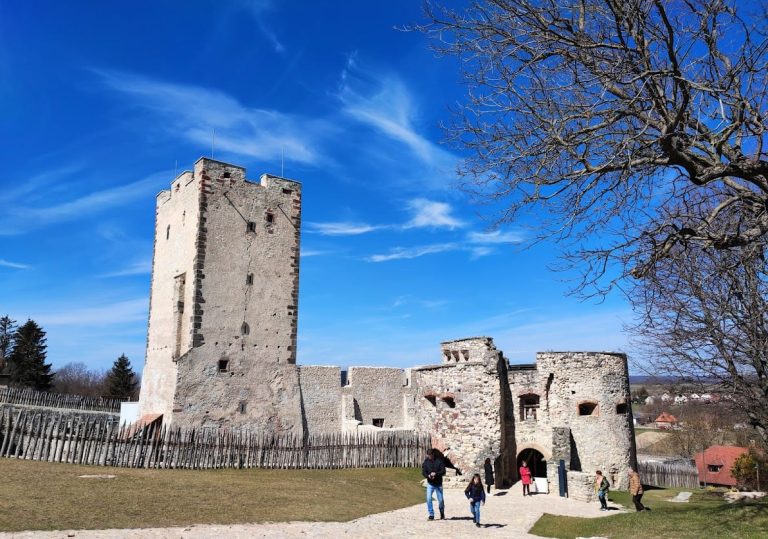
Excavation and monument-preservation work began in 2003. The southeastern tower was investigated and restored first, followed by the exposure of sections of the eastern and southern walls.
Remains
Enclosure and construction
Esseg Castle occupied an irregular enclosure measuring approximately 60 by 70 metres, with towers incorporated into its surrounding defenses. It stood at the western end of a limestone crag beside the Séd stream. Stone formed the principal building material. The first enclosing walls and the timber residential and service buildings built against them probably belonged to the thirteenth century. During the fourteenth century, these structures were rebuilt in stone.
Chapel and residential buildings
A chapel dedicated to Saint George stood along the northern side of the castle. It is recorded from 1332 and was among the principal structures reconstructed in stone during the fourteenth century. Fifteenth-century changes added larger buildings and further residential rooms along the eastern and western walls. The castle may also have contained a knights’ hall, while a cistern, a reservoir for storing water, occupied the northern part of the courtyard.
Surviving tower and walls
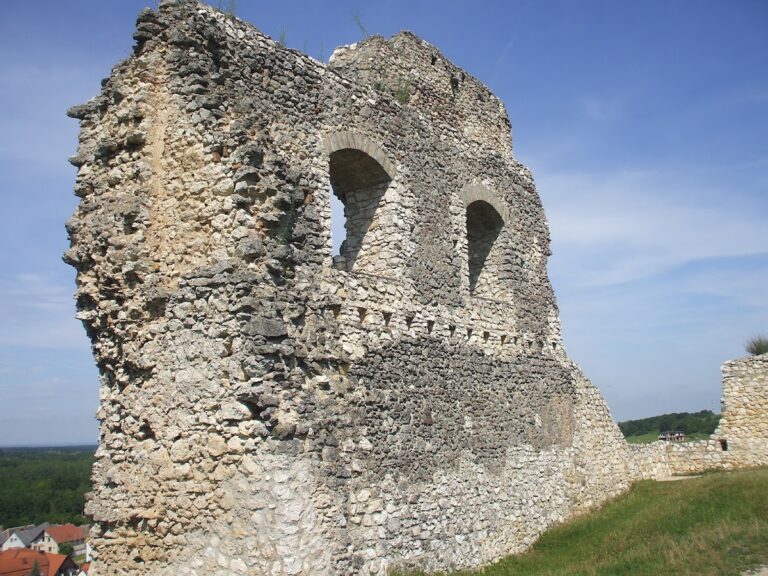
Only a rectangular tower on the eastern side remains visible above ground, together with short sections of wall adjoining it to the south and east. A loophole survives near the entrance of the eastern tower. The foundations of the former buildings remain buried, while the southeastern tower and portions of the eastern and southern defenses have been exposed through archaeological work and preservation.