St Mary Somerset: A Rebuilt Anglican Church and Its Surviving Tower
Site at a Glance
- Popularity
- Medium
- Country
- United Kingdom
- Primary era
- Early Modern
- Eras represented
- Early Modern
- Civilizations
- English
- Site type
- Religious
- Remains
- Church
On this page10 sections
History
St Mary Somerset was an Anglican church in the City of London, United Kingdom, rebuilt after the Great Fire of 1666 and completed in 1694 with a tower carrying Baroque ornament. Baroque was an elaborate European architectural style that flourished in the seventeenth and eighteenth centuries. The fire destroyed much of the City, and the church became one of 51 rebuilt under Sir Christopher Wren’s office.
Medieval church
A twelfth-century deed from the reign of Richard I (1189–1199) names the church as property of Hereford Cathedral. The origin of “Somerset” is uncertain. It may derive from Ralph de Somery, mentioned in records from the same period, or from Summer’s Hithe, a small Thames-side haven that lay closer to the church in medieval times.
In 1370, the mayor directed Brabant weavers to meet in the churchyard to hire workers after disputes with Flemish weavers. The Flemish group was told to meet at a safe distance in the churchyard of St Laurence Pountney. The episode was later recorded by John Stow, a London chronicler and antiquarian.
Rebuilding after the Great Fire
Before the fire, London had 14 churches dedicated to the Virgin Mary; six, including St Mary Somerset, were rebuilt afterward. Work on the new church began in 1686, paused in 1688 amid financial uncertainty associated with the Glorious Revolution, and resumed the following year. The Revolution was the political change of 1688–89 that removed James II from the throne. St Mary Somerset was among the last five of Wren’s 51 City churches to begin rebuilding, and the work was completed in 1694.
The parish was combined with that of St Mary Mounthaw, whose church was not rebuilt. The new building was smaller than its predecessor because the City took part of the site to widen what was then Thames Street. The parish was poor, and Wren arranged Coal Tax funds for furnishings here and at only one other church, St Andrew-by-the-Wardrobe. The Coal Tax was a duty on coal entering London, with revenue used for public works.
Eighteenth-century church
Gilbert Ironside, Bishop of Hereford and Chancellor of Oxford University, was buried at the church in 1701. He had opposed James II in defense of the rights of Oxford’s Fellows. In 1867, Ironside’s remains and black-marble tombstone were transferred to Hereford Cathedral.
By the late eighteenth century, the church had a Low Church reputation, a tradition within Anglicanism that stresses Protestant doctrine and comparatively restrained worship. An 1803 description called the church trampled and dirty and noted that Methodist preacher Mr Gunn preached there on certain days. Methodism is a Protestant movement that developed within the Church of England. The Bishop of Hereford held the patronage of the rectory until the mid-nineteenth century, when it passed to the Bishop of London.
Closure and preservation
From the second half of the nineteenth century, people moved from the City to suburbs in Middlesex, Kent, Essex and Surrey. City congregations shrank while new suburban communities lacked churches. The Union of Benefices Act 1860 enabled redundant City church property to be sold and the proceeds used to support church-building in the suburbs.
St Mary Somerset’s last service was held on 1 February 1867, attended by about 70 people. The parish was united with that of St Nicholas Cole Abbey, and the church was demolished in 1871. At an architect’s instigation, its tower was retained. Sale proceeds helped fund St Mary Hoxton, which received the church furnishings and bell.
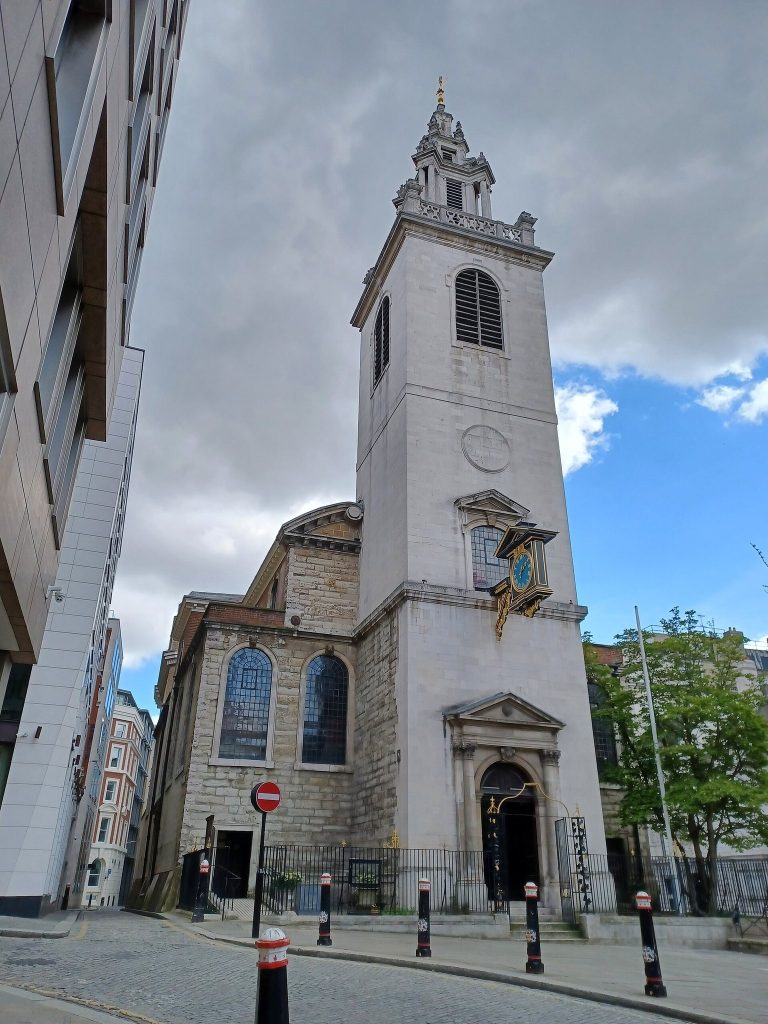
Before the Second World War, the tower served as a women’s rest room. It was designated a Grade I listed building on 4 January 1950. After bomb damage during the London Blitz, its pinnacles were removed and restored by the City Corporation in 1956; an inscription on the tower records that restoration.
Remains
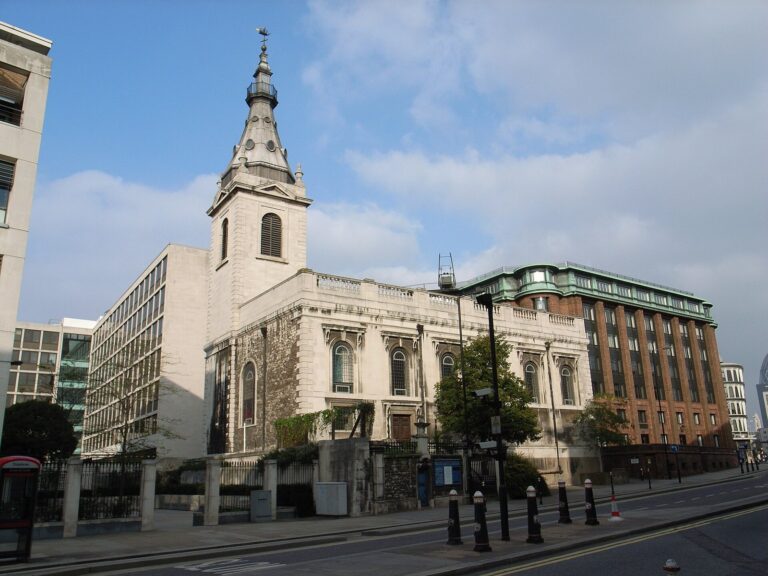
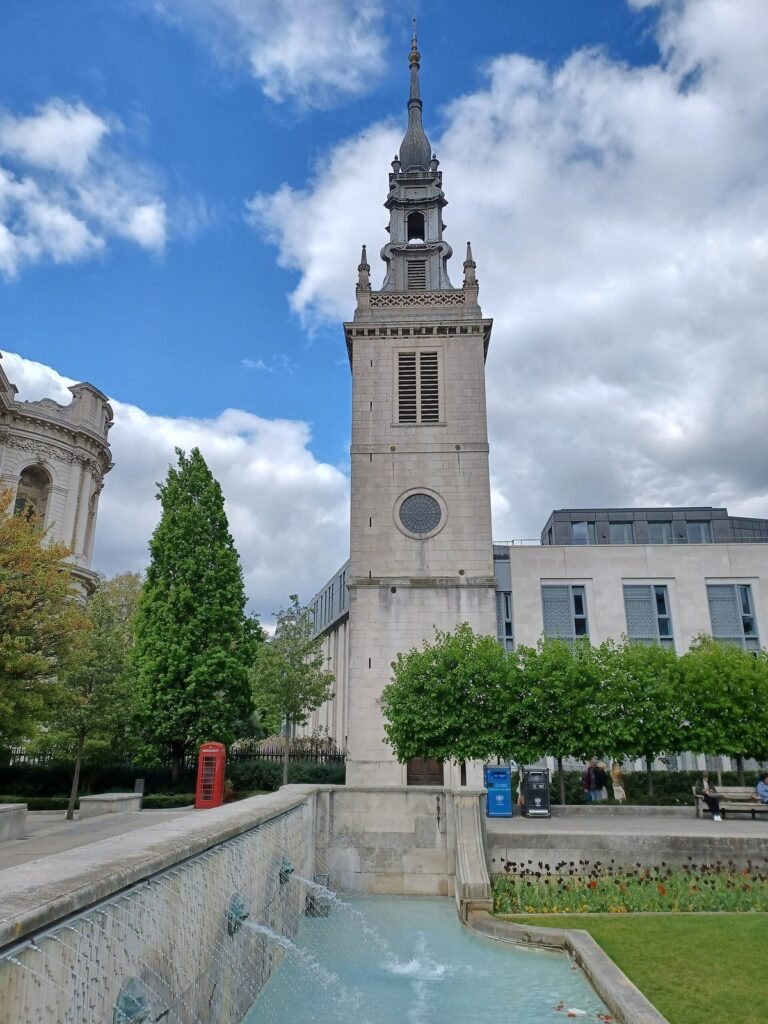
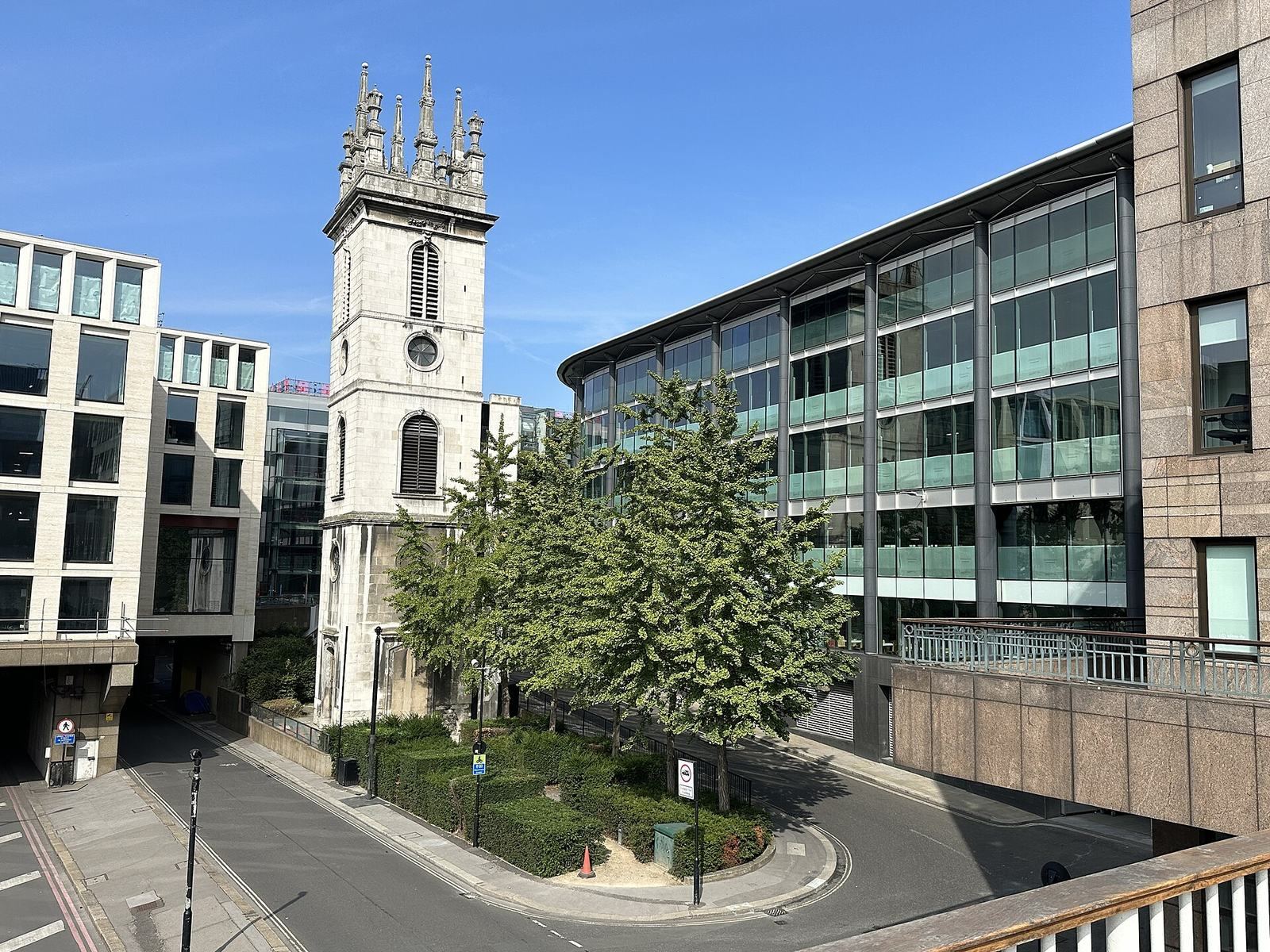
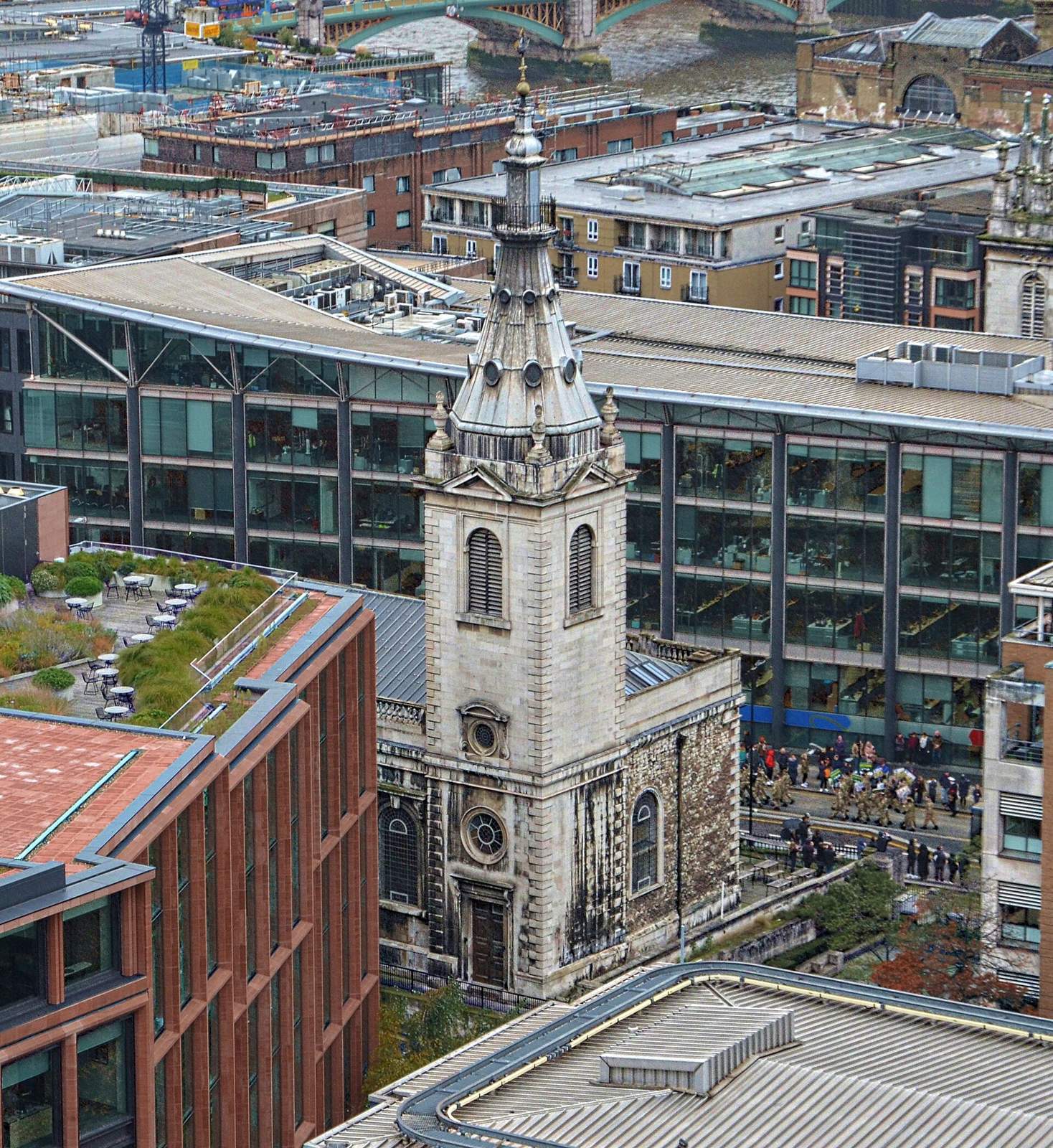
The former church paired an aisleless, flat-roofed nave with a tower projecting from its southwest corner. The tower is the only surviving part of the church. It now stands on Upper Thames Street, on a traffic island with a landscaped garden in the Queenhithe area of the City of London.
Nave and interior
George Godwin described the interior as a plain room with low, whitewashed walls. At the west end, two columns supported a gallery, from which the Royal coat of arms was suspended.
The tower
Masonry and windows
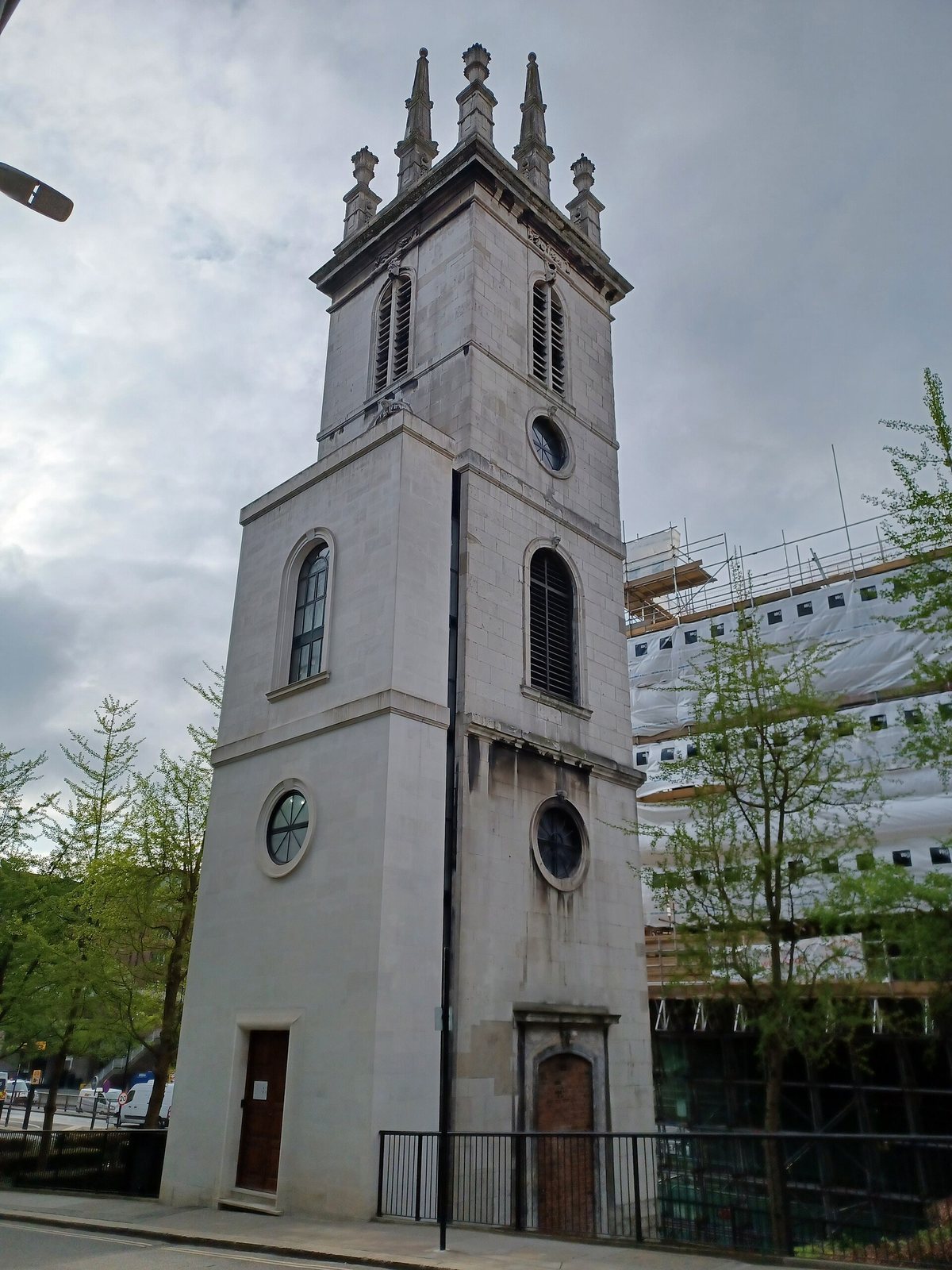
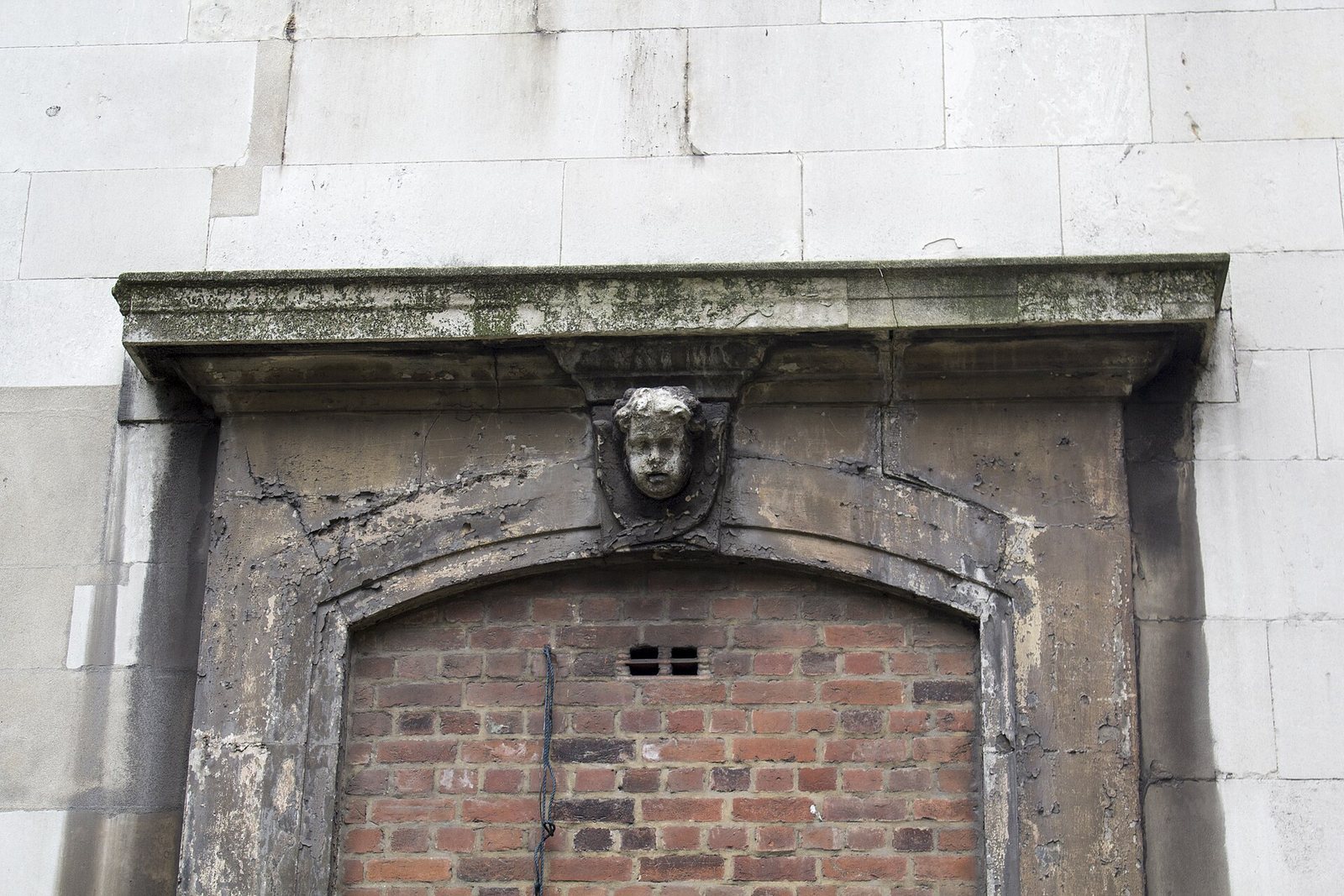
The tower rises 120 feet and is faced with Portland stone, a limestone quarried on the Isle of Portland in Dorset. Its storeys are clearly defined. On each side, circular and round-headed windows form alternating rows. Grotesque masks and cherubs serve as keystones, the central stones at the crowns of arches.
Upper ornament
Eight slender pinnacles crown the tower. The four at the corners have panelled bases and scrollwork capped with vases. Between them stand 20-foot obelisks, tall tapering shafts topped with spherical ornaments. The pinnacles are attributed to Nicholas Hawksmoor. Their arrangement can make them appear to change in height when seen from different viewpoints.