St. Martini (Münster): A Medieval Collegiate and Parish Church


Site at a Glance
- Rating
- 4.5
- Popularity
- Very Low
- Country
- Germany
- Primary era
- Medieval
- External website
- Open
- Eras represented
- Medieval, Early Modern
- Civilizations
- Holy Roman Empire
- Site type
- Religious
- Remains
- Church
On this page15 sections
History
St. Martini is one of Münster’s oldest Roman Catholic sacred buildings, located in Münster, Germany. Dedicated to Saint Martin of Tours, the fourth-century bishop venerated widely in Western Europe, it emerged during the town’s late-twelfth-century expansion into its southern and eastern districts. Construction is generally placed in the 1180s, when the church was already a three-aisled Romanesque basilica.
Foundation and Collegiate Organization
The earliest indirect evidence for St. Martini dates from 1187. No foundation-stone or consecration date is known. The new parish in the northeastern part of the expanding town was probably established under the direction of the bishops of Münster. One tradition connects its foundation with the episcopate of Herman II of Katzenelnbogen.
In 1217 Bishop Otto I confirmed five prebends that Herman II had established at St. Martini about thirty years earlier. A prebend was a fixed endowment whose income supported a member of a cathedral or collegiate chapter. Herman had bought back from Sveder de Thingethe, a cathedral ministerial who held it as a fief, a toll producing four marks. He paid fifty Cologne marks and assigned the toll revenues to St. Martini.
The church also received an archdeaconry, an ecclesiastical administrative territory overseen by an archdeacon. It had previously been assigned to the provost, while the associated holding was reserved for a cathedral canon. The archdeaconry or provostry extended across Ennigerloh, Ostenfelde, Lette near Clarholz, Oelde, Sünninghausen, Vellern, Diestedde, Wadersloh, Herzfeld, Lippborg, Uentrup, Dolberg, Heessen, Hövel, and Bockum.
A provost is first directly recorded in 1199, when Bishop Herman witnessed the transfer of the Sandendhorpe estate to Clarholz Abbey as “Herimannus, prepositus sancti Martini.” The dean appears in the surviving record from 1200, when Herman confirmed the possessions of Hohenholte Abbey. Although the provost was always a Münster cathedral canon, he received no income from St. Martini, held no place in the choir, had no vote in the chapter, and exercised no jurisdiction. The dean directed the local foundation and, from the beginning of the thirteenth century, also served as parish priest. Two chaplains later assisted him, while the senior canon led the chapter during a dean’s absence or a vacancy.
Endowments and Chapter Life
Other offices included the treasurer and the scholaster. The treasurer, initially known as the custos, first cared for liturgical equipment and later administered property connected with that responsibility. Two sacristans eventually took over the practical duties. Regulations associated with Pope Innocent III led to the creation of a scholastery, an educational endowment linked to the church school. Its scholaster managed the relevant property and appointed a school rector, who carried out the teaching.
The foundation created around 1187 provided the basis for the deanery and four additional prebends. Further endowments began in 1233, and the number of prebends had risen to seventeen by 1344. St. Martini had no common corporate property or central administration. Each canon drew a fixed income from his own prebend, lived in a curia, or residence assigned to a canon, near the church, and maintained a separate household.
The bishop initially controlled the appointment of prebendaries. The Vienna Concordat of 1448, an agreement regulating ecclesiastical appointments, gave the papacy substantial influence and divided the right of appointment between the cathedral and collegiate chapters in even-numbered months and the Apostolic See in odd-numbered months. Formal entry began with possessio, the taking of a prebend, for which tonsure and the minor orders were required. After completing his studies and serving for several years, a canon generally became a full chapter member through emancipation, usually after ordination as a subdeacon. He then obtained a place in the choir, a vote in the chapter, and control of his income. Membership usually ended with death or resignation, sometimes in favor of a relative. Exchanges with clergy at other churches also occurred, while expulsions were rare.
From 1333, endowed vicarages supported additional worship and perpetual masses for the souls of their founders. A vicarage was an endowed office supporting a cleric who celebrated specified masses. The sequence began with the altar of Saint James the Greater, under the patronage of Münster’s council, followed in 1335 by two vicarages for the deacon and subdeacon. Further foundations were dedicated to the Three Kings and Saint Olaf in 1360, Saints Catherine and Anne in 1425, Saint James the Lesser in 1433 under the council’s patronage, Saint Barbara in 1459 in the chapter house, Saints Philip and James in 1463, Saint John in 1470, and the Holy Trinity in 1522.
Reformation, Dissolution, and Later Use
In 1532 Adam Brictius thon Norde, a priest from Schöppingen who adhered to the Reformation, held Protestant services at St. Martini. After the end of Münster’s Anabaptist kingdom in 1535, the church returned to Catholic use.
Prussian troops occupied the Prince-Bishopric of Münster on 3 August 1802, but St. Martini was not secularized during that first occupation. An imperial French decree issued on 14 November 1811 dissolved the collegiate chapter. From then on, St. Martini functioned solely as a parish church.
During the Second World War, the church survived Allied bombing. A replacement organ was built in 1959, and part of the planned instrument was completed in the 1990s. On 2 December 2007, at the beginning of the new ecclesiastical year, St. Martini, St. Lamberti, St. Ludgeri, and St. Aegidii were merged into the new St. Lamberti parish. St. Martini and adjoining rooms later became the Münster Youth Church, used by the Diocese of Münster for diocesan youth work. The building is protected as built heritage in North Rhine-Westphalia.
Remains
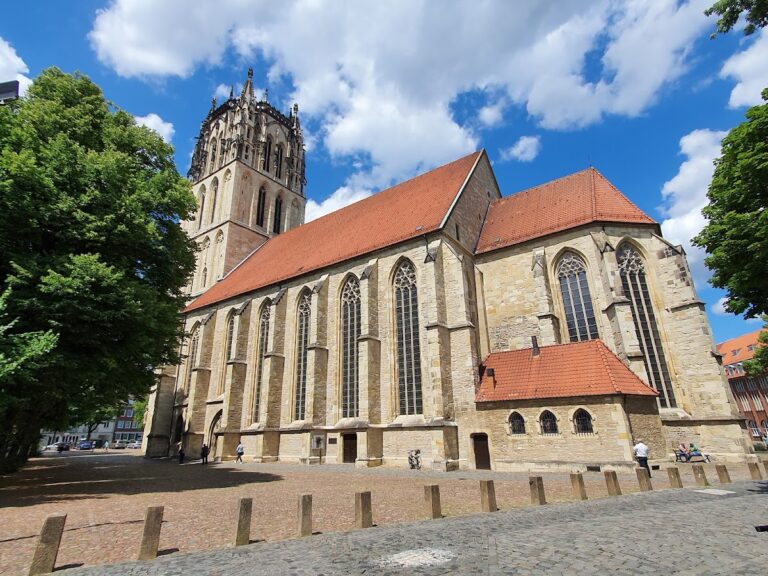
St. Martini stands at the junction of Martinistraße and Neubrückenstraße near Münster’s theater, within the historic-center quarter formed by Martinistraße, Martinkirchhof, Neubrückenstraße, and Stiftsherrenstraße. The surviving complex brings together Romanesque foundations, a medieval Gothic hall and choir, and a Baroque tower termination. Its fabric therefore reflects several major building phases rather than a single architectural period.
Church and Choir
Gothic Hall
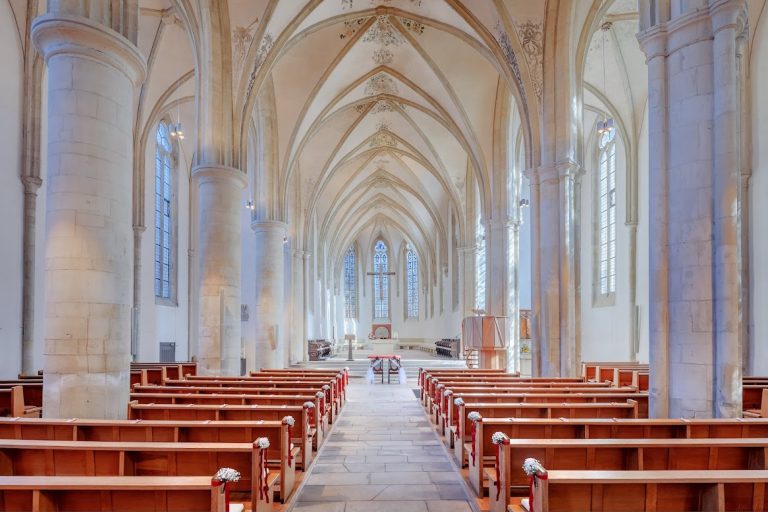
The first church was a three-aisled Romanesque basilica. During the Middle Ages, its nave was replaced by a three-aisled Gothic hall church, in which the central space and side aisles are approximately equal in height. Round piers support the interior structure. This medieval rebuilding forms the principal body of the surviving church.
Long Choir
A long choir was added around 1380. Its extension included a bay ending in a polygonal plan and covered by a star-shaped vault. The choir belongs to the Gothic expansion of the church and remains part of the building’s later medieval form.
Tower and Sculptural Decoration
Romanesque Base and Baroque Roof
The original western tower survives at its lowest level, where its Romanesque forms remain visible. Around 1480, this base was raised by two richly sculpted stories containing the bells. The original pointed roof was replaced around 1760 by a Baroque hood, reportedly designed by Johann Conrad Schlaun, an important eighteenth-century architect of Westphalia associated with Baroque architecture.
Stone Statues
In 1906, the Gothic upper section of the tower received twenty statues carved from Eifel sandstone by Münster sculptors. The figures reach up to 2.50 metres in height. The east side bears Saint Elizabeth by Arnold Kramer and Saint Catherine by Heinrich Bäumer. On the south are the Savior and Saint John the Baptist by August Schmiemann, together with Saint Anthony of Padua and Saint James the Lesser by Wilhelm Bolte.
The west side includes Saint Michael, the Madonna, Saint Gabriel, Saint Ludger, Saint Boniface, and Saint Martin. Heinrich Bäumer made the first five, while Arnold Kramer carved Saint Martin. The north side carries Saints Anne and Barbara by Robert Lobenberg and Saints Joseph and Aloysius by Anton Rüller. The tower corners contain the four Evangelists, with Saint John at the southwest, Luke at the northwest, Mark at the northeast, and Matthew at the southeast, all made by Arnold Kramer.
Interior Furnishings and Music
Altarpiece
Johann Bockhorst painted the altarpiece Mass of Saint Martin around 1654 for St. Martini. Bockhorst was born in Münster, worked in Antwerp, and was closely associated with Peter Paul Rubens. Since 1998, the painting has been held by the Stadtmuseum Münster.
Organs
The main organ stands in an organ chamber within the tower. Matthias Kreienbrink of Georgsmarienhütte built it in 1959 to replace the instrument destroyed during the Second World War. It initially contained Hauptwerk, Swell, and Pedal divisions. The planned Positive was added in the 1990s, although five of its intended eight stops were installed.
The instrument has a cone chest, a wind chest in which cone valves control individual pipes, twenty-seven speaking stops, and a transmission from Hauptwerk to the Pedal. Its action and stop mechanisms are electric. The couplers are II/I, III/I, III/II, I/P, II/P, and III/P. Playing aids include two free combinations, two pedal reversers, Tutti, a canceler, and a crescendo roller. A second Positive with two manuals, built by the Streichert firm of Göttingen, also stands in the nave.
Bells
Six bells hang in the high tower. Bells V and VI formed the church’s emergency and only peal until 1982.