Apostelkirche (Münster): Münster’s Principal Protestant Church

Site at a Glance
- Rating
- 4.5
- Popularity
- Very Low
- Country
- Germany
- Primary era
- Medieval
- External website
- Open
- Eras represented
- Medieval, Early Modern
- Civilizations
- Holy Roman Empire
- Site type
- Religious
- Remains
- Church
On this page9 sections
History
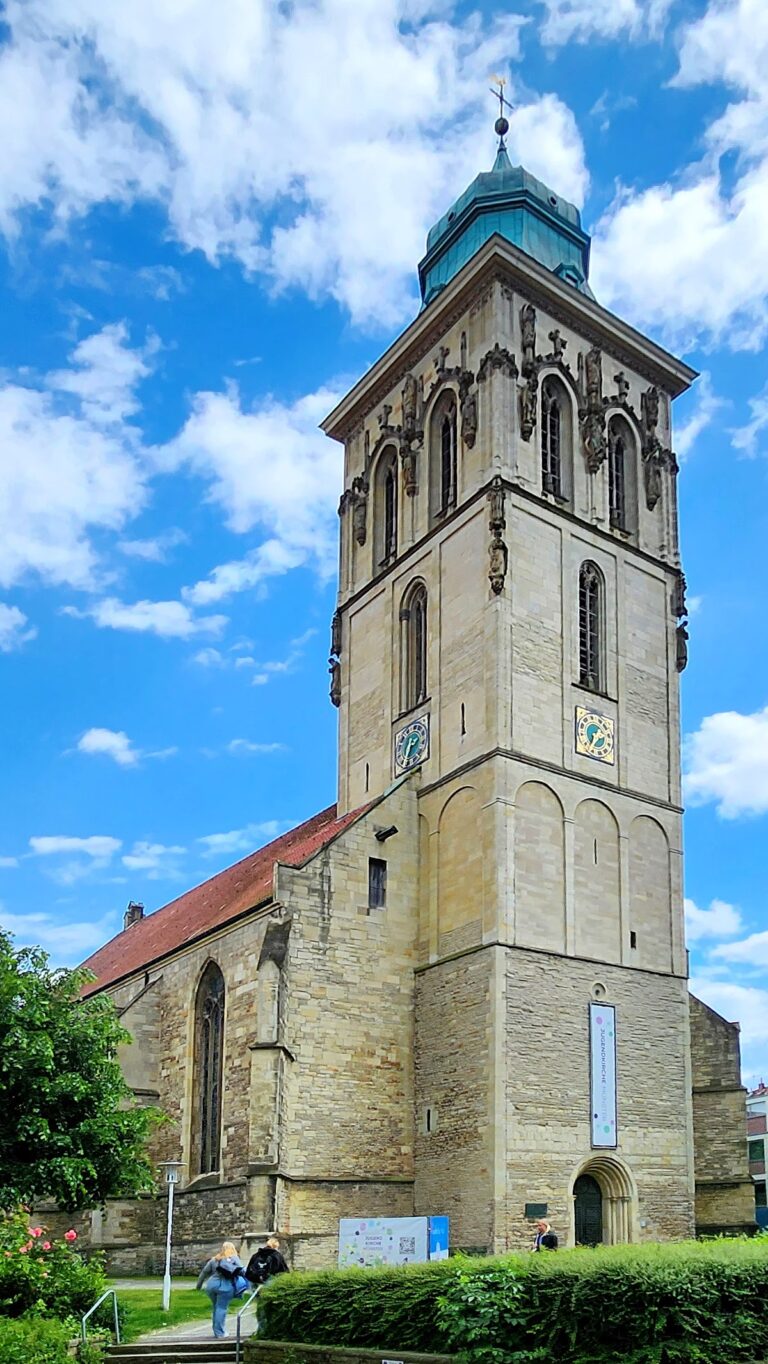
Apostelkirche is an Evangelical parish church in Münster, Germany, and the city’s principal Protestant church. Located in the northern part of the historic old town, it was built by Franciscan friars and is regarded as Münster’s first Gothic church and the oldest purely Gothic church in Westphalia.
Franciscan Foundation and Medieval Development
Franciscan friars from the Westphalian Custody of the Cologne Franciscan Province probably settled in Münster in 1247. With the assistance of Bishop Gerhard von der Mark, they acquired a large site around 1270 for a monastery and church. The nave, choir, and southern aisle had been built as far as the sixth bay by 1284. The church was originally dedicated to Catherine of Alexandria.
From 1517, the church served the Münster convent of the Conventual Franciscans, later commonly known as the Minorites. This branch retained conventual communities after the Franciscan Order divided into Conventuals and Observants during a dispute over the interpretation of religious poverty. More than 20 friars lived in the convent in 1371. During the plague epidemic of 1382, the Franciscans remained in Münster and cared for the sick and dying. Wennemar von Staden, the monastery’s guardian, became auxiliary bishop of Münster in 1382 or 1384.
Conflict, Reformation, and Franciscan Division
During the Münster Diocesan Feud of 1450 to 1457, a conflict between the city and Bishop Walram von Moers, the Franciscans supported the townspeople. Johannes Brugmann, a member of the convent, helped mediate the settlement. The convent survived both the Reformation and the Anabaptist conflicts of 1533 to 1535, although the church and monastery buildings were plundered and damaged. They were refurnished between 1536 and 1538. Twelve friars belonged to the monastery in 1566, and from 1619 it housed the Westphalian Minorite novitiate, where members of the order received their initial religious formation.
The Observants, the Franciscan branch that followed a stricter interpretation of poverty, established themselves in vacant buildings near the Johanniter commandery in 1614. A commandery was an administrative establishment of a military religious order. Around 1630, the Observants built a new monastery complex and church on Bergstrasse, giving Münster separate establishments for the two Franciscan branches.
Secularization and Protestant Use
The Prince-Bishopric of Münster was secularized in 1803. Secularization transferred or dissolved ecclesiastical institutions and property through state action, and in Münster it brought the closure of the Franciscan monastery. The Minorite monastery was formally dissolved on 14 November 1811, and the church was initially profaned.
After restoration under Karl Friedrich Schinkel, a leading German architect of the nineteenth century, the building was rededicated in 1822 as the Evangelical church of the Prussian military congregation. It passed to Münster’s Evangelical civilian congregation in 1840. The name Apostelkirche was adopted in 1922, after a second Evangelical church had been built in Münster. Much of the nineteenth-century interior work was later removed.
War Damage and Twentieth-Century Stabilization
The church suffered severe damage during the Second World War, including damage caused by Allied bombing. Provisional repairs were followed by reconstruction that continued until about 1960. Apostelkirche was rededicated on 30 October 1949 in the presence of Bishop Wilhelm Stählin, and Evangelical congregations on the Isle of Wight supported the rebuilding.
In 1963 and 1964, construction of a new district church office on the north side of the choir caused the choir’s north wall to begin tilting. Lowered groundwater had allowed the medieval timber-grillage foundation to rot. The northeastern part of the church was therefore underpinned with new pile foundations. Damaged paintings in the choir vaults were restored, and a Latin chronogram on the western choir vault commemorates the completion of the work.
Remains
Gothic Plan and Later Extensions
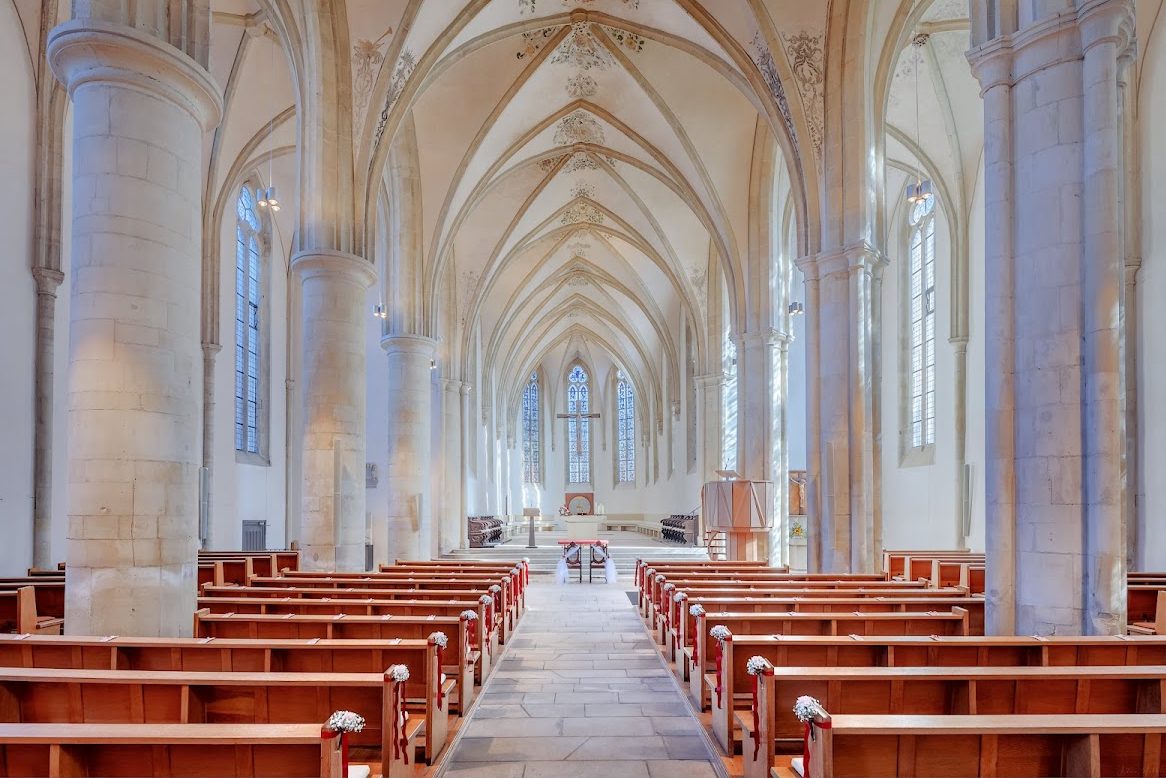
Apostelkirche is a Gothic hall church, a form in which the nave and aisles have broadly comparable height and create a unified interior space. The building was originally two-aisled and is now three-aisled. Its long, narrower choir consists of three bays and ends in a 5/8 termination, meaning that the eastern end has five sides arranged as five-eighths of an octagonal plan. The monastery formerly stood directly against the church’s north side.
The northern aisle and the two western bays were added between 1654 and 1659 to correct what was regarded at the time as a disharmony in the earlier building. These additions produced the present three-aisled arrangement while preserving the character of a mendicant-order Gothic hall. A roof turret rises from the eastern end of the nave roof and contains a three-part peal of bells made in Amsterdam in 1675.
Vaults, Windows, and Choir Art
Extensive late-medieval and post-medieval paintings survive on the vaults. Some sections had been covered over and were later uncovered. Their survival contributes to an interior that is largely unadorned in appearance, allowing the articulated Gothic hall to remain clearly legible. The nave windows contain simple hand-drawn Goethe glass, which gives the interior bright illumination. Colored-glass windows are found in the choir and in the rose window above the southern side entrance. Their designs were produced by Paul Weigmann between 1990 and 1992 and by Hubert Spierling between 1999 and 2000.
A crucifix hangs at the focal point of the choir. Beneath it is a panel from Heinrich Gerhard Bücker’s Genesis cycle, made between 1976 and 1979. The work consists of a circular cast-aluminium disk mounted on a copper square, with a convex gold disk at its center bearing fossils of two fish approximately 180 million years old. It interprets creation as being carried and permeated by the spirit of God. Bücker also designed the ambo, a raised stand for readings and preaching, as well as the baptismal font and Easter candle-holder during the same period.
Memorial and Organ
A fifteenth-century memorial stone is set into the church’s exterior wall. It commemorates citizens killed in the Battle of Varlar. The church’s organ history began with an instrument built by Johann Adolf Hillebrand in 1821. Because that organ caused continual problems, Friedrich Ladegast replaced it in 1879 with an instrument having 36 stops on three manuals and pedal. Fleiter Orgelbau enlarged it in 1923, but the organ was destroyed in 1945.
The present organ was built in 1968 by Paul Ott of Göttingen. It stands on the organ gallery at the south wall of the central nave and has 36 stops on three manuals and pedal. Its mechanical action transmits the player’s movements to the valves mechanically. The instrument has the couplers II/I, III/I, III/II, I/P, and II/P, together with a cymbal star, a small percussion device incorporated into some organs.