Überwasserkirche: A Gothic Hall Church in Münster, Germany


Site at a Glance
- Rating
- 4.6
- Popularity
- Medium
- Country
- Germany
- Primary era
- Medieval
- External website
- Open
- Eras represented
- Medieval
- Civilizations
- Holy Roman Empire
- Site type
- Religious
- Remains
- Church
On this page17 sections
History
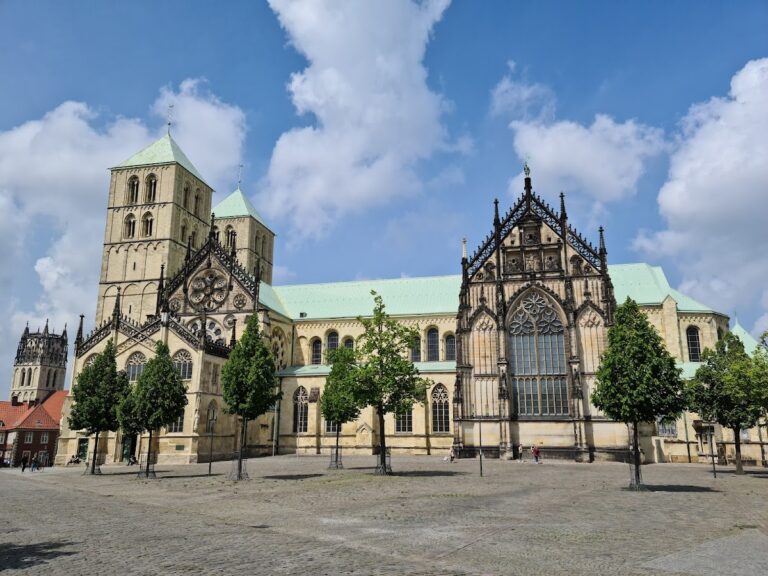
Überwasserkirche is a Gothic Catholic hall church in Münster, Germany, dedicated to the Nativity of Mary and built by the religious community associated with the Überwasser foundation. The present church was begun in 1340, while the name Überwasser, meaning “beyond the water,” refers to its position west of Münster Cathedral across the Aa. Its broad three-naved form and long history reflect the importance of the foundation, which combined religious observance, education, residence, and the management of landed property.
Foundation and medieval development
Bishop Hermann I of Münster established the canonesses’ foundation, a community for women, often from noble families, whose members generally did not live under the same vows as enclosed nuns. The foundation was inaugurated on 29 December 1040 in the presence of King Heinrich III, twelve bishops, numerous clergy, imperial princes, and nobles. It served as an educational and residential institution for women of the aristocracy. Until 1460, its abbess had to be of high noble birth. The first abbess was Bertheid, Hermann I’s sister, who died in Münster on 22 December 1042 and was regarded as a saintly woman.
The first church was consecrated on the foundation’s inauguration day and was probably a three-aisled building. Fire destroyed it in 1071. A replacement had been erected by 1085 to 1088, when eight chapels and altars were consecrated. The church and foundation later suffered greatly during the capture of Münster by Lothar von Süpplingenburg in 1121. Lothar, later Emperor Lothar III, was the ruler whose forces seized the city. After the destruction of the foundation, Bishop Egbert compelled the fleeing canonesses to return and adopt a stricter rule.
The foundation controlled extensive landed property in the Münsterland. Its holdings included the later Hülshoff estate near Roxel and properties at Deckenbrock and Lütke Deckenbrock. In the thirteenth century, Engelbert von Deckenbrock served as the foundation’s treasurer while also holding the office of Drost, a senior administrative and judicial position, for the chapter of Münster Cathedral.
The Gothic church and the foundation
The present church was begun in 1340, and its tower followed from 1363 until probably the beginning of the fifteenth century. The associated foundation continued to be governed by women from the Westphalian nobility until its dissolution in 1773. Its community therefore remained tied to the region’s aristocratic society long after the medieval rebuilding had begun.
Religious conflict altered the church’s use during the Reformation. Abbess Ida IV von Merveldt, who held office from 1509 to 1535, was compelled by the city government to permit Protestant preaching. During the Anabaptist rule of 1534 to 1535, a radical Protestant movement that controlled Münster before being defeated by episcopal forces, some canonesses accepted Anabaptist baptism.
The siege of Münster by episcopal troops in 1534 and 1535 also changed the building physically. The tower spire was removed, and cannon were installed on the tower platform to strengthen the city’s defenses. Sculptures from the west portal were torn down and embedded in the city walls for military purposes. The spire was rebuilt after the Anabaptists were expelled, but a hurricane destroyed it again in 1704.
Dissolution and later parish history
Papal approval accompanied the dissolution of the Überwasser foundation in 1773. Its assets were used to establish a seminary beside the church. That institution remained there until 2005 and later developed into the University of Münster. The university seal still depicts Our Lady of Überwasser, preserving the foundation’s Marian association in a later institutional setting.
For centuries, the church served as the parish church of the Überwasser parish, whose territory included the former farming communities of Gievenbeck, Sandrup, Sprakel, and Uppenberg. Since 9 March 2014, it has been the parish church of the merged Liebfrauen-Überwasser parish. This parish brought together the former parishes of St. Theresia at Sentruper Höhe, St. Sebastian in Nienberge, Liebfrauen-Überwasser, and St. Michael in Gievenbeck.
The church also became a burial place for members of the Droste zu Hülshoff family, including Heinrich I von Droste zu Hülshoff and his wife, who was born von Steveninck zu Möllenbeck. The family still possessed a burial vault there in 1570 and associated pews until 1631. Other burials include the Baroque architect Johann Conrad Schlaun and the priest and educator Bernhard Overberg, whose grave lies in the choir. Franz Friedrich Wilhelm von Furstenberg was first buried in the Überwasser cemetery, but his grave was transferred on 21 October 1929 to the canons’ cemetery of Münster Cathedral.
Music and education also link the church to Münster’s cultural history. Maximilian-Friedrich von Droste zu Hülshoff served as one of its organists. He was the uncle and composition teacher of the poet Annette von Droste-Hülshoff.
War damage and twentieth-century restoration
On 20 July 1941, Clemens August Graf von Galen, Bishop of Münster from 1933 to 1946, delivered the second of his three widely known sermons against the Nazi regime at Überwasserkirche. The sermon, titled “We Are the Anvil, Not the Hammer,” condemned Nazi policies and helped make von Galen internationally known.
Air raids on Münster during the Second World War severely damaged the church, although reconstruction remained possible. The interior was restored in 1968. Further work treated the windows between 1972 and 1975, the exterior of the tower from 1976 to 1983, and the tower more extensively from 1998 to 2001. Renovation took place from January to November 2016, followed by additional tower repairs in 2019 after stones had loosened. A new parish organ was installed in 1972, and the windows were redesigned by the glass painter Valentin Peter Feuerstein between 1972 and 1975.
Remains
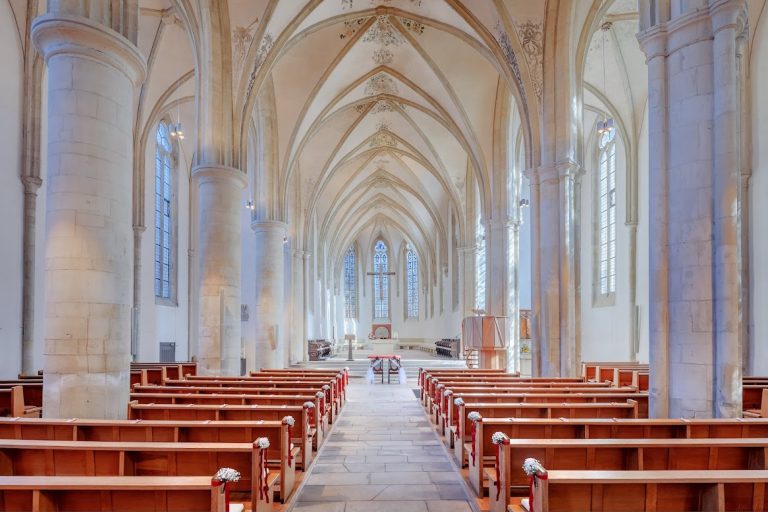
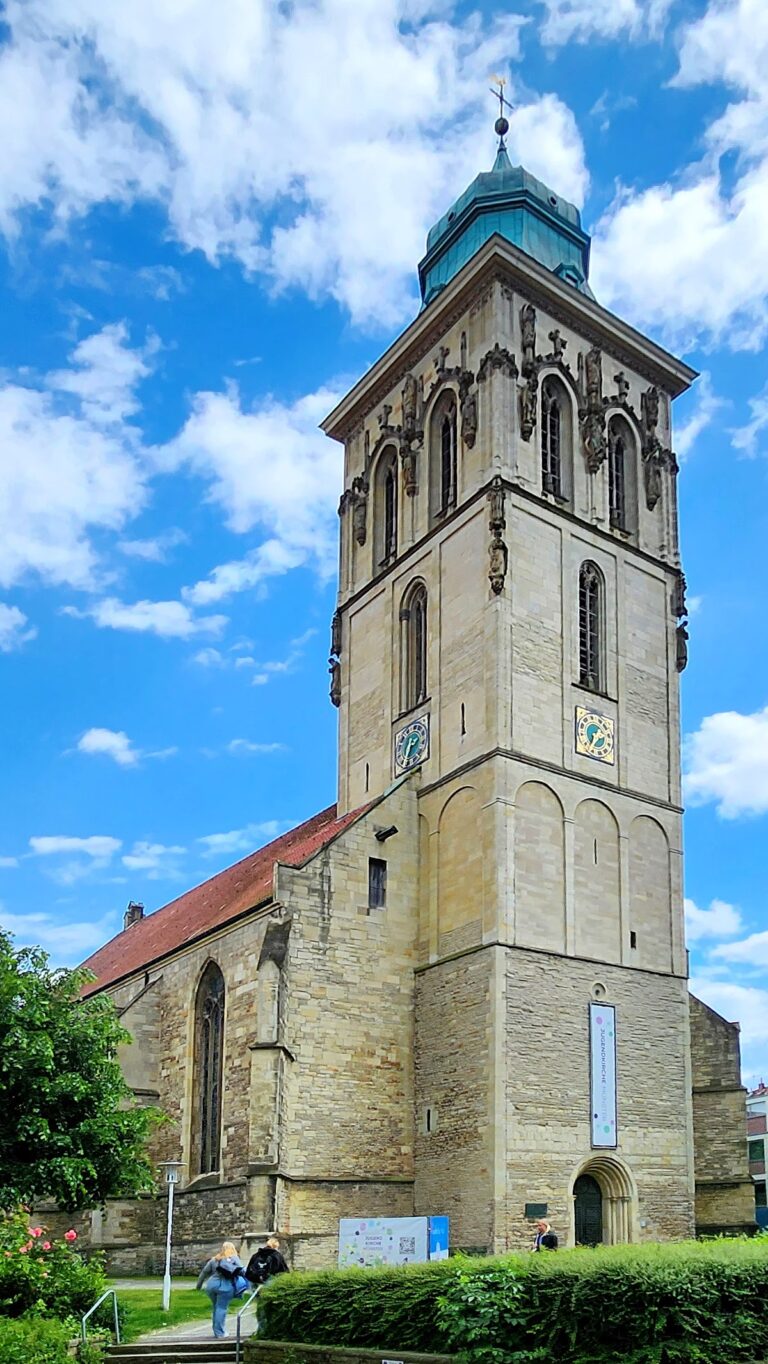
Überwasserkirche survives as a Gothic hall church with three naves of approximately equal height, creating a broad interior space. The church stands in Münster’s western city centre, west of the cathedral and across the Aa. Its tower rises 64.5 metres. Construction of the present building began in 1340, as an inscription above the west portal states, while the tower belongs to the building campaign that began in 1363 and probably continued into the early fifteenth century.
Portal and tower
West portal
The west portal originally carried eleven larger-than-life figures carved around 1370 to 1374 from Baumberg sandstone. Abbess Heilwigis von Wevelinghoven, who governed from 1367 to 1388, commissioned the work together with the foundation community. The workshop probably came from the Meuse region, with which Münster maintained personal and commercial connections. Mary with the Child occupied the central pier. Four apostles faced her on each side of the recessed, angled doorway, while Peter and Paul stood outside the portal funnel. The surviving fragments are now preserved in the LWL Museum of Art and Culture.
Tower hall sculptures
The tower hall contains a late-fourteenth-century Baumberg sandstone sculpture known as the “Saint Benedict.” It also preserves a late-fourteenth-century image of Christ with raised hands, likewise carved from Baumberg sandstone. This figure formerly served as the keystone of the choir vault, the central stone locking the vault’s construction.
Interior sculpture and memorials
Mary and Christ imagery
The church contains a Pietà dating from 1486 to 1500, showing Mary mourning over the dead Christ, and a choir cross from the third quarter of the seventeenth century. A relief of the Assumption of Mary, attributed to Gerhard Gröninger and carved in alabaster around 1625, is also preserved in the church. Johann Anton Koppers’s painting Assumption of Mary, measuring 15 square metres, was restored in 2019.
Funerary monuments
Gerhard Gröninger’s work includes an epitaph, a commemorative funerary monument, for Bernhard Huge and his wife Judith, as well as an epitaph for the Kerckerinck brothers. Another memorial for Bernhard Hausmann and his wife Elisabeth Wettelers is attributed to him. These monuments form part of the church’s surviving collection of sculptural memorials.
Baptismal font
A baptismal font attributed to Johann Wilhelm Gröninger dates from around 1720. Its alabaster base takes the form of a paradise tree with a serpent and an apple, giving the liturgical object a sculptural design associated with the biblical account of the Fall.
Ludgerus Chapel
The Ludgerus Chapel contains Johann Mauritz Gröninger’s stone relief Lying in State of Saint Liudger, made in 1691. Liudger was an early Christian missionary and the first Bishop of Münster. The chapel also contains versions of the church’s “Saint Benedict,” Christ with raised hands, Pietà, Assumption of Mary, the memorials for Bernhard Huge and Judith, the Kerckerinck brothers, Bernhard Hausmann and Elisabeth Wettelers, and the baptismal font.
Organs and bells
Organs
The church has two organs. The small choir organ was built in 1985 by the Oberlinger firm. The main organ was made in 1972 by Seifert of Kevelaer. It is a slider-chest instrument, using sliding boards to regulate the flow of air to the pipes, with 39 stops distributed across three manuals and a pedal. Its key and stop actions are electric, and its couplers connect I/II, III/II, I/P, II/P, and III/P.
Bells
Before secularization and the First World War, seven bells hung in the tower, five for the parish and two for the foundation. The destruction of the Second World War left the Marian bell of 1415 and the clock bell of 1613 from the 1926 peal. Two smaller bells were added in 1969. The Marian bell has elaborate cast decoration dominated by an Annunciation scene, although a tonal correction in 1926 damaged its music-historical value.
The clock bell was transferred to Trinity Church in 1939 and replaced at Überwasserkirche by an 1846 bell from St. Anna in Mecklenbeck. After Trinity Church was deconsecrated, the original clock bell returned to Überwasserkirche on 2 June 2012. It has since been displayed as a monument in the tower hall.