St Martin, Ludgate: A Wren-Designed Baroque Church in London
Site at a Glance
- Rating
- 4.8
- Popularity
- Medium
- Country
- United Kingdom
- Primary era
- Early Modern
- Eras represented
- Early Modern, Modern
- Civilizations
- British, English
- Site type
- Religious
- Remains
- Church
On this page11 sections
History
Early church and medieval tradition
St Martin, Ludgate is an English Baroque church on Ludgate Hill in London, United Kingdom. Dedicated to Martin of Tours, a fourth-century Christian bishop and saint, it existed before its first written mention in 1174. The church was Roman Catholic until 1538. Before the Reformation, it was under Westminster Abbey; after the English church’s break with Roman Catholic authority, oversight passed to St Paul’s Cathedral.
A church tradition says that Cadwallo, described as king of the Britons, was buried here in 677. The story is usually associated with Cadwallon ap Cadfan, a seventh-century ruler of Gwynedd whose death is placed around 682. The claim is historically doubtful: London was then controlled by Anglo-Saxon polities, and its walled city had been abandoned after the late fourth century. An earlier church sign instead named Caedwalla, a king of Wessex. That version conflicts with the account of Bede, an early medieval English historian, which says Caedwalla was buried in Rome. Another legend says an image of Cadwallo was placed on Ludgate to frighten the Saxons.
A Dominican monastery, known as Blackfriars because of the friars’ dark habits, was established nearby in 1278. The church was rebuilt in 1437. Parish books survive from 1410, and the church’s tower was struck by lightning in 1561.
Reformation and seventeenth century
Samuel Purchas, an English clergyman and travel writer, became rector in 1614. The Royal College of Physicians had its nearby premises in Amen Corner from 1614 to 1666. A burial register notes that on 28 February 1615 “an anatomy from the College of Physicians” was buried at the church. Literary links are uncertain: a line in The Roaring Girl about Ludgate’s clock may refer to St Martin’s, while the rhyme “I owe you three farthings, say the bells of St Martin” is more likely about St Martin Orgar.
The church was repaired in 1623, but the Great Fire of London in 1666, which destroyed much of the city, consumed it.
Wren’s church and later changes
Christopher Wren, the English architect associated with London’s rebuilding after the fire, designed the replacement, one of 51 churches attributed to him. The present building is dated 1677-1684. Rebuilding was largely complete by 1680, while its formal completion is dated to 1703.
The neighbouring city gate of Ludgate was demolished in 1760. Major work in 1893-1894 raised the church floor, and many bodies from the churchyard were removed and reburied at Brookwood Cemetery. In 1941, during the London Blitz, a German incendiary bomb damaged the roof; the church otherwise sustained relatively little damage during the Second World War.
St Martin became a Guild Church in 1954, serving a community associated with the City’s guilds and businesses rather than functioning as a parish church. It was designated a Grade I listed building on 4 January 1950, a category representing the highest level of listed-building protection in England. The church belongs to the Diocese of London and is associated with the parish of St Andrew by the Wardrobe.
Remains
The English Baroque church has a square plan, with four large columns inside it forming a Greek-cross layout, whose four arms are similar in length. The central square bay has a groin vault, made where barrel-vaulted ceilings intersect. The arms have barrel vaults, curved ceilings shaped like half-cylinders.
Tower and exterior
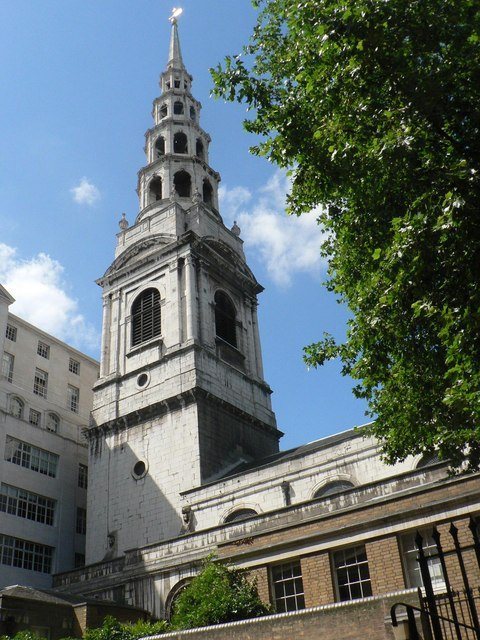
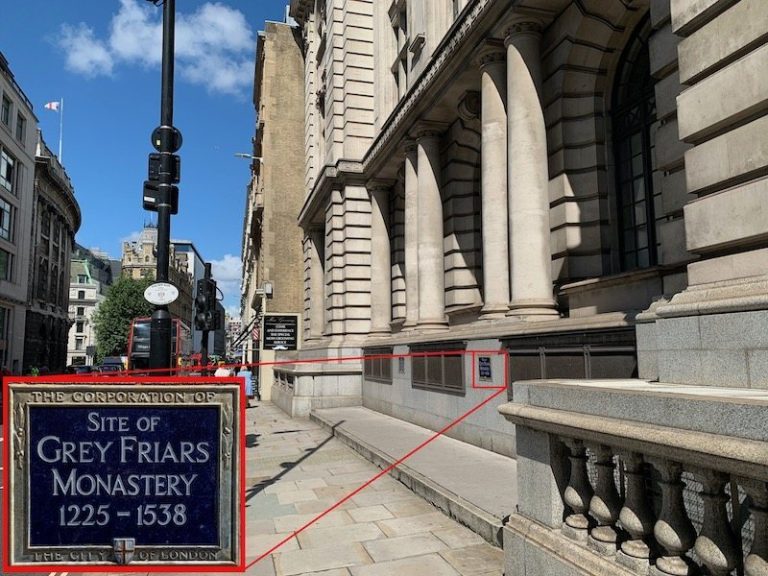
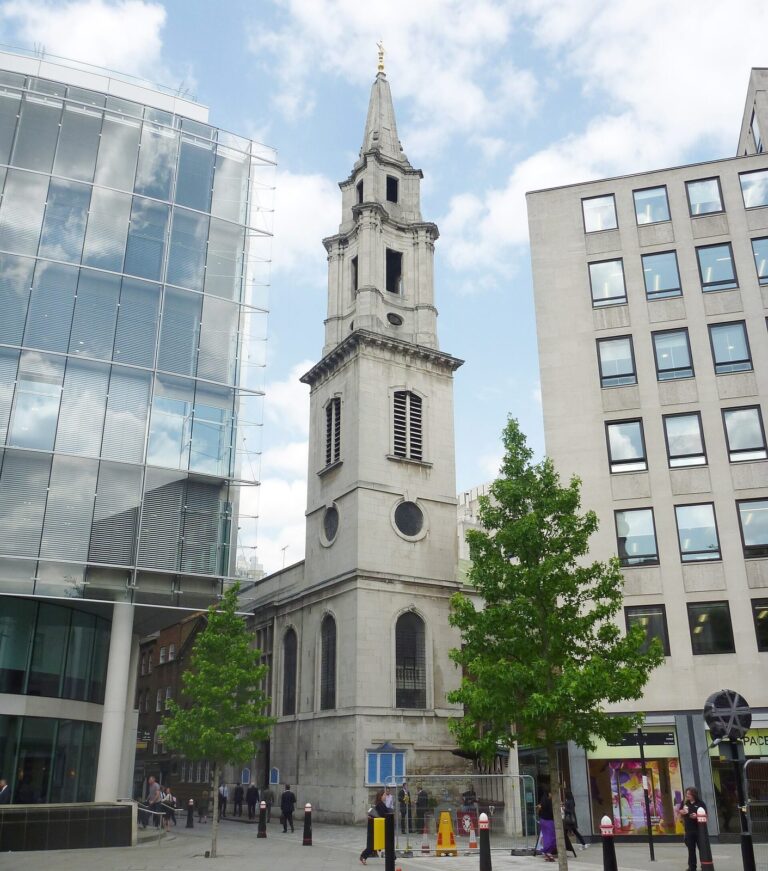
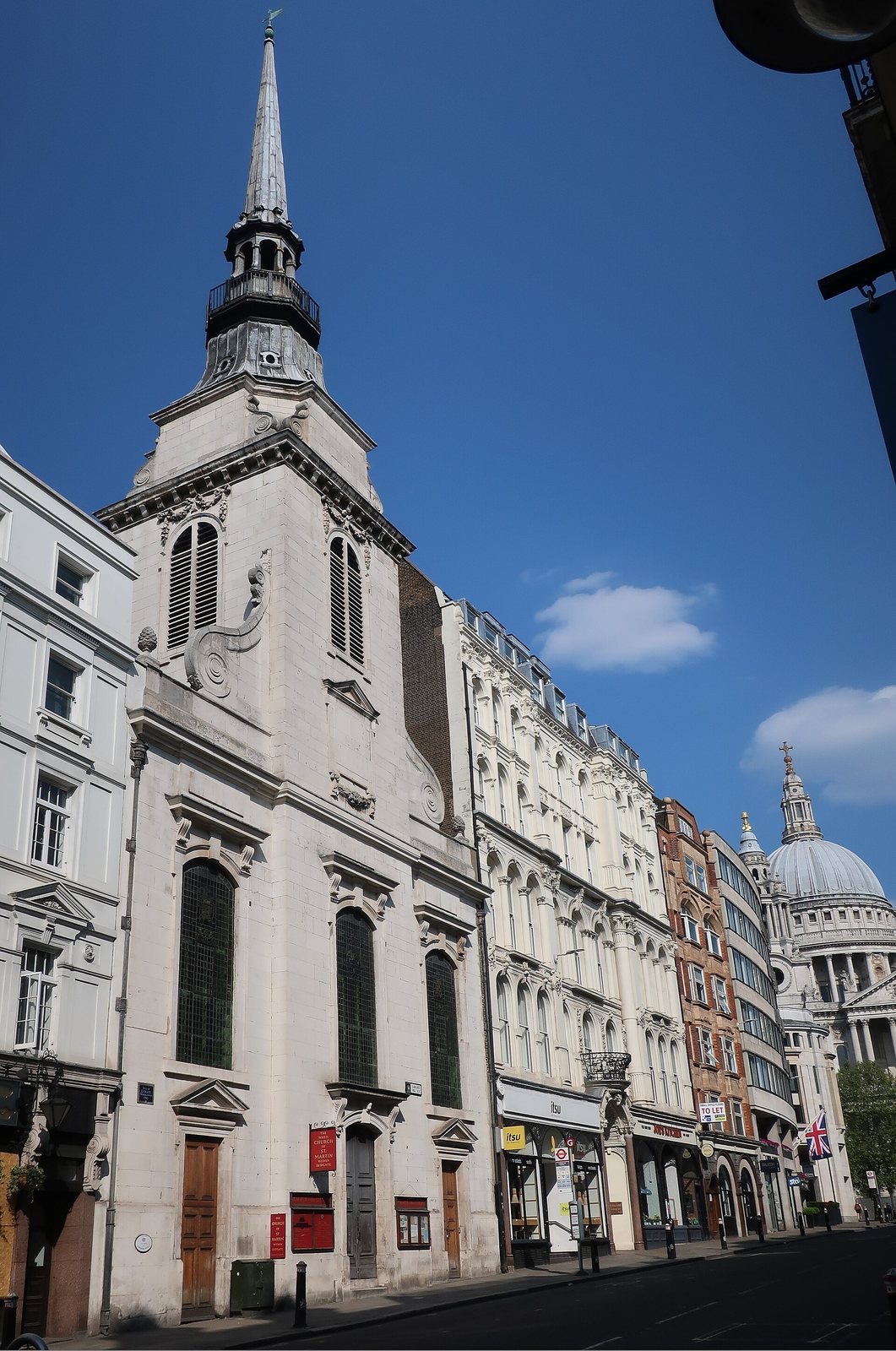
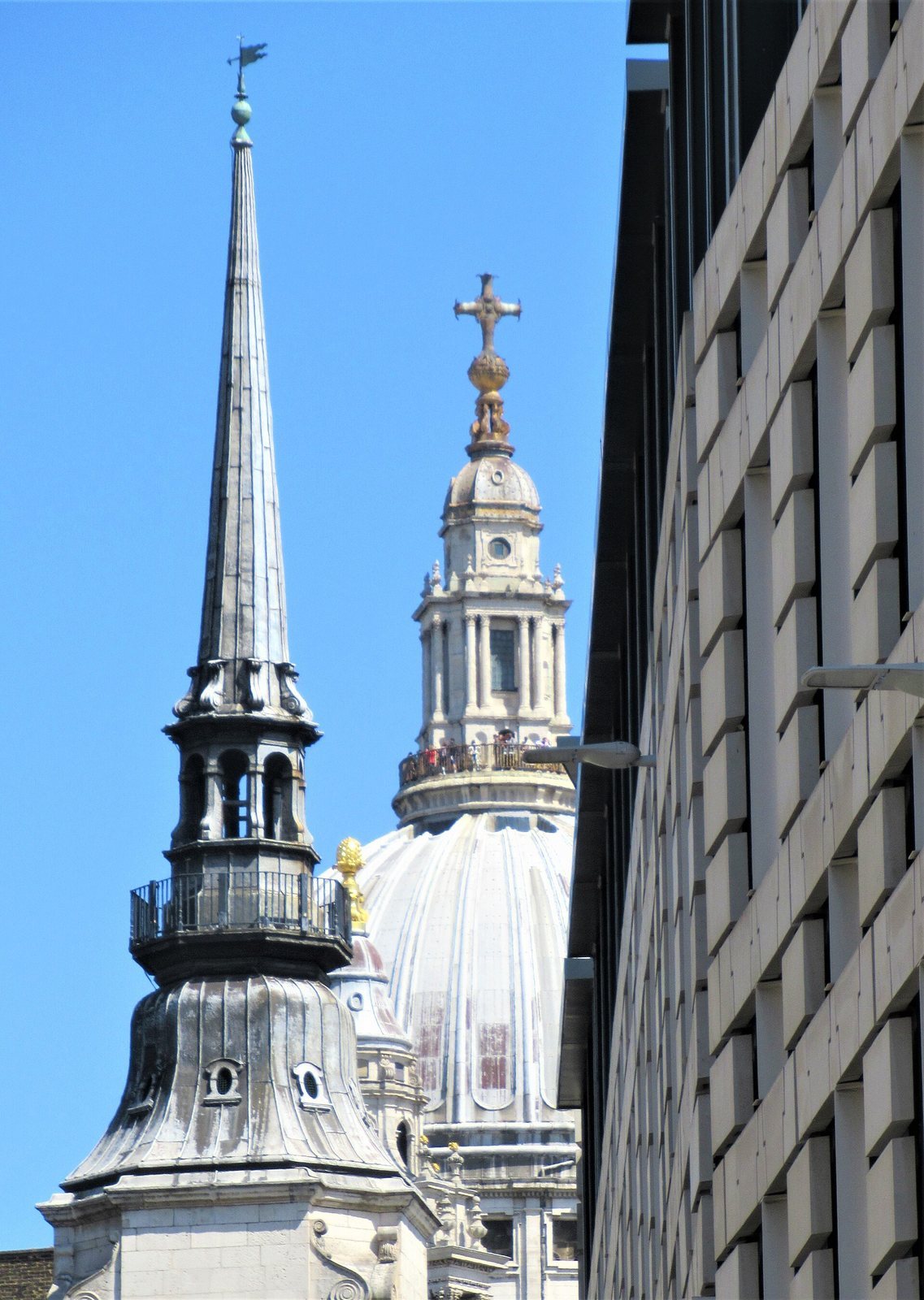
The tower projects slightly from the facade. Scroll-shaped forms called volutes connect it to the facade at either side. Its upper stage is octagonal and includes an open lantern, a raised structure with openings, and a gallery. Above it, a lead-covered octagonal cupola, or small dome, supports a balcony and a narrowing, obelisk-shaped spire. The spire reaches 158 feet (48 metres). From lower Fleet Street, it appears against the dome of St Paul’s Cathedral; Wren probably intended a contrast between the church’s pointed spire and the cathedral’s rounded dome. T. M. Baynes also painted a view from the steeple toward the river. A blue plaque beside the church marks the former Ludgate.
Interior furnishings and decoration
Font and churchwarden’s chair
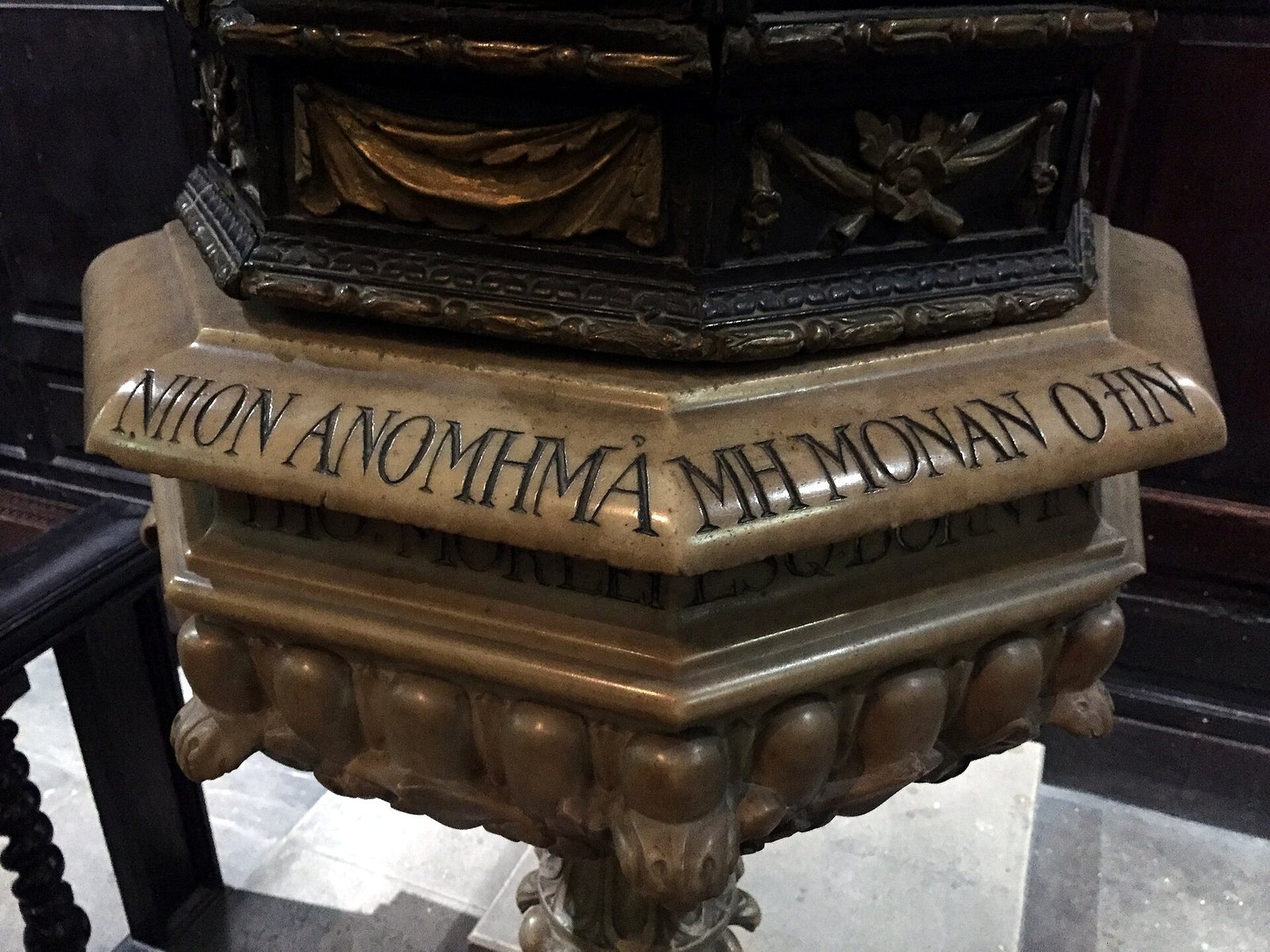
A chalice-shaped font dated 1673 bears the inscription Nipson anomemata me monan opsin, a palindrome, or phrase that reads the same forwards and backwards. Its meaning is “Wash the sins, not only the face.” The church also contains a carved oak double churchwarden’s chair from the seventeenth century, described as the only known example of its kind.
Windows and organ
The north windows, made by Powell of Whitefriars, depict the Abbot and Chapter of Westminster, the Bishop of London, and the Dean of St Paul’s. Powell also made the high-set windows on the south side. The organ, designed by Bernard Schmidt, dates from 1684.
Carvings and chandelier
Interior carvings include work by the sculptor and woodcarver Grinling Gibbons. Other carvings are attributed to the joiners Athew, Draper, and Poulden, and the carvers Cooper and William Newman. A chandelier dating to about 1777 came from St Vincent’s Cathedral in the West Indies.
Archaeological find
A Roman tombstone found on the church grounds in 1669 is now held at the Ashmolean Museum.