Greyfriars: A Franciscan Friary in Medieval London
Site at a Glance
- Rating
- 4.9
- Popularity
- Very Low
- Country
- United Kingdom
- Primary era
- Medieval
- External website
- Open
- Eras represented
- Medieval
- Civilizations
- English
- Site type
- Religious
- Remains
- Monastery
On this page8 sections
History
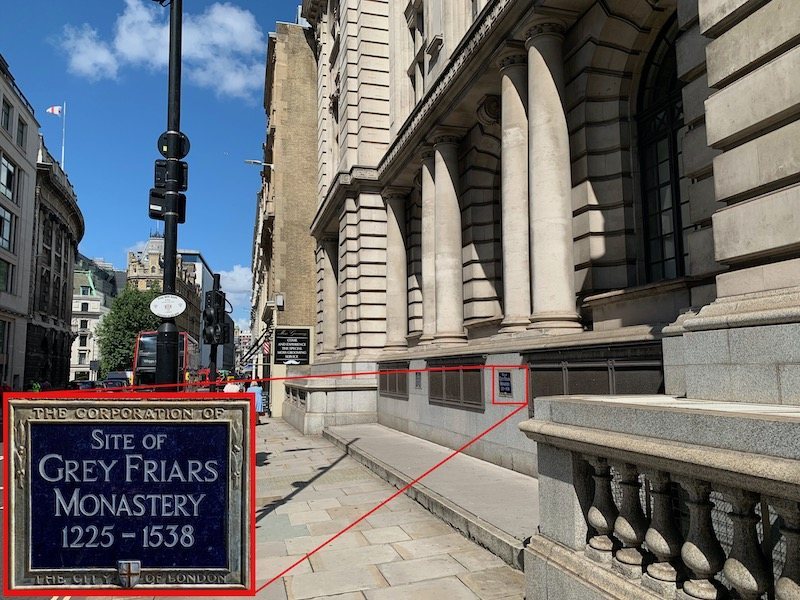
Greyfriars was a Conventual Franciscan friary in London, United Kingdom, founded in 1225 by the Order of Friars Minor, commonly known as the Franciscans. Located by Newgate just inside the city wall, it developed from a modest religious house into a major Gothic complex and intellectual centre before its dissolution in 1538.
Foundation and expansion
The Franciscan Order arrived in England in September 1224 and settled in London in the summer of 1225, after John Iwyn purchased land for the friars. Joce Fitz Piers gave the community property in Stinking Lane three years later. Further donations followed over the next 130 years, with the last recorded addition coming from Queen Isabella, who gave a tenement in 1353 or 1354.
Henry III supplied oak for construction in 1229. The community had grown to 80 friars by 1243, and the site was extended northward and westward by 1258. William Joynier, mayor of London in 1239, financed the original church, built its chapel, and contributed £200 towards the other buildings. This early friary was probably modest in scale.
Church construction and intellectual life
Further work on the church began towards the end of the thirteenth century. Henry le Walleis, another mayor of London, is traditionally credited with building the nave and supplying timber for the altars.
Queen Margaret, the second wife of Edward I, purchased land for Greyfriars in 1301–1302 in the parish of St Nicholas, where the choir was built. She spent 2,000 marks on the church before her death in 1318, but the work remained unfinished. Queen Isabella, the wife of Edward II, completed it with an expenditure of approximately £700, bringing the total cost of the new church to about £2,700. The Gothic church was completed in 1348.
Greyfriars also contained a studium, an advanced educational centre for members of a religious order, where friars studied logic and theology. Its extensive library and teaching community made it an important intellectual centre in the early fourteenth century, rivalled in status only by Oxford University. William of Ockham, Walter Chatton, and Adam Wodeham were among its members.
Burial place and dissolution
After its completion, the church became a favoured burial place for people of high rank. Queen Margaret and Queen Isabella were buried there, while the heart of Eleanor of Provence, wife of Henry III, was also interred in the church. Other recorded burials included members of the nobility, landowning families, and figures connected with royal and military administration, among them John Clinton, 6th Baron Clinton; John Dynham, 1st Baron Dynham; Beatrice of England; Thomas Brandon; Eleanor Percy, Duchess of Buckingham; and Walter de Beauchamp, steward to Edward I.
Greyfriars flourished during the fourteenth and fifteenth centuries. It was dissolved in 1538 at the instigation of Henry VIII during the Dissolution of the Monasteries, the process by which the king’s government closed religious houses and transferred their property to the Crown or other recipients. On 12 November, the friars signed a deed of surrender, probably prepared by Thomas Chapman, an agent of Thomas Cromwell.
Reformation and later destruction
After the surrender, some friary houses were converted to private use. The church was closed and used as a storehouse for treasure looted from France. In 1547 the Crown gave the church, several friary buildings, the two cloisters, and the surrounding ground to the City of London.
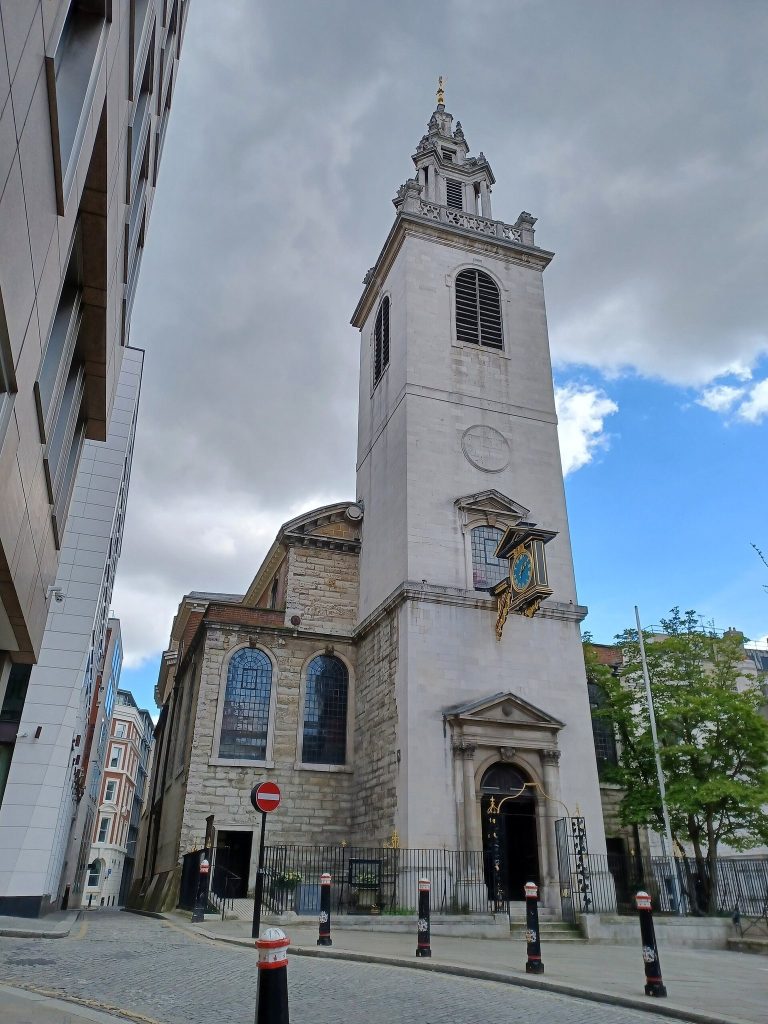
The former church, then called Christ Church, became the church of a new parish formed by joining St Nicholas and St Ewen. It reopened on 30 January 1547, but was destroyed in the Great Fire of London in 1666. Christ’s Hospital, a school for orphans, was established in some of the former friary buildings in 1553 by Edward VI and remained there until moving to Horsham in West Sussex in 1902.
Sir Christopher Wren rebuilt the church as Christ Church Greyfriars after the Great Fire. Wren was the English architect responsible for the rebuilding of many London churches after the disaster. His church was later ruined during the London bombing of the Second World War.
Remains
Church
The conventual church stood immediately inside the north-western section of the City of London wall, with open country beyond the wall when the friary was founded. Built in the Gothic style, it measured approximately 300 feet (91 metres) long by 89 feet (27 metres) wide. The church contained six chapels, eight additional altars, and numerous statues and images of saints, including at least eight documented saint images beyond those associated with the chapels and altars.
The surviving remains of the church after the Second World War are incorporated into a memorial garden. They represent the later history of the church as Christ Church Greyfriars, following its rebuilding under Sir Christopher Wren after the Great Fire and its subsequent wartime ruin.
Friary complex
The wider friary occupied a site that expanded northward and westward by 1258. Its buildings included the Fratrye, Librarye, Dorter, and Chapterhouse, together with a Great Cloister and a Little Cloister. A cloister was a covered walkway around an enclosed courtyard, while the chapterhouse served for official meetings and the dorter was the community dormitory.
Several former friary buildings continued in later use after the dissolution. Christ’s Hospital occupied part of the complex from 1553, and a later building now covers another part of the former site. That building was designed by Arup Group Limited and is occupied by Merrill Lynch.