St. Martin: Greding’s Romanesque Cemetery Church in Germany


Site at a Glance
- Rating
- 4.8
- Popularity
- Very Low
- Country
- Germany
- Primary era
- Medieval
- External website
- Open
- Eras represented
- Medieval, Early Modern
- Civilizations
- Holy Roman Empire
- Site type
- Religious
- Remains
- Church
On this page8 sections
History
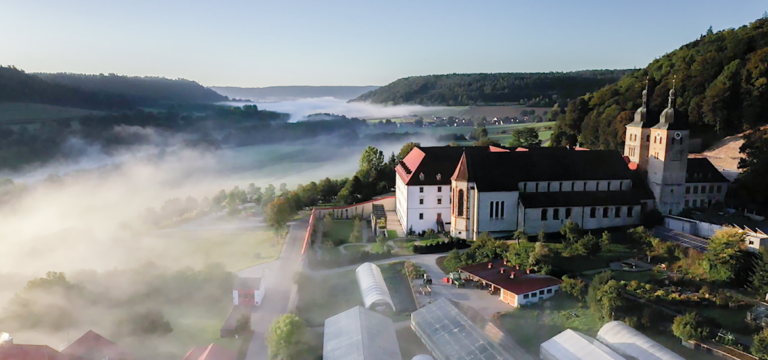
St. Martin is a cemetery church and former parish church in Greding, Germany. The city’s oldest and most important building, it is a Romanesque church from the mid-twelfth century and the largest Romanesque building in the former Prince-Bishopric of Eichstätt, a territory where a bishop also held secular power as a territorial prince. The church stands northwest of the city on a rise beneath Calvary hill and remains surrounded by the cemetery that served Greding until new burial grounds were created farther north in the 1950s.
Early foundations and the Romanesque church
The dedication to Saint Martin of Tours, a fourth-century bishop and major Christian patron saint, points to a Frankish foundation. The nearby Michaelskapelle, by contrast, has a Bavarian dedication. The lowest five stories of St. Martin’s tower date from the eleventh century. A smaller single-nave church stood with the tower before the present Romanesque basilica was built. A basilica is a longitudinal church with a central nave and flanking aisles. The surviving parts of that larger building were constructed in the mid-twelfth century, and Bishop Otto, who held office from 1182 to 1196, consecrated it in 1185.
The tower was raised by one story during the Early Gothic period, a transitional phase when pointed arches, larger windows, and greater verticality developed from Romanesque traditions. Its form closely resembles the tower of Eichstätt Cathedral. Before the side walls received paintings in 1588, the tower was raised again, the side aisles were heightened, and large windows were inserted into the southern aisle.
Parish use and early modern alterations
St. Martin probably remained the parish church of the original Greding parish until the eighteenth century. It was gradually replaced in that role by the former filial church of St. James. Church accounts from the early eighteenth century record continuing artistic and liturgical improvements. In 1703 the Cross Altar was demolished, eight chairs were made for members of the town council and clergy, and Philipp Detter decorated the high altar, Cross Altar, and a double altar frontal. Further work followed between 1712 and 1717, including ornaments, a crucifix shield, repairs to the clock, decorated altar candlesticks, and a confessional.
Secularization and preservation
During secularization, the transfer of church property into secular ownership during state confiscations of ecclesiastical assets, the church was sold to a farmer. It was used as a stable and barn, its walls were whitewashed, and the pulpit was removed. Ecclesiastical ownership returned in 1826, followed by renovation. Between 1903 and 1914, Albrecht and Friedrich Pfleiderer uncovered the paintings beneath the whitewash.
St. Martin now belongs to the Roth-Schwabach deanery of the Diocese of Eichstätt. The church is a protected monument and bears the Hague Convention cultural-property emblem. The cemetery wall is partly incorporated into Greding’s city wall. Its position and close connection with the fortification suggest that it may have formed the core or starting point of the town’s late-medieval defenses.
The church’s bell history was also shaped by the twentieth century. Apart from the first bell, all the bells were surrendered to the Wilhelmsburg tinworks on 12 May 1942, and the third bell was destroyed during transport. A new Sandtner organ was commissioned for Greding’s 900th anniversary because the previous instrument had been defective for forty years. Christian Heiß inaugurated it on 29 September 1991.
Remains
St. Martin is a three-aisled Romanesque hall church, meaning that its central nave and side aisles are of broadly similar height. The nave has four arcades, and the eastern choir ends in three apses, semicircular or polygonal terminations commonly found at the east end of a church. The ground floor of the western tower serves as the sacristy. The church formerly also had a western gallery illuminated by a window.
Medieval paintings and furnishings
The twelfth-century painting in the central apse shows Christ enthroned on a rainbow within a mandorla, an almond-shaped frame around a sacred figure. He holds an orb in his left hand and blesses with his right as ruler of the world. Four circles on either side contain an eagle, a man, a lion, and a bull, the traditional symbols of the four Evangelists.
The late-Gothic high altar dates from 1480. Its principal scene is the Crucifixion, with Mary Magdalene kneeling at the cross. Beneath it, a Burial or Lamentation relief includes Mary Magdalene, Joseph of Arimathea, Nicodemus, another woman, Mary the mother of Jesus, and John. Rococo sculptures of Mary and John, made in the eighteenth-century style known for ornate and graceful decoration, were placed beside the cross around 1780.
A late-Gothic statue of the Virgin and Child, dated 1510, stands to the right of the high altar. It formerly stood in St. James. Paintings on the southern wall show the Visitation, Mary’s visit to Elizabeth, Saint Christopher in a work dated 1370, Saint Dorothea, and Saint Martin. The northern wall contains a depiction of the Annunciation, the angel Gabriel’s announcement to Mary that she would bear Jesus.
Cemetery structures and the Michaelskapelle
A charnel house stands directly beside the church. Such a building held human bones removed from overcrowded burials, and this one reflects periods of need and misery, including plague outbreaks when the town could not bury its dead in the cemetery. The cemetery is enclosed by a wall, parts of which also serve as sections of the city wall.
The Michaelskapelle stands beside St. Martin. Its lower level contains an ossuary, or charnel house, holding the bones of approximately 2,500 people. The structure probably dates from the twelfth century and is documented by 1525, when a foundation was established for it. The ossuary was created in the fourteenth century after the cemetery became too small, and the practice of maintaining it continued until the eighteenth century. The chapel was dedicated to Saint Sebastian, Saints Crispin and Crispinian, the Archangel Michael, and All Saints. Its church festival took place on the Sunday after the feast of Saints Simon and Jude.
Tower bells and organ
The tower contains a five-bell peal. The Brotherhood Bell was cast in Neuburg in 1696 by Johann Schelchshorn. It has a frieze and relief decoration, a diameter of 1,268 millimetres, a weight of 1,200 kilograms, and a strike note of E-flat 1 minus 2.
The noon bell, also called the Mary Bell, dates from the first half of the fourteenth century. Its inscription carries the words “Ave Maria, full of grace, the Lord is with you,” placed between four rings. The bell has a diameter of 930 to 933 millimetres, weighs 525 kilograms, and has a strike note of B-flat 1 minus 2. Hermann Kessler, who also cast the fire bell of Saint Lawrence Church, is considered a possible maker.
A second Mary Bell, formerly used as the vespers bell, was cast in Eichstätt by Matthias Stapf in 1722. It returned to Greding after the Second World War in destroyed condition. Following unsuccessful repair efforts, the monument authority authorized recasting in 1948, and Karl Czudnochowsky of Erding produced a new bronze bell in 1950. It bears frieze and relief decoration, measures 720 millimetres across, weighs 220 kilograms, and has a strike note of C2 minus 1. Its inscriptions include “Ave Maria” and the maker’s name.
Bell IV, known as the Child-Death Bell, is a medieval bell dating to around 1300. It has no inscription or decoration, measures 475 millimetres in diameter, weighs approximately 70 kilograms, and has a strike note of C3 plus 1. It is now rung only as part of the full peal at New Year, while formerly it announced the death of a child. The Death Bell was cast in Nuremberg by Christian Viktor Herold in 1754. Decorated with a vine frieze, it measures 372 millimetres, weighs approximately 40 kilograms, and has a strike note of D3 plus 2. It hangs in the southern sound opening on the left and records a donation by Maria Magdalena Beyrin.
The Sandtner organ has two manuals, one pedal, eighteen stops, and 1,004 pipes.