Burg Rundeck: A Medieval Spur Castle Ruin in Bavaria


Site at a Glance
- Rating
- 4.5
- Popularity
- Very Low
- Country
- Germany
- Primary era
- Medieval
- Eras represented
- Medieval
- Civilizations
- Duchy of Bavaria, Holy Roman Empire
- Site type
- Military
- Remains
- Castle
On this page10 sections
History
Burg Rundeck, also known as Burg Erlingshofen and Stossenburg, is a medieval spur castle ruin in Germany near Erlingshofen, in the market town of Kinding, Bavaria. Its medieval origins lie before 1242, and the site occupies a steep strategic spur above the Anlauter Valley.
The Erlingshofen Castle
A predecessor castle at Erlingshofen was probably built in the twelfth century. Hadebrand and Gottfried of Erlungeshouen appear in the 1129 foundation charter of Plankstetten Monastery. Gottfried was still identified with Erlingshofen in 1169, by which time the family had moved to Arnsberg above the Altmühl Valley.
After the family established a new castle at Heideck, it adopted the name von Heideck in 1192. The earlier Erlingshofen castle was abandoned and may have been destroyed, but it remained within the lordship of Arnsberg. The lords of Heideck sold that lordship to Bavaria before 1305, and the Wittelsbach dynasty, which ruled Bavaria for much of the medieval and early-modern period, sold it to the Bishop of Eichstätt in 1473.
Documents from 1379 and 1381 describe the former Erlingshofen castle as an “old castle site.” In 1381, Paul Stosser built a new castle on its foundations. The Bavarian dukes retained the right to use the stronghold as a wartime base and gave it the name Stozzenberg. The Stosser family had originated at Bieswang, where its members served as knights to the Marshals of Pappenheim.
The Stossenburg under Bavarian and Eichstätt Lords
In 1383, Paul Stosser’s cousin Hans sold the castle to Duke Stephan of Bavaria-Ingolstadt. Stephan pledged it in 1388 to Heinrich Absberger of Rumburg for 500 gulden, and the castle was recorded on one occasion as the fortress Stolczenberg.
Following the third Bavarian partition in 1392, the castle returned to Duke Stephan III. He sold it in 1409 to the brothers Hans and Heinrich Absberger of Rumburg to settle his debts. Heinrich and his wife Adelheid founded a side branch of the Schenken family, a noble house, which took its name from the Stossenburg.
After Heinrich’s death, his nephews sold the castle in 1481 to Eichstätt Prince-Bishop Wilhelm of Reichenau for the 500-gulden pledge sum. A prince-bishop held both senior religious authority and secular rule over a territory governed by a bishopric. The Bishopric of Eichstätt then allowed the castle to decay, preventing the pledged property from being redeemed.
Abandonment and Modern Recognition
Nuremberg scouts found the castle abandoned in 1504. Substantial remains could still be seen during a 1601 visitation by Vitus Priefer, the Eichstätt vicar general. The name Stossenberg later fell out of use. Rundeck first appears as the site’s name in 1801, while its identification as the former Stossenburg was made only in 1932.
The ruin was secured in 1938 and again in 1981. It is protected as an architectural monument and is also recorded as an archaeological monument identified as a medieval castle. A local legend says that a wire once connected Burg Rundeck with Burg Brunneck, enabling knights to signal when a traveler or wagon approached so that it could be robbed.
Remains
Castle Enclosure and Earthworks
Burg Rundeck occupies an oval enclosure about 30 to 40 metres across on a steep mountain spur at 508.8 metres above sea level. The site is separated from the eastern plateau by a substantial system of three ramparts and ditches. The outer defenses comprise three staggered neck ditches, meaning trenches cut across the narrow land connection of a spur, with outer ramparts that carried palisades.
The particularly deep inner neck ditch continued around the entire castle as a ring ditch. On the western side, the ditch continued as a berm, a level strip alongside a ditch or rampart. This defensive arrangement resembles early-medieval earthworks sometimes called Hungarian ramparts, although that resemblance does not establish their origin. The main approach entered from the southeast by way of a gate route and bridge.
Enclosing Wall and Gate Tower
Enclosing Wall
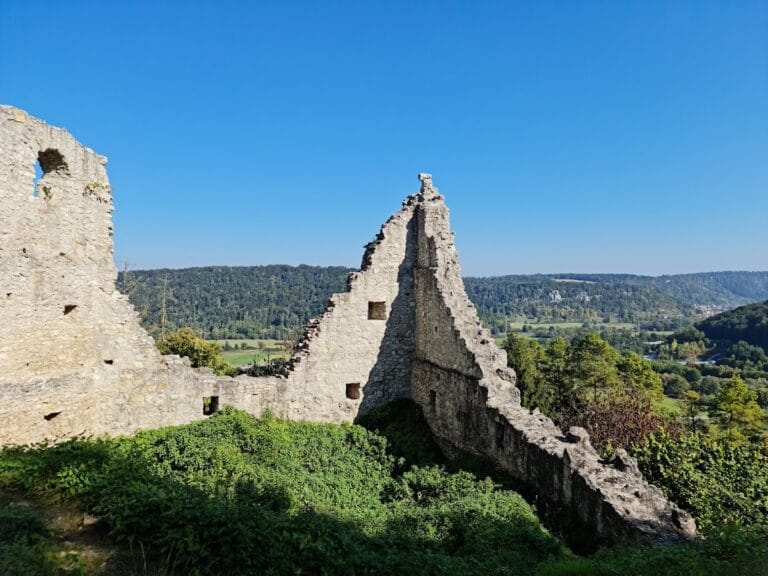
The principal surviving structure is the enclosing wall, a 1.50-metre-thick shell of rough limestone. About one-third of its original length remains, and the western outer face rises to approximately six metres. Burg Rundeck belongs with the neighboring Rumburg and Brunneck castles to a relatively uncommon type in which a high mantle wall, or protective outer shell, forms the principal defense around the interior.
Original putlog holes remain visible in the masonry. These openings held the ends of construction scaffolding and were deliberately left available for later repair work. A wall-walk, the protected passage along the top of a defensive wall, once ran around the enclosure; part of its set-back survives.
Gate Tower
A four-storey gate tower stood at the southeast entrance. It may also have served the defensive and representative roles of a keep, the principal fortified tower of a castle. A bridge led to the tower, and parts of its south wall and gateway passage survive.
Several surviving bossed ashlar blocks in the gate-tower area belong to the first castle. Bossed ashlar consists of dressed stone blocks with rough, cushion-like outer faces. Most of the other surviving masonry dates from the late-medieval Stossenburg, preserving the material contrast between the earlier foundation and the castle rebuilt by Paul Stosser in 1381.
Surrounding Fortified Landscape
Burg Rundeck stands on the Schlossberg spur above the Anlauter Valley. Burgstall Wieseck lies approximately 550 metres to the north-northwest, while the Kirchberg sectional fortification, described as early medieval or older, is immediately to the south. Farther west is the ruin of Brunneck Castle. Together, these nearby fortified sites place Rundeck within a wider medieval landscape of castles and earthworks.
Nearby sites